 Alexander Blok called Russia a Sphinx, although in the same famous poem he attributed to this creature an 'Asian face' and 'narrow eyes' — perhaps this is what a 'state-civilization' looks like, which for centuries does not answer the question of where exactly the troika-bird is rushing. What are its goals, and if everything is going according to plan, then what is the plan? The basic mystery of Russia lies in the undeciphered goal-setting of circular movement in a vicious circle. This movement historically self-reproduces, no matter how Russia is modernized. The gigantic — the last! — empire collapsed under the burden of this 'but we make rockets and dammed the Yenisei' (words from a song by Yuri Vizbor in 1964), and yet financial and human resources are still being wasted on returning to the self-consuming model.
The autocrat's administration is puzzled over why the economy is slowing down, even though the explanation is obvious and even demonstratively flies into the sky: either a 'Sarmat' missile is launched towards an (un)likely adversary (why not 'Scythian' following Blok, or 'Polovtsian' or 'Pecheneg' following Putin, not to mention 'Khazar'?), or the economy grows based on normal consumer demand, the production of what this demand can satisfy, and budgetary funds go to the development of human capital.
Economic Development Minister Maxim Reshetnikov was made a laughingstock, as he was forced to tell Putin how suddenly everything blossomed in the economy, coinciding with the equally sudden rise in the autocrat's ratings among pro-Kremlin pollsters — FOM and VTsIOM. The immortal thesis of academician Strumilin that it is better to stand for high growth rates than to sit for low ones, has spread to sociologists as well. One can only guess how they were reprimanded at Staraya Square for the latest sociological indicators. This is the sociology of power: as soon as it sees a bad number, it starts working with it. Not for nothing, under Stalin, several heads of the statistical department were repressed. When the tyrant familiarized himself with the results of the 1937 population census, the fate of chief statistician Ivan Kraval was decided — he was not destined to return to the green curtains of apartment 190 in the House on the Embankment. The era demanded optimism, and those who did not express it went under the article, like, for example, Dzerzhinsky's favorite employee at the Supreme Council of the National Economy and the compiler of the first five-year plan Abram Ginzburg — he based his work on the theory of 'diminishing growth', which was utterly intolerable, for which he was first arrested in 1931 on the completely fabricated 'Union Bureau of Mensheviks' case, and subsequently executed.
Nowadays, it seems, they don't shoot for the wrong numbers and lack of optimism, although the scale of repressions against elite representatives is widely revealed, like a flower at dawn. But one can lose their seat. Reshetnikov, rumors of whose resignation and replacement with more optimistic figures like the rector of the Presidential Academy Alexey Komissarov circulated in recent weeks, perhaps saved himself with his report to the president on the growth of everything in the world. The numbers operated by the minister, and then by Putin at the economic meeting, will not save the economy — as long as the model of 'military Putinism' (K. Rogov) is in place, stagflation is guaranteed, and self-deception is a fundamental principle of the regime's existence, which has been built over the last quarter-century. So the population of Russia, under massive frontal brainwashing, is no exception. The ruling clan engages in exactly the same thing in relation to itself.
In the first quarter, according to official data, GDP decreased by 0.2 percent. Reshetnikov's Ministry of Economic Development gave a figure of 0.3 percent. The ministry's growth forecast for 2026 is 0.4 percent. And this wouldn't be such a big deal — the main thing is for the economy to grow 'for the benefit of man'. But judging by the structure of the militarized economy, growth 'around zero' will be ensured at the expense of the same 'finished metal products' and other quasi-military products being consumed.
As Comrade Stalin would say (on a similar occasion!), 'these numbers are worse than counter-revolution'. To correct the shortcomings, one should simply change the measurement methodologies. For example, when at the end of the previous decade, real disposable incomes of the population were falling (apparently, this led to the removal of the last professional head of Rosstat Alexander Surinov), they simply changed the methodology, and now this indicator has long been at good levels. After all, the growth of salaries in the military-industrial complex provides a decent average temperature in the hospital.
Similarly, in sociology: VTsIOM, which relied on telephone surveys, partially switched to in-home interviews (which, generally speaking, creates methodological confusion — usually, either one method or the other is used, like the 'Levada Center', which works with respondents in person, not by phone). And Putin's ratings immediately went up. When necessary, something suddenly starts to grow quickly and simultaneously, for example, recently there was an outstanding jump in the indicator of the population's access to sewage, although the part of the population that still uses 'direct drop toilets' did not notice this.
The main thing here is not to dispute the leading numbers taken from thin air. Comrade Kamenev was outraged in past years: 'Numbers are drawn into political struggle!' The party corrected Comrade Kamenev by shooting him in 1936.
Overdue debts of enterprises are growing; the number of shops and retail outlets is falling; small businesses are collapsing under tax innovations and internet restrictions; the federal budget deficit is approaching 2 percent; more than 70 regional budgets are in deficit; the hole in the Pension Fund is growing; the volume of investments is decreasing, not to mention direct foreign investments; the labor shortage remains a problem, but at the same time, underemployment is growing at large and medium enterprises (this is what has replaced unemployment for decades — the worker is not fired, but works less and less); the construction industry is stagnating, housing commissioning indicators are collapsing; most industrial sectors are in decline or stagnation, the civil sectors of manufacturing are in the negative; the purchasing power of the population is decreasing; there are serious demographic problems; the digital sector can hardly develop normally with such internet restrictions and the fetishization of the security of a couple of dozen 'elite' representatives...
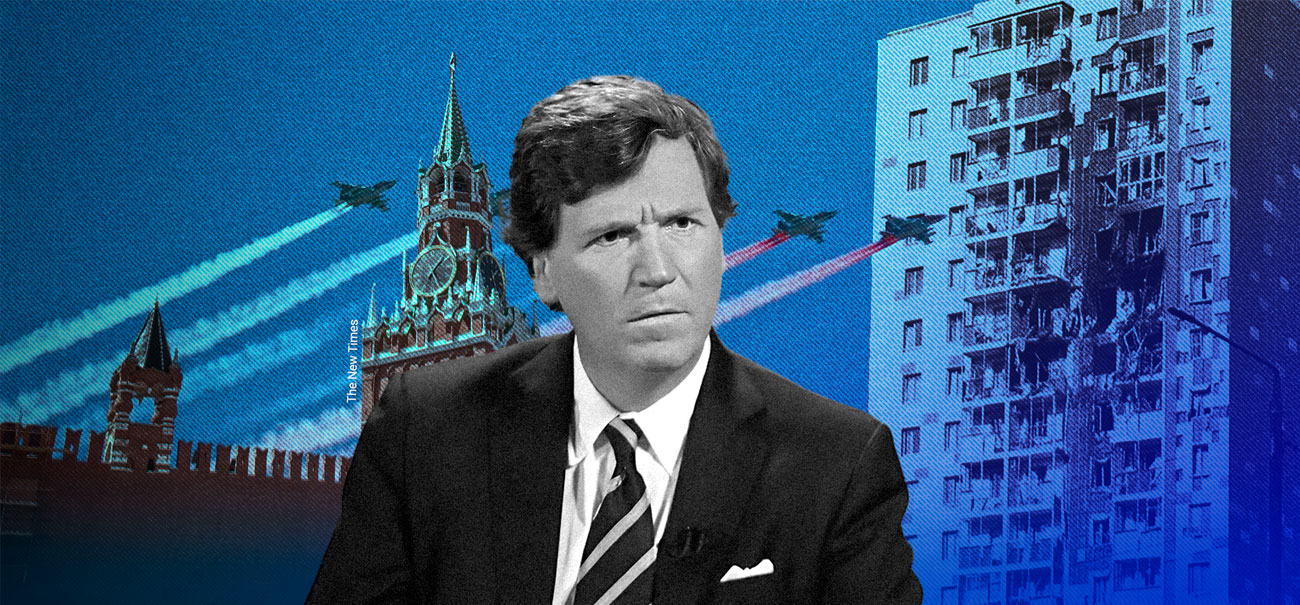
Tucker Carlson, American conservative political commentator
To all these challenges, we have one answer — superweapon, ensuring 'guaranteed overcoming of existing and prospective missile defense systems', 'the most powerful missile complex in the world'. Russia, it turns out, had so much money that it could have built 'the most powerful healthcare in the world', ensured the highest GDP per capita, rebuilt social protection systems and the pension system, stimulated small businesses so that their share in the economy reached European levels (from 20 percent to 50). Everything could have been better. But the 'Scythians' with 'slanting and greedy eyes' preferred 'movement' and 'Sarmat'.
This is a matter of priorities. This is a matter of choice. And having chosen such a path, one can indeed make a reverse journey down the steps of historical evolution — straight to those very Sarmatians and other Indo-Iranian tribes. There will be something to tell Tucker Carlson...
* Andrey Kolesnikov is considered a 'foreign agent' by the Ministry of Justice of the Russian Federation.
Photo: culture.ru / kremlin.ru.