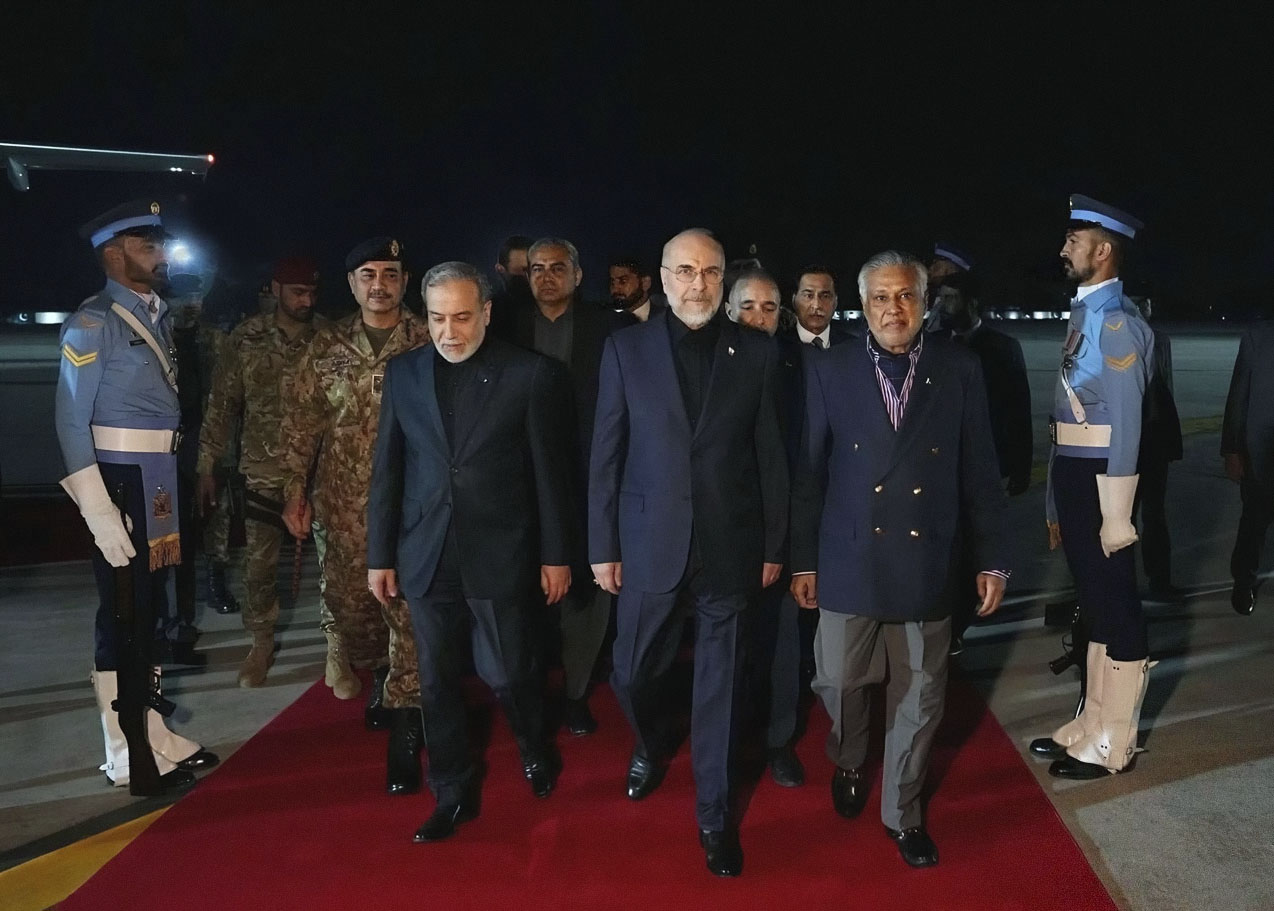
Foreign Minister Abbas Araghchi (left) and Iranian Parliament Speaker Mohammad Bagher Ghalibaf (center) at Islamabad Airport. April 11, 2026. Photo: Iranian Foreign Ministry / EPA / Scanpix / LETA
Yevgenia Albats*: The negotiations between the United States and Iran, mediated by Pakistan, ended in failure. The United States began a blockade of Iranian ports. The US Central Command sent a warning to shipowners that the blockade would cover all ships, regardless of their flag. Any vessel entering or leaving the restricted zone without permission may be stopped or detained. No ship will be able to make voyages from Iran and to Iran. Humanitarian aid will be allowed into Iran under full control and inspection — this is the statement of CENTCOM Commander Bred Cooper. And Donald Trump threatened on social media that Iranian ships approaching the maritime blockade zone would be immediately destroyed. Is the blockade of Iranian ports an admission of weakness or, on the contrary, a demonstration of strength?
The Regime's Achilles' Heel
 Yevgeny Shakhnovich: It seems to me that the blockade of ports in this war is perhaps the only right step. The more or less meaningful goal of this war, if you look at how it began and how it is developing, is regime change in Iran. Regime change in the format it has been going since February 28 — through bombings — in my opinion, is impossible. Historical parallels point to this. Therefore, the only way to influence the Iranian regime is to find its Achilles' heel. And the Achilles' heel in all petrocracies is, of course, oil revenues. This also applies to Russia. If it were possible to somehow block the flow of oil revenues, the Putin regime would not last long either. This was the case with the Soviet Union: when oil revenues collapsed, the regime also collapsed.
The goal of the blockade, as I see it, is an attempt to deprive Iran of oil revenues and thereby deprive the regime of financial levers of influence and support. Perhaps this is the only chance for some success. All other military steps seem strategically wrong to me; they could not lead to a result. Perhaps the blockade will lead to some major political changes within Iran. And then the goals of this campaign will be achieved. From my point of view, this is the only hope. But the weakness is that this is a long-term strategy, and in the American electoral cycle and in general in American, especially current, political culture, the time scale is measured in weeks, maybe months, but not years. The question of whether the desired result can be achieved within such a time scale remains open.
Yevgenia Albats: Nikita Smagin, you are an Iran expert and understand the processes taking place in Iran. From your point of view, what can the blockade of ports lead to (or not lead to)?
 Nikita Smagin: This is a question of perspective. If we are talking about some near-term perspective, then it seems to me that the blockade fundamentally does not change the situation. Iranian ships will not go out, but apparently, others will not go out either, because Iran will strike ships going through the Persian Gulf from within its territory (and now it may not even be from deep within). In this sense, Hormuz will remain blocked. Of course, it will now be blocked not only for Iranian ships but for all ships in general.
For Trump, the problem is that he has no victorious exit point from the war, and it does not seem that he is finding it
Right now, it seems to me that for Trump, the problem is that he has no victorious exit point, and it does not seem that he is finding it. Trump's strategy remains a mystery to me, what he wants and how he plans to win, at least in media terms. He is indeed going in some unclear direction. And so far, I do not see options for a victorious exit.
Yevgenia Albats: Nikita, you surely read Iranian blogs. Telegram channels are banned there, yet people find ways. What is the attitude towards what is happening inside Iran?
Nikita Smagin: An interesting point is how, in the absence of the internet in the country, people still manage to communicate. This is primarily through Starlink. But not many have it, about 100 thousand people or so. And how do other people communicate? A very interesting market is gradually emerging, the market of so-called white SIM cards. The internet is available to one percent of the population, even less — to state Iranian propaganda and some officials who are required to communicate by duty. They are issued white SIM cards, which allow access to the global network without any restrictions. And, of course, against this backdrop, a black market for these white SIM cards is gradually emerging. And these Quds SIM cards are already being traded in all directions. I am not sure if this is a massive project, but gradually people are starting to communicate through such SIM cards as well.
If we talk about the attitude towards events, it is mixed. Expat Iranian media say that there is a serious split in society, part of society believes that the Islamic Republic should be overthrown at any cost, and the war is worth it. Another part of society believes that this is an attack on Iran as such, on our nation, our homeland. And if you support America and Israel, you are against Iran. The split has always been there, but the problem is that it was more visible in the expatriate community, journalists, bloggers constantly argued with each other. And now the split runs right along family lines within Iran, going deep into society. People argue about who is a patriot, who is not, who is an enemy, who is not, and so on. It's a familiar dynamic, we've seen it in Russia. Some say war is not the answer, while others say it is the right way, the only way. There is, of course, some loyalist faction, with a different agenda.
Yevgenia Albats: David Sharp, what do you think about the blockade of ports?
 David Sharp: I think this step should have been taken almost from the very beginning. It would have been the most sensible thing to do. The fact that it was not done immediately was a mistake. In my opinion, it is precisely because of this that Iran felt a certain additional boost of courage. They decided that the Americans and the Arab countries of the Persian Gulf were so afraid of even limited strikes on their territory and rising oil prices that they could afford a lot, that they had great freedom of action, and closing the Strait of Hormuz was a sacred duty. Meanwhile, an absurd situation arose where, in order to somewhat — I emphasize, somewhat, not globally — block the rise in oil prices, Iran's oil exports continued, at inflated prices and with sanctions lifted. This situation gave Iranians a sense of stability. And it's good that the Americans went for the blockade.
What is the goal? The regime cannot be overthrown by this either. Moreover, if Iran agrees to a deal, the blockade of the strait by the Americans will cease. The task is to force the Iranians themselves to abandon the blockade of the Strait of Hormuz. This is the minimum task. In this case, for President Trump and the Arab countries, the situation will look like Iran did not change the status quo in the straits, that at least the situation that existed before the war remained. In this case, Trump has the freedom to maneuver in terms of stopping hostilities and continuing negotiations with Iran to achieve a major deal. There is no need to rush to conclude it because Iran is physically and economically very weakened and under sanctions. Naturally, the American administration can make concessions to Iran. But to make concessions as a result of the war, not within the framework of a major deal, would not be a victorious picture and would be very negatively perceived by the Gulf Arab countries, except for Qatar. They are quietly pressuring the Americans very seriously in the spirit that under no circumstances should Iran be allowed to have even some visual achievement. Otherwise, it will end badly for the region and lead to Iran, despite losing a significant part of its military potential, acting more arrogantly. As for the implementation of the blockade, technically it is quite easily feasible, and much depends on whether the Iranians will take any military retaliatory steps, whether they will strike at Arab countries, whether they will start hitting their tankers and American warships if they enter the Strait of Hormuz or demonstrate attempts at demining. If the Iranians start striking and deploy Iran's mosquito fleet or unmanned suicide boats, there will be an escalation, up to a flare-up of hostilities. But behind the scenes, negotiations continue, as always happens in our region. The two-week truce period has not expired, and we will still hear about the negotiation track. Meanwhile, the parties are shaking off, recovering from a military point of view. The American group in the region is being strengthened. The aircraft carrier "George Bush" passed Gibraltar, a significant amount of ammunition is being transferred. If the US plan to blockade the Strait of Hormuz does not work in terms of Iran's compliance, I assume that strikes will resume. And again, on the agenda may be, for example, an operation to capture Kharg Island.
If the Americans stand firm and do not let ships directly from Iran, whether for China or anyone else, the Iranians will have a choice: whether to physically strike at the infrastructure of Arab countries at a time when a ceasefire is in effect. If they return to this practice, they have a good chance of getting a serious response. However, here I cannot vouch for either the Arab countries or the Americans. But it will be a very escalating step.
Unclaimed Expertise
Yevgenia Albats: A question for Professor Shakhnovich. The US has no shortage of experts on the Middle East and specifically on Iran. Not to mention that the US has a very large Iranian diaspora from those who fled the Islamic revolution in seventy-nine. But it seems that the United States cannot achieve any of the goals set in this war. Newspapers wrote that the military warned President Trump that Iran could block the Strait of Hormuz. So Trump knew about it. As we now learn from American press publications, the start of the war was by Secretary of War Hegseth, Marco Rubio was not sharply against it, although he did not particularly support it. Vice President Vance, who Trump sent to negotiate with Iran, was sharply against it. It seems that the people in the US who started the war against Iran had a rather poor understanding of who and what they were dealing with. What do you say?
All that can be agreed with Iran under the current regime is approximately the same deal that Obama concluded in 2015. That is, renunciation of nuclear weapons while retaining everything else. The regime will not agree to anything more
Yevgeny Shakhnovich: This is the general trend now in the United States. Expertise, expert opinion, competence are pushed not even to the second, but somewhere to the tenth plan. It is believed that the leader's intuition should completely surpass any expertise. Although it was not so difficult to understand what would happen with the Strait of Hormuz, especially since such a story already happened under Reagan. Unfortunately, the leader's intuition prevailed, despite the fact that this war has not only no technical possibilities to win it but also no clear goal. If the goal is to agree on something with the Iranians, then, in my opinion, all that can be agreed with Iran under the current regime is approximately the same deal that Obama concluded in 2015. That is, renunciation of nuclear weapons while retaining everything else. The regime will not agree to anything more.
Returning to your question about experts. They exist, but look: all negotiations are conducted by two people who are completely incompetent. Nuclear negotiations include quite a lot of expertise regarding the processes that can lead to the creation of nuclear weapons. But Whitcoff with Kushner and the whole company did not even take a team of specialists with them. Therefore, my opinion on what this war can end in principle is plus or minus the 2015 deal.
Yevgenia Albats: The basis of Trump's intuition, as American media wrote, was the success of the operation in Venezuela. But in Venezuela, there was a completely non-functioning state. In Iran, there is a fairly strong state, as it unfortunately is in the Russian Federation. What do you think — addressing Nikita Smagin, — what did Donald Trump and his entourage not know about Iran, not understand, and therefore got into this war?
Nikita Smagin: Regarding expertise, I can say that there is an important point. Experts, as a rule, always call for caution and recommend acting less because any action leads to unclear consequences. Trump doesn't like this. And he had an important example of the Abraham Accords. There were so many expert discussions that moving in this direction was either impossible, or very difficult, or something else. And he went ahead and did it. It seems to me that this approach characterizes him as a politician. He doesn't want to listen to experts; he does it differently. And we see in practice that when you do not do as experts advise, you sometimes get unexpected, quite interesting results.
If we talk about what Trump's advisers did not know or did not understand about Iran, then I think they generally do not understand what Iran is, and they are not interested. They try to apply such a negotiation framework that you pressure, and the person will back off. But the Iranian position is as follows: we have a certain interest, and no matter what you do, we will not go further. We agreed to the deal, but you will not push us further. I think the issue here is underestimation. People prone to authoritarian approaches often think that if you corner a person, if you pressure, pressure further and further, he will eventually give up. But not everyone gives up; some dig in their heels.
Military Oligarchy
Yevgenia Albats: Who is actually running Iran now? Does Mojtaba Khamenei, from whom orders are issued, actually exist?
Nikita Smagin: Of course, he exists. The other question is, in what condition is he? If he were not alive, intelligence would have already reported it. But his role, by and large, is symbolic. He personifies that the Islamic Republic exists, nothing has happened to it, that Khamenei is still in power, albeit another one. And that is his task. But if we take management, decision-making, then there is such a military oligarchy, that is, collective management. It is obvious that there is some institutional transformation because the previous institutions cannot function as before. Something needs to change. We have enough evidence that they find it difficult to communicate, they are afraid to use phones. So this is a story about collective management in a situation of problematic communication, in a situation of coordination problems, in a situation of constant adaptation, restructuring of everything happening. And yet management somehow still exists. This is military management.
Yevgenia Albats: So the Islamic Revolutionary Guard Corps, do I understand correctly?
Nikita Smagin: Either the corps, or people from the corps, or people close to the corps, like Mojtaba himself. So yes, the IRGC plus people close to it.
Yevgenia Albats: So, as they write, even more conservative people than before. Or is it not true? They were in power, and they remain?
Nikita Smagin: No, this is still a more militarized wing, more radical, more conservative people who tend to view everything through the prism of security. That is, these are people with a military background and more unequivocal positions. I think that those who are still left from the previous elite, who were not killed, like the same parliament speaker Ghalibaf and Foreign Minister Araghchi, retain some pragmatism. It is no coincidence that they went to negotiations because they are capable of some compromises. But for most of these people, the position is — this is a battle to the very end. They look through the prism of the so-called sacred defense, the war with Iraq, when they fought for 8 years, fought, fought, ended with a draw but survived. I think most of them view what is happening in this paradigm. And the only chance to negotiate is to negotiate with people who are still left from the previous elite because the previous elite was a little more pragmatic.
Unity around the flag occurred primarily among loyalists. That is, those people who were already for the government. People who were against it are either in apathy or in a survival period
Yevgenia Albats: The media constantly reports that executions continue in Iran, young people who participated in protests in January-February are being hanged. Then, according to various estimates, almost 30 thousand people were killed or injured. Do you want to say that those who protested then now believe that they need to unite around the leader because this is a war against the entire Iranian nation? Or do they understand that this is the only opportunity to change the harsh regime because there are not enough internal forces?
Nikita Smagin: I think that unity around the flag occurred primarily among loyalists. That is, those people who were already for the government. Among the masses of people who were against it, I do not see any unity. They are either in apathy or in a survival period. They do not act. They may not support US and Israeli strikes because in such a situation, breakdowns begin, the agenda becomes more complicated, narratives become more complicated, everything is "not so clear," but nevertheless, they do not become the electorate of the Islamic Republic. They just move to the periphery. They just live, just survive. We do not have normal sociology for analysis, but nevertheless, by some signs, we see that the government is still very afraid of people. For example, it sends text messages saying that if, God forbid, you take to the streets, the response will be stronger than on January 8. January 8-9 was just a brutal suppression. Or the head of the police said that there are no more protesters, all will be considered terrorists. There were also videos of armed people walking around Tehran and shooting at windows from which anti-government slogans are chanted. Previously, you could shout from the window, it was one of the options for safe protest. Now they shoot. This also tells us that the government does not feel safe. So, I think there was indeed a serious consolidation of those people who were loyal or slightly doubted. They have become even more active, they are ready to go to pro-government rallies, some are ready to stand as human shields around power plants, we have also seen this. But it is still a minority. I think 20-30 percent.
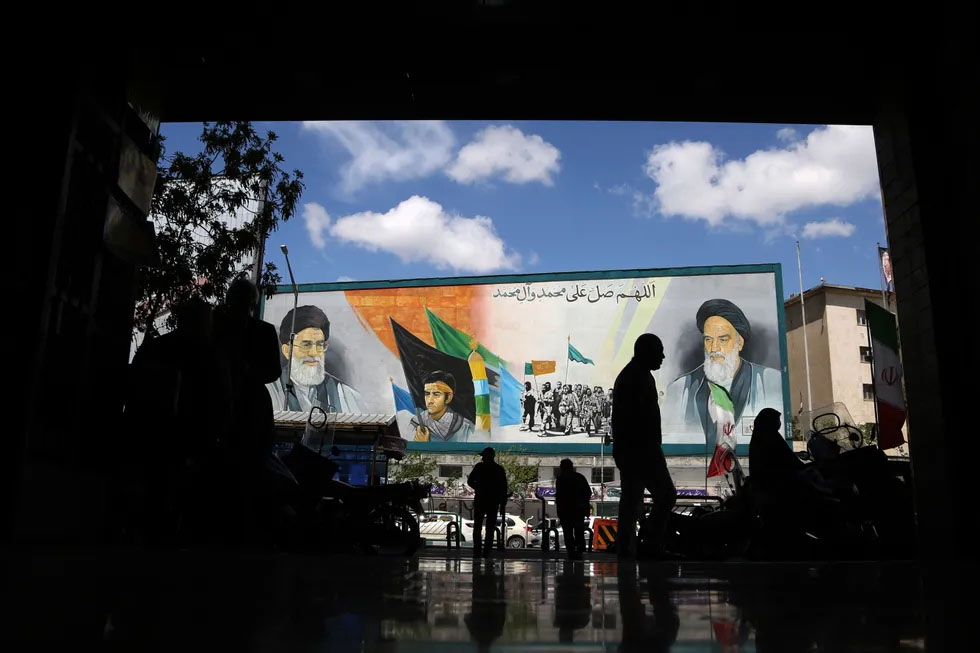
Tehran, April 8, 2026. Photo: Fatemeh Bahrami / Anadolu / Getty Images
Israel Disappointed
Yevgenia Albats: Unlike Iran, in Israel, sociology exists, and last Sunday the results of a poll were published, showing that three times more Israelis consider this war a failure than a victory. About 70% of respondents said that the two-week truce was more of a concession by the US to Iran than vice versa. We know that Prime Minister Netanyahu gave a very optimistic speech, talking about great achievements. But as we know, neither the nuclear threat nor the missile threat has disappeared, and there has been no regime change in Iran. What do you say, David?
David Sharp: From the point of view of achieving goals, this is absolutely not the case. From the point of view of the nuclear threat, everything that was only dreamed of destroying for decades has been destroyed. Iran's nuclear threat, except for the enriched uranium they have left, has been pushed back as much as possible. This is what all Israeli prime ministers dreamed of, what all Chiefs of the General Staff dreamed of. And this is the only outcome that was considered in the event of a military operation against Iran. Everything else, such as an agreement on uranium enrichment, the de facto cessation of the nuclear program through diplomatic channels — this is a big bonus that is dreamed of. But it does not depend on Israel. What depended on Israel and depended on the United States has been done, as far as intelligence knows, in an optimal mode. Regarding the missile program, something similar. Already produced missiles could not all be destroyed, this is complete absurdity. No one promised that. The point was to inflict maximum damage on Iran's missile program. In everything related to production, the goals of this operation were achieved a week before its end. All known targets were hit and destroyed. All priority targets that were planned to be hit to weaken Iran's military-industrial complex and inflict economic damage on the regime were also hit and destroyed. Everything was prescribed, including in the operational order of the Chief of the General Staff. With the achievement of these goals, everything is very good. No one was going to guarantee the overthrow of the regime within the framework of an air operation or destroy all missiles to the last one. This is beyond absurd, and no one claimed that.
The desire to destabilize the regime was there. And all efforts were made for this. Who knows, maybe in a year or two or three it will fall, and then it will be possible to talk about a great strategic success in hindsight. Meanwhile, a significant success has been achieved in everything related to the destruction of Iran's military capabilities, so that in the next round, which is quite likely if the regime does not fall, Israel will approach with much greater advantage than in the current round. If in the current round, 500 more ballistic missiles flew at Israel, the situation would be radically worse. And this shows how important it is to weaken the regime in case of a big war with it. And a big war, as we understood after October 23, can happen at any second, which Iran proved to us.
Many in Israel are dissatisfied because they did not quite understand what it was about. They drew very powerful goals in their own heads that are unattainable. That is, dissatisfaction is also because people want much more, which is unattainable from a military point of view.
For Israel, it is important that the Americans do not look defeated. This is very important for the future of the region and for how freely Iran will feel
There is one of the most important components that was really not achieved from a military point of view. But it is related to the political context. This is that no strike was made on the most important objects of Iran's oil, refining, and energy infrastructure. Most Israeli politicians advocated for this, to weaken the Iranian regime, to knock out economic resources for its existence as much as possible. But here they encountered the considerations of the United States, which for various reasons did not suit this, including due to oil prices, which jumped due to Iranian strikes on Arab countries. Israel has narrower interests, America as a superpower has broader interests and broader responsibility. Accordingly, strikes on energy were not made, and therefore the maximum task from Israel's point of view was not fulfilled. The minimum task in military terms is certainly overfulfilled. The Strait of Hormuz, by and large, is of little importance to Israel, but for Israel, it is important that the Americans do not look defeated. This is very important for the future of the entire region and for how freely Iran will feel. But not looking defeated is the business of the White House administration. In my opinion, some decisions were not made in a timely manner, and some things were not taken into account, including Iran's desperate reaction.
In Israel, people are disappointed that the regime did not fall. But nowhere in the military order and nowhere by the Prime Minister was it said that in the fifth week after the bombings, the regime would dissolve itself. If someone invented this for themselves, it is their problem.
Yevgeny Shakhnovich: I will only note that "someone" is none other than President Trump, who constantly wrote in his tweets in True Social that the regime is about to fall. Perhaps in the Israeli leadership, such a task was not set, I cannot say anything about this. But in the United States, if you look at what the supreme commander says, the goal was regime change in Iran. The military weakening of Iran has probably been achieved, and this is a great success. But the fact is that Israeli society and American society probably look at all this differently. Americans do not look at global goals; they are only worried about an extra dollar for gasoline. This is the political reality in the United States. And Trump and his Republican Party have to take this into account because we still have elections. The example of Hungary shows that this sometimes works. Therefore, there are limitations in all political aspects.
Yes, probably, from Israel's point of view, the goals of the war have been achieved, and no one really thought about more, but from the point of view of American society, which believes that it pays for all this, the goals remain unfulfilled. This is because their president spoke about completely different tasks. The Iranian regime has become, as always in such cases, more radical and will be even less willing to compromise.
What will Trump and his team do in the development of these events? What will they agree to in negotiations with Iran? From my point of view, they will have to agree to something because there is simply no other option. They can continue to bomb, but this will not lead to results that will be significantly different from those already achieved. The matter will end with some kind of agreement, which, as I already said, will largely resemble Obama's 2015 year. Trump, of course, will declare that this is an absolutely, fundamentally different matter.
Yevgenia Albats: It was written that Iran has enriched uranium for a dozen, if not more, atomic bombs. How serious a factor is it that Iran retains enriched uranium, which everyone says would be good to take away from Iran?
Yevgeny Shakhnovich: For the United States and Israel, this is a very serious factor. It is realistically possible within a month, if there are about several hundred centrifuges, to enrich it, at least to the possibility of creating several bombs. This was again one of the main reasons for the war. If the nuclear program remains and this uranium remains in Iran, the global goal of the war has not been achieved. Another thing, and there will be a big debate on this topic, I do not think that Iran planned to make an atomic bomb. But in the current situation, it may be planning because it will see it as insurance against a repeat of the war and will completely change its position on this topic. My feeling is that their position was — to be on the brink of readiness, but not to make the atomic bomb itself. Perhaps I am wrong, I do not know. But Kim's example shows them that here is your insurance. No one touches him, nothing is done with him, on the contrary, they go to meet, and so on. Therefore, as a result, Iran will try to accelerate this program. Iran has very strong physicists, education, and the level of scientific expertise is incredibly high.
If you look at the polls in America, you can see a breakdown in attitudes towards Israel. The difference is not even between Republicans and Democrats, which also exists, but more between generations
Yevgenia Albats: In the American media, there was a report that Tucker Carlson, who until recently was a staunch supporter and propagandist of Trump, called him a "slave of Israel." On the one hand, this sounds very funny, on the other, in the MAGA movement, which is Trump's main electorate, there are very strong sentiments that this whole war happened solely because Netanyahu twisted Trump's arms. How serious a threat do you see in Carlson's statement in terms of growing anti-Semitism in America?
Yevgeny Shakhnovich: I see this as a huge, very serious threat. If you look at the polls in America, you can see a complete breakdown in attitudes towards Israel. The difference is not even between Republicans and Democrats, which also exists, but more between generations. I saw a poll where among people significantly younger than us, from 18 to 34, support for Israel is 10%. From poll to poll, responses can vary greatly depending on the wording of the questions, but nevertheless, in all of them, fundamental support for Israel is less than 50%. This reality needs to be taken into account, as well as the fact that power in America changes, Trump is not eternal, a lot is happening there. And therefore, it seems to me that Israel, Israeli society needs to adjust its position accordingly. At least very carefully monitor all trends. I am afraid that if the war is not very successful or unsuccessful, Israel will be blamed for it happening.
Is the War Long-Term?
Yevgenia Albats: Nikita Smagin, a question for you. Based on the data you have, how much resources does Iran have to continue the war?
Nikita Smagin: It's a question of intensity. If at the level of exchanging strikes in the Persian Gulf zone, then it's months. Not indefinitely, but very long. As long as this power exists, as long as the regime has not changed, some volume of weapons will still be there, and they will still be able to strike. And sometimes quite painful.
Yevgenia Albats: What volume of weapons can we talk about? After all, the military industry has been largely destroyed by bombings.
Nikita Smagin: Yes, to a significant extent, nevertheless, the ability to produce something remains. Not to mention that some countries, as we see, are not averse to supplying something to Iran. Russia, according to leaks in the Western press, supplies modernized Shaheds.
Yevgenia Albats: China supposedly supplied missiles.
Nikita Smagin: With China, it's unclear, more a question of whether they will supply more. If we are talking about MANPADS or some materials for missiles, they were supplied before. Be that as it may, Iran receives some support. Military actions in the Middle East, at least in the Persian Gulf zone, are beneficial to Russia for now. Supplying Shaheds, significantly improved in Russian realities, is quite simple. And they, on the one hand, support a certain level of conflict, which pushes up oil prices, and on the other — consume interceptor missiles, which otherwise could be used in Ukraine. That is, the level of confrontation that causes damage at least to the Persian Gulf countries, Iran can maintain for months. Expecting that everything will end by itself, I think, is not worth it.
Yevgenia Albats: David Sharp, your point of view, how long can this war continue?
David Sharp: You can't stop this war unilaterally. The US will have to make a choice: play Iran's games or try to raise the stakes. However, raising the stakes, as Nikita correctly noted, does not guarantee the end of the war because the resources to shoot in at least some quantities, and especially to disrupt shipping in the strait and affect Arab infrastructure, will remain with Iran. Complete destruction of the missile potential, I emphasize, complete — cannot be. I do not particularly attach importance to Russian support and doubt that they can supply a significant number of Shaheds if they supplied them at all. By the way, Iran had and has more advanced UAVs than even Russian upgrades. Iranians have long made devices capable of attacking moving ships, not just static targets. But these are details. The desire to raise the stakes will be there for the Arab countries if they are subjected to strikes during the blockade of the Strait of Hormuz, and for Israel, and for the United States. Israel's desire to raise the stakes, I mean the phased destruction of key Iranian infrastructure, has been there for a long time because whatever leadership Iran has now, the main ideological postulates are the same. And what will the Iranian leadership do if they start losing, say, initially 20% of electricity production, then more? If they decide: we go to the end and lose everything — in this case, they can actually lose everything. I am not sure that even with a radical approach, losing all economic resources is what they are counting on. However, you cannot be sure of anything. There are always two sides in a war. One of them may act irrationally, in the opinion of the other. You need to proceed from possibilities. They will have the opportunity to shoot. Let's see if they decide to shoot if the opponent moves to qualitatively new levels of defeat.
Simulation of Reality and Elections
Yevgenia Albats: In November, there are midterm elections in the United States. All major sociological firms say that Trump's Republican Party will lose both the Senate and the House of Representatives. At a minimum, Trump is losing the House of Representatives. Professor Shakhnovich, given the rising gas prices and the general irritation that the war in Iran causes among Trump's voters, how long will the United States continue this war?
Yevgeny Shakhnovich: I believe that not for long, precisely for the reasons you mentioned. Objectively, what Trump needs most is not the security of Israel and not even some geopolitical gains, but he needs to retain his power in the form it is. For this, he needs Congress, and primarily the House of Representatives. I do not think he will lose the Senate, the arithmetic does not work very well there, but he will almost certainly lose the House. And I think he will try to do everything to prevent this from happening. If he needs to agree to Iran's terms, except for the most humiliating ones, of course, he will most likely do so. He will declare that all goals have been achieved because he is a postmodernist person; it is not what actually happens that matters to him, but the simulation of reality, which he produces with more or less success. I will make ten reservations that I may be wrong, but my forecast is that he will not resume military actions, at least on a large scale, after this truce. They will come up with some kind of agreement that will more or less save face for both sides, which will differ in some way from Obama's, to say that in this point we went much further. And after that, the war will end. But the problem is that given the oil logistics and technical capabilities, gasoline will be expensive, possibly until the elections. And this will affect their results.
And most importantly, this war is completely incomprehensible to the American voter. In June twenty-fifth, Trump announced that Iran's nuclear program was destroyed. Since then, nothing has happened that in the eyes of Americans would justify a new attack. Trump promised that there would be no wars under him. The war in Ukraine will end in 24 hours, no new wars in the Middle East, peace everywhere. And suddenly he starts a big war in the Middle East. With such an attitude to pre-election promises, elections in the United States are not won...
Video Version
* Yevgenia Albats, Nikita Smagin in Russia are declared "foreign agents".