 The globe of Russia is consistently shrinking. Just the last week alone is worth noting: Russian-Syrian negotiations (for the second time in a short period; moreover, as with the Taliban, with those whom they were recently fighting); Russian-Emirati negotiations; Putin's meeting with the Secretary of the Supreme National Security Council of Iran Ali Larijani; a phone conversation between the Kremlin's host and the President of the Central African Republic; shortly before all this — a meeting with Palestinian leader Mahmoud Abbas ("Moscow — like our second home"). Finally — a meeting of the Commission on Military-Technical Cooperation with Foreign States:
"...We sincerely value our historically strong, friendly, truly trusting relations with African countries. In different years, the USSR, and then Russia, supplied African countries with a significant amount of weapons and military equipment, trained specialists in their production, operation, repair, as well as military personnel..."
Partly on these relations, the Soviet Union also stumbled... Only Sergey Lavrov was lucky — between Namibian and Syrian officials, for the first time in many years, he managed to meet with a representative of the Western diplomatic establishment Liz Gregoire van Haaren, co-coordinator of the UN reform negotiations.
To the Kremlin, urgently
One could assume that Putin is following in the footsteps of the Soviet Union — Syria, Iran, Africa. But the USSR in the years of stagnation, despite all the difficulties, still built relations with the United States and key European states. The western vector in today's Kremlin policy is absent. As well as the policy towards Israel is reduced to highly episodic talks with Benjamin Netanyahu (the last one took place on January 16, where Putin outlined mysterious "principled approaches") — Iran and Palestine are somehow closer to the Kremlin.
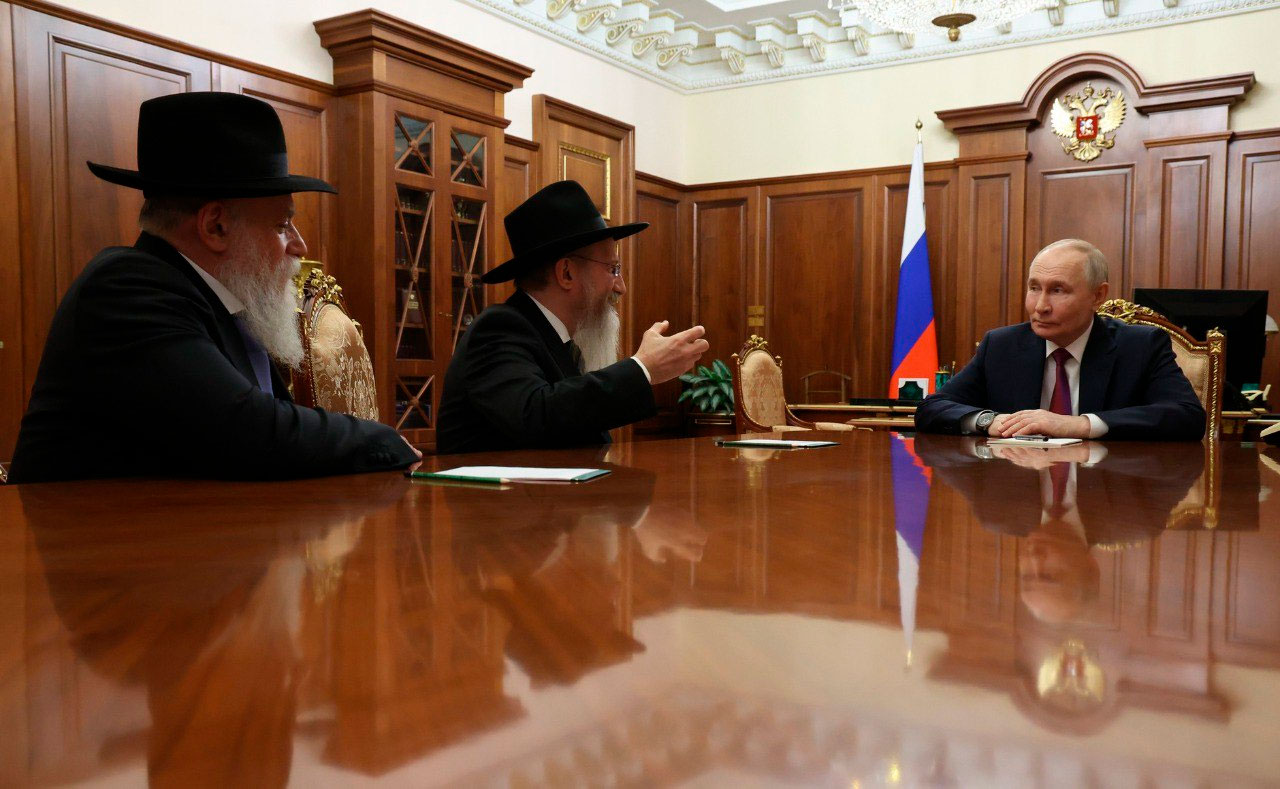
Meeting of V. Putin with the Chief Rabbi of Russia Berel Lazar (in the photo in the center) and the President of the Federation of Jewish Communities of Russia Alexander Boroda (in the photo on the left). Photo: kremlin.ru
However, when necessary, two people are urgently summoned to the Kremlin to create the right PR picture — the Chief Rabbi of Russia Berel Lazar and the President of the Federation of Jewish Communities Alexander Boroda. The Holocaust Remembrance Day and the Day of the Breakthrough of the Siege of Leningrad coincide. In the Kremlin's propaganda logic, they are united not because these are two of the greatest tragedies, but because it is necessary to equate the Nazis of that time with today's "Ukrainian-European". And thereby once again strengthen the thesis that the West has always attacked Russia and there is no difference between Napoleon, Hitler, and NATO.
Of course, official Russian Jews perfectly understand that they are being used, but, like the Kremlin's Jewish organizations, including those that were destroyed by the Kremlin itself, prefer to build normal relations with the authorities. Is this a desire to gain protection for Russian Jews or still for themselves? Both the Jewish Anti-Fascist Committee, crushed by Stalin, and the Anti-Zionist Committee of the Jewish Public in the late Soviet times could not protect Soviet Jews from the pogrom campaign against cosmopolitans, from the semi-official anti-Semitism of more vegetarian years, from the extremely negative official attitude towards Israel and the persecution of refuseniks. How the Yiddish culture was not saved by the magazine "Sovetish Heymland", which was headed by another "Kremlin Jew" Aron Vergelis, son-in-law of Valentin Kataev — the readers left or assimilated. Naturally, no official Jewish organizations could help the Soviet intelligentsia and Soviet dissidents, among whom there were many Jews. But they entered a kind of ethnographic department of the nomenclature, these very "Kremlin Jews".
Today in Russia, anti-Semitism is not a serious open problem not because Berel Lazar and Alexander Boroda go to the Kremlin (after all, indeed, it's better they go than not, although their somewhat deliberately folkloric appearance disorients the Russian working masses about what Russian Jews look like). But because there are physically few Jews. And there are even fewer after February 2022. And xenophobic sentiments are primarily directed against migrants, mainly from Central Asia. There has been some substitution, which does not solve the problem of xenophobia as a whole, not to mention the open state stimulation of Russian nationalism and national-imperial resentment. Without anti-Semitism, all this ideological economy cannot exist.
"Those who are for Putin and the SVO — are also harshly xenophobic-anti-Ukrainian and simultaneously anti-Israeli"
Unreliable exchange
And there is definitely a problem with anti-Israeli sentiments: those who are for Putin and the SVO — are also harshly xenophobic anti-Ukrainian and simultaneously anti-Israeli. According to the "Levada Center", when it comes to the Palestinian-Israeli or Iranian-Israeli conflict, sympathies are clearly on the side of the Palestinians or Iran. Here, for example, is a survey from June 2025 (Israeli strikes on Iran): the majority of respondents, of course, do not care how to relate to the sides of the conflict, while a third of the respondents (29%) sympathize with Iran, and 3% (!) with Israel. The social, gender, political composition of Israel's sympathizers exactly matches the portrait of opponents of the SVO and Putin and supporters of the pro-Western democratic development of Russia: youth under 24 years old, those who do not approve of Putin's activities as president, those who trust social networks and YouTube channels as a source of information.
One can say that with their visits to the Kremlin, Berel Lazar and Boroda legitimize the regime in the eyes of the Jews. And one can consider that they ensure the peace of the Jewish communities and Jewish culture. Official "anti-Zionist" Jews acted in exactly the same logic under Soviet power.
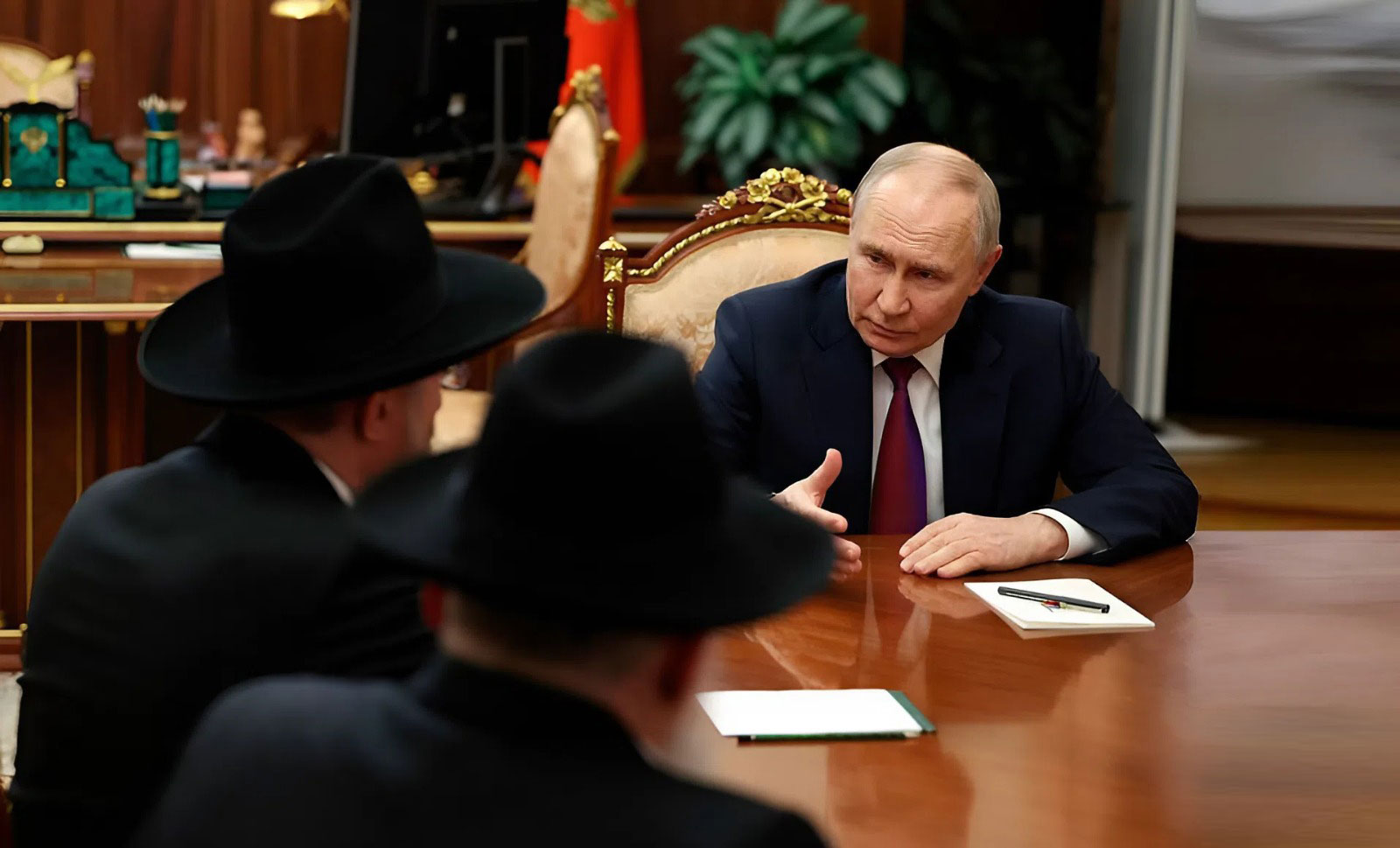
Photo: kremlin.ru
But the exchange — peace in exchange for use in specific situations, as it was the other day, — is not quite equal. If the "Kremlin Jews" used their political weight (or is it insufficient?) to solve some delicate issues, they would be invaluable. After all, Putin thinks in terms of exchanges and deals no less than, say, Trump. Why don't the rabbis stand up for Evgenia Berkovich and Lev Shlosberg, for example? I'm sure it never occurred to them that this would be an act of genuine protection of the political rights of Jews in today's Russia. Why don't official Jews talk to Putin about Israel and Palestine, Israel and Iran, try to somewhat reduce the level of demonstratively respectful Kremlin attitude towards Hamas and the regime of the ayatollahs? Their own peace and the relative security of the communities are more important.
Well, as Yuri Davidovich Levitan wrote, "everyone chooses for themselves..." Putin's guests have chosen their path. Does this conformist road, which seems like a highway, guarantee that at some point the Kremlin will not need to expose a "Jewish-Masonic" conspiracy? No, it does not guarantee. Does such a scenario seem fantastic? And did the SVO scenario not seem fantastic a few years ago? They joked about "Jewish-Banderites", but Russian propaganda builds its bizarre constructions precisely on the principle of oxymoron — combining the incompatible.
In September 2024, 18% of "Levada Center" respondents considered the actions of Hamas on October 7, 2023, justified, 42% found it difficult to answer. Life in the era of the SVO turns morality upside down and irreversibly spoils morals. Have the "Kremlin Jews" achieved much with their visits to Putin? Probably nothing. It's good that the Jewish Museum and Tolerance Center is working, but the Museum of the History of the GULAG was destroyed. But high-ranking rabbis are unlikely to have ever thought that the protection of the memory of political repressions is directly related to Russian Jews.
Kremlin thinking is still very narrow. Like the globe of the Kremlin.
*Andrey Kolesnikov is considered a "foreign agent" by the Ministry of Justice of the Russian Federation.