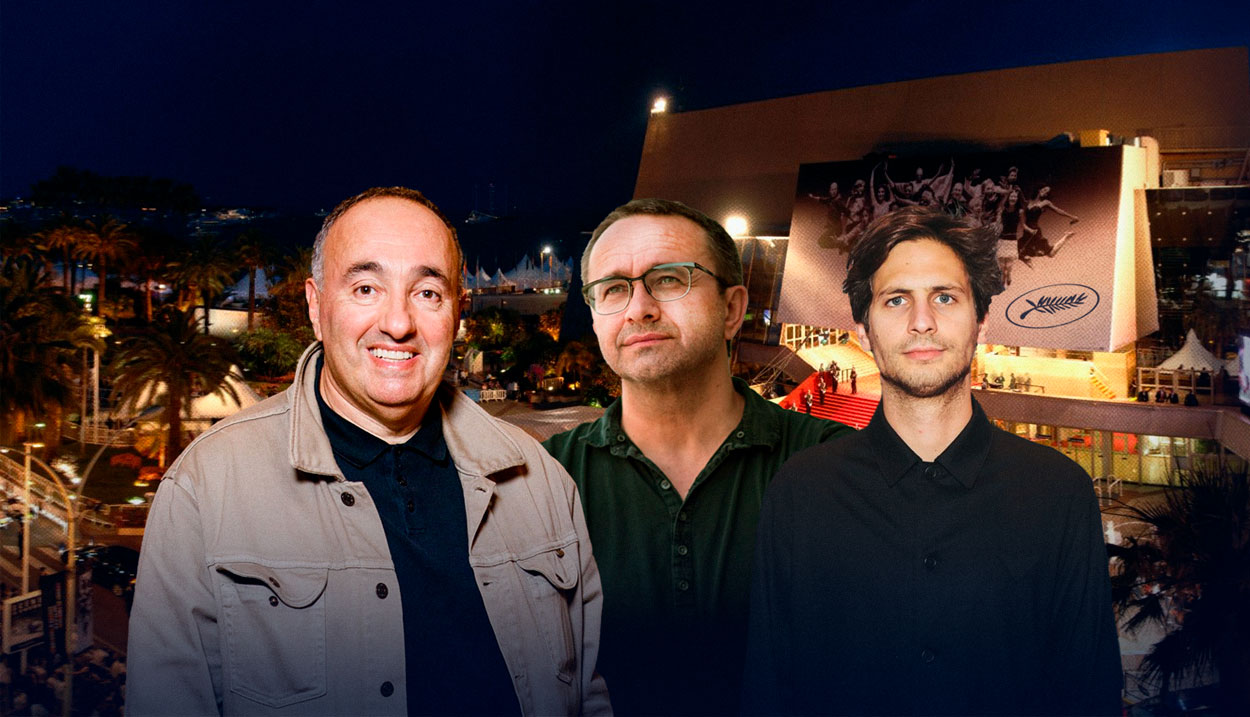
Alexander Rodnyansky, Andrey Zvyagintsev, Alexander Molochnikov
Evgenia Albats: As far as I know from the press, you are currently producing a film by a very talented young Moscow director, Alexander Molochnikov, called “Extremists.” I'm very curious, do people in Europe, who are now living in anticipation of a big war with Russia — and for almost 5 years now there has been a terrible war in Ukraine — really want to watch a movie about this?
Alexander Rodnyansky: Cinema, which primarily (and this is a healthy, correct feeling) comes from the audience's need — it is usually called genre, audience, commercial, whatever, and such films include various genre films, made primarily by famous Hollywood studios, — is primarily aimed at satisfying the need. There are films that have a need to speak out on a topical issue, primarily concerning the authors.
For Alexander Molochnikov, this is important, and by the way, this is his second attempt, because before this feature film he made a short film called “Extremist.” The film was about Sasha Skochilenko, that activist girl, artist, who received 7 years in prison for merely (just think!) replacing price tags in a supermarket on some goods with small pieces of paper with information about what is happening in Ukraine, about the civilians killed there. For this, she was given 7 years (later she was released as part of a large exchange orchestrated by Germany and the United States).
And on this topic, Alexander Molochnikov made a short film, it was very successful, received two student BAFTAs (BAFTA — the annual award of the British Academy of Film and Television Arts. — NT), it was Molochnikov's diploma film, despite the fact that, as you rightly noted, Sasha was a very famous Moscow theater director, primarily theatrical, working at the Moscow Art Theater, the Bolshoi Theater, and others, but he managed to make several films. Two feature films and a series that was quite noticeable, and after his short film received two student BAFTAs, it also made it to the so-called Oscar shortlist.
Based on this film, the next one appears. It is no longer about Sasha Skochilenko, the heroes of this film are not so much specific people currently in Russia (and it is about them, who are in prison, who are somewhere else, I will not go into details), but rather characters from several dozen stories of specific people, those people in Russia who were not afraid to speak out against the war. That's why they received sentences, that's why the film is called “Extremists.”
And that's why, actually, Sasha decided to make it and involved me in it at the time. I supported him, as did a number of other colleagues. And we all decided to make this film, which, if it turns out to be worthy, authentic, honest, and emotional, will be able to attract the audience's attention. Sometimes films, as I said, are made from the very beginning from this point of view, with the desire to make it honestly and thereby evoke the corresponding reaction of viewers who did not suspect at the first stage that they would want to watch a film about the unpleasant details of current life in Russia.
The Opportunity to Speak Out
Evgenia Albats: The Western audience, at least in the United States, already looks at the war in Ukraine somewhat distantly and is quite indifferent to the fact that people are being imprisoned in Russia. There is much more written here about the fact that people in Russia do not protest against the war. The attitude towards us as people who not only lost but who failed to resist the regime, I think, weighs heavily in the West.
The film “Extremists” will be about those who are imprisoned. I think it would be fair and honest to at least try to tell these people about those who do not suspect that there are many honest, worthy, and courageous people in Russia
Alexander Rodnyansky: I have encountered this many times and consider it naive and unfair. There were and are many people in Russia who disagree, protest, speak out, and we don't need to tell each other about them. It is clear that we are not talking about millions of people, nevertheless, I am not a supporter of such a “white coat” view. One way or another, there are films that give the opportunity to speak out if the authors believe that it is unfair to treat all Russians as weaklings, genetic slaves, or cowards doomed to eternal slavery, as, let's not hide the sin, my compatriots Ukrainians often say. If the authors of the film disagree with this, they have the right to speak out.
And in this way, Molochnikov and his co-authors, and everyone involved in this film, starting with the lead actress, the wonderful actress Chulpan Khamatova, People's Artist of Russia, who left a brilliant career in theater and film in Russia, despite the fact that nothing threatened her there except for continuing a no less prosperous life, — left everything and ended up in the West with three children, where she has a difficult life, like everyone else: like Varvara Shmykova, who also successfully acted in Russia, like Pavel Titov and many others who left because of the war. And someone stayed in Russia, someone is imprisoned. And this film will be about those who are imprisoned. I think it would be fair and honest to at least try to tell these people about those who do not suspect that there are many honest, worthy, and courageous people in Russia.
Evgenia Albats: Are you not afraid of ending up on the “Peacemaker” list? Let us remind you that this is a list compiled by Ukrainian activists who include everyone they don't like.
Alexander Rodnyansky: You yourself formulated the main quality of this list. It is compiled by some activists, it is not a state site, it has nothing to do with the Ukrainian state. If someone doesn't like the people who run it, Anton Gerashchenko and his comrades, they will add that someone there. There are already several hundred thousand people there, just for reference. Well, they will add.
They recently added Andrey Zvyagintsev, one of the most honest people I know, and certainly one of the most talented filmmakers living in the world. They added him right after his brilliant film “Minotaur,” which tells exactly about how Russia lives during the aggression carried out by the Russian army in Ukraine, the killing of Ukrainian civilians, the destruction of Ukrainian cities — the film takes place in September twenty-second during the announced mobilization. And the director of this film, which received the Grand Prix of the Cannes Film Festival, the second most significant award of the most famous and influential film festival in the world, was considered possible to be included in the “Peacemaker” list. Is this fair? No, in my opinion, it is not fair. But what can you do, people are different.
Evgenia Albats: I am on this list after I traveled almost all over Ukraine, from Kyiv, Khmelnytskyi to Odessa, Mykolaiv, and Kherson, writing from there. So I know this firsthand. And I know that Ukrainian audiences periodically attack you very sharply, as do Russian audiences. And here you are making such a film as Molochnikov's “Extremists.”
Alexander Rodnyansky: For which I am definitely not ashamed. I think it can turn out to be honest, it can turn out to be talented. The material is very interesting, and I think it's important to make such films. I haven't made films in Russian and about what is happening in Russia for several years, and I didn't even participate in Andrey Zvyagintsev's film, with whom we made three films together and collaborated for 12 years. It seemed to me that during the war it was unfair. But I watched “Minotaur,” it made a strong impression on me, it struck me. I thought it would be fair to help talented directors from Russia too, who found themselves outside their own country and are trying to make non-conformist, honest films about what is happening with their country.
Bombs and the Red Carpet
Evgenia Albats: We are talking at a time when you are going to the Venice Film Festival, and I caught myself thinking about this. On the one hand, you write in your blog every day about how people are being killed in Ukraine, how its cities are being destroyed. And I start every day by checking how many have been killed in Ukraine again, and now in Russia too, because the war has already come to Russian territory. I have close ones there, it naturally worries me a lot. On the other hand, there is a festival somewhere, a red carpet, expensive dresses. Well, here in America, the war in Europe is very far away. But how does it feel in Venice, in Italy? What do you feel when after the morning news about the dead in Ukraine you arrive in Venice and see this red carpet? I'm not coming from a “white coat” perspective, don't think that.
For professionals, the festival is a gathering point. Festivals allow films with strong authorial statements, made on sharp, sometimes even provocative topics, to start their journey into life
Alexander Rodnyansky: I understand, don't worry. Well, listen, for professionals, the festival is a gathering point. This is the place from where films start their journey into life. I have been going to film festivals for thirty-seven, to be precise, years annually. To festivals in Cannes, Venice, and Berlin, each of which I have films in the last four years. Otherwise, our films do not live. These festivals allow films with strong authorial statements, made on sharp, sometimes even, I would say, provocative topics, to start their journey into life.
For example, Venice is famous for its sharp cinematic statements. Few people know that in Venice, traditionally, from 15 to 20 absolutely brilliant documentaries are shown. For example, Ukrainian Sergey Loznitsa, one of the directors who made a lot of sharp films and whose film “Two Prosecutors” was in the Cannes competition last year. And this year there will be his documentary film called “Imperium.” From the title, it is clear that it is about the Soviet past. There will be a film “My Unwanted Friends,” the second part, as I understand it, of a dilogy, and the first was made by an American director of Russian origin, Yulia Lokteva, about journalists. The first was about the journalists of “Rain”**. And now, probably, about those who stayed or left, I haven't seen it yet. There will be a film by the famous American documentarian Alex Gibney about Elon Musk. And knowing Gibney, who made films about Snowden, Khodorkovsky*, and many such sharp and unexpected things, the film about Musk arouses my particular interest.
There will be a very provocative film in the competition, made by two Israelis involved in the creation of the Oscar-winning documentary film No Other Land. This film is, naturally, very pro-Palestinian. But the new film is made only by Israelis. And, apparently, it is also very critical of their government and how it conducted the operation in Gaza. I am waiting for it without much sympathy, I do not share these positions at all, but I am still curious to see what they will do. Ukrainian documentarians' films about the war have been shown there repeatedly.
In other words, it is there, at major festivals, that those films begin their life, which can gather an audience in cinemas and make them watch films about unexpected painful circumstances of modern history. There will be films about Iran, about what is happening in the Middle East, about the situation in European countries, both feature films and documentaries.
Therefore, I treat this as work. Red carpets are a wonderful part of the festival, absolutely external, which is important for those who come there for the first time or guests. And for those who, like me, come to show their film and promote it in life, meetings are important. I need to show the film, get a reaction from the press. And the future of the film will depend on it: whether the rights to its screening will be acquired by numerous television channels, or theatrical festivals, or various platforms on the Internet.
Evgenia Albats: You currently have a series “High Value Target: The Hunt for Saddam” coming out on American TNT. The theme of war and dictators clearly occupies you?
Alexander Rodnyansky: Honestly, I have always been wildly dependent on real circumstances. I have always loved feature films and films and series based on true events, on real stories, on human biographies, on what is called the clash of cultures, on the stories of totalitarian regimes and authoritarian leaders. The premiere of the series you mentioned will take place in the United States on the broadcast channel TNT, but then it will be released a month later on a major streaming platform. I won't say which one yet, because it should announce it itself. And in other countries, it will be released on completely different platforms, including in the Middle East, simultaneously in all Arab countries. And discussions have already begun there about the series because, naturally, many expect the worst from it: disrespect, insults in their address, and so on.
And we are proud of what we did, to be honest. I worked on this series for almost seven years. And it all started with my closest associate reading a book written by former CIA analyst John Nixon, the person who specialized in the psychology of Middle Eastern leaders and was sent in 2003, during the Gulf War, as part of the CIA residency mission in Baghdad and became the one who, understanding Saddam Hussein's psychology well, understood how to find him after he could not be found for several months.
And after the capture of the former president of Iraq by the United States Marines, he identified him by tribal tattoos, scars on his body, and conducting a short interview with him — this was important because at that time there were versions of numerous Saddam Hussein doubles. For the success associated with the capture of the president of Iraq, John Nixon was granted a special professional honor, he became the very first person, the first American, who was entrusted with interrogating Saddam. And he spent several weeks talking with Saddam in the basement of the former presidential guard building in Baghdad. After which, in fact, he realized how many false ideas about Saddam the Americans had, and Saddam and the Iraqi side had about America and its strategy.
After that, being recalled to Washington and having the opportunity to report to the President of the United States, George Bush, about what is happening in Iraq, he tried to prevent the inevitable explosion that later occurred in the Middle East. An explosion that we all still experience and whose consequences we feel daily in the news reports, and not only from the Middle East, these wars and conflicts that have polarized society in Europe and the United States. All this could probably have been prevented if we had behaved differently in Iraq. In fact, the series is about this. The main role of John Nixon is played by the brilliant and very popular actor Joel Kinnaman, who starred in “Altered Carbon” and a huge number of other films and series.
Evgenia Albats: Such a big, tall handsome man...
Alexander Rodnyansky: By the way, John Nixon looks similar, also a tall handsome man. He came to our filming. He actively helped us, and we are in very close and even friendly, I would say, relations with him. It was important for us that he liked the series. I hope that this is what happened. In any case, he said so. Several absolutely excellent Arab actors played roles in our series. We tried to be as accurate, authentic as possible, to follow all the circumstances, down to the details, so that everything corresponded to the events that took place in 2003, 2004, and 2005 in Baghdad and around. Naturally, this also applies to Washington. We have a meeting with Bush there, the very one that John Nixon accurately described in his book. It is important to note that the dialogues with Saddam are based on real interrogations that Nixon recorded and later published in his book.
The Uncontrollability of the World
Evgenia Albats: There is a stereotype of superpowers that control the world.
Here is Russia, a large superpower with nuclear weapons, with huge reserves of Soviet weapons. It has been killing Ukrainians and Ukraine for 4 and a half years. And at the same time, it has become obvious to everyone that Russia cannot defeat Ukraine. We see how the United States of America, together with Israel, started a war against Iran. But at least they had, unlike Russia, a more or less provable reason for this war, since Iran is indeed developing nuclear weapons. Everyone understands that the first thing Iran will do with these nuclear weapons is strike Israel first, and then the United States. The question is, we see how a big country cannot cope with Iran, even though it is also a country on the brink of collapse, with economic problems, and so on. So it is obvious that our understanding of how the world is organized is now collapsing significantly. What do you think?
Alexander Rodnyansky: What worries me is not so much the topic of dictators, but the complexity of the world. Its, if you will, uncontrollability, non-linearity. What has always worried me the most is the danger of primitive, simplistic models of understanding the world. And what you briefly described is exactly that. On the one hand, the so-called collective West proceeds from the fact that the Russian Federation has violated all international laws and, despite even its own treaties, has attacked Ukraine with an aggressive war that has no justification in the modern world. On the other hand, all Western countries without exception are afraid of escalation, afraid of transitioning into a third world war, and for a long time were cautious both with providing assistance to Ukraine and with pressure on Russia, and sanctions were adopted based on any motives, but not such as to cut off Russia from financing the war.
The same story with Iran. A complex conflict, within which we can say anything, but it showed that the United States of America today is not a country that provides a security umbrella for the Gulf states, which for many years, even decades, proceeded from the idea that the United States is the guarantor of their security, and today this is no longer the case. Iran has declared a completely new model of war, within which aircraft carriers and airplanes do not have decisive significance, the war is happening on Manhattan and Wall Street. And partly this is true.
The world has become more complex. The United States has lost its unique status as a superpower, whose army frightened everyone and guaranteed absolute victory. Under Trump (although it started with Barack Obama), the US itself abandoned the role of world policeman, withdrew from the global game. Trump decided to focus on dominance in his hemisphere, leaving Europe to the Europeans and dealing with China in terms of economic and technological competition. Of course, the world has changed drastically.
It is absolutely clear that the war in Ukraine has changed its nature. This summer, Ukraine made the war symmetrical, the war escalated and became harsher, more brutal, more bloody. More and more people are dying. In my native Kyiv, there have been continuous air raids for the last few days. Something is constantly burning, something is exploding, dozens of civilians are dying daily. But what to do? This is war. And this is my answer to your question. The world is changing, changing monstrously. I am afraid that such wars can continue indefinitely, having consequences significantly broader and on a significantly broader space than when they began.
Evgenia Albats: You were born in Kyiv, lived there and worked for many years, your son was an economic advisor to the President of Ukraine, Volodymyr Zelensky. You, of course, observe what is happening there. I cannot help but ask about the dismissal of Defense Minister Mykhailo Fedorov and his actions afterwards, about the interview in which he said that elections need to be held in Ukraine, and so on. What we call an elite split in political science is evident. How much does this cause you concern, considering that the war continues?
Alexander Rodnyansky: Listen, well, Ukraine is such a country, nothing new is happening. In Ukraine, there is constantly not even a hidden, but a completely open political struggle. Maybe this is, on the one hand, a weak point of Ukraine. Of course, it is more convenient when you have a pyramidal vertical, like in Russia, and the monarch's word is mechanically passed down, like water in a tank, from top to bottom. And in Ukraine, every phrase of the president, every directive, every speech is subject to close scrutiny and sometimes harsh criticism. And it has always been like this. Maybe there is also a plus in this, even during the war.
Mykhailo Fedorov was a successful defense minister, he is young, in Ukraine they traditionally love young pro-Western technocrats. Remember the conflict between Yushchenko and Yanukovych, and so on. This is a traditional disposition. And Fedorov, of course, attracted universal sympathy, primarily because he also came out of the ministers of digitalization, was a successful deputy prime minister responsible for an effective application, a kind of analogue of State Services, but significantly more advanced and convenient for citizens during the war. But it is clear that he had a conflict with the Commander-in-Chief of the Armed Forces of Ukraine, General Syrsky. This conflict did not contribute to the management of the army, the conduct of the war. And the president removed them both, replaced Syrsky with Drapaty and Fedorov with Khmara. This is the president's right. There was a huge discussion about this and it even continues, but not as actively.
And Fedorov became an advisor to the Minister of Defense of Italy. Many consider this not the most successful political step for him if his previous statements are viewed as a declaration of political ambitions. They believe it would be better for him to contribute to Ukraine's victory at home. This is again an opinion that can be discussed. I am not a political consultant.
I believe that in Ukraine the government is strong enough. And as long as the hatred for the enemy exceeds the scale of criticism of one's own government, nothing will change. The aggressor is hated much more than the government is criticized. And they criticize it for a lot and often for a reason. Such is the specificity of Ukrainian political life.
And even if the president changes, what will change? All other contenders for the position of president are either generals (General Zaluzhny, General Budanov, General Beletsky, etc.), or former Defense Minister Fedorov. How will this change the situation with the war? But we still have no elections during the war. Political discussions have no concrete continuation. The main content of Ukrainian political life is still the war. Money is needed to finance it, this is the main problem lately. And the main drama is whether Europe can provide the missing billions for this hardest war and who exactly in Europe can do it.
There Will Be No Capitulation
Evgenia Albats: The British magazine The Economist published an article stating that Putin's position within the country has worsened significantly and even that Putin supposedly said such a phrase that in case of defeat “They will hang me”. Therefore, he is afraid of negotiations, that is, ending the war. I want, of course, to see the person to whom Putin said that they would hang him. I can roughly imagine who he might have said such things to, if he did at all. And I think that none of the journalists have access to this source or sources. But the question is the following. Zelensky and Ukraine continue to fight in Donbas. Now everyone is waiting for the activation of Russia's autumn campaign, they talk about a new mobilization. It is quite obvious that the main Russian forces will be concentrated in Donbas. Tell me, do you think it makes sense for Ukraine to continue fighting for the remaining 10-12% of Donbas that have not been captured? I remember how Kaha Bendukidze, whom Poroshenko at one time planned almost for the position of head of the Central Bank, told me: “Donbas is a suitcase without a handle.”
Putin believes in the possibility of victory. He knows for sure that the war can be escalated. I am afraid that he seriously believes that this can be achieved by creating maximally unbearable living conditions in Ukraine
Alexander Rodnyansky: Without a handle or with a handle, it doesn't matter. I am not ready to discuss this. People still live there, citizens of Ukraine. In Kramatorsk and Sloviansk, in the agglomeration of these cities, there are still several settlements where more than 100 thousand Ukrainians live. And it is primarily about them, who are on the territory defended by the Armed Forces of Ukraine. I am not talking now about the residents of the occupied regions, who are also Ukrainians, but this is a separate conversation. No Ukrainian politician will ever in their life be able to take the courage, bravery, and risk to give up territories not conquered by Russian troops. How can this be? This is capitulation. The very fact when you surrender your own territories without a fight is equal to capitulation. And the Ukrainian leadership has repeatedly said, in fact, not even from the very beginning, this started somewhere about two years later, about the readiness to stop along the line of combat contact. And this position is accepted by Ukrainian society. And Ukrainian society, on which the Ukrainian leadership depends, is the key difference between the Russian situation and the Ukrainian one.
Because Putin does not depend on what is said on the street and what is said in the kitchens of Moscow houses. All these talks about Putin, to whom he said that they would hang him, or that he would be removed tomorrow, are, excuse me, idle fictions. No one has ever talked to Putin from those who write these texts, and no one has ever approached him closer than 15 kilometers. This is all childish babble.
Putin believes in the possibility of victory. He knows for sure that the war can be escalated. I am afraid that he seriously believes that this can be achieved by creating maximally unbearable living conditions in Ukraine. The winter will be catastrophically difficult. The last one was monstrous, old people died in high-rise buildings because there was no heating, no water, no communication, they could not call either volunteers or an ambulance to bring them medicine, food, or something else. Elevators did not work, they could not go down or up. This year they promise to make everything even worse.
Putin speaks about this directly. He is destroying logistics centers, infrastructure today. A couple of days ago, it was announced that they are starting to destroy the energy infrastructure again. This is his plan. It is absolutely clear. Putin is counting on three things: on endless pressure on the front, which will be intensified if mobilization is carried out in Russia, on the winter, during which it will be difficult for Ukrainian cities to survive, and on a change in the political situation in one of the most important European countries supporting Ukraine. Next year, let me remind you, elections are planned in France in April. How will the new French president behave? Who will it be?
So far, 8 months before the elections, according to all forecasts, Le Pen wins in the second round. She does not support Russia, at least rhetorically. But such one hundred percent full support for Ukraine, as Macron has demonstrated all these years, should not be expected either. What will happen in Germany, how events will develop in other European countries, few people also imagine. And this is Putin's hope. So he presses.
No one doubts the resilience of the Ukrainian army, but will there be enough money to continue the war and what will happen inside Ukrainian society, how it will support the front and the efforts of the Ukrainian leadership to hold it — these are the fundamental questions that are important for Ukraine and Ukrainians today. So far, there are no signs that Ukraine will weaken its determination to resist.
Evgenia Albats: Yes, except for the fact that Putin and his guys have started blackmailing again with the use of nuclear weapons. Unfortunately, European and American politicians are frightened every time. That is exactly why, I believe, the war has been going on for so long. It could have ended in twenty-three.
Alexander Rodnyansky: Honestly, I think it might not have started if in fourteen Barack Obama had imposed at least some of the sanctions that were imposed in twenty-two. And when they limited themselves after the annexation of Crimea to childish sanctions, which are shameful to recall, Putin and his comrades realized that in fact, nothing threatens them, and they can calmly prepare for the next stage.
The responsibility of Western leaders is actually colossal, and their underestimation of the threat is unthinkable. We all made mistakes, but we did not hold the main political positions and were not responsible for such decisions of colossal importance as those made by Obama, Biden, Merkel. All these people talked to Putin. All these people could have come, in fact, to the closing of the Olympics and talked to him there. You remember when no one came, he was left alone in the stands, offended, humiliated, pathetic. And literally, the next day, the operation to capture Crimea began.
I believe that such trifles matter. As one of the characters in Mario Puzo's book “The Godfather,” which became the basis of a great film, said, you need to keep friends close, and enemies even closer. If you are afraid of Putin and consider Russian aggression possible, then you need to be close, you need to talk, communicate, meet, and not teach like a child who misbehaved at school, by coming or not coming to the closing of the Olympics.
As a result, after thousands of numerous mistakes, we have everything we have received: a war that cannot be stopped, America that is withdrawing from influence, no longer financially helping Ukraine at this stage, and, accordingly, no longer influencing decisions on Ukraine (or not to the extent it could if it participated in financing its defense). Only Europeans help, and at this stage, it is in fact Germany, which has become Ukraine's key partner in this war thanks to the unthinkable opportunities and assistance it provides to the country.
Evgenia Albats: So you do not consider the visit of the head of the CIA to Moscow as a sign that the United States is returning to the topic of achieving peace in Ukraine?
Alexander Rodnyansky: Any conversations can take place, but why should Putin react to these conversations? It is absolutely clear that Putin has a plan. I do not understand how a person in Putin's place, who has taken on all these monstrous risks, received all conceivable sanctions, became a political outcast in the modern world, a person with whom, in fact, no one talks, will agree to stop the war, in which, as it seems to him, he can win, just because someone wants to stop it. And even at the stage where he does not get what he wants.
And he wants one thing. This is not any Donbas. He wanted and wants one thing. He wants control over Ukraine. In what form — he is probably ready to discuss, whether it will be a form, conditionally speaking, of Belarus or Georgia, but he certainly wants to have influence over all the decisions made by the Ukrainian government. In other words, he does not want to see a sovereign independent Ukraine. This is dangerous for him. This was actually always formulated by them. Even if they said meaningless words about denazification and demilitarization, it always meant one thing.
And I have only one question: why should he abandon these plans today? What should make him do this? Russians are dying? Did he ever react to this? Russia has stopped developing — so what? Does he care about the economy? He does not necessarily need to end the war. He understands that the more he is asked, the more he can demand in return. It is more convenient for him to reopen these conversations if he forces Ukraine to go through a difficult winter, to go to the presidential elections in France in April. And after that, perhaps, he can start some conversations, as it seems to him, from a position of strength. I described how I imagine the logic of the people on that side, no more.
Anti-Semitism, as It Was Said
Evgenia Albats: The last question. You also write about this in your blog. Another group of Hollywood actors wrote another letter demanding to rein in Israel. I also believe that Israel committed a number of war crimes in Gaza. Whether they could have been avoided or not in conditions where all of Gaza is a solid Hamas and tunnels is not very clear, but the fact remains. At the same time, everyone has already forgotten about October 7 and the monstrous crimes against Israelis at the festival and in the kibbutzim. Here Molochnikov is making a film, and if you heard the interview his partner and producer gave to TV host Irina Shikhman, she actually expressed all this rhetoric, which is now very popular in the United States. Grantors refuse to give grants, publishers do not print Israeli authors. And if you fly to Israel and write reports from there, you are made to understand that you flew to the wrong place. In general, this is an absolutely real story of developing anti-Semitism that goes far beyond the war in Gaza. Explain to me why your colleagues, filmmakers, are so focused on Gaza? Why don't we see them writing letters or coming out in defense of Ukraine or in defense of Christian villages being destroyed in Uganda? Yes, people are killed all over the world. But why don't they write letters about Ukraine, why don't they insist that Trump provide new aid specifically to Ukraine?
Alexander Rodnyansky: This outrages me no less than it does you. Do you want me to explain this logic to you? I can try. These are people of extremely leftist beliefs. These are not liberals, the difference between liberals and so-called progressives, democratic socialists of America, is only in that, as someone aptly put it, with a liberal you can “agree to disagree”: after talking, agree that you hold different beliefs, then sit down and have coffee or dinner together, exchange opinions, and, so to speak, remain friends. But the so-called progressive will not listen to you. He denies you from the first second. This is a fundamental point.
For these people, the main enemy is American capitalism. Not Israel, not Jews as such, but American capitalism, American corporations, which are guilty of all the mortal sins that modern humanity suffers from, among which are the climate crisis, endless colonialism and its consequences, and all these manifestations of gender relations, list as many as you like. America and American imperialism manifest themselves in different territories. The key outpost is Israel, which, in their opinion, is practically an American proxy, embodying all the worst that exists in American capitalism. And this, so to speak, is imperialism, colonialism, white domination, apartheid, genocide, and so on. That's all.
They are still anti-Zionists, not anti-Semites. They supposedly treat Jews well, but Israel badly. And also, if you talk to decent people, they will tell you: we do not treat Israel badly, but only the right-wing government of Israel.
Let me immediately clarify, I have no questions for those people who criticize the Israeli government. I fully understand why it can be criticized. And I personally very much hope that in the elections in Israel on October 27, those political forces will win that will be able to replace the prime minister and give Israel the opportunity to speak in some other language. I fully understand those people who believe that Israel acted disproportionately in Gaza. I am ready to listen, read, and discuss any information about war crimes if there were any. But I am not ready to talk to those who believe that there was genocide, apartheid, and so on. A state in which more than 2 million Arabs have more rights than in any Arab country in the region is not apartheid.
Basically, in the West, there has been a strong alliance of the ultra-left with Islamists, which at this stage in history in Europe and the United States has turned out to be perhaps the most effective. To this must be added the many years of funding of universities through Qatar and other states that adhere to the ideology of the “Muslim Brotherhood,” contributing to the emergence of certain types of disciplines, programs, departments, teachers. Add the absolute disproportion of the number of teachers in the main universities of the United States, the disproportion between people registered as Democrats and people registered as Republicans, there literally 1 to 40-45, in Harvard even more, it seems. Of course, we get a picture of a young generation that not only does not take pride in America but hates America, is ashamed of America.
Listen to what is demanded at large pro-Palestinian demonstrations. The American flag appears there only when it needs to be burned or torn apart. The same in the UK, the British flag only to be burned. At these demonstrations, they chant “Death to America” or “Death to Israel,” as in Iran: death to the great Satan, death to the little Satan. And it is sad that this is popular among filmmakers, traditionally inclined to leftist ideology, since cinema and art in general always protect the interests of the humiliated, the weak, the poor, minorities, and so on. Naturally, they have grouped together.
I would not exaggerate, I would say that there are a lot of them, but far from the majority, they just, as always in such situations, represent an active, very loud minority. The danger is great, but nevertheless, it seems to me that one cannot fail to notice the forces opposing them, and a large number of people expressing themselves in a completely different way.
After all, somewhere the truth takes its course. It has already turned out that among the journalists whose deaths were blamed on Israel, most turned out to be Hamas and “Islamic Jihad” terrorists. Data has already come in, which was even discussed at the UN, that there was no hunger in Gaza, that on the contrary, a large number of children suffer from overweight. Much has already become absolutely obvious, but what can you do, unfortunately, the stars you mentioned have influenced millions of people with false facts they reported. Unfortunately, such letters are being signed even now, right before the Venice festival. The festival is being demanded to pledge allegiance to some ideology, which the festival has avoided all these years. And the organizers were forced at the last second to include in the program a documentary film I mentioned, harshly criticizing Israeli actions in Gaza.
We live in a complex world, unfortunately, the pressure is increasing. A huge number of anti-Semitic acts on the streets. This worries me terribly. A person who shares these points of view could probably explain their logic to you much more thoroughly and convincingly, but for me, this is completely unacceptable. Maybe it makes sense to talk to such people. But while you and I are on the same side of the barricade, we have to only reconstruct this logic.
Alexander Rodnyansky — a well-known film producer, four-time Oscar nominee, winner of the Golden Globe, Nika, TEFI, Golden Eagle awards. Producer of two films by director Andrey Zvyagintsev — “Loveless” and “Leviathan,” both were nominated for an Oscar. Producer of the documentary film about Russian Nazis “Russia 88” by Pavel Bardin and “I Love You” by Alexander Rastorguev and Pavel Kostomarov, “Beanpole” by Kantemir Balagov, “Stalingrad” and “The Ninth Company” by Fyodor Bondarchuk. Author of the books “The Producer Comes Out” and “Loveless. About Putin's Russia in Nine Films.” After the start of Russia's military aggression against Ukraine, he left abroad. In October 2022, the Russian Ministry of Justice included Rodnyansky in the register of “foreign agents.” In October 2024, a Moscow court sentenced him in absentia to 8.5 years in a colony under the article on the public dissemination of “knowingly false information” about the Russian Armed Forces (Art. 207.3 of the Criminal Code of the Russian Federation). Two films in which Alexander Rodnyansky participated as a producer will be presented at the Venice festival: “Road to Jericho” by Israeli Amos Gitai and Place to be (“The Best Place”) by Hungarian director Kornél Mundruczó.
Video Version
* Evgenia Albats, Alexander Rodnyansky, Mikhail Khodorkovsky are declared “foreign agents” in the Russian Federation.
** “Rain” is recognized as an “undesirable organization.”
*** “Instagram” belongs to Meta, included in the list of “extremist” organizations.