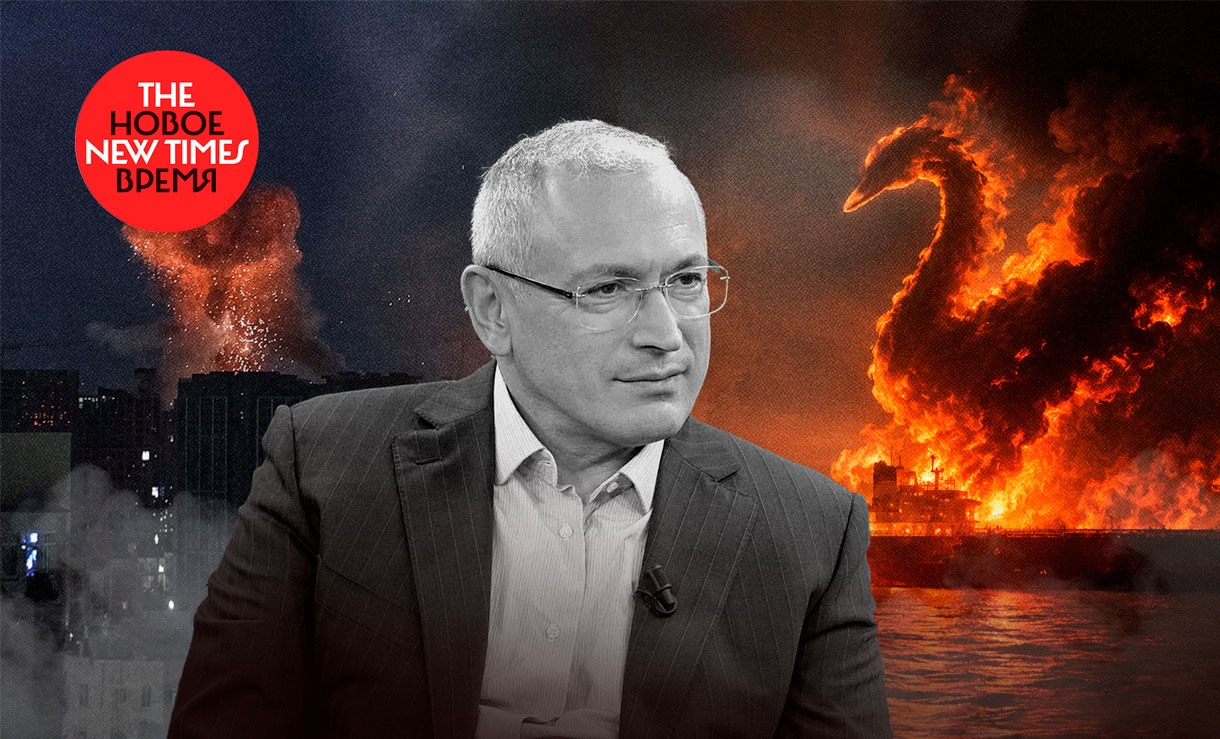
Mikhail Khodorkovsky
Yevgenia Albats*: Mikhail Borisovich, I spoke with one of my good acquaintances, who had been running a business in Russia for many years and was very successful. And I asked him: «Do you think the black swan has arrived?» And he said: «I think it's still just a sparrow». I meant that Russia is now forced to buy gasoline and bring it all the way from India, where Russia supplies oil. From your perspective as an oilman, former head of Yukos, what is happening at the gas stations?
Crisis, but Not Systemic
Mikhail Khodorkovsky: I always hate to disappoint people who, like me, are waiting for this regime to finally end. But seriously speaking, the only time I thought the Putin regime was under real threat was the end of twenty-two — beginning of twenty-three, when Russia had real failures on the front, associated with Putin starting a war he was absolutely unprepared for. Because he believed his associates, who convinced him that there would be no systemic armed resistance, but rather civil confrontation, and he sent people there with shields and batons. At that moment, there was a very serious crisis, which eventually resulted in the Prigozhin mutiny, an even more serious crisis. And I must say that we — those who oppose Putin inside Russia, those who oppose Putin outside, liberals, and Z-niks, who at that moment were also generally against him, and Western countries — missed this moment. For a number of reasons, but the basic one, unfortunately, is that we were not the determining factor in this situation. The main thing was the fear of Western countries of the fall of the Putin regime. We remember that it was said then that Putin should not lose, and Ukraine should not win. They were afraid of nuclear weapons, afraid of the collapse of Russia as a result of the regime's fall.
And now I agree with your unnamed interlocutor's definition: it's still a «sparrow». What Ukraine did — it dealt a fairly significant blow to Russian oil refining. Losses amounted to up to 25% in gasoline. And given that the usual overproduction of gasoline, specifically motor fuel in Russia, was 10–15 percent, the shortage is now also around 10–15 percent. In specific numbers, this is about 1 million tons. Real problems now are in the private transport sector and minor problems in the public transport sector. And in part of air transportation. This is not a systemic crisis. A systemic crisis is when freight transport comes to a complete halt. But since most transport runs on diesel, and diesel was produced significantly more than consumed, they somehow manage to manage it for now.
We see that in some regions the crisis is purely man-made. The necessary work has not been done because Putin lacks management personnel of sufficient quality
What caused problems in this segment of the transport market? You see, when they start hitting your enterprises and you don't know where they will hit next, logistics, transportation, reserve manipulation, procurement, and so on become significant. From this point of view, procurement in India is a fairly reasonable step: you send oil there, and bring gasoline back. India produces significantly more gasoline than it consumes. So why not buy it. Does this solve the problem? Not entirely, but there are still a number of steps that could help solve this problem. But for this, the system must work efficiently. There are two serious methods for manipulation. The first is what liberal economists talk about: let the prices go. You will have a dozen regions where gasoline prices will soar fivefold, consumption will drop there, you will somehow dampen it with budgetary funds, and the market will do the rest. Maybe not so quickly, but within two to three months the market will figure it out. But Putin cannot afford this, because prices soaring fivefold, for example, in the Moscow region or in the Volga region — it is very noticeable and very unpleasant.
So there is a second method — administrative redistribution. This means additional limits on rail deliveries, lowering the requirements for gasoline quality, somewhere releasing from state reserves. And so on. With the administrative method, companies must work very effectively together with the state apparatus.
But they never worked like that, they just don't know how. That's the result. We see that in some regions the crisis is purely man-made. The necessary work has not been done because Putin lacks management personnel of sufficient quality.
Yevgenia Albats: So in principle, even a 25% loss in oil refining is not serious enough to cause such a deficit?
Mikhail Khodorkovsky: Well, look, a huge amount of straight-run gasoline is produced. This is the seventy-sixth, which is used for the chemical industry. It's certainly lousy, but there are technologies by which the octane number is raised to 90, even to 92. Of course, not all cars will be suitable for this. Catalysts will fail, there will be other unpleasantness. But you can cut out a segment of consumers to whom this gasoline from the state reserve is specially supplied. Say that at these gas stations this gasoline for such types of cars is available.
Yevgenia Albats: Do you mean the strategic reserve?
Mikhail Khodorkovsky: Yes, which is stored at the bases of the State Reserve or at the bases of companies in separate tanks. At least at the time when I worked, we kept half a month's production at these storage bases. That is, really half a million to a million tons in the country are scattered in different places. With such losses, this gives the opportunity to hold out for a month if you distribute it normally. In general, it's not that difficult. During this time, purchases must be made. There is India, there is Iran not yet bombed, there are Saudis, even Japan. There are many countries where this unfortunate million tons a month can be gathered.
For the global oil refining industry, a million tons of gasoline a month is certainly a strain, but not too much. Added 20%, well 30% to the price and got it for yourself. Yes, it's extra money, but that's not the main thing. Then the real problem begins. Ports are under attack, it's far and long to bring from the Far East. Railways work poorly, usual redistribution works poorly. Even the gasoline that is available is not in the regions where it needs to be consumed. There is really a lot of work, and highly professional work with risks. But a professional, competent government should cope with this challenge.
Yevgenia Albats: How many days would it take you to solve this problem?
Mikhail Khodorkovsky: A month.
Yevgenia Albats: The Russian press, state propaganda say that the problem will be solved within a few days.
Mikhail Khodorkovsky: Well, they are lying, of course. But they have already lost a month, more than a month. If they solve the problem in July, it means twice as long as they should have.
The Tomahawk Factor
Yevgenia Albats: So you don't see this gasoline shortage crisis dragging on?
Mikhail Khodorkovsky: Well, listen, I'm still not such a good military specialist to say how much the Ukrainians are now improving their weapons. If they are given «Tomahawks» or something similar, the situation will change radically. 2,000 «Tomahawks», and goodbye to the oil industry in the entire European part. Solving this situation will not be so easy. Diesel will already fly, and diesel is the harvest company. That's the first thing. Second, I don't fully understand how much the Putin managerial class has already disintegrated today. I knew who Alekperov was and how he could work. I knew Chernomyrdin when he was prime minister, and how he could work. And these specialists with arithmometers I don't know.
Yevgenia Albats: Well, and your sworn friend Sechin...
Mikhail Khodorkovsky: Probably, he is not dealing with this now, but it doesn't matter. The problem with Sechin is that he is a sybarite, he likes a good life. It would be great if he didn't kill people in the process. And since he is involved in this, it's not good. But how capable he is today to shake himself up and become the Sechin he was at the beginning of the journey, and how much he has gained qualifications during the time he has been involved in the oil industry, I don't know. I think not at all. I think he is now just an old, bloated Sechin, who still only knows how to yell at people, yell at specialists who eventually scatter, and doesn't know how to work. So I think that <Chairman of the Federation Council Valentina> Matviyenko was right when she said that this is not a gasoline crisis, it's a managerial one. It's a crisis of an aging, inefficient administrative machine.
Yevgenia Albats: In general, you don't think this crisis could become a «black swan» that could push the nomenclature around Putin to say: «You know, enough is enough, we're tired». Because, as many have written about, the cardinal solution to the problem is only to end the war. There seems to be no other.
People want this war to end, but they don't want it to end with Russia's defeat, because they understand that the loser cries. And pays. Therefore, they want it to end «on our terms»
Mikhail Khodorkovsky: There is a certain problem here, which, unfortunately, is poorly understood in the West, and I am trying to explain it. Ukraine has two paths. Either they fight and hold on, or they fight and capitulate. Two options. Putin has three options. He fights, loses. He fights, wins in the current state. And he turns the war into a «people's» one. We must realize that today's dissatisfaction of the Russian society with the fact that there is a war is not dissatisfaction with the fact that we are killing neighbors. The first six months or so people were in shock that we are killing our neighbors, killing our brothers and relatives in the literal sense. And then a person, such a beast, gets used to everything. They got used to it, and then they forgot who started the war. Now people honestly don't remember who started the war. Four years is a long time, and propaganda has worked. So, people want this war to end, but they don't want it to end with Russia's defeat, because they understand that the loser cries. And pays. Therefore, they want it to end «on our terms». What «our terms» are, no one knows. It's clear that territorial acquisitions don't concern anyone. Well, it should end so that we are not the losers. Because if we are the losers, there will be reparations, tribunals. And everyone, all 140 million people, will go to the tribunal, the Kremlin told everyone. People have these kinds of fears. And therefore, Putin has three options for action. And he really doesn't want to switch to the people's war option, because from a political point of view, it's a huge problem for him. Future. He will win the war, but it will end for him with kerosene.
All as One
Yevgenia Albats: What do you mean by people's war?
Mikhail Khodorkovsky: Well, when propaganda comes out and says that this is actually an existential war that the West is waging against Russia. And if we are almost defeated now, it's because we didn't know how to fight, were not ready. «They» decided to completely destroy us. I don't know, some African tribes are coming from the south, someone else is coming from the north, and these from the west. And they practically defeated us, so everyone who can hold a weapon, and so on... This works. At the beginning of the Great Patriotic War, it worked. Nothing has changed in this regard.
Yevgenia Albats: Well, back then it was clear what our parents were going to the recruitment points for. Because they understood, my dad understood, that he had to protect mom...
Mikhail Khodorkovsky: How did he know he had to protect mom? How did he know, excuse me for such an unpleasant question, that the Germans were not a cultured nation that would come to Moscow, change the mayor to a decent one, and say: «All right, let's all build together».
Yevgenia Albats: You ask an incredibly precise question. You know, I was in Toropets, where my grandmother is from. There was a large, very large Jewish ghetto. A couple of surviving Jews remained, I found them, we walked through the Jewish cemetery, completely neglected, and I asked them. Why didn't people leave here when the war started? They say: because there were Germans in Toropets during the First World War, and there were no problems, they did not single out Jews as someone to be destroyed. They behaved quite decently, as far as possible in wartime conditions.
Mikhail Khodorkovsky: Well, of course, your parents and mine, grandparents, were told this by Soviet propaganda. And as we now know from the results, they told the truth in principle, because, unfortunately, there was no need to invent anything. What Hitler did, there was no need to invent additionally. And these, the current ones, will easily invent. And tell it exactly the same way, and 80 percent of the population will believe it.
Yevgenia Albats: Do you think everyone will rush to the military enlistment offices: «the fatherland is in danger»? They can't even recruit people for money now. Why are they paying 3.5 million for signing a contract?
Mikhail Khodorkovsky: Because we don't have a war now. We have an expeditionary corps fighting. Putin does not dare to say that we have a war. Because to say that we have a war, he has to say: «I, Putin, messed up». That's what he has to say, and he's not ready.
Yevgenia Albats: Mikhail Borisovich, the most rabid Z-niks, such as Karaganov, like «Tsargrad», like Okhlobystin, like Solovyov, are already talking about mistakes made during the war. And Okhlobystin shouts that «Moscow is behind us», we can't give it up.
Mikhail Khodorkovsky: Well, that's Okhlobystin shouting. Has Putin ever said it? No, he hasn't made any mistakes.
Yevgenia Albats: German Gref, whom we both know well, said (and everyone quotes him): «I don't believe there is anyone in this country whose main concern is anything other than the quickest possible cessation of hostilities». According to the banker, the full-scale war, continuing since February twenty-second, has led to a sharp rise in interest rates, a fuel shortage, and a worsening economic situation. And he emphasized that the Russian economy will not be able to function long under extremely high rates. This is a hit on the Central Bank and Nabiullina, for sure. We understand that Gref is aiming for the Central Bank, but nevertheless, he named among the negative consequences the fall in wages, job cuts, and problems in the fuel market. So this is quite publicly stated by the head of the largest state bank.
Mikhail Khodorkovsky: Putin says the same thing: our task is to end this war as soon as possible with our victory. Just adds a couple of words — «with our victory». Our task, so to speak, is to minimize the harmful consequences for the Russian economy from the actions of these evil Ukrainians, who for some reason are bombing our oil refineries. Well, they just went crazy, apparently. What did we do to them that they are bombing these oil refineries?
Who Needs Donbass?
Yevgenia Albats: Today, again, 12 people died in Ukraine.
Mikhail Khodorkovsky: We are very philosophically discussing: yes, like when civilians die, it's bad, and when military — well, they are fighting there, right? How many of them die every day?
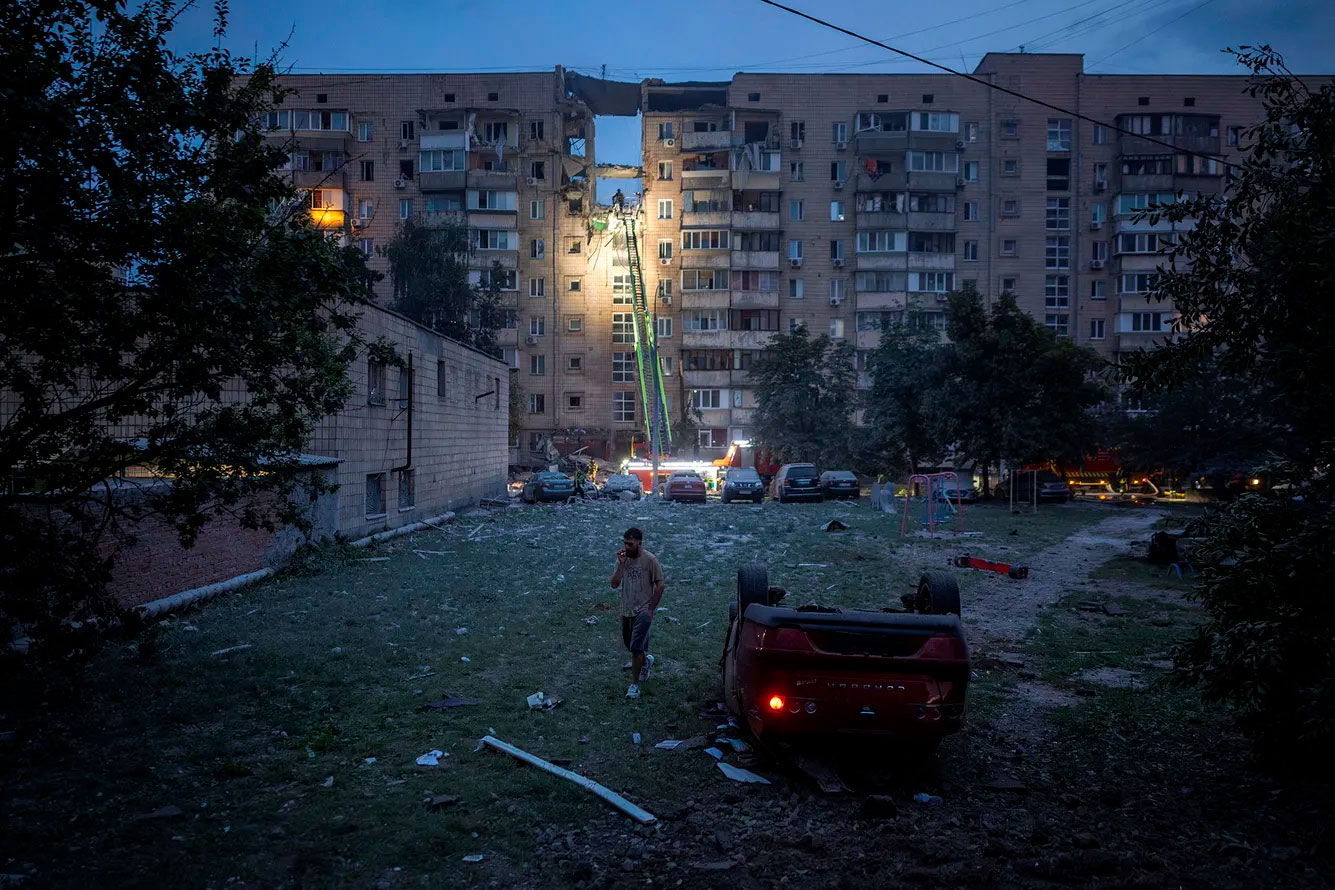
Kyiv after the shelling on the night of July 6. Photo: Thomas Peter / Reuters / Scanpix / LETA
Yevgenia Albats: Absolutely. And the figures given by Western intelligence, that already on both sides almost 2 million dead and irretrievably lost, that is, with severe injuries, this is, of course, some kind of nightmare horror. Not to mention that the war has been going on longer than the Great Patriotic War.
Now people don't ask the question «why», because it seems like we are not fighting, someone is making money in such a stupid way. And if a people's war is declared, then questions will arise
Mikhail Khodorkovsky: And now imagine: Putin declared this war a people's war, and here it ends, this war.
Yevgenia Albats: He can't afford any grassroots mobilization.
Mikhail Khodorkovsky: I agree. Because now people say: well, okay, the expeditionary corps is fighting, they are making money. And if it's a people's war? And we all have to do something? Then the question is asked: «For what?» For what? They captured Donbass. Who needs this Donbass? There are no factories, the mines are not needed by anyone, the cities are destroyed, the people have scattered, the land is all mined. For what? We have the Oryol region, the Belgorod region, the Kursk region. I'm not even talking about the lands beyond Moscow. No roads, no normal utilities, no normal hospitals. For what? Now people don't ask these questions, because it seems like we are not fighting, someone is making money in such a stupid way. And if a people's war is declared, then questions will arise.
Yevgenia Albats: I have a slightly different scenario in my head. I drove, was behind the wheel for two weeks, and listened to a very detailed biography of Mao Zedong. I was especially interested in how he dared to raise the youth to destroy even the beginnings of conspiracies against him among the party nomenclature. The whole story with the Red Guards, when he gave young guys the opportunity to kill, smash, humiliate all those who were bosses yesterday, take their houses and property, etc. I don't think Putin will declare any people's war, he will be afraid. But what he might do is raise the returning criminals, the so-called heroes of the SVO, whom we now see in the electoral lists of various parties, against officials and bureaucrats who, from Moscow, make decisions and prevent the tsar from being kind and loving his own people. He might well do that.
Mikhail Khodorkovsky: No, it's impossible. Firstly, what advantage did Mao Zedong have, why could he use them? Because in China of those years, there was a huge amount of youth. I can't say the exact figure, but I think about 30% of the population. These are people who felt they had no future, and they had to gnaw this future from the older generation, and they gnawed it. But there were very many of them. And those who went through the SVO are really 1.5% of the population.
Moreover, I would like to point out that most of those who are now being thrown for election somewhere are not real participants of the SVO, but various kinds of business travelers who went there to get a record in their personal file. They just came to the front from time to time, put these marks on themselves. But in fact, there is not much declassed element that nevertheless fights. I think about 20%.
Yevgenia Albats: What difference does it make to him? Declassed are former criminals.
Mikhail Khodorkovsky: They can't do anything. Tell him: «Go kill the minister who sits on the third floor», — he won't be able to count the floors. Therefore, it's very hard to use them. He will go better to the neighboring store and kill there, there is a bottle of vodka, and the minister is something big and far away. I don't think this is a real danger.
The real danger is in the case of mobilization, even partial, because then people with ambitions will go there, who are forced to break away from business against their will and who understand that they are owed. Either they were convinced by propaganda that they are defending their home, then they are owed for defending their home. Or they are owed simply because they were sent to solve a problem that Putin and his minions messed up, right? And they went and solved this problem. And they are owed, but owed by everyone. There is no such Mao Zedong, you understand? Our average age of the population is not like in China at that time: they are 24 years old, we are over 40. Quite adult people, quite understanding. While there are 200,000 sane ones of those who return, something can be done with them: spread them out to distant garrisons, continue to pay crazy money just so they don't pop out. But if there are a million, two, three of them, I mean sane, real ones who understand, — this is a problem. And Putin is exactly afraid of this.
Criminal Infantry
Yevgenia Albats: I wanted to ask you as a former prisoner: you were part of the prison population of Russia for 10 years. Why did they rush to the front so much, what drives them? Money is understandable. But they can't help but know that they are being sent to «meat» assaults.
Mikhail Khodorkovsky: I really spent a lot of time with these people side by side, and not only in the colony. Among the shift workers, up to 70 percent had served time. That is, I worked with these people all my life. You can't say they are all bad. They have their own concepts. And where the real problem is — they have a very short planning horizon.
When you talk to a person in prison, with an ordinary one. Well, you robbed someone, took away a phone, a small town, 30,000 residents. Didn't you understand that the police would come to you in a day? No, I didn't think about it. Really didn't think about it. That's what they are like. They have a one-day planning horizon. So when recruiters come, the story is simple: either the operations department will beat you today, just beat you, or you sign this paper. Signed, the day is over. The next day, when you signed the paper, either the operations department will beat you, or you get on the train. I get on the train. Then you ended up either in training or immediately on the front. Either you take a gun and shoot in that direction or run somewhere, or you will be beaten or killed here. Well, I run in that direction...
This is the problem. There in the colonies, more than half are people with a very short planning horizon. This is their main difference. These are the ones who become criminal infantry. This is exactly what different bastards use. Now Putin is doing what different criminal authorities did before. Those people are more advanced, advanced enough to use this criminal infantry. And now Putin is using them for his needs.
Yevgenia Albats: You probably read about the wild concepts that exist on the front. What tortures are there, how people are tormented, how they are forced to give money to officers for everything, how they put each other in pits, rape, etc. Some kind of culture of savagery and absolute barbarism. Don't you associate this with the fact that there is a lot of prison stuff there?
Mikhail Khodorkovsky: It is there, but it's still not the overwhelming part. The problem is that they have gathered a declassed element from all over the country. That's the whole point. You can either work with these people, adapting them, as they do in Switzerland, where they help such people exist taking into account the problems they have in mentality. Or, as we do, they are let down this path, instilling a criminal culture in them. In prison, this is done quite easily. In prison, a person values life low. In prison, I valued my life in pennies because when you have hopelessness behind and ahead, well, what is it worth?
Europe Has Changed
Yevgenia Albats: Mikhail Borisovich, the third part of the questions to you is as a person who is now part of the Russian platform at the European Parliament, and as a European politician, if you like. Tusk, the Prime Minister of Poland, stated that we need to prepare for different scenarios. I don't want to scare anyone, he said, but the coming months may be critical, especially for the Baltic countries, as the war in Ukraine is changing. We shouldn't be scared, but we can't ignore it. He means that Putin might start aggression against the Baltic countries and against Poland. NATO Secretary General Rutte stated that military spending in Europe has been brought to 4% of GDP on average. As we remember, when the war had been going on for three years, spending was still 2%. The only ones who understood the real threat were the Poles, who began to truly invest in defense. Tusk's statement indicates that Europeans are genuinely worried, and there are probably intelligence data on this. In the British Parliament, it was also said that defense spending needs to be increased. In other words, there is concern that Putin, to divert attention from internal problems and the fact that the war is moving to Russian territory, might start new aggression. And thus the statement that the war is not with Ukraine, but with the entire West, becomes a reality. And your hypothesis that he declares the war «people's» or, in any case, declares mobilization, also begins to work. What do you say?
He believes he can scare Europeans by creating pressure so that Europeans change their elites to those who would be against the war and, accordingly, abandon Ukraine
Mikhail Khodorkovsky: Putin has made a number of steps that are moving the situation in this direction. Maybe he thinks he's playing, but it causes the reaction we see and hear. And ultimately, it can become a self-fulfilling prophecy. They passed a law allowing him to use troops abroad to protect Russian citizens. A decision was made on the accelerated granting of Russian citizenship to people living in Transnistria. A similar situation with Estonia's Narva. The Security Council discussed the possibilities of Kaliningrad existing in isolation from Russia. He's making hints to Europeans. What does he want to achieve with this? In my opinion, the situation for him has become radically different from what it was at the beginning of the year. Then he thought he could negotiate with Trump and solve the Ukraine problem in his favor. And the Europeans could stand aside. However, Trump is out of the game, and it turned out that Europeans, firstly, have enough opportunities to continue helping Ukraine, and secondly, they are capable of bringing Trump back to the negotiating table on their side. That is, they had enough tools for this. And thus his targeting frame shifted towards Europe. This is quite serious. He believes he can scare Europeans by creating pressure so that Europeans change their elites to those who would be against the war and, accordingly, abandon Ukraine. That's his thought. And a number of ideas are being played from this.
I don't believe in a full-scale invasion because there are no forces for this. Well, imagine that in the same Estonia there are about 70,000 people ready to fight. To break through a seventy-thousand-strong group, not counting the support of the Baltic countries and NATO support, you need to have a two-hundred-thousand-strong group. He is struggling to gather 300,000 a year for the group in Ukraine. And here you need to gather another 200,000. He will face a well-drilled military machine, the Baltic countries have been learning in NATO for 30 years how to fight. Yes, there are few of them, they do not have sufficient amounts of conventional weapons. Yes, they do not have nuclear weapons, but these are people who are quite effective at fighting. And they have working intelligence, and targeting works, and air support works. In general, from this point of view, there will be no toys. From Russia's side, there will be a blunt, brutal breaking of the situation or, more likely, provocations. Provocations, the assassination of individual political figures, pressure like entering Narva or something like that.
Yevgenia Albats: Provocations for what purpose?
Mikhail Khodorkovsky: To pressure European public opinion. This is a traditional method, this is what is defined as terror, as terrorist methods of warfare, when forceful impact is used to pressure public opinion so that people pressure politicians and issues are resolved in the interests of terrorists. In fact, terror is now the only way Putin can fight. Winter bombings of energy facilities in Kyiv are a typical terrorist method of warfare. He wants to arrange the same in Europe, albeit on a different level. There is one small nuance. I am afraid he misunderstands Europeans. He reads them incorrectly. By the way, Trump also reads them incorrectly. Two years ago, tell Europeans that they need to spend 2% of GDP on defense. «What? How can it be?» Now 4% — and it's fine. Tomorrow it will be 5%. And the number of people ready to bristle is not small. Of course, conducting mobilization in Europe is not an easy story, but we do not forget that there are 450 million of them. 450 million. If only 2% of them, and this is very likely, agree to become reservists or participants in military formations in one form or another — this is 9 million.
Yevgenia Albats: Putin takes this into account, and this should stop him?
Mikhail Khodorkovsky: No, he doesn't understand this. He believes they will be scared. And they won't be scared. That is, they will be scared at first. And then they will become furious. And we see — in Europe, there is a gradual replacement of politicians with others, ready to take responsibility. By the way, I am very surprised that people think that right-wing politicians are those who will be peaceful both towards Russia and towards America. Well, look at Italy, at Giorgia Meloni. Please, a right-wing politician. And who will say she is weak?
Yevgenia Albats: Of course, she is a woman, she is strong. She became the prime minister in a country where a woman was once held only as a model. Of course, she is strong.
Mikhail Khodorkovsky: Trump got caught in one second.
Yevgenia Albats: Aren't you afraid that Germany has started to arm itself?
Mikhail Khodorkovsky: This scares everyone in Europe. Everyone knows that waking up the Germans can create a long-term problem. Germans have been convinced for many years that living without war is much better. And the Germans received dividends from peaceful life. Waking up the Germans is generally a double-edged story. Putin can create long-term troubles for Europe, but we must understand that this will end badly for Russia.
Yevgenia Albats: Still, there are some experts around Putin who tell him that getting into Europe is impossible. Or do you think he might be cornered and decide that there is nothing to lose? And, for example, use tactical nuclear weapons.
Mikhail Khodorkovsky: He will not use tactical nuclear weapons for one simple reason. Putin is not an insanely brave person. That is, he is not a coward, but he is not insanely brave. Not the person who puts his life on the line. And it is clear that any use of nuclear weapons draws a target on his forehead. After that, it's a matter of time before they first kill those close to him, and then him. He understands this perfectly, and he is definitely not going to step over this step. I don't think he is ready for this. But regarding conventional war, yes, he can be mistaken, he can think that he will scare Europe, although my opinion is that four and a half years of war have changed not only Russia, they have changed Europe too. Poland has bristled, the northern countries have bristled. It's not only the Baltic countries, it's Finland, Norway, Sweden, and Denmark, it's the UK that has joined them. Even without Germany and France, it's already 140 million people.
Yevgenia Albats: But a full-scale war in Europe will spare no one. Twice Europe has gone through this, and it ended very badly for all of Europe.
Mikhail Khodorkovsky: I don't think there will be a large-scale war. I think there will be unpleasant special operations, a significant number of people will die. It will be unpleasant for everyone. I recently studied how the war of intelligence services ended in the fifties when the Soviet Union killed about a hundred Western agents. The names of these agents are known. It is believed that the West killed approximately the same number of Soviet agents. Their names have not been disclosed to this day, but it is believed that there were no fewer of them. And after they realized that it was impossible to find professionals for work in intelligence because people do not want to be killed, everything gradually ended.
How to Defeat a Dictatorship
Yevgenia Albats: Mikhail Borisovich, it is quite obvious that there is fermentation in Putin's entourage. We saw how disdainfully Putin spoke about Abramovich, who brought him an unpleasant letter from Zelensky. We know that Abramovich is to some extent, if you like, the leader of this fronting nomenclature Moscow, which simply does not know what else to come up with so that all this finally ends and they can live again as they used to: make money in Moscow, spend it in the West. Can we expect them to say: «Finally enough»?
In the 21st century, no number of unarmed people can stand against even a very small number of people with weapons. Since the last century, this has been the situation when machine guns were invented. Unfortunately, these are the realities of modern weapons. Everything is determined not by morality, but by how many people can be killed with one barrel
Mikhail Khodorkovsky: You always treat them a little romantically. When the war began, these people, who have excellent strategic thinking (otherwise they simply do not get there or do not stay there), were shocked. The entire nomenclature was shocked, they understood that this would not end well for them.
And now, four and a half years later, 15–20, maybe even 30 percent of them are beneficiaries of this war. This is not the first circle, but nevertheless, in the second, third circle, there are enough beneficiaries of the war. The rest still don't like it, but don't consider these people ready for any risky steps. There are no such people there. If you remember who changed the Russian tsars — it was the guard. And Putin feeds the guard.
And here we must understand that in the 21st century, no number of unarmed people can stand against even a very small number of people with weapons. Since the last century, this has been the situation when machine guns were invented. We know the history of European dictatorships. There are four, well-known in the 20th century. Germany, Italy, Spain, Portugal. Nowhere did the dictatorship falter until the death of the dictator, nowhere.
Unfortunately, these are the realities of modern weapons. Everything is determined not by morality, but by how many people can be killed with one barrel.
Yevgenia Albats: Unfortunately, too many. But there is the experience of military dictatorships in Uruguay, in Argentina, in Chile, and the experience of overcoming them. There are several options when the juntas were forced to leave. In Argentina, they lost the war for the Maldives. In Uruguay, they agreed. I asked the first president of the country after the junta in detail, who told how everything happened. And in Chile, there was also an agreement of elites.
Mikhail Khodorkovsky: No, no. I don't know very well how it happened in Argentina and Uruguay, but I think that opposing power structures also appeared there.
And in Chile, the situation was very clear. If it weren't for the position of the Americans, Pinochet wouldn't have gone anywhere.
Yevgenia Albats: I don't want to delve into it, it's a separate big topic. I just want to say that it was different. And with European dictatorships too. It's important to me that you think that no matter how tired the Russian nomenclature is of this war, at least the so-called liberal part of it, it won't do anything. They are impotent, that's clear. But those young Chekists who are around Putin, who are also long-time millionaires, won't they dare to send the grandfather to retirement, as they once did with Khrushchev?
Mikhail Khodorkovsky: Only on one condition. If the army, starting to suffer a military defeat, turns away from him.
Yevgenia Albats: Yes, that's the Argentine option. Absolutely right.
Mikhail Khodorkovsky: That's why I said at the beginning of our conversation that at the end of twenty-two — beginning of twenty-three was the moment when the Putin regime could suffer a real defeat. The regime itself. But alas, a different decision was made, and this decision turned out to be irreversible.
Yevgenia Albats: Nevertheless, I still can't imagine that this can continue for too long. It's too much against the interests of the main beneficiaries of the Putin regime, it seems to me.
Mikhail Khodorkovsky: And I think about what to do. In fact, my work is aimed at what needs to be done so that when Putin leaves, we do not enter a new cycle. Because, unfortunately, if we take all the regimes we talked about, then by and large only the Franco regime coped with its evolution itself, albeit after Franco's death. All the others exclusively under external influence. And it still took a whole generation's life, 20 and more years. In Russia, there will be no such influence. And it is very important that we, without any occupation, which is impossible, manage to return the country to normal tracks after the end of the Putin regime. And normal tracks in my view are, in general, the European path. But the path where Russia balances between Europe, China, and the Muslim south, being a very large, but nevertheless balancing element, because to perform another role, we, alas, in the wars of the 20th, and now the 21st century, lost too much of the population. If there were half a billion of us, we could play another role. And now we can only play the role of balancing between centers of power.
Yevgenia Albats: Let's see who turns out to be right. Frankly, I am absolutely convinced that by the end of this year we will see some shifts in this direction. But let's see.
Mikhail Khodorkovsky: I really, really want to lose in our argument.
Video Version
* Yevgenia Albats, Mikhail Khodorkovsky are declared «foreign agents» in the Russian Federation. Mikhail Khodorkovsky is included in the list of «terrorists and extremists».
Photo: Gleb Garanich / Reuters, Euronews.