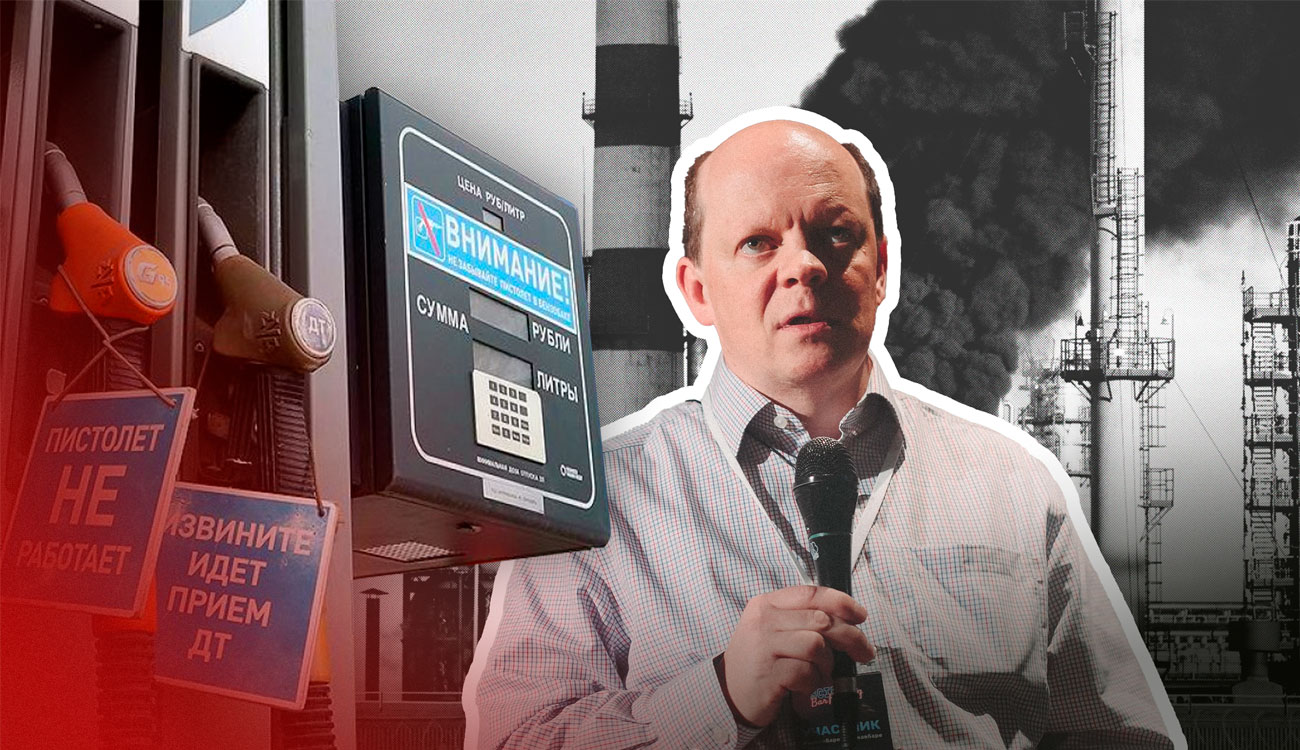
Sergey Vakulenko
Yevgenia Albats: Sergey, I remember a similar gasoline crisis in Moscow at the end of the 1980s, after which the Soviet Union practically collapsed. What is happening?
Sergey Vakulenko: We could start with the Pechenegs, of course, but in general, there is a war going on, and Ukraine has sharply increased the number of drones used. Compared to the beginning of the year, the increase is about one and a half times. And these additional thousands of drones per month are also targeting refineries, putting them out of action more frequently, more massively, and in greater numbers. Russia had a certain reserve of processing capacity. Ukrainian drone attacks are not new; they began at the very start of the twenty-fourth year, but then their numbers were small, and now they are transitioning into quality.
Drones Against Gasoline
Yevgenia Albats: Russia is the third-largest oil-producing country in the world. They can refine oil in Belarus. Why can't they establish this logistics?
Sergey Vakulenko: Well, look, the processing volume in Russia is about 270 million tons per year. The production volume is about 500 million tons per year, processing 270, which is about half. Belarus processes 14–15 million. Accordingly, it also needs something for itself.
Yevgenia Albats: But it also sells, it lives off this, as far as I understand.
Sergey Vakulenko: It sold and lived until the twentieth year, until it found itself under sanctions due to the well-known <forced> landing of a plane in Minsk flying to Vilnius, and could no longer export its oil products. Accordingly, Belarus reduced its processing volumes, but it turns out there aren't that many spare capacities, about half of a large plant. That is, a load of 14–15 million tons per year, a maximum of 20 million they can provide. That's quite little. The Moscow refinery is 12 million tons per year, just the Moscow refinery.
Drone attacks are concentrated in the central part of the country, where the most people live, where the demand and consumption are the highest. And there, accordingly, are problems both in making gasoline and in delivering it there
Yevgenia Albats: How much has oil processing in Russia decreased now compared to pre-war years?
Sergey Vakulenko: By about 25–30%. At the same time, gasoline production has actually decreased less. Some measures have been taken to produce more gasoline from less oil, so gasoline production has not decreased in the same exact percentage proportion, but in order, by the same magnitude. The second point: now drone attacks are concentrated in the central part of the country, this is Kirishi, Ryazan, Moscow, Kstovo, Yaroslavl. Of course, the Middle Volga region is also attacked, and there is the Samara cluster, three plants, and Tatarstan, and Volgograd also gets its share. Accordingly, this is the part of the country where the most people live, where demand and consumption are most concentrated. And there, accordingly, are problems both in making gasoline and in delivering it there. In the Moscow region, it is arranged so that crude oil comes to Moscow via an oil pipeline, gasoline is made from it in Moscow, it goes to an oil depot, which is actually located on the territory of the Moscow refinery, and from there it is distributed by tankers. In principle, there is a large railway station on the territory of the Moscow refinery, designed to export fuel. And the Moscow railway hub is probably capable of handling these cargoes. But the current situation fundamentally changes how gasoline was distributed across the country.
Yevgenia Albats: Has the Moscow refinery completely stopped working?
Sergey Vakulenko: The Moscow refinery is not working now. There was news that it is stopped until the end of twenty-sixth year. To be honest, this is surprising to me because other plants that were attacked by drones usually came out of repairs in 2–3 weeks, even after repeated strikes. Why Moscow should take so long to repair is not entirely clear to me. But the source of information is not very reliable, apparently, we need to wait until the fog of war clears.
Yevgenia Albats: You wrote that the configuration at the Moscow refinery was changed, explain what that means.
Sergey Vakulenko: Imagine an old-school computer, with a separate box under the table, a separate monitor somewhere on the table, a separate keyboard. And compare it with a modern compact laptop, where everything is in one small device. It was the same with the Moscow refinery—many separate installations that performed various chemical and physical manipulations with oil to turn it into gasoline. In the end, they built one combined installation, which has different nodes. Different blocks processing oil raw materials and oil semi-products are very close to each other within one combined installation. Accordingly, when a drone hits such a thing, the damage from it is spread across several nodes of the refinery. This is not always the case; certain measures are still taken to contain a fire, explosion, or accident within a node so that other parts do not suffer, to minimize damage in case of an accident. But no matter how you twist it, if one installation is 100 m away from another, that's one story, and if it's 10, it's another. And therefore, the Moscow refinery may find it more difficult to repair than others. But still, there has never been a case where a plant went into repair for seven months.
Cutting off Crimea
Yevgenia Albats: Well, that's Moscow, the central region has the most population and a very high demand for gasoline. But why is there such a problem in Irkutsk, where a special situation has been introduced and people can't refuel at all? Or in Crimea?
Sergey Vakulenko: Very different reasons. With Crimea, it's clear, there is no local production of oil products in Crimea, everything is imported. And the supply routes to Crimea are actively being cut by the Ukrainian armed forces. That is, it's a frontline and semi-siege situation.
Yevgenia Albats: How was gasoline previously delivered to occupied Crimea?
Sergey Vakulenko: There were terminals in Feodosia and Kerch capable of receiving bulk cargoes. They were delivered by small tankers. Then the Kerch Bridge was built, and trains with fuel went over the bridge. What happened then? There was sabotage, an explosion of a truck in which a bomb was disguised, a train was passing at the same time, and after the explosion, the tanks caught fire. After that, transporting fuel by rail was banned. On the other hand, the classic Kursk direction railway through Melitopol and Dzhankoy ended up in Russia's possession. They transported along this railway and continued to transport by sea. And what is happening now? The corridor along the northern coast of the Sea of Azov is completely within firing range. It's impossible to transport. The ship's sea capacities are largely damaged. Only ferries or some trucks passing over the bridge remain, which is also not encouraged, there is a rather strong weight restriction. Accordingly, due to prolonged Ukrainian attacks, Crimea's ability to receive any cargoes has significantly decreased. And Ukraine is systematically working to reduce Russia's ability to supply Crimea.
Yevgenia Albats: Why are there empty shelves in stores in Crimea? People write on the internet that there is no bread, they can't deliver it.
Sergey Vakulenko: I'm not much of a specialist in how grocery logistics is organized. I can only guess, but I assume that the crisis there is already systemic. Firstly, not many products are imported from the mainland. Ideally, Crimea is a breadbasket, but with the cessation of water supply through the North Crimean Canal even before the war, everything became bad, and after the explosion of Kakhovka, there was no water at all. Therefore, there are problems. I'm not sure that a lot of wheat was grown in Crimea. Most likely, it was brought from the Krasnodar Territory. If so, then there may simply not be much flour there. There are now problems with the supply of any goods to Crimea. But this is not only because there are problems with fuel, but because the roads leading there are within firing range.
China is Far
Yevgenia Albats: What happened to Trans-Ural? I mean Irkutsk, the Baikal region.
Sergey Vakulenko: There is a huge, very large Angarsk Petrochemical Complex located in the city of Angarsk, 40 minutes from Irkutsk, which should, in theory, supply Eastern Siberia. But what is happening? "Rosneft," apparently, is trying to compensate for what it cannot produce at its Samara group of plants with supplies from Siberia. That is, it is trying to supply the European part by taking at least part of the resource from the Siberian region. This is a hypothesis, I cannot know for sure, but it is the most reasonable explanation.
Yevgenia Albats: It seems to me that this is still strange, since there is a lot of very heavy military-industrial production concentrated beyond the Ural Mountains. There were nuclear plants and installations in the mountains, etc. And it should be assumed that there should be a large number of strategic fuel reserves concentrated there. I can't quite understand why there are such cries from Irkutsk and Tyumen. Tyumen is generally the capital of the oil region.
Gasoline is a very inelastic commodity. Its consumption does not decrease significantly. Even a ten percent shortage of gasoline becomes very noticeable to consumers
Sergey Vakulenko: There was also a refinery in Tyumen that was hit. Moreover, the refinery there is recent, fresh. Tyumen was rather supplied from Omsk. But again, if you pull a large amount of resource to the European part, the Asian part of the country gets less. In the country, there is a shortage of gasoline against the usual level of consumption by 10–15%.
Yevgenia Albats: Only that much?
Sergey Vakulenko: Yes, but it's very noticeable because gasoline is a very inelastic commodity. Its consumption does not decrease significantly. Even a ten percent shortage of gasoline becomes very noticeable to consumers. Accordingly, if this resource goes to Europe, then the Asian regions get less. And there is also a crisis, a situation where you have to stand in line, pay more. But if you look at the aggregate demand, even such slightly extreme measures, as it turns out, do not reduce demand very much.
Yevgenia Albats: You said that large supplies went from Omsk beyond the Ural Mountains. Omsk borders Kazakhstan. In Kazakhstan, as I remember, there is a lot of oil and probably refineries. Why can't gasoline and diesel be purchased in Kazakhstan to supply the Asian part of Russia and bring it from there to Moscow?
Sergey Vakulenko: Because Kazakhstan, where oil production is 100 million tons, about a fifth of Russia's, produces about 15–17 million tons of oil products and consumes about the same amount. Moreover, the Omsk plant also supplied oil products to Kyrgyzstan, Tajikistan, and Mongolia.
Yevgenia Albats: The Russian Minister of Energy at one of the latest meetings with Putin said that oil products were purchased in Kazakhstan. Is that not the case?
Sergey Vakulenko: They were purchased, but not in volumes that play any noticeable role. There was some exchange: Kazakhstan received aviation fuel, kerosene, and sold gasoline to Russia, but these are not radical volumes at all. They can slightly ease the situation but not solve the problem.
Yevgenia Albats: So neighbors can't sell gasoline to Russia to solve the gasoline crisis in Russia?
Sergey Vakulenko: They can't. Well, China can, but it's very far, supplying Russia with gasoline from China is not easy.
Yevgenia Albats: Gasoline and fuel, in general, are at the core of many supply chains. Do I understand correctly that this will also affect air transportation?
Sergey Vakulenko: Overall, it will affect, yes. But this is the least of all the problems Russia will face now.
Yevgenia Albats: What is the biggest problem?
Sergey Vakulenko: The primary, most important problem is private individuals. Because the private gasoline car fleet is the most affected market. The fact is that for aviation kerosene, the production surplus over consumption was 30%. For diesel, about 45%, and for gasoline 10%. That is, the gasoline safety margin is minimal. Gasoline is the fuel for passenger cars and small delivery trucks. Large equipment, agricultural machinery, buses, trucks—all diesel. Kerosene, in principle, has a large reserve, but the first supply line for Moscow's airport hub was pipelines from the Moscow refinery. The second supply line was pipelines from nearby plants: Ryazan, Yaroslavl, Kstovo, all affected. The third line, already completely spare, is railway overpasses. To keep Moscow flying, this fuel needs to be brought from afar by rail. In the same Omsk, there may be plenty of aviation kerosene, but at Vnukovo and Domodedovo, it will be worse.
Yevgenia Albats: So there will be a reduction in air transportation, which means an inevitable reduction in the volume of goods coming to Russia both through gray imports and legally.
Sergey Vakulenko: Not quite. Goods mainly come by sea, the main cargo turnover is sea containers. Again, if you are transporting something to Russia, then theoretically you can refuel there so that you have enough for the return journey as well.
Yevgenia Albats: So you don't assume that this could lead to a reduction in goods in stores?
Sergey Vakulenko: Well, it depends on which ones. There will rather be a logistical problem, but not immediately, because distribution is mainly still on diesel equipment. And diesel is the least affected share in this situation because there are large reserves.
Yevgenia Albats: Because there is a large surplus of production over demand and, accordingly, reserves?
Sergey Vakulenko: The reserves are not that large. There are no significant reserves of motor fuel in Russia. Well, there are for three to four weeks. There is also Rosrezerv, but that's a separate story, these are strategic reserves, whether they will be put into action is a completely separate question because there are reserves for the army and for civilian forces. There are commercial reserves of companies, refineries, etc. And just in the spring, they were supposedly accumulating for the summer peak. Although the attacks began in mid-April, the crisis was almost invisible, partly because, apparently, fuel was being taken from reserves.
Yevgenia Albats: You answered my question about why the crisis is happening now, even though refineries have been bombed for two years.
Sergey Vakulenko: They were bombed not with the same frequency, not with the same power, not with the same coverage. The number and severity of the damages inflicted on Russian oil refining now are noticeably higher than a year ago. A year ago, they managed to repair at about the same speed as the damage was inflicted. Now the balance seems to be on the side of the drones.
Protection from "Nuclear"
Yevgenia Albats: Russian intelligence probably reported that a number of international companies, American, Israeli, European, began to truly help Ukraine, including in the production of drones capable of reaching Moscow. How could it happen that the Russian Federation, which has been at war for five years, did not foresee the protection of its refineries from strikes by the Ukrainian army? I understand that you are not a defense specialist, but you worked in a large oil corporation. Surely, every corporation has plans in case of war. In the Soviet Union, there were plans in case of nuclear war, and many plants may still be operating because they were built for such a case. Why was the Russian Federation unable to build protection for its gasoline sources?
Sergey Vakulenko: It's pointless to build a plant in case of nuclear war because if a nuclear war really happens, firstly, these plants will be useless, and secondly, you can't protect yourself from such large bricks falling on your head with anything.
Yevgenia Albats: We see that Iran builds military production in the mountains.
Sergey Vakulenko: In case of nuclear war, the only thing they do there is silo-based missiles and missiles on nuclear submarines in solitary navigation, which guarantee a retaliatory strike. And there is the concept of Mutually assured destruction (MAD), that is, no one is going to win a nuclear war. The standard concept of nuclear war is that if a nuclear war starts, we will all die in it. That's it. What there was protection from was ordinary classic aerial bombardments in the style of World War II. So that in the event that bombers drop five-hundred-kilogram or ton bombs, the production capacities are spaced out so that one block suffers from a bomb fall and the fire on this production block does not affect neighboring tablets. More or less, that's how it was built. But planning production in case of war—no, there was no such business planning. No one was laying down for this. What state strategists who got involved in the war without assuming that their industry might be vulnerable were thinking is a complex question, but I will honestly tell you that nowhere in the world now, probably (I don't know about North Korea and Iran), neither in the Persian Gulf nor, I think, in Israel, did they think about it. If we look at how the Haifa or Ashdod refineries are arranged, they do not differ much from Moscow from a satellite. They are also standing in the open air. Probably, there is an "Iron Dome" around them, but we know that it can be breached in principle. But there, of course, the opponent is of a completely different caliber, Ukraine is now a much more serious opponent with all the material and technical support of the Western coalition.
What Prices Are Allowed
Yevgenia Albats: In one of your recent articles or Facebook posts**, you wrote that the Russian authorities now have two options. The first: raise gasoline prices so much that people cannot afford to buy it, that is, refuse to travel by car. And the second is to maintain a deficit situation, providing only basic needs. What steps can or, in your opinion, should the Russian authorities take to somehow solve this problem in the summer when the whole country travels and flies?
Sergey Vakulenko: It's very difficult for me to think for them and I don't really want to. They can't solve the gasoline problem now. There is a question of what to do in a situation where there is already little gasoline and it needs to be divided among many mouths. Indeed, there are several ways. Allow the market to decide this...
Yevgenia Albats: That is, raise prices...
Sergey Vakulenko: Well, after all, prices in Russia are not set directly by the state. The state manages prices and tries to give advice and hints to oil companies on what gasoline prices should be. But it's not about raising them. Prices are allowed to rise faster and stronger than in a normal situation. Rosstat also quite demonstrates this. Somewhere there is gasoline, but for 120 rubles, for 140, at the so-called commercial price, as it was in the post-war Soviet Union or in Moscow in the eighties in cooperative stores. What is the situation now? There are large companies where gasoline is 70–80 rubles, but it's either there or not. And there are small private networks that, by hook or by crook, obtain it, but set the price as it turns out. Conditionally 140–150. Accordingly, the state either tries to keep prices low or says: live as you want, let the market decide, let prices soar as they please and distribute themselves. Another method they can use is to distribute QR codes for buying gasoline, say, 20 liters a week for the most urgent needs. And everything beyond that is at the market price. But this is already a question of how to distribute a rare resource, not how to make gasoline appear. This is more about how to make sure gasoline goes to those who really need it.
Yevgenia Albats: For example, to ambulances.
Sergey Vakulenko: Well, you can allocate some to ambulances. A separate question is what to do with theft and selling on the side. Seal the necks? But how and what to do to ensure citizens, that's the question.
Yevgenia Albats: If the Moscow refinery is not quickly repaired, will Moscow be without gasoline for the next six months?
Sergey Vakulenko: Once again, the news that the Moscow refinery will not be launched before next year seems doubtful to me. I can come up with some reasons why they might want to do this, even if it can be repaired faster. This is for reasons not to create a lure for drones, so there are no new shots of flying lids, so there are no new shots of burning installations against the background of residential buildings. For these reasons, they may not want to launch immediately. Again, if the government wants, it can make sure there is gasoline in Moscow. But at the cost of it not being in Irkutsk.
Yevgenia Albats: As it was in Soviet times when trains were sent from Ryazan for sausage. Tell me, please, how much oil products does the war take?
Sergey Vakulenko: Very little. Because the war is not mobile now. There is no breakthrough situation, no tank pincers for hundreds of kilometers. There is no situation where thousands of planes take off every night. The war is, firstly, stationary, not very mobile; secondly, Russian planes fly, bomb with KABs, rockets fly, including with liquid fuel, but it's different there. The front is somehow supplied, shells are brought, but this is not a mobile war situation like World War II or "Desert Storm." The current war is more like World War I.
Yevgenia Albats: So if the war is stopped, which seemed to me the right decision, stopping it would not solve the gasoline crisis in Russia?
Sergey Vakulenko: If the war stops, then the attacks on refineries stop, repairs begin, and this would probably solve the problem quite quickly.
Yevgenia Albats: As I understand it, there are problems with delivering spare parts for refinery repairs?
Sergey Vakulenko: So far, they have somehow been repaired, generally without significant problems.
Yevgenia Albats: So the volumes of fuel going to the war do not solve the problem. Or do they?
Sergey Vakulenko: They don't solve it at all.
Yevgenia Albats: The only thing that solves the problem is stopping the war, stopping drone attacks. Then you can repair the refineries and restore Russia's gasoline supply. Right?
Sergey Vakulenko: Well, there may be some theories that Ukraine will run out of drones. Or Russian air defense will get some kind of wonder weapon that will suddenly act as a powerful shield against drones. These are purely hypotheses and, in my opinion, not the most likely. Or Russia will suddenly manage to respond so harshly to Ukraine that the situation will change dramatically. But this is a hypothesis from another sector of expertise than mine.
Putin has a very special perception of reality. He seems to really love the song about "you just need to learn to wait," and everything will be fine. What his economic block thinks, I think, is no longer very important to him
Yevgenia Albats: I understand, but after the strike on the Kyiv-Pechersk Lavra, anything can be expected. Do you think the Russian government understands that it is in a deadlock and that the only way out of the gasoline deadlock is to end the war?
Sergey Vakulenko: I can't read their minds. I understand that at least personally, Putin has a very special perception of reality. And the value of victory and defeat is different. Putin seems to really love the song about "you just need to learn to wait," and everything will be fine. What his economic block thinks, I think, in this situation, is no longer very important to him. He has so much at stake that, as in the Gaidai film: "I have two paths. Either I lead her to the registry office, or she leads me to the prosecutor."
Fear of Losing
Yevgenia Albats: And my last question. Can you recall any other oil-producing countries that found themselves in such a gasoline crisis, and how did they get out of this situation?
Sergey Vakulenko: Well, a million such countries. Even Venezuela, which had a gasoline crisis, but mainly due to a complete lack of spare parts for refineries.
Yevgenia Albats: Because there was a blockade?
Sergey Vakulenko: Blockade and advanced socialist methods of management. Iran also had gasoline issues during the war with Iraq. This is a forty-five-year-old story.
Yevgenia Albats: And how did Iran get out of the situation then?
Sergey Vakulenko: There were long tightened belts, and then they somehow rebuilt. People adapt to a lot, and life somehow gets structured. Although it's not easy.
Yevgenia Albats: I am primarily interested in this from the point of view of what might force the Russian regime to stop this horrific aggression in Ukraine, where more than a million people have already died. If the gasoline crisis helps with this, then let everyone stop driving cars.
Sergey Vakulenko: The thing is, "the Russian people have endured a lot," to the east of the Oder, people are stubborn and very resilient. Putin had the logic that if Ukrainians sit without light and heating in winter, they will surrender. But it didn't work. I wouldn't assume that Russians are less resilient than Ukrainians. These are people of roughly the same mold. On the other hand, the Russian authorities are certainly no less harsh to their citizens than the Ukrainian ones, and I think significantly harsher.
Yevgenia Albats: Ukrainians are defending their land, their right to a sovereign state. Many times they tried to gain sovereignty, and each time it ended badly, that is, not at all. They understand that if they lose their independence now, they will not have an option during the lifetime of this and the next generations. I think many Russian citizens do not quite understand what the war is for. Besides the fact that somewhere in Ukraine, Nazis, fascists, bad people suddenly appeared, who need to be killed, because of which now there is no way to go to the garden, the market. I don't think this is a serious, strong motive.
Sergey Vakulenko: My feeling is this: for many Russians now, it may not be necessary to win this war, they don't really care about Donbass. Crimea wasn't really needed by half the people either. But for quite a few people, in my opinion, it's important not to lose this war. The fear that if we go to peace talks from a position of weakness, we will be put on peas, dismembered, made slaves. "Russian fragrant bread will be called by the word brod," and so on. This fear exists. And it seems that in order not to lose the war—not to win, but not to lose—they, I think, are ready to endure quite a lot. In the minds of many people, the picture is built with the help of propaganda that this war is not for victory over Ukraine, but some existential one, for survival. And that's why in various chats there are calls that the state should think about applying the "final answer." It's creepy to read, but these are not isolated statements of completely detached z-bloggers. And it seems that for quite a few people, the reasonable answer will not be to pressure the government for a quick peace treaty on any terms.
When European politicians say that in the future security structure there should be troop limitations, measures that will guarantee that Russia will never be able to repeat anything like this, even if it really wants to, for many Russian people these are red flags: their imagination builds the most terrible pictures of perhaps not Mongol-Tatar, but Ukrainian-German yoke. And to prevent this, they will be ready to endure not being able to go to the dacha, harvest potatoes, or ask Putin to use nuclear weapons. Unfortunately, the situation is such. Although my ideas about this are more from reading Telegram channels, chats, etc.
Yevgenia Albats: Thank God that in such rigid authoritarian regimes, such grassroots mobilization plays no role. In such regimes, the main role is played by the closest circle, the so-called elites, but I prefer to call them the nomenklatura. They are the force that can create, for example, a situation with Paul I or repeat the story of sixty-four with Khrushchev's resignation.
The apocalyptic scenario is possible, but even the well-known "hawk" Sergey Karaganov, who pretends to engage in political science at the Higher School of Economics, talks about how many mistakes Russia has made. That is, even this comrade, who constantly publicly called for the use of nuclear weapons, says that, in general, they don't want this. They actually mean how to blackmail with the use of tactical nuclear weapons to scare, and they successfully did this with Biden and the Europeans for at least the first three years of the war.
Sergey Vakulenko: They have a teacher. This is exactly the game that the North Korean regime loves, knows how to play, and practices. Nuclear blackmail is exactly what the Kim dynasty has been doing for quite a long time and successfully.
Yevgenia Albats: Everything is possible. Nevertheless, I want to think that the Russian nomenklatura, the billionaire nomenklatura, which lived for 30 years in conditions of more or less market economy and created assets around the world, may not want to continue living in a golden cage, as the Soviet nomenklatura did not want. That's why the Soviet regime went where it went. Where the cruiser "Moscow" went...
Video Version
* Yevgenia Albats is declared a "foreign agent" in Russia.
** Facebook is owned by META, declared "extremist" in Russia.
Photo: Science Bar Hopping.