 In 1970, the first person to set foot on the Moon, Neil Armstrong, visited the USSR. The visit was not widely publicized, as acknowledging foreign achievements was not allowed by state PR, and the masses of workers, if they met the astronaut, might get overly excited about the triumph of universal, not communist values. Valentina Tereshkova personally pinned an honorary badge on Armstrong's lapel—back then, it was still considered that peaceful achievements in space were important for all humanity. Moreover, the policy of détente was beginning to take shape, and five years later, the docking of the "Soyuz" and "Apollo" took place (the joint program was launched in May 1972, when Brezhnev and Nixon first met at the highest level). Years passed, and the role of Valentina Tereshkova was sharply grounded in a harsh political landing: her legendary charisma was used in 2020 to nullify President Putin's terms. From universal heights, she had to descend to tyrannical lowlands. Then came the catastrophe of February 2022 and Russia's lag in the space field: the only response the "Russians" could give to the "Artemis-2" flight to the Moon was musings about how we would soon fly to Mars. By the way, we have already been to Mars: "Mars-3" was there in 1971, and in 1975, the "Venera-9" and "Venera-10" stations sent photos of Venus to Earth.
"Defender of the Sky"?
Putin did not congratulate Trump on the "Artemis-2" flight. The USA, despite all the chemistry between the two autocrats, remains an adversary, and increasingly so. Again—what a great difference between the two eras: on April 12, 1961, John Kennedy immediately sent a congratulatory telegram to "Chairman Khrushchev." For him, the space race was a matter of US prestige, but achievements for the development of all humanity—in both humanistic and scientific dimensions—were no less important.
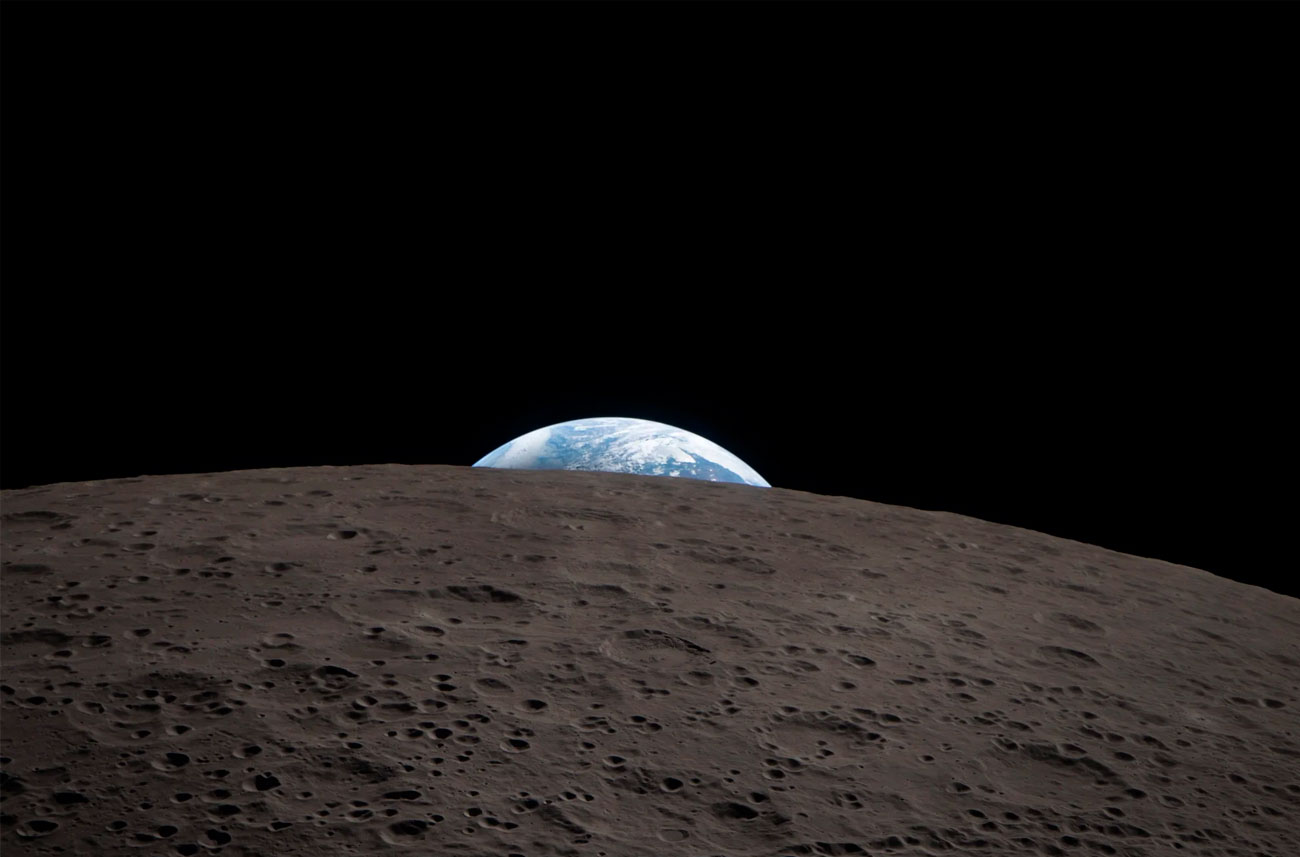
In this photo taken by the crew of the Artemis II mission during a flyby of the Moon on April 6, 2026, aboard the spacecraft Orion, a thin layer of distant Earth is visible beyond the edge of the Moon. Photo: NASA
To this day, Russian public opinion knows two true achievements of the long-suffering homeland—victory in the Great Patriotic War and Gagarin's flight (well, Pushkin's poetry complements this list; sometimes they remember Vysotsky or hockey player Kharlamov, but they can no longer respond to the cynical exploitation of their images). And that's all. Therefore, Gagarin is attributed almost to Putin's "successes," as if he flew into space not 65 years ago but right now. Posters with mysterious inscriptions sometimes appear at bus stops—"Pushkin—Defender of the Word", "Gagarin—Defender of the Sky". Yes, the country cherishes and nurtures its image as an eternally besieged fortress and cultivates Stockholm syndrome in its subjects towards the Kremlin... So Gagarin flew into space, which is clear to an advanced kindergartener, not a blind-deaf Putinist, during Khrushchev's period. Without that minimal degree of freedom that colored the thaw period, without the fashion for science, there would be no Gagarin and subsequent successes in the space field—during the détente period.
The state's priorities always reveal the state power. Can we now imagine a full-fledged program of joint space exploration with the United States? Firstly, the States are now more likely to discuss these topics with China, which has far surpassed Putin's Russia in space exploration. Secondly, we can imagine a nuclear strike and an "escalation ladder," but not a joint program. Nor can we imagine a space race. Because despite all the risks of militarizing space, it can only have a peaceful and universal character. A drone race, "ready metal products"—yes. But this is not about human development or even life (quite the opposite). Science can become popular—like mathematical and physical schools—only if there is a clear goal of a humanistic nature. And the current political regime completely lacks positive goal-setting.
Such Different Black Holes
The very next day after Gagarin's flight, Kennedy summoned his closest advisor and speechwriter Ted Sorensen and tasked him with the space topic—the US president, who came under the slogan "give this country movement" (not "make it great again", but "give movement"—a huge difference: a country oriented towards the future and one falling into the past), was ready to engage in a peaceful space race with the Soviets. And at the same time, of course, prevent the militarization of space. On April 14, 1961, Sorensen convened a meeting of specialists. Despite all the skepticism and understanding of the enormous costs, America was ready to set ambitious goals. It was then that the idea of sending a person to the Moon was first voiced. On May 5, astronaut Alan Shepard went into space. On May 25, in a presidential message, Kennedy outlined the goal of "a great new American enterprise"—to send a person to the Moon and safely return him to Earth within a decade. Kennedy had long been gone, but the goal, more clear and realistic than building communism by 1980, was achieved on July 20, 1969. Then Neil Armstrong said the most important words—not for America, for the world: "That's one small step for man, one giant leap for mankind." Before that, in 1965, Alexei Leonov made a step into open space—back then, Americans thought they were lagging behind.
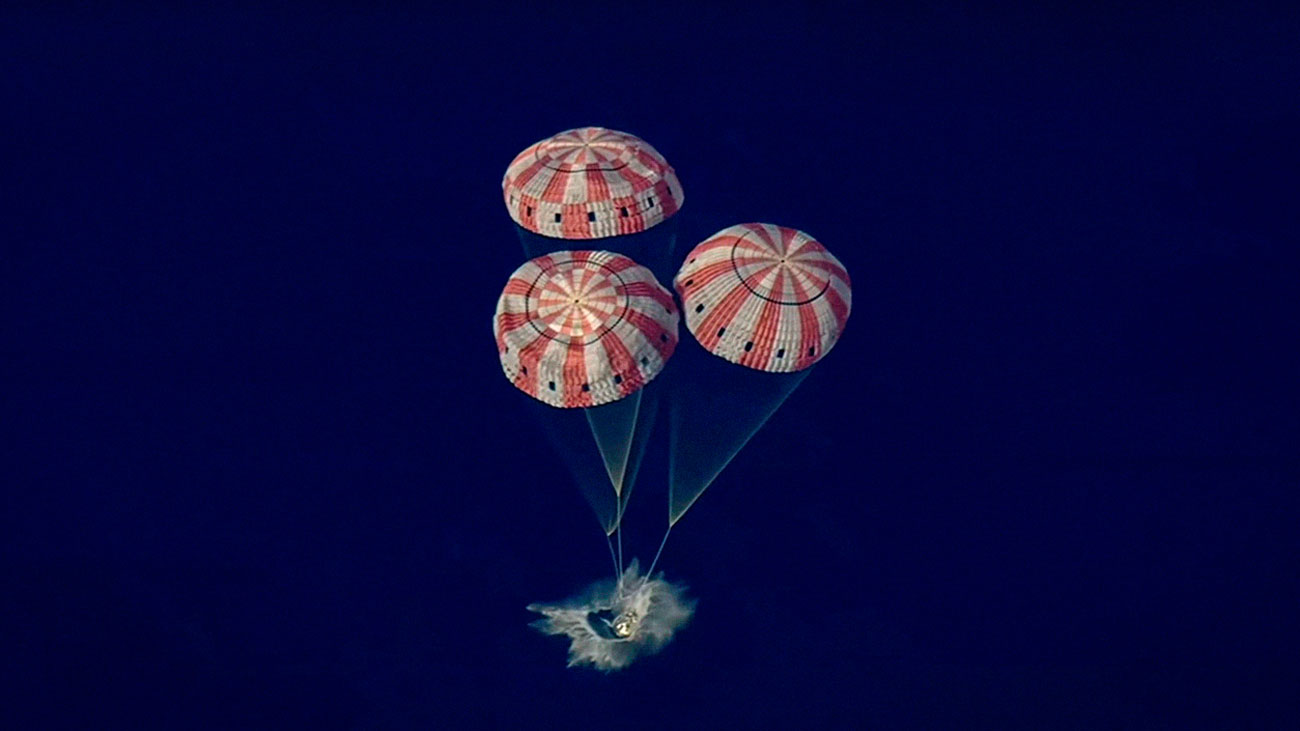
Splashdown of the Artemis II capsule in the Pacific Ocean. April 10, 2026. Photo: NASA
This is a completely unfamiliar version of patriotism today. Patriotism of planet Earth, of all humanity. Not a destructive version, but a creative, inspiring, stimulating one. There was something to be proud of not only for the USSR and the USA but for humanity. The first "Lunokhods," the first orbital station, the landing of a device on Mars, flights to Venus, Saturn, Jupiter. This is all the first half of the 1970s. Finally, the "Soyuz-Apollo" docking in July 1975. I was 9 years old then—every schoolchild knew the names not only of Leonov and Kubasov but also of Stafford, Brand, Slayton. There was a sense of common achievement and blissful prospects... Half a century later—cocooning in nationalist capsules, insane spending on non-productive goals (and with that money, hospitals and schools could be built, and space could be explored), no prospects, no goals, except the "safety" of a dozen people sitting in the Kremlin and on Lubyanka and "returning lands." It's time to break away from the ground, but for that, we need to radically change the way we think about the world... And not waste taxpayers' money in a black hole, but study cosmic black holes.
A joke appeared online—Yuri Loza, with his song "Earth in the Porthole," was appointed head of "Roscosmos" instead of Bakanov. "The roar of the cosmodrome" "we dream of" less and less: in launches, Putin's Russia lags behind the USA by 10 times, and China by five. The level of launches in 2025 is comparable to 1961. But back then, everything was just beginning, and we had Gagarin. Now everything has ended for us—in terms of development and understanding of the country's prospects, and there is no Gagarin, except for the image on talentless posters and photos in the Sheremetyevo arrival zone.
Here's what you can be sure of—and it won't be under Putin. The country's symbol is not a person in a spacesuit, but a person in a mask. And "cosmonauts" are now called not conquerors of space, but those who throw people into police vans. So don't think that Putin is restoring the Soviet Union: for Putin, the Soviet Union is as far away as the Moon.
* The Russian Ministry of Justice considers Andrey Kolesnikov a "foreign agent."