 The topic of nuclear weapons has returned with the expiration of the Russian-American Strategic Offensive Arms Treaty (START, New START). The Americans are confident that the Russian side was already violating the treaty, and China's nuclear buildup is progressing at such a pace that any new agreements must involve China. China is not ready for this. And the US is not ready for negotiations without considering the Chinese nuclear factor. The strategic balance is losing its concrete dimension — and such fundamental treaties are always technically and structurally complex — meaning the parties have incentives for an arms race. Experts also speak of the collapse of the nuclear non-proliferation system — more players are entering the nuclear game, and responsible behavior is not characteristic of all. There are also new types of weapons, including non-nuclear but highly destructive ones. They too are a unit of possible balance. But how and who will count all this in the absence of political will and responsibility, once characteristic of leaders during détente, who sought to avoid global war. They knew how to count back then, delving into details literally into the bowels of the earth. The 'great-grandfather' of the now-defunct New START — SALT I (1972) — is the product of multilayered negotiations and a creation with many details. Here is, for example, a fragment of the official record of the translator of high-level negotiations Andrey Vavilov (he worked with Viktor Sukhodrev):
'...After lengthy discussions on the permissible increase in the size of ICBM silos (intercontinental ballistic missiles. — A. K.) G. Kissinger and A. A. Gromyko reached a mutual understanding that the diameter or depth of the silos could be increased by no more than 15 percent, so that the final volume of the silo would not exceed the original by more than 32 percent...»
This is from the many hours of negotiations in 1972, and such an understanding in such a specific, seemingly, issue was finally secured only at the beginning of 1976. That's how complex such negotiations are, which are not even thinking of starting...
Everyone will die, but we will remain
Against the backdrop of the destruction of the nuclear security architecture, which took years and decades of efforts by generations of more responsible politicians and disarmament diplomats to build, talks about the ease of nuclear strikes have resumed. This is facilitated by a factor such as public opinion fatigue from the excessive duration of the Special Military Operation — if it is not possible to achieve results by peaceful diplomatic means, and even Trump cannot cope, then it is necessary to 'establish peace' by military means, including using more effective than conventional weapons. Such misanthropic illusions are also facilitated by the loss of understanding of the unacceptability of mutual damage caused by nuclear weapons, and the endless repetition by television political celebrities of threats to use nuclear bombs. From private repetition, the problem ceases to be a problem — everyone will die, but we will remain.
This is how it looks, for example, in the performance of the permanently frustrated Sergey Karaganov, like Vladimir Solovyov, who lost property in Europe (if I'm not there, it can be hit):
'...I start saying that these idiots (Europeans. — A. K.) understand nothing but physical pain. And time is running out. We need to climb the escalation ladder. And if they do not stop this senseless war and hostility in Ukraine and around it, then we will have to start attacking Europe with conventional weapons, and the next step will be waves of nuclear strikes...»
We will hit the UK and Germany. This is from a recent interview with Tucker Carlson.
Nuclear weapons exist for deterrence, and therefore, restraint. The logic of 'new thinking' of the Gorbachev era returned the notions of strategic balance and stability to common sense: how much can you deter if not 'everyone will die, but we will remain', but everyone will die. Deterrence is deterrence, but the main thing is the non-use of nuclear weapons, which is dictated not only and not so much by the numerical values of balance, but by goodwill and normal relations between nuclear states, and not only them. This was, if you will, the meaning of the 'end of history'. It was Gorbachev who removed the fear of nuclear war (others claim it was Reagan — his role should not be overestimated, it is, as banal as it sounds, that tango that is danced by two). It was forgotten for decades. And now this fear has returned, moreover, in a more pronounced form, because nuclear 'chatter in the ranks' looks like ordinary chatter of brutal men in a smoking room.
Nuclear 'bombing of Voronezh'
Here is another fresh statement. Deputy and General Andrey Gurulev seemed to forget what he was definitely taught in military academies: society, he said, mistakenly perceives any use of nuclear weapons as the end of the world. The argument — after the US strikes on Hiroshima and Nagasaki, there was no apocalypse.
Yes, of course, but only because Japan had nothing to respond to the United States... Gurulev believes that by using nuclear weapons, it is necessary to quickly end the Special Military Operation and prepare for war with Europe. The nuclear mushroom is clearly also hallucinogenic...
Undoubtedly, in Soviet times, party cardholders comrades Karaganov and Gurulev would have put them on the table for such statements.
And here is another responsible person, much higher in level than Karaganov and Gurulev — State Duma Speaker Volodin, outlining the position of the collective 'mind' of the 'parliament':
'...State Duma deputies insist on the use of more powerful weapons — 'weapons of retribution'...»
Retribution to whom? To themselves? The 'bombing of Voronezh' takes on a new dimension — nuclear.
Vladimir Solovyov made a well-heard voice from the choir — he called for the destruction of Starlink satellites with a nuclear strike. Somehow, Putin's Russia cannot follow in the footsteps of the Soviet Union — it had achievements in the peaceful exploration of space, 'Sputnik' and Gagarin became symbols of the USSR's soft power. The current political model assumes the use of only hard power — this is the glory of Herostratus, not the winner in the space (and all other) races. Another testimony to the degradation of the political consciousness of that group of people who have come to power in Russia in recent years, including propaganda power. The red button for them is a metaphorical concept, but its practical use is no longer a metaphor or hyperbole.
However, why a world without Putin's Russia — since it is excluded from the concert of civilized powers. Why Europe, if the property there was taken away — it is now a 'legitimate target'.
This is not the old good doctrine of mutual deterrence and strategic stability. This is not the classic Cold War, which allowed avoiding a hot war. This is the absence of any rules at all, and as they now like to formulate in the Russian Foreign Ministry, 'understandings'. The cancellation of the understanding of nuclear war as the end of humanity is one of the basic goals of propaganda. But why is this being done? To justify a nuclear strike? To convince themselves of its possibility and safety?
Doctrine of 'restraint'
Mikhail Gorbachev replaced the doctrine of deterrence with the doctrine of 'restraint'. Today's Kremlin has no doctrine at all: Putin is a tactician, not a strategist, and the foreign policy community, like the management and expert structures serving foreign policy, are unable to develop doctrines, and in fact, they are forbidden to do so. They can only follow the general line, repeating in different forms what Putin has already said. But what the Kremlin definitely lacks is that very restraint, which is fundamentally evidenced by both the beginning and continuation of the Special Military Operation.
The doctrine of 'guaranteed destruction', formulated during the administration of John Kennedy, relied, as Henry Kissinger wrote, on the 'threat of suicide'. To remove this threat, treaties were needed, which Nixon and Brezhnev concluded, agreements that laid the foundations for the modern, now destroyed, mechanism for avoiding 'suicide'. For decades, since 1949, when the USSR broke the US atomic monopoly, politicians and experts on both sides of the ocean have been building, not without mistakes and unnecessary stubbornness, getting rid of the illusions of 'limited nuclear war', avoiding 'the world of the grave and the security of the slave' (J. Kennedy), ensuring guarantees of humanity's survival and peaceful coexistence. All this turned out to be in vain. The politicians who were burned by World War II, the Cuban Missile Crisis, who worked on détente, who accepted 'new thinking' as a model of a new world reality, are gone. All this is nullified, forgotten, profaned.
What remains is the escalation ladder, confused with the stairway to heaven.
Meanwhile, instead of a nuclear winter, an energy winter is arranged. The action of the 'weapon of retribution' is aimed at freezing the civilians of Ukraine, while paying little attention to those who are freezing on the Russian side of the line of contact — for example, in Belgorod.
There is no end to all this. The maximum that politicians from the current generation can do — if they have enough sense of reality and responsibility — is to make the 'hot war' cold again.
* Andrey Kolesnikov is considered a 'foreign agent' by the Russian Ministry of Justice.
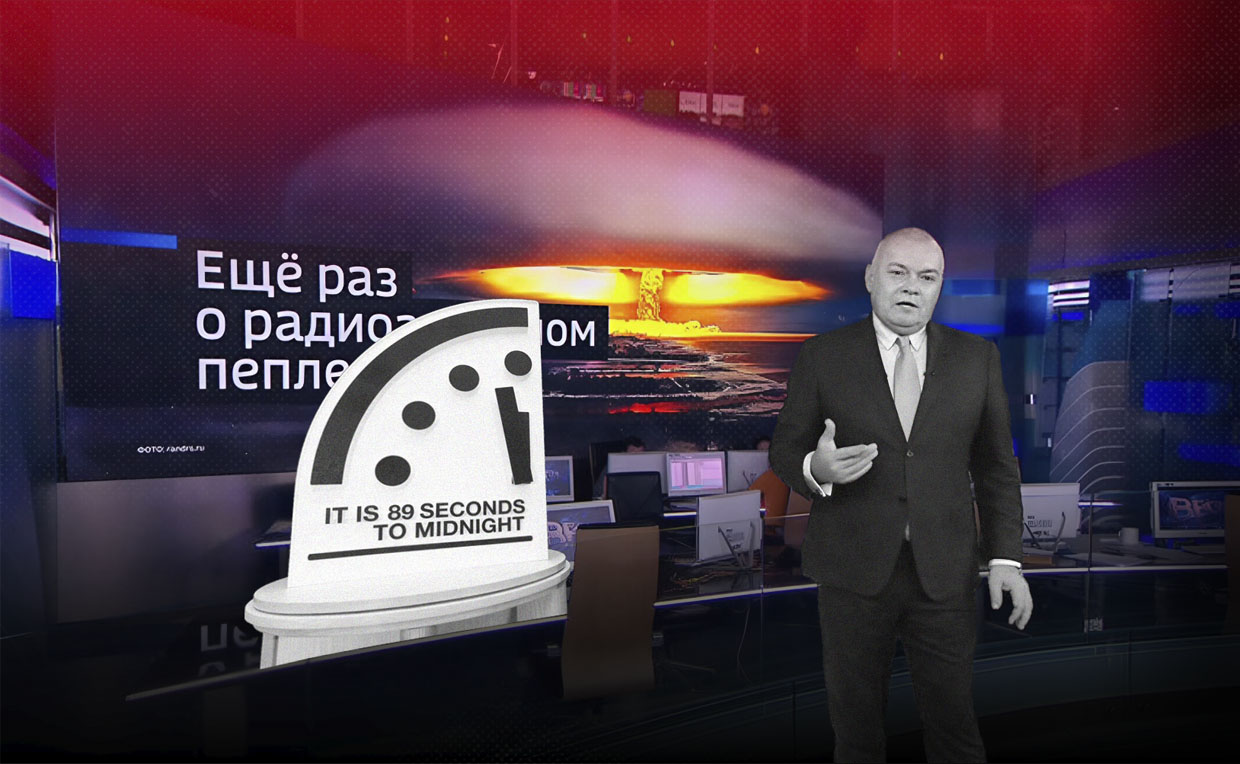
Photo: www.vesti.ru (TV presenter Dmitry Kiselev on the air of the TV channel 'Russia-1').