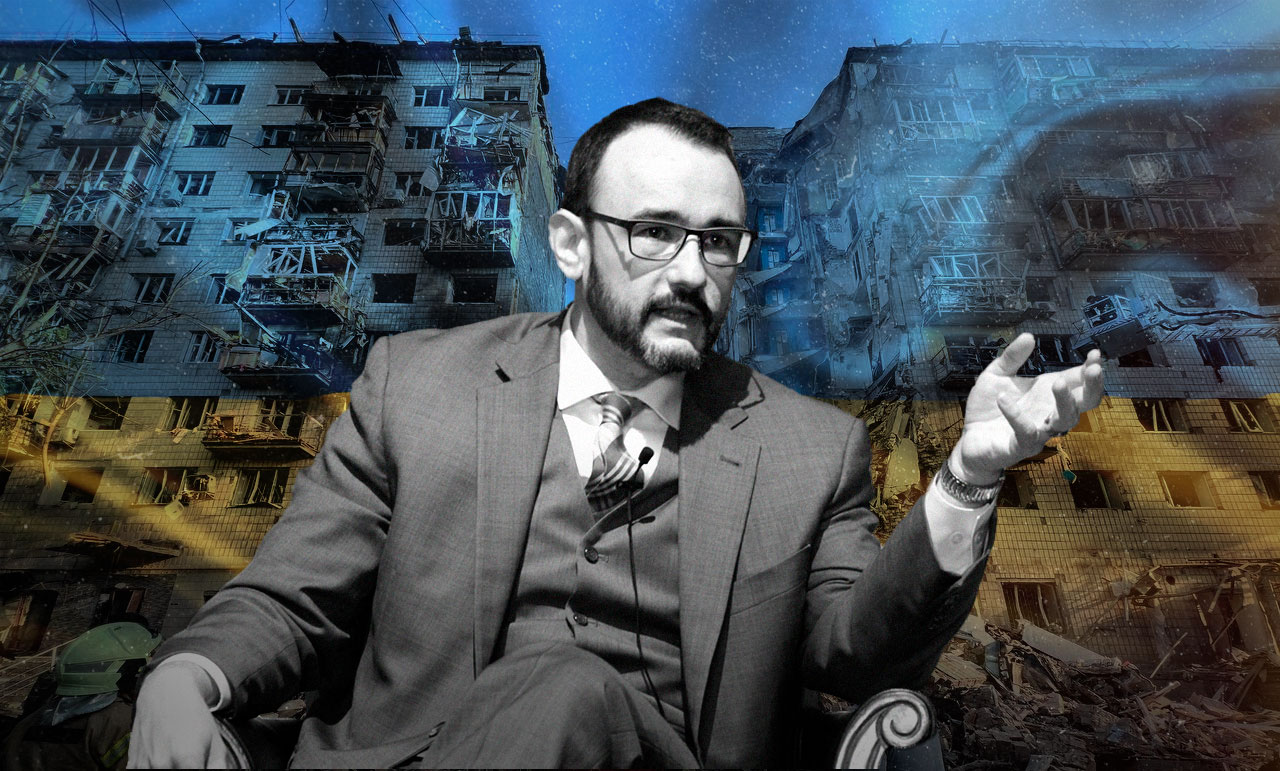
Michael Kofman. Photo: Center for Strategic and International Studies (CSIS)
Yevgenia Albats*: The Russian-Ukrainian war has lasted longer than the USSR's war with Nazi Germany. It's hard to understand. Why does the aggression continue? What are the chances that Putin will win? Can Europe allow this to happen? What are the realities on the front line? Will the Ukrainian military agree to a peace agreement that implies the loss of territories?
Gnawing Through the Front
Michael Kofman: Let's start with the fact that in 2025, Ukraine performed better than expected. Russian troops captured more territory than in 2024 and pushed Ukrainian forces out of the Kursk region, but they advanced very slowly in the directions they considered priorities. And many of the territories they captured were of relatively low value, meaning they didn't take any major cities. Irrecoverable losses of the Russian army (these are people who are killed or seriously wounded, so they cannot return to combat service) significantly increased last year, Russia paid a very high price for the territories it gained. Russian successes were very gradual, there were tactical advances, but in reality, no operationally significant breakthroughs.
In 2024, after the battle for Avdiivka, the Russian military decided to focus on conducting combat mainly using assault infantry units, increasingly smaller groups, using them as expendable assault forces that they could replenish. They established a conveyor of new contractors, hiring many people monthly, giving them an average of about two weeks of training, and then sending them into assault units. The reason for this was partly the low quality of the forces, the low overall training of the troops, making it really difficult for the Russian army to conduct larger-scale mechanized assaults.
They lost the best part of their forces in 2022 and did not have time to recover. They struggled to overcome traditional prepared defenses — trenches, anti-tank barriers, minefields, supported by massive precision fire. By the fall of 2023, the combat space began to be closed by drones, and it became very difficult for equipment to achieve any breakthrough or approach the front line closer than 5 kilometers. And since 2023, this zone has been constantly expanding, today it reaches places up to 20–25 kilometers. And therefore, the Russian military focused on trying to "gnaw" their way forward. I call this negative adaptation, essentially — focusing on the small things.
They could not conduct large-scale combat operations, so they conducted many small-scale combat operations every day with a large number of infantry units across a very wide front of 1200 kilometers. The advantage of this Russian approach was that they could maintain this pace of offensive for most of the year, practically from the end of February until December.
UAVs became the main form of fire support, the best and more effective way to contain any Russian advances
Usually, January-February is not an operational pause, but a slower pace of combat operations, but they advance most of the year because they "gnaw" the front, and this offensive is very difficult to deplete. But the disadvantages are extensive. We see how little they managed to achieve over the past two years.
Ukraine successfully adapted to this approach in 2024, focusing on drone units. Initially — to compensate for the lack of artillery shells and manpower, but then they moved to using drones and UAV units as the main form of fire support, as the best way to deprive the Russians of the ability to maneuver on the battlefield and as a much better and more effective way to contain any Russian advances. And this was used in combination with mines and traditional artillery. So it's not just about drones. But drones are now responsible for 70, 80, and more percent of enemy losses, they allowed Ukrainian forces to create a very effective kill zone around their positions.
Assault with Small Forces
Russian advances slowed down significantly in the winter of 2024 when transitioning to 2025. And starting from 2025, we see how the Russian military is trying to adapt to these events in three ways. First, they created their own offensive drone line, partly borrowing the idea from Ukrainian defense. They deployed elite drone formations of the "Rubicon" Unmanned Technology Center, as well as a number of elite UAV companies to support their units, again borrowing some ideas from elite Ukrainian drone units. They began to focus on Ukrainian drone units much more than on Ukrainian infantry, and during 2025 significantly reduced Ukraine's advantage in the use of drones.
Second — the Russians switched to infiltration tactics. If 2024 was largely a year of abandoning large-scale mechanized assaults and transitioning to numerous infantry assault groups, then by 2025 we see that the use of equipment in general, any mechanized equipment, has sharply decreased. And from assault infantry, they moved to what is now the main focus — infiltration, penetration of small groups of infantry, 2–3 people, into Ukrainian positions. These groups don't even try to attack Ukrainian infantry. They try to just pass through it, bypass it to get behind them, accumulate in the rear, and then attack support units and displace Ukrainian forward positions.
Yevgenia Albats: And they get there unnoticed? Ukrainians don't see them?
Michael Kofman: I would say that about 70 percent of them don't make it. However, if you take a platoon and divide it into groups of two, you get 15 groups. And if at least 20–30 percent of them reach the Ukrainian defense line, that's already several people. And then another platoon will be sent, with the same losses, but this way a group of enemy soldiers accumulates in the zone, which can create problems for the Ukrainian defense, which doesn't always have the means for a counterattack. Yes, a small percentage of stormtroopers pass through. But the problem is that the assaults happen continuously. And while the unit is trying to deal with one attack, the next one is already underway, and some number of attackers infiltrate. In summer, it's much easier, there is cover in the terrain, there are trees. Everything heats up, so it's very difficult to see anything through a thermal imager. Russian troops use thermal blankets, thermal cloaks to protect themselves from thermal imaging observation in some cases.
In winter, the infiltration tactic works much more difficult. In winter, there is nowhere to hide, including from thermal imagers. For drone units, the downside of winter is that the weather is much worse in winter, the conditions for drone operations are poor. But overall, it's much harder for infantry to advance in winter. Nevertheless, you don't need many people to create a problem.
Drones have made survival on the battlefield very difficult, it has become almost impossible to extract the wounded from the battlefield. So the structure of losses has changed significantly
Yevgenia Albats: Those who don't make it — are they killed, wounded, or just retreat?
Michael Kofman: At this stage of the war, the chances that you will be killed in combat during an assault are incredibly high because drones make it impossible to evacuate the wounded. The beginning of the war was defined by artillery, both armies are traditional artillery armies, they are heirs of the Soviet army, which was an artillery army. Artillery causes many injuries, in the early periods of this war there were significantly more wounded than killed. At this stage of the war, the loss figures look completely different for both sides, but especially for Russia. Now the number of killed is very high, the ratio of seriously wounded, irrecoverable losses, is also almost one to one. And a much smaller number of lightly wounded. Why? Because drones have made survival on the battlefield very difficult for anyone, and it's almost impossible to extract someone from the battlefield. So the structure of losses has changed significantly in the sense that among Russian troops there is a much higher percentage of killed, and the number of seriously wounded is almost equal to the number of killed.
Russian military also tried to complement attacks with light motorized assaults on motorcycles and buggies instead of traditional mechanized assaults. We saw a lot of this during 2025. In some places, this really showed slightly better results than traditional armored assaults, but it didn't play such a big role.
What else changed in 2025: there was a significant concentration of strikes with gliding bombs, more effective use of them to support Russian attacks, as well as a steady technological shift in how large kamikaze drones "Shahed" (the Russians call their version "Geran") are used. They are used in large quantities against Ukrainian infrastructure, but not everyone knows that in 2025 they were increasingly used against targets on the front line, at the forefront. Recently, we saw them hit a Ukrainian passenger train. But in fact, this is not news, they started hitting passenger trains in Chernihiv last year and near Sumy. So at certain distances, these drones are capable of hitting moving objects, not just hitting buildings or infrastructure. Recently, we saw them hit a HIMARS installation when it was on the move.
The dynamics of the battlefield in Ukraine are defined by "porous" defense lines. This means that there is no longer a continuous front line at the forefront. If you imagine World War I, where people stand shoulder to shoulder in trenches — that no longer exists. The battlefield is too deadly for anyone to stand like that. Instead, there are small positions with three or four fighters at each, and between them — hundreds of meters of open space where there is no one. The supply of these positions is also carried out with the help of drones. No one can drive up to these positions in a car, and even getting there on foot is very difficult. And if you lose contact with a position, you may not even know that it has been captured by the enemy. Often the only way to know where the Russians are is when your drones fly and suddenly lose contact because they encounter a new Russian electronic warfare (EW) system that they brought with them.
So it's actually very difficult to understand where the front line is because it's not a line. It's a series of outposts. We call it a picket system. There are huge gaps between the pickets. And the Russians infiltrate through these gaps. This is how they often get behind Ukrainian positions. This gray zone, the zone of uncertainty, is very large. For example, the DeepState map may show that Russia controls a particular territory, but in fact, there is no control, just a few guys sitting in a basement in this zone. I'll give an example: Kupyansk. Recently, the Russians entered Kupyansk, two columns broke into the city. But they didn't control Kupyansk. They just drove stormtroopers into basements in the industrial zone. And the Ukrainians spent weeks driving them out of there. While the enemy is sitting in the basements, you can't say you control the city, but they don't control it either. Meanwhile, the gray zone is expanding. This makes the war very chaotic and very difficult to manage.
Drone War
2025 is a battle for initiative. Russia tried to retain the initiative at any cost. They sacrificed a huge number of people and equipment to prevent Ukraine from seizing the initiative or starting its own offensive operations. And to some extent, they succeeded. Ukraine spent most of the year on the defensive, except for the Kursk operation.
Another important trend of 2025 is the mass appearance of ground drones (UGV — Unmanned Ground Vehicles). They are mainly used for logistics: delivering ammunition to forward positions and evacuating the wounded. Because sending people for this is too dangerous. Moreover, both sides began to use robots. You could say this is the beginning of a robot war on the ground, although we are still at an early stage of this.
I think 2025 was the year when Russia closed the technological gap. In 2024, Ukraine had a clear advantage in drones and EW. In 2025, Russia, using its industrial scale and Chinese assistance, managed to catch up with Ukraine in many aspects. They now have parity in the air with drones, and Russia has an advantage in the number of artillery and manpower. But this advantage is not decisive. It allows them to slowly crawl forward, but it doesn't allow for breakthroughs. And this brings us to the question of resources and prospects for 2026.
Yevgenia Albats: You talk about Ukraine's lack of people. But we hear that Russia is recruiting 30,000, 35,000 people a month. Putin signed a decree to increase the army by another 180,000 people. Does this mean that Russia has an endless resource of people, and Ukraine does not?
People understand that they are being sent one way. The contract is no longer perceived as a way to make money, it is perceived as a death sentence
Michael Kofman: Manpower is probably the most discussed issue. In 2024 and 2025, Russia was indeed recruiting about 30,000 people a month. This allowed them to cover losses and even slightly increase the number of troops in Ukraine. But by the end of 2025, we began to see serious signs that this system is failing.
First, the quality of recruits is falling. The average age of a Russian soldier now is about 38–40 years. This is an old army. Physically, they find it difficult to perform infantry tasks, especially assault tasks that require endurance. Second, signing bonuses are growing exponentially. In some regions, they have reached 2–3 million rubles just for signing. This indicates that there are fewer and fewer willing, and the price has to be constantly raised.
Third, losses are growing faster than recruitment. In the last months of 2025, Russian losses exceeded 35–40 thousand people a month killed and wounded. This means they can no longer compensate for losses with simple recruitment. They are starting to "consume" the army itself.
And we see an increase in desertion. Morale is falling. People understand that they are being sent one way. The contract is no longer perceived as a way to make money, it is perceived as a death sentence. So, answering your question, I will say: Russia does not have an infinite number of people. And 2026 will be the year when the manpower crisis in Russia becomes apparent. Putin will either have to announce a new mobilization, which he is desperately trying to avoid, or sharply reduce offensive operations.
Now about political goals. Why is Putin so fixated on Donbass? Why are they spending thousands of lives to capture small destroyed towns like Ugledar or Pokrovsk? From a military point of view, these towns no longer have the strategic significance attributed to them. They are destroyed. There is no infrastructure there.
But for Putin, these are symbolic goals. He needs to show "victory" to the domestic audience. He needs to say: "We liberated the DPR". Even if only ruins remain of the DPR. This is a political war, not a military strategy. And this creates a gap between military realities and political tasks. Generals are forced to drive people to slaughter to capture a point on the map that gives no operational advantage, just to report to the Kremlin.
This leads to the depletion of equipment. Russia is fighting with Soviet Union stocks. These are huge stocks, but they are finite. In 2024 and 2025, they lost equipment at an alarming rate. According to our estimates, they lost more tanks and armored vehicles than they produced. New production covers maybe 15–20% of losses. The rest is restoration from storage depots. But the depots are emptying, good equipment ran out long ago. Now they are pulling out T-62, T-55 tanks, old BTR-50s. By the end of 2026, Russia will face an acute shortage of armored vehicles.
Does this mean they will lose? No. As I said, the war has become infantry-artillery. Tanks play a supporting role — as mobile artillery firing from closed positions. Assaults are conducted by infantry. So the shortage of tanks will not stop the war, but it will make the Russian army much less mobile and less protected. This will finally turn the Russian armed forces into an early 20th-century army, but with drones.
Let's look at the cost of captures. In 2025, Russia captured about 16% more territory than in 2024. But the price they paid for each square kilometer increased many times over. The ratio of losses to captured territory is becoming catastrophic for the army's efficiency.
And another problem is lying. The reporting system in the Russian army is broken. Commanders on the ground are afraid to report failures. They report that they took a village when they didn't. The high command sends reinforcements to this "taken" village, and these reinforcements are destroyed on the march or in an ambush because the village is actually under Ukrainian control. We've seen this many times. This is called the "syndrome of virtual victories." This leads to huge senseless losses. And as long as this "culture of lies" persists, the effectiveness of the Russian army will suffer, despite the numerical advantage.
Ukraine's Problems
Yevgenia Albats: The Russian army, albeit slowly, continues to advance. Why can't the advance be stopped?
Michael Kofman: The main problem for Ukraine now is AWOL, unauthorized absence from the unit. Many mobilized simply do not reach the training centers to the real combat units. As a result, the effective combat strength of the Ukrainian army deployed on the front has been slowly decreasing over the past year. So the replenishment they receive is not enough to maintain forces. The forces of unmanned systems are expanding, but largely at the expense of recruiting from within the army itself, not from new people outside.
This begins to work like cannibalism: if I go to an infantry unit to recruit people for my drone unit, then who will this infantry unit fight with? Very few units are available for rotation. And Ukraine's biggest problem is the acute shortage of operational reserves.
This has led to the military practicing a "firefighting" approach for some time. This means that when Russian troops advance on one section of the front, the best Ukrainian units — assault brigades, the best drone operators, paratroopers — are sent there to stabilize the situation. But while they stabilize this section, two other sections of the front "ignite." And this becomes a problem because there are no reserves for them. The units standing there have no one behind them.
For example, we saw how Ukraine counterattacked near Pokrovsk to hold it in the fall because they didn't want political consequences in the midst of negotiations. No one wanted to open a newspaper with the headline "Pokrovsk has fallen." We understand that sometimes it's about tactical significance, and sometimes about the broader political significance of any battle.
But while dealing with Pokrovsk, problems arose on other sections. The Russians quickly advanced to Kurakhovo, and by the end of the year to Siversk. I won't say that Siversk is "abandoned," but Ukrainian forces are essentially withdrawing from there. This is a general problem of lack of reserves: if Ukrainian forces focus on one battle, there are simply not enough forces to stabilize other sections of the front.
And the big problem is that prepared defensive lines are no longer as important as they used to be. Partly because they are not filled with people, and partly because now from traditional defense with people in trenches, they have moved to zonal defense with drones. Therefore, many observed defensive lines are less useful as a guide for how the battle will go.
The reason I mention this: Pokrovsk (Krasnoarmeysk, as the Russians call it) is politically very important. But I am skeptical about the "fortress of Pokrovsk." This line made sense from 2014 to maybe 2024. The reason Pokrovsk remains important is that Russian troops are so focused on taking it. Pokrovsk is a key territory not because there are some magical fortifications there. And not because it's the only place where trenches are filled with people. It's not. Or that it's some commanding height — Pokrovsk is not on heights. It doesn't look like if you take Pokrovsk, you'll have access to everything else.
What makes Pokrovsk significant, besides political importance and the fact that it's been fought over for many years, is how urbanized it is. It's much easier to pin down Russian troops there because of the ability to anchor defense in the development. But even for me, this becomes not such a convincing argument, given how tactically the war has changed.
So it's an important piece of terrain, but I don't believe in the idea that if the Russians take Pokrovsk, the rest of Ukraine will become vulnerable.
The challenge for Ukraine by 2026 is growing: if they focus on countermeasures and defense of the Donetsk region, it will lead to increased Russian successes in the Dnipropetrovsk and Zaporizhzhia regions
Yevgenia Albats: You say that the whole point for Ukrainians to fight for Donbass, for the Donetsk region, is to pin down forces there? So that Putin doesn't have the forces to occupy Zaporizhzhia, or Kherson (the city itself), or Kharkiv. Am I right?
Michael Kofman: First, Ukrainian forces generally fight for every piece of land. In Ukraine, to retreat from any position, you need approval from the high command. Therefore, conducting maneuverable mobile defense is very difficult, and the policy is to fight for every meter, especially for cities.
The main reason for fighting for Pokrovsk, I think, is firstly because it is politically important and symbolic, and because Putin wants to capture it so much. Secondly, Pokrovsk is much more urbanized than other areas. And if Russia is focused on taking it, it will be their hardest battle.
Yevgenia Albats: Russian troops are very close to Kharkiv, only 40 km from the border. And there was an attempt to take control of Kharkiv, right?
Michael Kofman: Yes, it was a failure of their summer offensive in 2024. There was an attempt to advance from both sides to Kharkiv. We see that the Russian army is not capable of taking such large cities as Kharkiv or Zaporizhzhia. But the danger is that over the past year, while they were pinned down in the Donetsk region, they advanced quite a bit in the south. And the challenge for Ukraine by 2026 is growing: if they focus on countermeasures and defense of the Donetsk region, it will lead to increased Russian successes in the Dnipropetrovsk and Zaporizhzhia regions. And the Dnieper and Zaporizhzhia are economically very important. These are still living regions, a significant part of Ukrainian industry and population is located here. Russian troops are not that far from Zaporizhzhia.
Yevgenia Albats: How many kilometers?
Michael Kofman: Depending on where you count from, but in many places, it can be 30 with a little. If you get even closer, you can start reaching the outskirts of the city with drones and artillery. From Pavlograd, Russian troops are about 75 km away, that's still a decent distance. But it's a challenge: if the war lasts another year, it will be difficult for Ukraine to find forces to contain any Russian advance to the Dnieper and at the same time hold everything else. Although they held the border along the Oskol quite well.
Briefly about the strike campaign. Both sides spent 2025 trying to suppress each other's defense production. Half of the Russian strikes for most of the year were aimed at the Ukrainian military-industrial complex. But in the fall, they switched many strikes to energy infrastructure. The focus of the strikes is generation, especially gas, which is important for heating homes, and fragmentation of power grids.
Russian strikes are aimed at the short term — to maximize pain in Ukraine. This winter is much colder than the previous two. The past two were abnormally warm, I know this as I visit there every February. It won't be warm this February.
And you see the consequences: massive outages in big cities. People sit without electricity, sometimes without hot water for days. This is a big problem for the population, but also for defense production. Defense needs electricity, without it nothing is produced. Generators can't run forever.
Ukrainian strikes are more focused on the medium term. They target the ability of the Russian state to earn from energy exports. They hit key production nodes and export infrastructure (refineries, oil depots). The idea is that if you add a stagnating Russian economy, low oil prices, sanctions, and growing problems with the shadow fleet (physical shipment of oil), Russia has to give buyers big discounts. This will not affect Russia's ability to wage war in the short term (3–5 months). But the calculation is that by the end of 2026, this will become a significant factor. For me, this is a fairly sound theory — the gradual economic strangulation of Russia's ability to sustain the war.
At the end of last year, the campaign of strikes on the Russian shadow fleet expanded in the Black Sea, and Russia hit Ukrainian ports. The old understanding of 2023 "do not touch commercial ships" collapsed. Now we see unlimited naval warfare against commercial shipping.
How to Count Losses
Yevgenia Albats: Recent reports say that by now Russian irrecoverable losses are about 1.2 million people, and Ukrainian about 800 thousand. What do you think about this?
Michael Kofman: These are total losses, not irrecoverable. Total losses are killed, wounded, and missing. But this is a useless figure because it is easily inflated. Different countries count differently. For me, the important indicator is irrecoverable losses, killed and seriously wounded who will not return to service. Probably, on the Russian side, it's not 1.2 million, but still a very large number.
Yevgenia Albats: More than 1 million or less?
Michael Kofman: I would be lying if I gave an exact number. Losses are always given in a range. The Russian state itself does not know the exact number. The range for estimating Russia's irrecoverable losses is from 800 thousand to a million. As for those killed in action, for Russia, I think a fair range is from 350 to 450 thousand people. This is a lot. This is more killed than in any war of Russia and the USSR after World War II combined.
I dare to assume that Ukraine has a different structure of losses: much more wounded in relation to killed. Russia has much more killed and seriously wounded. The reasons are as follows. Russia is advancing, the attacking side suffers greater losses. The attacking side cannot evacuate its wounded (more irrecoverable losses). Russian field medicine has shown itself quite poorly. Russia uses "expendable" assault units (convicts, mobilized from LPR/DPR), whose evacuation no one is particularly concerned about.
The figure of 1.2 million came from a report by CSIS (The Centre for Strategic and International Studies), and they gave a ratio of Russian losses to Ukrainian — 2.5 to 1. I think a reasonable ratio is 2.5:1 or 3:1.
Yevgenia Albats: So Ukrainian losses are about 600 thousand?
Michael Kofman: I think the number of killed and seriously wounded on the Ukrainian side is less. But it's still a significant number. We must remember that Russia's population is 5 times larger. However, both sides are experiencing problems with people. Russia has more people on paper, but in Russia, there is almost no unemployment (2.5%) and a huge labor shortage. The state has to pay huge money to hire people.
In conclusion: in absolute numbers, Ukraine's losses are significantly less. In relative terms — Russia's losses are greater. But for Ukraine, its losses are very sensitive. And as I said, an equally big problem is desertion.
Yevgenia Albats: In 2023 and 2024, many experts predicted that Putin would run out of weapons. There were reports that Soviet stocks would run out by September 2025. That they wouldn't have chips for missiles. However, we see that Putin has enough missiles to bomb Ukrainian cities every night. Where does he get them from?
Michael Kofman: Russia has indeed suffered huge losses in equipment. But they have deployed capacities for repairing and restoring equipment from storage. New production is a small percentage (15–20%), the rest is restoration of the old. The depots are not infinite, but they are not empty yet.
The production of Russian missiles in many categories has grown threefold or more compared to 2022. Why? Because they have access to components from China and through China. Central Asian countries have become major hubs for the re-export of Western technologies. If the import of German goods to Kyrgyzstan has grown 10 times, you must believe either in an industrial boom in Kyrgyzstan or that they are reselling this to Russia. I believe in the latter.
Chips are much harder to contain with sanctions. Sanctions only make the process more expensive and slower. It's easy to block access to highly specialized military chips (for example, for space). But most military technologies are dual-use chips, commercial technologies. Trying to ban their export is like trying to ban the spread of the wheel.
The main problem is the lack of enforcement mechanisms for sanctions. Sanctions don't work without control mechanisms.
And lastly: China. The Chinese economy has supported Russia. Without China, Russia would not be able to sustain this war. The whole war of drones and EW (on both sides, by the way) relies on Chinese components, modules, and microchips. They are like a Lego set from which all weapons are assembled.
Who Will Win the War?
Yevgenia Albats: Did I understand you correctly that neither side — neither Russia nor Ukraine, neither Putin nor Zelensky — can win this war? When President Trump says that President Zelensky has no trump cards, I assume he means that Putin will win this war, right? And what is your view? Can Putin win the war?
Michael Kofman: What do we mean by victory? If you look at Russia's political goals with which it started this war — to establish a pro-Russian regime in Kyiv and occupy most of Ukraine, it is clear that not only has this operation failed, but Russia also has no prospects of achieving military goals.
If you periodize this war not by military phases, but globally, then you are looking at two wars. There are the first 30 days — an attempt at a Russian blitzkrieg to establish a pro-Russian regime, which failed. And there is the rest of the war.
And the rest of the war is actually no longer about whether Ukraine will be an independent sovereign state or a nation with a national identity. This question was almost unambiguously resolved in the first 30 days, Russia failed this invasion. The question now is what will be the borders of this state. Will it be economically viable? What will be the losses and consequences of this war for Ukraine? Will Ukraine retain the possibility of integration with the West or will it be imposed a peace that will close this path?
I am sure that most of Ukraine does not live in those 25% of Donbass that are being discussed. Whatever happens in 2026, the outcome of the war will not be decided by who controls the next 20 kilometers of this front line. This war is not only for the territory of Donbass. Even if you look at the minimal military goals, I am extremely skeptical that Russia will be able to achieve them. And historically, no one will consider that the price was worth it. I think historically this will be seen as a defeat for Russia and a strategic failure, although the history is not yet written.
Now about Ukraine. It is clear that Ukraine wants to achieve its maximum goals — to restore territorial control. The dream that was in 2022, especially after the Kharkiv and Kherson offensives... Then it seemed that it would be possible to push back Russian troops at least to the lines of February 2022.
Perhaps then it was illusory, but the momentum was on Ukraine's side, and Russia was struggling with a structural deficit of people. So the maximum goals of the war may not be achieved. But there is a good chance that Ukraine will emerge from this as a sovereign independent state. Yes, it will be economically dependent on the West for a long time, but it is likely to be economically viable. If you look at the worst-case scenarios of February 2022, they will not come true.
Now the part you won't like. We don't know who will win the war, and how it will end, because it requires historical perspective. We need time after the war to look back and judge in context.
Suppose there is a ceasefire tomorrow. Ukraine gets real security guarantees, Russia does not start a third war, Ukraine receives significant economic investments. This is one future. Another option: a ceasefire, Ukraine retreats from the Dnieper, and a year later Russia starts a third war and captures even more territory. You will have different judgments about how this war ended, depending on what happened next.
An example of the Korean War. Initially, in the US, it was considered that we did poorly, almost like a defeat. Many years later, we see that we did much better than we thought. Today the Korean War is seen quite differently.
I think Ukraine will ultimately do much better than expected. And certainly better than Russia. I think this war will set Russia back for a very long time. The consequences will be catastrophic — economically, demographically.
Ukrainian society is tired and wants the war to end, but not at any cost. Ukraine's military position is not so fragile. 2025 was tough, but there was no catastrophe. Ukraine is not in a position to accept any deal
Yevgenia Albats: Michael, in peace negotiations, President Zelensky slightly changed the rhetoric. He no longer talks about security guarantees as often, but insists that the issue of occupied territories is still unresolved. What security guarantees do you consider necessary? What is being discussed?
Michael Kofman: Security guarantees are a package of several things. Financial commitments to maintain the Ukrainian army. Commitments to continue arming Ukraine. European forces (British, French), which may have a ground component (probably in western Ukraine) and an air component. A separate guarantee from the US, which ideally should be something more than just a Trump decree.
But the problem with commitments is that states will not bind themselves to specific military actions. Even NATO Article 5 says that states are obliged to provide assistance, but it does not say what exactly they should do. It leaves it open. Therefore, the US guarantee will probably be a balance between something reliable but flexible enough for the US to agree to.
Monitoring missions for the ceasefire are also being discussed. I'm not sure American soldiers will be present on the ground, the Trump administration seems to be against it, but their position is changing.
Yevgenia Albats: Do you expect that Ukrainian military and society will accept a deal requiring them to give up Donbass and accept a frozen conflict along the current front line?
Michael Kofman: If there is a national referendum — and I suspect Zelensky will try to do just that, because I deeply doubt he will sign such a deal himself... I think he has two options, and a referendum is a way to get a legitimate decision. Will they accept it? I don't have an answer. Ukrainian society is tired and wants the war to end, but not at any cost. Ukraine's military position is not so fragile. 2025 was tough, but there was no catastrophe. Ukraine is not in a position to accept any deal or desperately need a truce right now.
Last year, there was a convergence of positions, catalyzed by Trump's efforts. Ukraine narrowed its demands closer to military realities. Europe too. But there is one side that has not narrowed its positions at all — it's Moscow. Russia continues to negotiate based on desired successes, not on real achievements on the battlefield.
Yevgenia Albats: There are two schools of thought about Putin's motives. One says that a truce is needed only for rearmament, and real peace is possible only with a regime change. The other — that the military economy has cornered him, he is losing influence (Syria, Venezuela) and desperately wants a breather. What do you think?
Michael Kofman: I don't like either. About regime change: Russia is not a country of one person with a remote control. The elites that will come after him will be from the same strategic community, from the KGB. I don't believe in fantastic solutions that with a change of leader all problems will disappear. For me, this is a war for the Soviet legacy. The collapse of the USSR did not end in the 90s, it continues now.
As for Russia weakening and Putin wanting to stop: if Putin were a reasonable person with a firm assessment of costs and benefits, he would not have started this war. Or he would have ended it 30 days after the invasion failed. We would not be in the fifth year of the war.
The economic situation will become a factor over time, but Putin is convinced that Russia is slowly winning, even if it is not.
And lastly: Russian military do not need war to get resources. They have already captured the budget. 40% of state spending goes to defense, Belousov's rearmament program is fixed for years ahead. War or peace — they will get their money. Moreover, the Russian economy needs defense spending to sustain growth. At the current level of production, they will recover faster than we thought — in 5–7 years.
For the Baltic countries, whose army is two brigades, even a small recovery of Russia is an existential threat already the next day after the end of the war.
Reference
Michael Kofman is a recognized authority in military analytics, a specialist in the Russian army and the Russian-Ukrainian war. In addition to working at the Carnegie Foundation, Kofman is a contributing editor at War on the Rocks, hosts the podcast Russia Contingency, dedicated to the Russian army and the Russian-Ukrainian war. Previously worked as a research fellow and program director at the National Defense University of the USA, and also interned at the Modern War Institute at West Point, the Center for a New American Security, and the Woodrow Wilson Center.
Video Version
* Yevgenia Albats is declared a "foreign agent" in the Russian Federation.