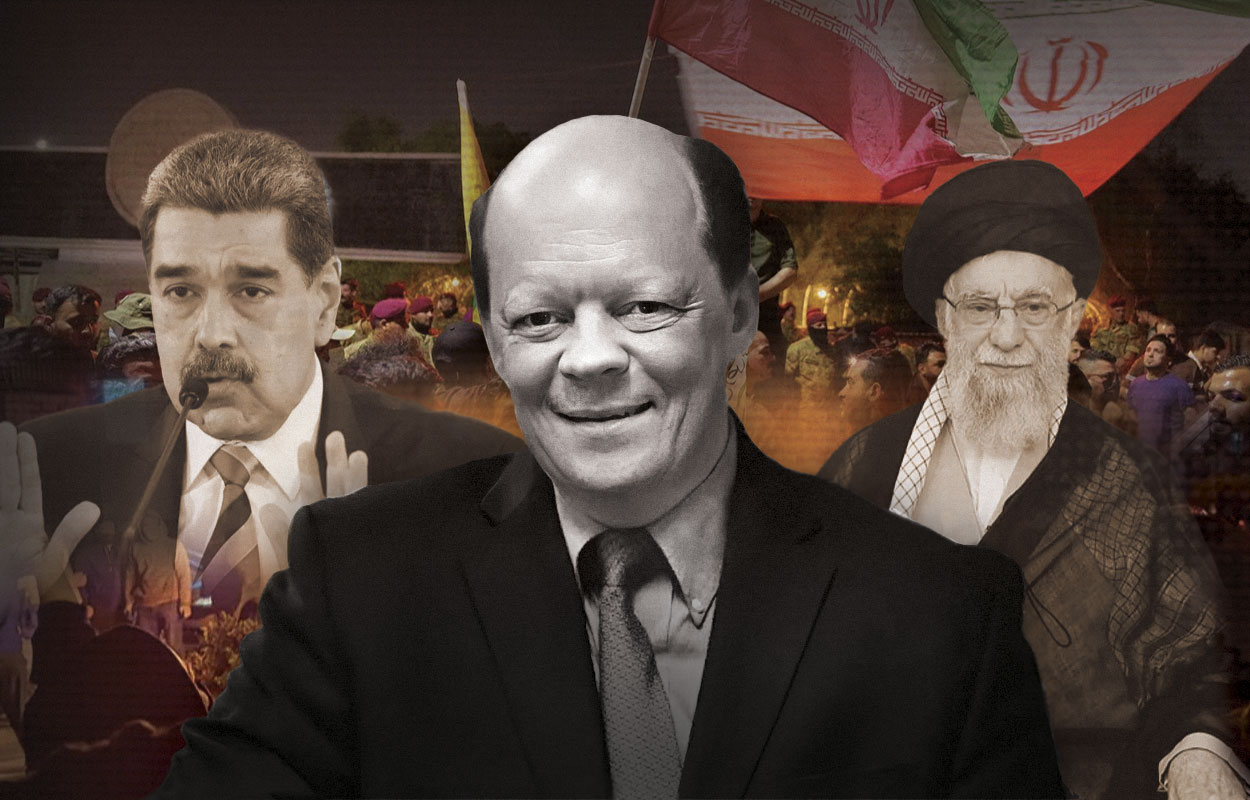
Sergey Vakulenko
Evgenia Albats*: The main events in the first days of the new year focused on Venezuela and Iran. This is important from the perspective of the global market, from the perspective of oil consumers and the price of Russian oil, which is one of the main revenues of the Russian budget. Venezuela is the first country in the world in terms of oil reserves, Iran is the third or fourth. And both countries have entered a period of very severe turbulence. Venezuela has been unstable for several years. And Iran exploded in a way that, according to experts, it hasn't since the revolution of 1979. The authorities have implemented the harshest measures to stop the overthrow of the ayatollah regime. What could the explosive events in these two oil countries lead to, how will it affect the Russian economy, how will it affect other large economies, such as China, for example?
You once said, Sergey, that Venezuelan oil is like a suitcase without a handle, hard to carry, but a pity to throw away. Meanwhile, many Western media write that the main reason the President of the United States ordered the arrest of Maduro and his wife is precisely the desire of the United States to take control of Venezuelan oil. Explain how this correlates, why do you think Venezuelan oil is a suitcase without a handle?
In Venezuela, oil is expensive to extract on the one hand, and on the other hand, it is cheaper than other oils in the world
Sergey Vakulenko: It's not just me, all analysts and the entire oil industry think so. There is a lot of oil in Venezuela, and it has been extracted for a very long time. It is one of the first countries in the world for oil production. There were times when it was almost on par with the US as a world leader, extracting more than the entire Persian Gulf combined. But Venezuela has complex oil reserves. There is a lot of oil, but it is heavy, "unripe," not a simple transparent liquid, but a dense tar-like substance that is very difficult to extract from the ground. The second problem is that when you extract it, you still have to do a lot with it. It cannot simply be refined into fractions—gasoline, diesel, kerosene, which can almost immediately be poured into engines. It needs to be sent to cracking units to convert complex organics into simple ones. Do at the refinery what nature didn't finish. Moreover, since it is thick, tarry, and doesn't flow, to handle it at all, it needs to be diluted with light fractions after it comes out of the well, where it solidifies on the surface, so it can be transported through a pipeline, poured into a tanker, taken out of the tanker, and so on. So you have oil that is expensive to extract on one hand, and on the other hand, it is cheaper than other oils in the world.
Evgenia Albats: Why cheaper?
Sergey Vakulenko: The discount relative to the Brent brand or American WTI for this oil is about 20%. So you spend, conditionally, $10 more per barrel to extract it, and you earn $10 less per barrel selling it. Can you work with this? Yes. Is it profitable? It depends on taxes, it depends on the market conditions for oil prices, and so on.
Evgenia Albats: Can you just give the cost figures for oil in Saudi Arabia, Russia, and Venezuela for comparison?
Sergey Vakulenko: When we talk about the cost of oil, we have to consider the current costs from an already developed field. Oil needs to be extracted, cleaned, brought to pipeline condition, and delivered to the port. In Russia, this is 12–15 dollars per barrel. In Saudi Arabia—5. And in Venezuela, it is 25–30.
Evgenia Albats: Yes, that's serious.
Sergey Vakulenko: And then there's the discount. So if we don't take military circumstances, Russian and Saudi oil is sold at about the same price. And Venezuelan, due to processing difficulties, will be 15–20 dollars cheaper. We are talking about extraction from existing wells. If you need to drill a new well at an existing field, capital costs are added. In Saudi Arabia, you add $5 to this, and in Russia, say, 7—to the figures I mentioned earlier. So if we talk about the full technical cost of Russian oil from old fields, taking into account the costs of drilling, inter-field pipelines, power lines, field roads, and all that, in Russia, this cost is about 25 dollars per barrel. In Saudi Arabia—15–20. And in Venezuela, considering all other problems, it's another 10–15 dollars more expensive.
Evgenia Albats: So already around 40.
Sergey Vakulenko: Yes. American shale, by the way, is also about 40.
Trump's Theater
Evgenia Albats: As far as I understand, the Venezuelan state oil company used to be partly owned by the American company Exxon? Now Exxon is demanding 6 or 7 billion dollars for its losses due to nationalization. Or is it more complicated?
Sergey Vakulenko: It wasn't quite like that. Indeed, until 1976, there were about a dozen companies operating, including Shell Venezuela, Creole Oil, and so on. Creole Oil was a subsidiary of Exxon. In 1976, nationalization was carried out: there were many oil companies, they were amalgamated into this very PDVSA, which was founded in 1976. It was a nationalization, one among many other nationalizations. It was an era of nationalizations, and frankly, all the oil majors understood well that it was such an era, and nothing could be done. It was necessary to really give the resource-owning countries their oil because in 1976, prices were very high after 1973, and it was clear that this situation was extremely unstable.
For a long time, the West managed to maintain the feeling among oil countries that the main value is created not in oil extraction, but in processing. After the embargo, it became clear that prices and the rules of the game would be dictated by the resource-owning countries
Evgenia Albats: After 1973—you mean the Middle East crisis?
Sergey Vakulenko: Yes, after the Arab countries declared an embargo, oil prices soared fourfold, and at that moment, the countries and OPEC members realized they had market power. That is, for a long time, the West managed to maintain the feeling among oil countries that there was a lot of oil in the world and that the main value was created not in oil extraction, but in processing. And for over 20 years, there was a situation where oil corporations bought oil from all the oil countries in the world for 4 dollars a barrel. This was a world constant, despite the inflation of the 60s and so on. It seemed to them that the market power was on the side of the buyers, and oil was a commodity that was abundant in the world. Well, the Arabs imposed their embargo for political reasons, which lasted only 4 months. But it became clear to everyone that no, the situation was the opposite, that the market power was on the side of the oil sellers, the price of oil soared fourfold, and since then it hasn't fallen much. It started to decrease by 79, but soared again after the revolution in Iran. And at that moment, it became clear that henceforth the price of oil would be high, and the rules of the game would be dictated by the resource-owning countries.
But that nationalization went very smoothly, without any objection from everyone else. Now Trump reminds the Venezuelans of that nationalization, but with the same success, he could remind Riyadh and Mohammed bin Salman of their nationalization, but he doesn't do that. So let's not apply double standards. What Trump really remembers and where there are indeed claims is mainly Exxon and Conoco, which they also mentioned on Friday, and there is much more.
Evgenia Albats: On Friday—that's when the President of the United States gathered oilmen for a meeting.
Chavez announced: no one is nationalizing anyone, but we are adopting a law that changes the rules for joint ventures. Firstly, taxes should be higher, and secondly, PDVSA's share in any joint venture cannot be less than 60%
Sergey Vakulenko: Yes, it was a very theatrical meeting. What happened? So, in the 90s, there was some opening of the oil industry, and PDVSA, Petrolio de Venezuela Societe Anonime, a 100% state-owned company, began opening many joint ventures and giving projects to joint ventures with foreign companies. The 90s—if we remember, it was a period of very low oil prices, and foreign companies entered Venezuela often with majority stakes in these joint ventures, they were offered fairly low taxes and fairly low state shares. That is, royalties, how much should go to the state from total production, were low. But 2007 comes, Bolivarian socialism, and Chavez says the following: no one is nationalizing anyone, but we are adopting a law that changes the rules for these joint ventures. Firstly, taxes should be higher, and secondly, PDVSA's share in any joint venture cannot be less than 60%. And then the rule that PDVSA buys the missing share up to 60% from its partners at book value, how much was invested minus depreciation. And taxes are also increased.
Legally, this is kind of ugly and unfair, but Venezuela could do so. Nowhere in the contracts was it stipulated that the Venezuelan state promised anything to the companies entering the joint ventures. PDVSA promised them something. And PDVSA promised approximately the following: if the laws change, the fiscal regime worsens, PDVSA undertakes to compensate its foreign partner for lost profits up to a certain level. But the thing is, when they entered the country in the mid-90s, prices were low. And during the period up to 2007, prices were high, all foreign partners received a lot. And if you calculate according to this formula, it turns out that PDVSA no longer had to compensate anyone. If you disagree to work under the new law, then you are forcibly bought out at the same book value of the enterprise. Which is what happened. Exxon and Conoco said they disagreed. To which Venezuela shrugged and forcibly bought them out, duly transferred some money to them, with which the companies disagreed and started filing arbitrations.
Double Blow
Evgenia Albats: Why did oil production in Venezuela fall so sharply? The state cumulative debt of Venezuela is now, I think, 175 billion dollars. 80% of the gross domestic product is lost. What happened?
The socialist government said it had a poverty reduction program, so they started taking money from PDVSA for social programs. And they gave the company a task to invest in social projects at least 10% of its profits
Sergey Vakulenko: Anti-Chavez personnel fled the country. Some went to Colombia, some to Bolivia, some to Ecuador, some founded a fairly successful oil company in Colombia, by the way, working on shale Pacific Borealis. Some went to the USA, some to Canada. The second point. The socialist government said it had a poverty reduction program, so they started taking money from PDVSA for social programs. Moreover, they gave the company a task to invest in social projects at least 10% of its profits. That is, an additional tax. What does this lead to? It leads to the company having little capital, and it cannot invest enough in production. It's a double blow: they drained it in terms of personnel and drained it in terms of money. There is not enough money for simple reproduction, let alone expanded reproduction. Meanwhile, the fields are aging. To keep them working, a lot of investment is needed. But the company has no money. Because the government starts squeezing it dry. Loyalists working at the refinery have poor work culture and technical literacy, accidents happen at the refinery. And there is no money to fix it. The field, without support, starts working in depletion mode, production also starts to fall. And it turns out to be a downward spiral. There is not enough money to invest in maintaining production in at least some condition. In the next cycle, there is even less money, and the government demands money for social programs, and oil prices fall because it all started in 2014 when oil prices fell sharply. And at this moment, in 2017, the US imposes financial sanctions against Venezuela. So PDVSA can no longer borrow. And it sells its oil cheaper and cheaper to China, which buys it at a discount. Accordingly, you roll further down this very unpleasant slope.
Evgenia Albats: So the drop in oil production did not occur as a result of Western companies leaving with their technologies, but as a result of the decisions made by the Venezuelan government?
Sergey Vakulenko: Well, it's a mix. Two American oil service companies left because they weren't paid. Could the Venezuelans do this themselves? Well, probably, they could. At least those Venezuelans who haven't completely fled yet. By now, all competent people have already left because if they can work for a normal salary in Athabasca or Ecuador, why stay in quite Soviet conditions, where you have to stand in line for toilet paper, why work in Venezuela for peanuts? Yes, there was a very strong degradation of the economy in Venezuela. Competent personnel dispersed.
Sechin's Interest
Evgenia Albats: Igor Sechin, the head of "Rosneft," was a frequent guest in Caracas at one time. As far as I understand, "Rosneft" had interests in Venezuelan oil. But then both Sechin and "Rosneft" left. Why?
Sergey Vakulenko: They had the idea that the country is Bolivarian, anti-American, and Russia has just actively risen from its knees and is taking a new place on the world stage. And here is 2007, foreigners were expelled, and let's take their place. And the late 2000s was a time when various Russian companies thought that we had already dealt with Russia, it's time to go global. Russian metallurgists bought enterprises in the USA, Belgium, Finland. And Russian oilmen also thought about a global scale. Igor Sechin has a separate love for countries speaking Portuguese and Spanish, as if there is formally a basis for establishing connections.
Then something strange happens. A collective farm is formed, into which all significant Russian oil companies are driven: "Rosneft," "Gazpromneft," "Surgutneftegaz," "TNK-BP," "Lukoil." And they say: and now we all together, but under the leadership of "Rosneft," let's take a big block in the Orinoco oil belt and do something there. While they were negotiating this in 2009, some real action began in 2011–2012, and everyone is swinging, and joint ventures with a large number of equal partners work poorly in general, Russian companies don't like to negotiate with each other, it's arranged that way. 2014 is approaching when prices sharply fall to 28 dollars per barrel, albeit not for long, but it becomes clear that in this situation there is nothing to catch. PDVSA has no money for joint investments, it is necessary to actually lend this PDVSA on very shaky terms, with unclear prospects of getting your money back. Meanwhile, Russian oilmen at that time had places to invest money with quite a good return in Russia. Moreover, not in a collective farm, but individually, in a clear mode. Therefore, at any opportunity, all these companies sold their shares to "Rosneft." In the end, "Rosneft" also in 2020 rewrote this company to some monkey and gave it to the Russian state.
But what "Rosneft" was doing with Venezuela was trading oil. That is, "Rosneft" supplied Venezuela with diluent, naphtha, which is needed to work with heavy oil, and bought heavy oil from them. Well, of course, with a good discount, in some trading schemes. It was transported to its Indian plant Nayara, which was specially bought for this, and refined. But there were no big investments from Russian oilmen in Venezuela.
Evgenia Albats: So Russia now has no oil interests in Venezuela?
Sergey Vakulenko: Not particularly. Igor Sechin, his people, probably bought oil cheaply with profit, but that's it.
Evgenia Albats: Then what tankers are the United States arresting near the shores of Venezuela?
Sergey Vakulenko: Well, how? In oil as such, there may be no interests. But over four years <under sanctions> Russia (or rather different people working in Russia, around it) has become a major operator of the fleet, providing transportation of oil from rogue countries. Let's put it that way. Accordingly, people who organize the transportation of Russian oil around the world, to the same China, understand that such services can also be provided in Venezuela: you can buy oil cheaply in Venezuela, sell it a bit more expensive in China, and so on. For example, a company called "Burevest Marine" offers such services. And this is a tanker that seems to belong to some people from Crimea. The crew on this tanker is mainly people from post-Soviet countries, Georgia, Russia, Ukraine. With the same success, it could belong to Azerbaijani businessmen, who are also quite active players in this market segment.
Evgenia Albats: And they were transporting Venezuelan oil?
Sergey Vakulenko: They, apparently, were carrying naphtha from Iran to Venezuela, the very diluent. That is, they were going with cargo to Venezuela, not from Venezuela. Specifically, this vessel, which was "Bella 1," hastily became "Marinara" and painted the Russian flag on the side. There are other tankers captured, but some of them seem to have no particular ties with Russia. These are specific deals of specific people, somehow connected with Russia.
Evgenia Albats: And now, when these tankers are arrested, the United States simply expropriates this oil. Am I understanding correctly?
Sergey Vakulenko: It's a very shaky story, what can be done there, what can't. While these tankers are captured, the cargo is seized, lawsuits are filed against the crews, accusations are made, it is said that all this was done by order of the New York federal court. But the thing is, the jurisdiction of the New York court does not extend to international waters, and these tankers did not enter US territorial waters. Therefore, how legitimate it is to conduct an arrest in international waters is a very complex question.
The Fox Sees the Barrel
Evgenia Albats: At this now-famous meeting of oilmen with Donald Trump, a representative of Exxon said that Venezuela is a country where you can't invest money. What does this mean? That political risks are very high? Then what does Trump mean when he says he is now "managing Venezuela"?
Sergey Vakulenko: Darren Wood, a representative of Exxon, who was the only one who dared to tell Trump how things stand, said the following: you are urging us to invest there, but at current prices, with current political risks in Venezuela, with an unclear situation on what terms we will enter there, with problems of physical security, it looks unattractive. A lot of money will need to be invested, the return on capital is not obvious, and there is no clear legal framework on what terms we will work there. Long-term stability of fiscal conditions is also not promised by anyone there. Trump's words are not enough, Exxon is not used to it because today Trump is there, tomorrow Trump is not, and the day after tomorrow there will be some other government of Venezuela, which will say—who are you, yankee go home. And this is quite a reasonable concern.
Evgenia Albats: How many years will it take to restore more or less acceptable oil production in Venezuela?
Sergey Vakulenko: The standard estimate is that to bring it to the level of 3.5 million barrels a day, there was such a peak, it will take 10 years and 100–150 billion dollars of investments. It won't be much faster because there is no oil service industry capable of mastering this money faster.
Evgenia Albats: Then what is Trump counting on, implying that the operation in Venezuela and all related expenses will be covered by Venezuelan oil?
Sergey Vakulenko: I have a complete feeling that this is a situation where the fox sees 300 billion barrels, the fox is captivated by the barrels, and so on. And then there's no need to count, that is, we judge by some high headline figures, and then we'll figure it out. The logic is roughly the following: well, it seems that the Chinese are working there. The Chinese are pragmatic people, they won't work at a loss. And if so, it makes sense to oust these Chinese from there and enter there yourself. Production can be ramped up, and it will be even more profitable. That is, the logic is such, it is not arithmetic, it operates with simple concepts.
Evgenia Albats: For China, have the risks increased?
Sergey Vakulenko: For China, the risks have certainly increased if there will be a puppet government that will do what they are told from Washington. Trump says that China can buy Venezuelan oil, work in Venezuela it cannot.
China credits Venezuela and includes it in its orbit with credit resources, as it does in many places around the world. This is roughly what Great Britain did in the 19th century
Evgenia Albats: You say there are many problems in the Venezuelan oil industry. Meanwhile, China is working there. Is it still profitable for it?
Sergey Vakulenko: China has such an approach that it goes around the world and seeks to stake out certain natural resources for itself, even without much concern about whether it is profitable in terms of money. The second point is in taxes and how much a particular country, a particular government, a particular state takes for itself from the development of natural resources. China credits Venezuela and includes it in its orbit with credit resources, as it does in many places around the world. This is roughly what Great Britain did in the 19th century. Loans are given to countries, no matter, Congo, Sri Lanka, Venezuela. And then, when the country cannot repay this money, a conversation is held with it. Well, okay, you can't pay with money, pay with sovereignty. China is doing exactly this now.
Evgenia Albats: A number of American analysts believe that in 2027 China will try to capture Taiwan, and a conflict with the United States of America will begin. Therefore, it is necessary to remove Chinese interests where they can reach the US by 2027. Am I understanding correctly?
Sergey Vakulenko: I don't think China can reach America from Venezuela so easily. Venezuela is a very wayward country. It's not like it would be inclined to place Chinese military bases on its territory. So, I think this is not the most important battlefield, but maybe there is such a consideration.
Excess Oil
Evgenia Albats: What does the current turbulence in Iran, which is becoming more and more bloody, mean for oil prices and for the economy of Russia, for the economy of China, and so on?
Sergey Vakulenko: If in Iran suddenly there is indeed an end to the regime, and it happens with great upheavals, as it was in 79, and Iranian oil production falls sharply,—about 2.5 million barrels a day will leave the world market. 90% of this, if not more, is bought by China. Now there is a surplus of production in such volumes. And Saudi Arabia and the United Arab Emirates have reserves of production capacities that can be launched to compensate for this. If the ayatollah regime is overthrown quickly, the younger son of Shah Pahlavi triumphantly returns to Tehran, and the regime change happens relatively quickly and relatively bloodlessly, and Iran's oil industry continues to work. Iran opens up for investments, sanctions are lifted from Iran. What happens? In 6 months, Iran increases its production by about half a million barrels a day. In another three years, for example, by a million or two barrels a day. But here nuances begin. Because Iran is still a member of OPEC. By the way, like Venezuela. Will they be allowed to ramp up their production so much without entering into a certain conflict with the rest of OPEC? And do they need it themselves?
But in general, of course, if suddenly in both countries there is a normal regime change and at the same time there are no severe civil wars, then in theory this means that more oil will appear on the world market. For Russia, this is a problem. While oil was in some deficit a couple of years ago, some had to buy it with political risks—where can you go, there is no other. And now, when there is an outright surplus on the market, you can buy not from Russia. You can buy from someone else, and they agree to take from Russia only with a high discount.
Evgenia Albats: Now about 100 million barrels a day are produced in the world.
Sergey Vakulenko: More like 105. And it needs 103–104.
Evgenia Albats: So now 2 million more is being produced than needed. And hence the fall in oil prices?
Sergey Vakulenko: Traders buy oil and store it either in shore storage facilities or charter tankers and use them as floating storage, assuming that the price will rise later. This is how it happens. China buys quite a lot. And China has built a lot of shore storage facilities, sharply increased the volumes of its strategic reserve. Analysts say: isn't China stockpiling oil in anticipation that it might face a blockade? It will continue to receive oil from Russia, but, say, from the Persian Gulf countries, from Australia, from other English-speaking countries, it will be difficult for it to receive oil. Isn't it stockpiling in case of a possible operation against Taiwan?
Evgenia Albats: American analysts are quite confidently saying that we need to prepare for 2027 when China will try to occupy Taiwan.
Sergey Vakulenko: At the very least, China is now creating more opportunities for itself for this.
Evgenia Albats: How much does Russian oil cost now?
Sergey Vakulenko: About 59 dollars per barrel.
Evgenia Albats: If there is a discount, is it still above 50?
Sergey Vakulenko: Approximately 52. But this is in Indian and Chinese ports if Russian oil companies provide the transport of their oil there themselves, and this is not a very transparent situation. If you are not a very big Russian oil producer, or something went wrong, and you want to sell your oil in the port of Primorsk or Novorossiysk, they will offer you a low price there. Because indeed organizing the transportation of Russian oil is a complicated matter, causing headaches, creating risks. Then indeed they will offer a low price. The other thing is that not so much oil is sold at this price in the ports of Novorossiysk and Primorsk. The main first sales go to the ports of India and China, and often the carriers are very often associated with the oil companies. Someone may consider that the cost of freight, insurance, and so on is very high, but it is paid as it were to themselves or close companies to people. The other thing is that the price, which is determined by rare and not too numerous deals in Primorsk and Novorossiysk, serves to calculate taxes from the oil industry in Russia. And from the point of view of the Russian budget, oil indeed costs 35 dollars per barrel.
Evgenia Albats: It was always said that the Russian budget can withstand a situation where oil is not below 40 dollars per barrel.
Sergey Vakulenko: There were different cutoff prices, both 40 and 45. Again, what does it mean the budget can withstand? The Russian budget has endured a lot, it will endure cheaper oil too. And the talks about military spending and social programs, which allegedly will have nothing to finance, are from the series of who will drink more and eat less. From the series of what will happen with taxes. VAT is raised quite sharply, noticeably. Subsidies are removed, as much as possible. More money is taken from independent gas companies to take less from Gazprom. Hidden taxes like the recycling fee are taken, and so on. Gentlemen Siluanov and Sazanov (the deputy minister just for taxes) are creative people, they can come up with a lot.
By the way, Iran's current problems are partly from the same—that oil revenue has fallen significantly. In fact, unrest in Iran began with Iran deciding to abandon multiple exchange rates, which greatly affects the interests of the Iranian merchant class.
Evgenia Albats: There is rampant inflation, on food 50–70%. And plus a wild water shortage, 5 years of drought. It is very reminiscent of 2012 when there were "chicken riots" in Iran, and this is the main source of protein in Iran. Now, as far as I understand, there is also a problem with prices, with a shortage of chicken, and so on.
Sergey Vakulenko: Well, among other things. But this is partly a result of the fact that "the people of their kingdom no longer respect", that is, the war with Israel has dealt a heavy blow to the morality and authority of the Iranian authorities. There are also economic reasons, they are noticeable. And the Russian budget will have a hard time even at 35 and 40 dollars per barrel. But, on the other hand, there were also various luxuries in the budget like the construction of the metro in Moscow or high-speed highways Moscow-Petersburg. Something can be cut quite easily.
Evgenia Albats: Is the price of oil rising due to events in Iran?
Sergey Vakulenko: Not visible yet. Everything is still quite calm.
Evgenia Albats: China receives a lot of oil precisely from Iran. Are supplies continuing or have they stopped?
Sergey Vakulenko: They continue. They go as before.
"Gazprom" Won't Be Allowed to Die
Evgenia Albats: You mentioned "Gazprom." I just read, the hole in "Gazprom's" budget is 6 trillion rubles. Does this seem true?
Sergey Vakulenko: This is probably the debt that "Gazprom" has indeed become harder to service. Mainly these are issued debt obligations. It's not easy to service them because credit rates are high.
Evgenia Albats: So "Gazprom" is bankrupt?
Sergey Vakulenko: No, not even close to bankrupt. "Gazprom" can quite successfully service its loans. Moreover, from another segment of the gas industry, surpluses are taken to support "Gazprom."
The economic system of modern Russia is capitalism. With distortions, state capitalism, and everything else. But it is capitalism, in which economic authorities are used to working in crises
Evgenia Albats: When in the late 80s the price of oil fell sharply, there were many conspiracy theories that the United States then agreed with the Saudis to drop the price of oil. The Soviet Union became bankrupt, the country's gold reserves were sold off, there was practically no money in the State Bank, and as a result, this led to the collapse of the Soviet Union. To what extent can oil prices and energy prices now fall so that the Russian Federation faces similar problems?
Sergey Vakulenko: For the Soviet Union, the fall in oil prices was another straw on the camel's back. It exacerbated the situation, but there were many other reasons why everything happened, including the very story that "the people of their kingdom no longer respect", and a very big naivety of Mikhail Sergeyevich Gorbachev and his assistants in how they carried out reforms, and a very strong centrifugal situation, the growth of aspirations of republican elites for independence. Yes, there was noticeably less money from the reduction of foreign exchange and oil revenues, it weakened the possibilities for maneuver, but it was not the cause. If we talk about modern Russia, it does not have a fairly large complex of those problems that the Soviet Union had, which led to economic collapse and disintegration. Again, the price of oil cannot fall as low as it did then. The market is not in such a disbalance as it was then. And now the closing element of world oil production is American shale. This is a fairly strong regulator of the price system. Therefore, for a very long time, the price probably cannot be below 50 dollars per barrel. And the economic system of modern Russia, no matter how you twist it, is capitalism. With distortions, state capitalism, and everything else. But it is capitalism, in which economic authorities are used to working in crises. These are quite competent economic authorities. Much more competent than the economic authorities of the Soviet Union. Therefore, the margin of safety of this system, in my opinion, is quite large...
Video Version
* Evgenia Albats is declared a "foreign agent" in Russia.