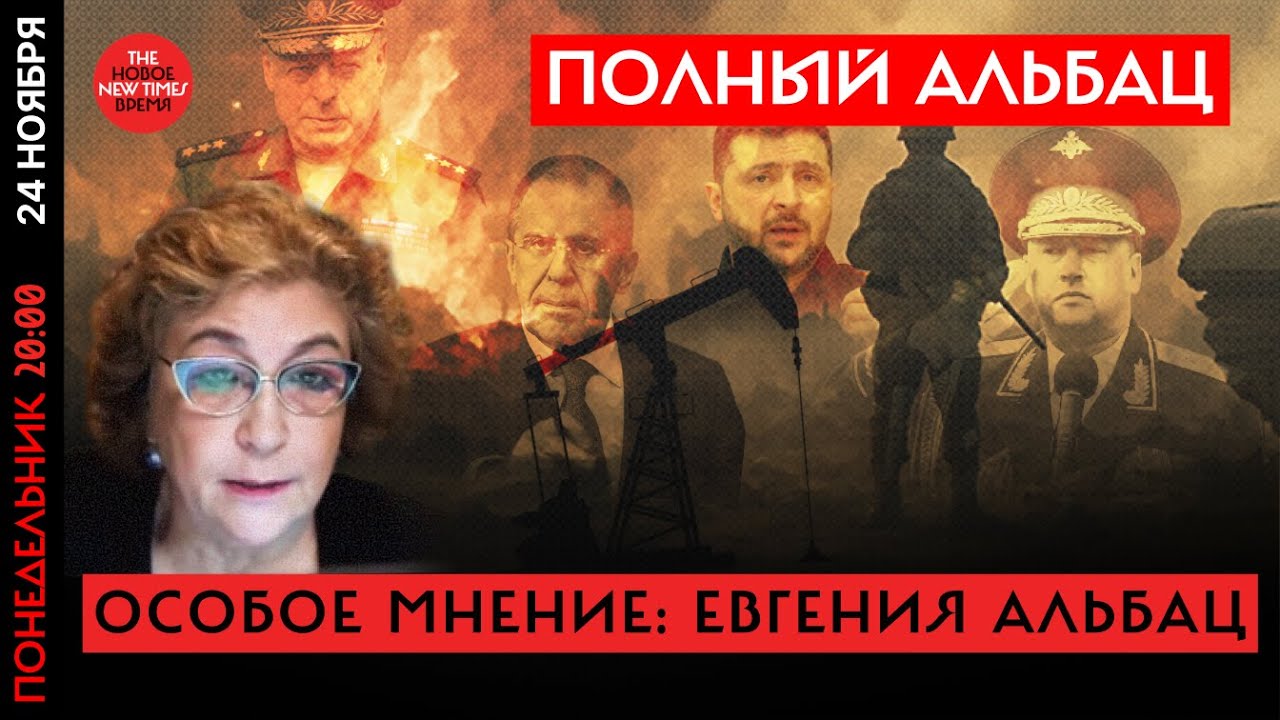
The results that many expected by the end of 2025 (at least I was most waiting for), namely the end of the war, did not happen. On Sunday, the President of Ukraine, Volodymyr Zelensky, and the President of the United States of America, Donald Trump, met in Florida. Before this, Trump, as is his custom, called Putin. And immediately after this call, the president's assistant for international affairs, Ushakov, came out to the journalists and said that Ukraine needs to withdraw its troops from Donbas as quickly as possible, leave Donbas, and abandon all its territorial claims to Donbas. When Volodymyr Zelensky and Donald Trump spoke at a press conference after the talks, Zelensky said that they had discussed everything and agreed «by 90 percent», but there were still unresolved issues. Obviously, the issue of territories is that very unresolved problem. Trump also said that the territorial problem remains, but it must be understood that it might be better to agree now, as further on, Ukraine might lose even more land. He meant that Putin is not going to stop, that Putin will continue to bomb Ukraine and thus force Zelensky to make territorial concessions.
The meeting on Sunday was preceded by completely frantic bombings of Ukrainian cities, primarily Kyiv and Odesa. In Kyiv, most of the city was left without electricity. The situation in Odesa is also very difficult. The «New York Times» published a large report from Odesa about how people live there when there is practically no heat, elevators do not work, and there is no hot water. It is quite obvious that Putin has set himself the task of completely destroying Ukraine's energy infrastructure and forcing people to simply flee the country. Once again, a child was killed, this time Kristina, who was 4 years old, died in the Zhytomyr region as a result of a Russian raid. More than 400 drones and 50 missiles were launched over Kyiv alone. Russia, of course, should bow to Chairman Xi: through China, supplies of chips necessary for the production of these killer missiles are coming.
War without respite
Putin once again met with the generals, again in camouflage. He emphasizes in every way that he is not just the supreme commander-in-chief, but he leads this victorious march of Russian troops capturing houses and villages in eastern Ukraine. Putin made it clear that he is not going to stop the war, he is ready to cease fire only after some peace agreement is signed.
Zelensky, apparently, will have to agree to some concessions in Donbas because Ukraine cannot win a war of attrition against Russia: Russia has four times the population, its economy is on a war footing, and Putin does not care how many civilians he kills
On the other hand, he also needs a break. The economic situation is very difficult. The situation in businesses is very difficult. He bluffs, pretends that everything is fine with him. Maybe he is fine, but the rest of the country's population is not doing so well. And therefore, it seems to me that in the coming year, even in the coming months, they will agree on something. Perhaps we will see a Cyprus option. Maybe it will be the option of two Koreas. Although it is obvious that despite the fact that Europe provided Ukraine with a loan of 90 billion dollars, which allows covering the debts of the Ukrainian budget and paying for weapons, nevertheless, for the Korean option, as our diplomat Boris Bondarev* said, some conditions are still needed, guarantees similar to those once provided to South Korea are needed. One way or another, Zelensky, apparently, will have to agree to some concessions in Donbas because Ukraine cannot win a war of attrition against Russia: Russia has four times the population, its economy is on a war footing, and Putin does not care how many civilians he kills.
Ukraine also strikes Russian territory, primarily oil refineries, oil storage facilities, and military factories. But, as observers write, civilian casualties among the Russian population are many times less than among the civilian population of Ukraine. Zelensky is up for re-election, and he cannot help but think about what is happening to the people. I want to wish Ukrainians strength; they have shown the whole world that they are a great nation capable of resisting a much stronger opponent, capable of fighting for the right to be an independent sovereign country.
Farewell
Last week, at the age of 84, Irena Stefanovna Lesnevskaya, who was the founder of the magazine «New Times», passed away. We told the story of the magazine's creation in detail on our portal. I want to tell a little about Irena Lesnevskaya herself. At one of the anniversaries of the «New Times» magazine (and we celebrated almost every year because we were always waiting for us to be shut down), someone said this phrase: «Many talk about freedom, Lesnevskaya is one of those rare people who invest in it». This is absolutely true. In 1991, after the failed coup, she began producing television programs under the REN-TV brand, and by 1997 it was already a separate channel REN-TV. «Rena» is Lesnevskaya's name. Then the story of «New Times» began.
Irena Stefanovna was an absolutely amazing person. With a very difficult fate, which - only in fairy tales, I think, it happens - despite the wild difficulties that had to be overcome, was generally successful. In the sense that she wanted to create a television channel - and she created it. She wanted to make an «oxygen cushion» in the form of a magazine for everyone - she did it. She raised a wonderful son, who was the main love of her life. She was married three times, she had a million admirers, half of Moscow ran after her, many, many very famous people admired Lesnevskaya.
She was born during the war in 1942 in Kazakhstan. Her father, Stefan Lesnevsky, was in exile there. Her grandfather, Jan Lesnevsky, was a well-known Polish communist, sat in various prisons and exiles together with Dzerzhinsky, the creator of the bloody VChK institute. And when 1937 came, naturally, as was customary with comrade Stalin and all the others, he was imprisoned and shot in one of the Moscow prisons. As Irena Stefanovna's brother, Stanislav Lesnevsky (he was 7 years older than her and was very involved in Irena's upbringing, according to her), told, their grandfather's Polish family did not particularly like their mother. She was Jewish, and, as Stanislav Lesnevsky said in an interview with me - well, what can you do, Poles did not like Jews, Jews did not like Poles.
Irena grew up first in Kazakhstan, in this exile. They lived insanely poor. Her father studied at the Moscow Power Engineering Institute, the famous MPEI. He was arrested right in front of his son's eyes, and then they and their mother came to him in the Urlyutub district of Kazakhstan. Stefan Yanovich Lesnevsky received five years of administrative exile, for the son of a shot «enemy of the people» it was, in general, quite a vegetarian term. Irena Lesnevskaya was born in this exile. Then they returned to Moscow, lived in a communal apartment in Gazetny Lane.
Irena Stefanovna's maternal grandfather, Yakov Markovich Goldstein, was a watchmaker. (Jan Lesnevsky, by the way, was a shoemaker, and when after the revolution he was offered some positions, he refused and continued to engage in shoemaking.) And Yakov Goldstein was a watchmaker. Once Irena, who did not particularly spread about her own Jewishness, showed me albums: she had rabbis in her family, they lived in a Hasidic town in Poltava region, Ukraine. Most of the Goldsteins left for America before the First World War, and Irena Stefanovna's grandfather for some reason stayed in tsarist Russia. In 1924, they moved to Moscow, settled on Trubnaya, and there the grandfather opened his small watch workshop.
Irena Stefanovna's mother earned money by teaching German, tutoring, and then working in a school for children with developmental disabilities, as we would say now. Of course, there was little money, so Irena started working at a very young age: in some laboratory, in a kindergarten, in a pioneer camp. And then she fell in love. As she herself said, it was madness. She fell in love with the famous political prisoner and famous writer Vladimir Maksimov. In my opinion, it was love for a lifetime. And life was very difficult because Maksimov was not published, as many other wonderful and talented writers were not published, who as a result drowned their lives in a glass of vodka. They could all be endlessly seen in the Central House of Writers on Herzen Street, where they served snacks of sauerkraut, and there they drank terribly. Maksimov was a binge drinker, he drank for two weeks, sold everything that was in the house. This continued for 12 years, until the KGB explained to Maksimov that either he leaves to hell, or they imprison him. Maksimov left, ended up in Paris. And in Paris, he began publishing the famous magazine «Continent». And Lesnevskaya had all the pleasures of persecution from the KGB, which very persistently worked on her. For this, there was a special person in the Writers' Union, General Ilyin, who was very good at talking to writers. In general, it was a difficult story...
The freest channel
And then at some point, the television period of Lesnevskaya begins. She came to Central Television (there was no other, actually). And there was the program «Kinopanorama». She wrote texts, directed this program, but, in my opinion, until 1988 her name did not appear in the credits. They made the program for a long time with Eldar Ryazanov, who hosted «Kinopanorama». And then what happened happened: perestroika, freedom, REN-TV, Lesnevskaya made various programs, including funny ones, like «White Parrot» with Nikulin, Arkanov, Gorin, with the best satirists of the country.
The years of emerging capitalism in Russia, the fierce struggle for the REN-TV channel, for advertising, for a place in society hardened her
As far as I know, she dictated a book, it is a rather frank book, they made it together with Olga Kuchkina. In general, it was a very tough life. And Lesnevskaya - a smart, powerful, very pragmatic, tough person, sometimes extremely cruel. I myself encountered this when Irena Stefanovna in 2013 decided that the «New Times» magazine was no longer needed. And I allowed myself to disagree with this. In general, the years of emerging capitalism in Russia, the fierce struggle for the REN-TV channel, for advertising, for a place in society hardened her. She did an interview with Boris Yeltsin. She did the first interview with Naina Yeltsina. She participated in the campaign for Boris Yeltsin's election in 1996. And we talked a lot about this later, how much it was a terrible mistake for the democratic development of Russia. First on the shooting of the parliament in 1993, and then in the presidential elections of 1996, in fact, the democratic path of Russia ended. People in Russia saw that nothing changes, that no matter what words are spoken, the authorities, as they killed, continue to kill, as they were unable to conduct fair elections, so they are unable. Another question is that, of course, it is impossible even to compare the elections that were under Boris Yeltsin with what happened later under Putin, when open falsification of voting results began, ballot stuffing, substitutions, non-admission of opponents, non-admission of opposition parties, and so on.
Unfortunately, during Boris Yeltsin's time, monstrous mistakes were made. And the choice of the USSR KGB lieutenant colonel Vladimir Putin as the president's successor, as it seems to me, was a quite logical result of Yeltsin's second term, when Yeltsin began to bring more and more KGB officers closer to him. I remember well how Irena Stefanovna and I sat at her house on the night when in March 2000 the first, only more or less clean, elections of Putin took place. The only ones. And we talked with her about how it could happen that in a country that lost millions of people repressed, shot, and killed starting with the red terror of 1918, when there was just constant destruction of its own people and its own country, could elect a president from the KGB.
Throughout our joint work on the magazine, Lesnevskaya never allowed herself any censorship restrictions
Returning to Lesnevskaya, on February 12, 2007, the first issue of The New Times with James Bond on the cover and the declared main theme of the issue: «Who and why killed Alexander Litvinenko?» appeared on the newsstands. This is how Irena set the bar that there are no forbidden topics, and this was a completely forbidden topic because everyone understood that the order to kill the former FSB officer from the anti-terrorism department came from the very top, that such orders were given only by the top officials of the state. Everyone perfectly understood that Lesnevskaya was taking a big risk by starting the magazine with this topic. Nevertheless, throughout our joint work, she never allowed herself any censorship restrictions. After a very tough article «The Kremlin's Black Cash», about how during the 2007 parliamentary campaign money was brought in suitcases to the presidential administration, and then <deputy head of the administration> Surkov distributed this money to all parties, both red and white, democratic and non-democratic, one of the authors, Natasha Morar, was not allowed into Russia on the grounds that she was a citizen of Moldova, although she graduated from the sociology faculty, moreover, the budget department of Moscow State University. She was deported from Domodedovo and declared a threat to national security. It took 4 years and 3 months for Natasha to be allowed into Russia. All this went through Lesnevskaya, and there was never any reproach from her, although she warned that «it would be bad». Because even before that, when in the third and fourth issues of the magazine a large article by Ilya Barabanov* was published about how the organization of hooligans and Red Guards «Nashi» was created and how it worked, Vladislav Surkov called her and said: fire Albats. To which Lesnevskaya directly sent him to hell.
Another story about Irena Stefanovna is related to Alexei Navalny**. In 2017, when Lesnevskaya was no longer connected with the magazine and all the nightmares and difficulties associated with our divorce had already happened, Alexei Navalny, upon leaving the premises where he rented some rooms for the «Anti-Corruption Foundation»***, was splashed in the eyes with green paint, in which something was clearly added, after which Navalny could not look at the light. Apparently, the retina was damaged, he had a narrowed pupil for the rest of his life. Doctors in Moscow, both at the Helmholtz Institute and others, told him that he needed to go abroad for surgery, otherwise, he would remain blind in one eye, and that this operation could not be done in Moscow. Not because there were no good hands, there were hands, but there was no special equipment. And Alexei did not have a foreign passport, it was taken away after he was under house arrest for a year, then there was the «Kirovles» case.
This was not the first problem that needed to be solved when it came to Alexei. And I then contacted one of my very good acquaintances, who had access to various high places, and asked for advice on how to act. The person advised writing a letter to Mikhail Fedotov, who then headed the Human Rights Council under the President of the Russian Federation. It was necessary to act officially through the presidential administration. So, it was necessary to go directly to Fedotov. And I understood that the only one who could negotiate with Fedotov and whom he could not refuse was Irena Lesnevskaya. She called Fedotov and asked him to come to her home. This is all Lesnevskaya. Fedotov could not say «no» to her. But he said he wanted to make sure that Navalny was not lying, that he really had such a situation with his eye. And at Irena Stefanovna's house, Alexei Navalny and Mikhail Fedotov met. Fedotov had the pleasure of making sure that Alexei was completely crippled. At the same time, I wrote to Dmitry Peskov, the president's press secretary, he also had some conditions. In short, the incredible miracle that only Lesnevskaya could do happened. She was generally a person who could do miracles. And I remember well how Alexei called me and said that he had the passport in his hands. The rest is history. He had a very successful operation in Spain. And although they could not completely cure his eye, nevertheless, he could see with it.
Truth against dictatorship
Another event of the outgoing year, I think, is very important to mention a stunning film that was released on Netflix. It is called Cover Up, it is a documentary film dedicated to the famous investigative journalist Seymour Hersh. This is the very Hersh who first reported on how orders were given in Vietnam to destroy at least two villages along with the inhabitants - the Nazis did the same. And this is the very Hersh who uncovered and published in the «New Yorker» the story of «Abu Ghraib», when American guards of the Iraqi prison abused the prisoners.
The most important tool of resistance to authoritarianism is truth. It gives society a tool not only of control but also of fighting against the authorities, who always try to hide information, always try to deceive
I found it interesting to watch not only as a journalist but also as a person who teaches about authoritarian regimes and thinks a lot about the fact that the presidential system that exists in the United States of America is very dangerous from the point of view of turning into autocracy, into dictatorship, as it happened many times in Latin America. Unlike Europe, where almost all countries are parliamentary republics. I watched this film and thought about the fact that man is bad. This is at the core of political philosophy. Read the First Book of the Old Testament, the Torah, which is called «Genesis» in the Christian version, and «Bereshit», «Beginning» in the Jewish Bible. Man in his natural state is not much different from a wild animal. There is neither morality nor law, nothing. Man is driven by the instinct of self-preservation, the instinct of reproduction. And in this sense, as philosophers wrote, he is terrible and bad. And therefore it is so important that around a person is built what we now call institutions. Institutions are not only organizations, not only rules, constitutions, laws, but they are also norms and concepts. That on which trust between people is based, when there are rules - even not necessarily written, but unwritten rules of life in society: what can be done and what cannot be done.
And in this documentary film, it is very well shown that the most important tool of resistance to authoritarianism is truth. Because the truth, which is uncovered by journalists like Seymour Hersh, gives society a tool not only of control but also of fighting against the authorities, who always try to hide information, always try to deceive. Freedom of the press is the most important institution that is a tool of protection and struggle of society against any authoritarian, dictatorial power. Exactly for this reason, as we observed in Russia, Putin began with the dispersal of NTV, with the destruction of free media. And exactly for this reason, after the murder of Anya Politkovskaya in 2006, Lesnevskaya considered it so necessary to create a free magazine. Because without truth, society cannot do without. Without truth, only the same dictators, autocrats, and tyrants as he himself can fight against a dictator, an autocrat, a tyrant.
Tomorrow the sun will rise
In the Soviet Union, we did not have another holiday as important as the New Year. It was the only non-ideological holiday. And it was a holiday of hope. Well, it can't be bad all the time. Something good must happen. I think it is still very important to believe that good things will happen. No matter what happens, Lesnevskaya always said: and still, the sun will rise tomorrow. Despite all that she went through and saw a lot of grief and misfortune in her life, she always believed that the sun would rise tomorrow, it was an important, very important mantra. It is the only thing that allows people to continue to fight and believe that sooner or later they will win.
Video version
* Evgenia Albats, Boris Bondarev, Ilya Barabanov are declared «foreign agents» in the Russian Federation.
** Alexei Navalny is still on the list of «terrorists and extremists».
*** The Anti-Corruption Foundation (FBK) is considered an «extremist» and «undesirable» organization in the Russian Federation.