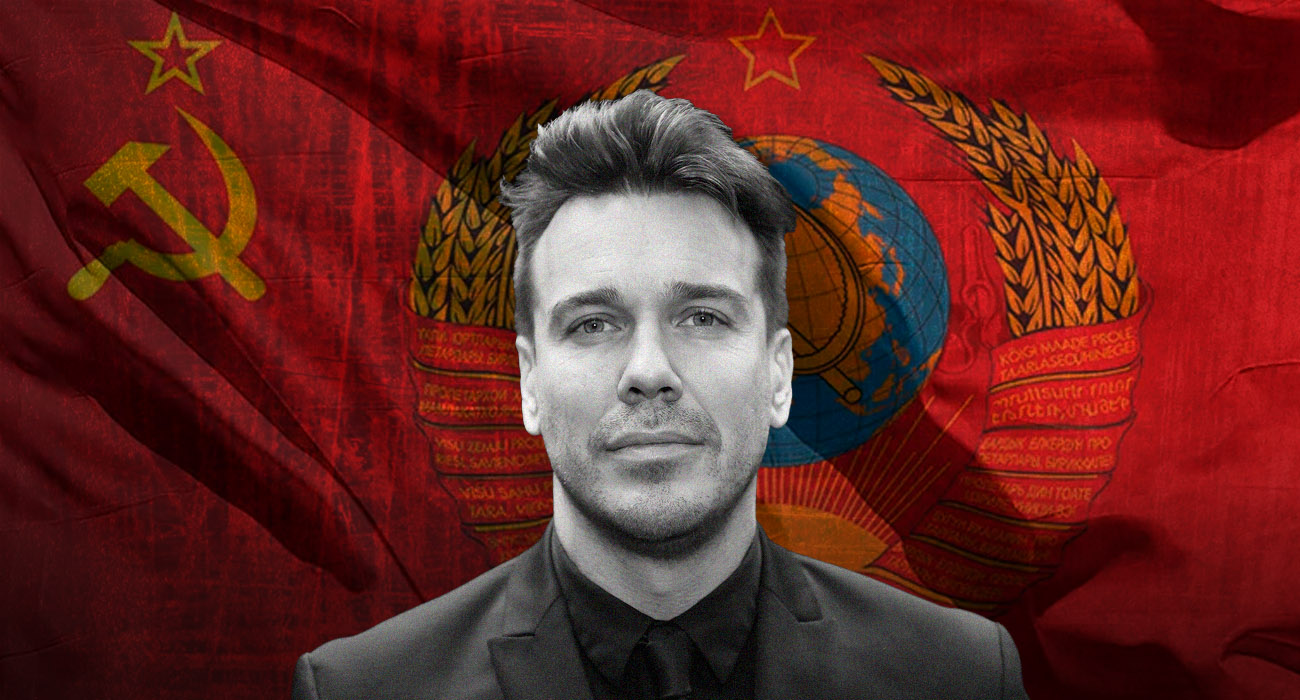
 Mikhail Zygar. Photo: E. Chesnokova / RIA Novosti
Evgenia Albats*: Mikhail Zygar is releasing another book — «The Dark Side of the Earth. A story about how the Soviet people defeated the Soviet Union». My first question, Mikhail, is about the dark side of the Earth. Do I understand correctly that this is an allusion to the shadow side of the Earth, meaning the state when the Earth covers itself with its shadow from the Sun's rays?
Mikhail Zygar: On one hand, of course, it's a play on Dark Side of the Moon, but it's really about the so-called bipolar world order and the bipolar attitude towards this world. I'm trying to show that this is a rather ridiculous approach, and dividing everything into a black side and a white side is very primitive, hence the ironic title. I'm rather saying with this title that there are no dark sides. Of course, there is a banal notion that on the other side of the planet everything is completely different, and as it was supposed to be believed in the Soviet Union and as today's propaganda presents it, everything on our side is blooming and thriving, while on that side there is a terrible global backstage.
Evgenia Albats: I was just thinking that you chose this title to show that there was a country called the Soviet Union, which had many very talented people, which had many things that other countries did not: resources, a vast territory, and human capital, yet it was always under some shadow that closed it off from the sun, and it lived in the dark. There is such a notion among Orthodox Jews that the whole world lives in absolute darkness, and people follow the light of the Torah, only this helps them see some light. To some extent, this is Plato's idea that people sit in a dark cave and are afraid to get out into the sun because they are afraid to see themselves and others in some light they are not used to. That's why Plato wrote that countries should be governed by philosophers who are not afraid to look at the light.
Mikhail Zygar: These are also images that fit and also explain the title of this book. There are many storylines about different heroes. For example, there is a story about a young Grigory Yavlinsky, who goes to the city of Leninsk-Kuznetsky by assignment and discovers there that all the people in the Soviet Union, whom he, it turns out, did not know until that moment, have lives that are a programmed dead end. There is an image of a monstrous poster «Communism is inevitable», but in fact, it is an inevitable dead end, and for each person, essentially, life passes in a dead-end mine. There are many frightening images, yes.
Collapse or disintegration?
Evgenia Albats: In your subtitle — a story about how the Soviet people defeated the Soviet Union. Honestly, I didn't understand this because the Soviet people, including your heroes, are very not black-and-white, they have a lot of intertwining elements. One of the heroes, as it seemed to me, who represents the people, not the elite that lives far from the people, but the people, is Vladimir Vysotsky. And at the same time, the most popular of the people's bards has a life dream of a «Mercedes», and he dies from drug addiction, from an overdose.
The Soviet Union was not dismantled. It disintegrated from within, as a result of the efforts and lack of efforts of those people who lived in the Soviet Union
Mikhail Zygar: It seems to me that the subtitle «How the Soviet people defeated the Soviet Union» is very accurate because that's what I wanted to write the book about. I want to preface the answer by saying that I wrote the book for more than six years, even before the COVID times, I started interviewing different people. I traveled almost the entire former Soviet Union. I met mainly with politicians, but not only with politicians, with former leaders of the people's fronts of various republics, with former last or penultimate first secretaries of the republics or first presidents. In general, with a large number of people, but it was very important for me not to focus only on Moscow. It was important for me to look from different sides, from Vilnius, from Tbilisi, from Kyiv, from various points. And with some people, I had very interesting dialogues. There were several such people who corrected me: I said that I was writing a book about the disintegration of the Soviet Union, and they said — you should talk about dismantling. Because the Soviet Union did not disintegrate, it was dismantled. I do not think that the Soviet Union was dismantled. And I wanted to demonstrate that it was not a global backstage. It was not a CIA conspiracy or the Dulles plan. And it would be primitive to reduce the historical process to the consequence of the arms race and say that Reagan and Bush Sr. won the Cold War. It seems to me that it is a much more complex process with millions of actors, and the Soviet Union disintegrated because it was the consequence of the life activities of those people who lived in the Soviet Union. It disintegrated from within as a result of the efforts and lack of efforts of those people who lived in the Soviet Union.
I honestly admit, I do not divide people into the elite and the people. For me, everyone is people, from the Baltic republics to Central Asia, including the cultural elite. The book is mainly about the idols of millions, about the rulers of thoughts, about those people who intellectually and culturally lead people, who create the space in which people begin to believe. The book is largely about what people believe in and how their faith changes, starting from 1961 to 1991. It seems to me that this is exactly what I wanted to say, this is the conclusion I came to, but I could not come to another conclusion because this is precisely my belief. I believe that what happens historically is the effort of the people, not a handful of conspirators.
Evgenia Albats: It's not about conspirators. You are probably familiar with Yegor Gaidar's book «The Death of an Empire», where he shows the mechanism of how the Soviet Union collapsed. And you, by the way, in the book, Grigory Yavlinsky from Leninsk-Kuznetsky, where he was sent by assignment, returns to Moscow. And he writes a dissertation, the essence of which was that everything simply does not work and cannot work. After which, I think, he was expelled from the institute or asked to take a leave.
Mikhail Zygar: There are two terrible stories. First, he is taken by the KGB, and then he is locked in a tuberculosis dispensary.
Evgenia Albats: Well, yes, as it always was under Soviet power, they cannot believe that a normal healthy person can think that Soviet power, the Soviet economy, cannot work.
Mikhail Zygar: That is, it theoretically does not work, but at the same time, it works like a chicken that has had its head cut off, continues to run. But Yavlinsky states that it all does not work, and there are many such people who begin to insist that it cannot continue like this. And Gaidar is in my book, and Chubais, and this economic circle. It is precisely from the intellectual efforts of many different people that a general understanding is created that nothing works.
Evgenia Albats: This book in style, it seems to me, in how it is written — in such a real past tense, reminded me very much of your book about the end of the Russian Empire «The Empire Must Die». It seemed to me that this is just the second volume.
Mikhail Zygar: That's exactly how it is. It was conceived that way. Both books are synchronously written as if it were happening now. But at the same time, that was my initial idea — to write one and the other book about the collapse of two empires. Moreover, I plan to write a third part when the Third Empire similarly ceases to exist.
About cooperation and collaborators
Evgenia Albats: You have many very interesting characters in your book. Three are most interesting to me: Grebenshchikov*, Nevzorov*, and you, Mikhail. Although you also have Alla Pugacheva, and the leaders of the people's fronts, and the then leader of Kyrgyzstan Akaev and his story about what happened in Belovezhskaya Pushcha. And, of course, there is Chubais and Gaidar. But I would like to talk to you primarily about BG. The history of the Leningrad Rock Club is known, we wrote about it back in «Moscow News». The fact that this club was created by the KGB to control rockers is also not a big secret. I was struck by how you portray Grebenshchikov. I understand that many people follow him, his philosophy of non-violence, etc. And in this sense, especially in recent years, Grebenshchikov appears almost saintly. Your Grebenshchikov is a very unpleasant young man who is in love with himself more than he deserves.
What is most interesting to me, as a person who has been writing or researching the KGB all my life? Grebenshchikov says that his grandfather was the manager of Soviet special services back in the 1930s. In parentheses, I will say that Putin's father also worked in the same economic department of the NKVD, which was headed by one of the most terrible Chekists, General Blokhin, who personally executed people. Grebenshchikov tells this story about his grandfather to KGB officers, which charms them. Again, a wonderful, very accurate detail. Because the KGB was one of the most closed caste structures in the Soviet Union. This detail with Grebenshchikov in the KGB is very interesting because it is very accurate. In the KGB, they primarily took people who had some relatives there. This was a very important thing for the structure.
And another quote:
«...If we want to play, then we need to go through them. And if we need to go through them, then we need to find a common language...»
You quote Grebenshchikov. That is, BG says: we are ready to make any deal with the most disgusting structure, the most vile and criminal structure of Soviet power in order to be able to play. Did he tell you this in an interview or was it written somewhere before?
Mikhail Zygar: No, of course not. Let me start half a step before that. I always respect the right of any reader to read as they feel. And in this sense, the book is written as a puzzle. It has many storylines, many fragments, many details. And every reader sees their own. I have already let it go, it has sailed away from me, and I am probably also one of the readers now. Grebenshchikov seems very sympathetic to me in this book. He is sympathetic to me as a person, but in the book, he seems a bit more complex. He seems unsympathetic to you, you look through your lenses, through the prism of your life and your experience.
Evgenia Albats: The lens of a person who was reported on, who was written about, who was therefore limited in a number of opportunities. Yes, of course, for me, people who cooperated with the KGB are beyond my respect.
Mikhail Zygar: Grebenshchikov has a certain value system. He explains that in fact, he treats both the KGB and the Soviet Union and the state as a monster, you don't need to think about it. It is impossible to cooperate with the state, it is impossible not to cooperate with the state. It can only be ignored. Quote:
«...I realized that you can't negotiate with the monster-state. Whatever you say, monsters are looking at you, thinking only one thing — now I will eat him. We didn't think about any Soviet system, compared to what we are doing, the system is nothing at all. Not even a microbe, not an infusoria. Just zero. After all, we are talking about eternal things, and the political system is like a bad spring day. It will end today, tomorrow will be another...»
BG not only did not try to cooperate with the KGB. He tried to create a smokescreen that would distract them because he is actually focused only on himself and what he is doing, on his creativity, which seems eternal to him
What is important to me and what seems important to him of that period. He has a paired character, his close friend of that time Sergey Kurekhin, who is known as a prankster, who constantly trolls everyone, constantly engages in mystifications and invents some strange reality. Of course, I heard this story about Grebenshchikov and his mythical grandfather who worked in the OGPU from him personally. I spent a lot of time with Boris Borisovich. He was one of my first interlocutors when I started writing this book. This is all firsthand. And I perceive it as in some sense a prank. He not only did not try to cooperate with the KGB. He tried to create a smokescreen that would distract them because he is actually focused only on himself and what he is doing, on his creativity, which seems eternal to him. Only this matters, only his music matters. Everything else, the KGB, the OGPU, the CPSU — it's all a bad spring day that doesn't scare him, doesn't embarrass him, doesn't interest him. He does it not for a good life, but so that they leave him alone. And I perfectly understand you. For people for whom the KGB is not a bad spring day, it is a much brighter, more tangible, perhaps more vile threat — it is difficult to share his approach. He treats it in some sense as a blessed musician, and he has a completely different approach to the KGB, he prefers to ignore it. And thus begins to cooperate with it. And he openly talks about it. There is a development of this story when the American Joanna Stingray arrives, and in fact, he acts as her curator and intermediary. He comes to her and says that they are interested in you, it's time for you to meet them halfway.
Evgenia Albats: You quote from the book how Grebenshchikov talks about his relationship with the office:
«...About once every two months, the curator calls him to a safe house. This is always the dwelling of ordinary citizens who cooperate with the KGB and provide their home for their needs. Sometimes the curator changes...»
That is, he definitely signed a paper, a skin as it is called, agreeing to cooperate with the state security agencies and provide them with the necessary information. In my second book about the KGB, I have a whole chapter about informers. I talked to people who were recruited. All of them, especially those who were called the creative intelligentsia, cooperated with the KGB precisely to be left alone. To be allowed to go abroad, to be allowed to work normally, to be allowed to publish. They wanted to live normally, they wanted to get an apartment, and they could help. When you talk about Grebenshchikov — about the eternal, I listen to you and think: this is «Demons». Absolute «Demons» by Dostoevsky.
Mikhail Zygar: I understand everything you are talking about, at the same time Grebenshchikov believes that it is all different.
Evgenia Albats: I have communicated with such people, and I know that if they do not dare to open up, they remain under control forever. They are not let go. And the story of Grebenshchikov, which I did not know, shocked me greatly. Because I do not understand how in the head of a talented person all this combines. He preaches all the time now, I sometimes watch him on the internet. He talks about the eternal, about goodness, about important things. And I think to myself, how many did he casually betray because he thought it was unimportant, it was not eternal.
Mikhail Zygar: You look at it, among other things, also as a historian of the organs. This is your path and your expertise. And he looks at it completely differently, he even tells how and what he talked about with these people from the organs. He says that he specifically presented information to them in such a way as not to report on anyone. On the contrary, he used communication with them to warn his friends. If they asked about someone, he would then go and warn that they were interested in you. In the previous book you mentioned, «The Empire Must Die», I had a favorite character, Georgy Gapon, who believed that he could ride the devil and have fun. This, of course, is a deceitful hope. As a rule, any person who hopes that he is using them, and not being used, is deluded and mistaken, thinking that it is possible. But I don't know. You, as a specialist, can see better. Maybe there are ironclad rules, and it always happens this way. In the case of Grebenshchikov, I don't fully understand, I think he was rather let go. Most likely, they forgot about him. Or he really turned out to be a person who bent his line and, in general, was not a toy in their hands. He turned out to be a larger figure than those people with the same names Viktor Vasilyevich or Vladimir Viktorovich or Vadim Vyacheslavovich, who periodically curated him.
Young Mistakes
Evgenia Albats: Another one is Solzhenitsyn, he is described very interestingly by you. I am very grateful to you for not kneeling before him because it is very difficult, he was indeed a great writer. And at the same time, as a person, he was absolute scum. And his political views were completely monstrous. But at the same time, it is impossible not to think that this is a person who wrote «The Gulag Archipelago», «One Day in the Life of Ivan Denisovich», «Cancer Ward», «In the First Circle», etc. It is very difficult to write about Solzhenitsyn, and you wrote about him very frankly, it seems to me, and very accurately.
I was interested in another character of yours, who was very much in the last months of the Soviet Union's life. This is Alexander Nevzorov. I remember his «600 Seconds» well. Actually, Nevzorov himself talks about the fact that he was a fascist, although the most openly «I am a fascist» is said by Dugin in your book. From this narrative, it turns out that Nevzorov was in constant direct contact with both the head of the KGB Kryuchkov and the former head of administrative bodies, and then the speaker of what they called the parliament, Anatoly Lukyanov. And with other people who later formed the GKChP. And that he was just one of those who pushed these elders to make a coup. Is this all really so, or is it Nevzorov's fantasies?
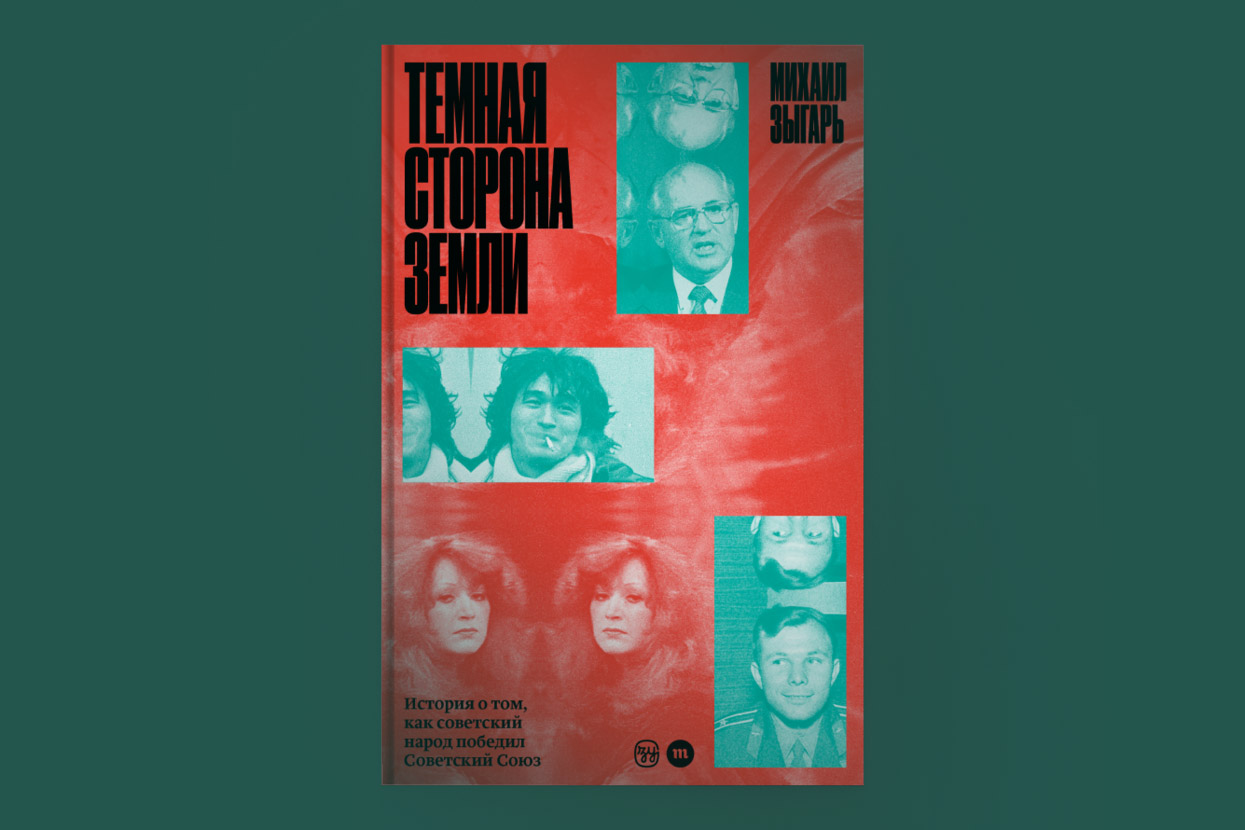
Cover of Mikhail Zygar's new book
Mikhail Zygar: Very good question. I emphasize throughout the book that the source of all these stories, all these legends, is Alexander Glebovich himself, because all his counterparts were no longer alive at the time I was writing the book. Therefore, it is difficult for me to determine where the terrible black myth about himself, which Nevzorov creates, begins, and where the truth is. His stories seem very convincing to me in places because there are many details, for example, when he starts telling that Kryuchkov's adjutant knew how many lemon slices to put in his tea and what he likes to eat and drink. And this suggests that maybe he is mythologizing something, but there are some grounds. At the same time, today's Nevzorov, critically relating to himself, talks about this black biography of his, which he now kind of condescendingly condemns. He treats it as a youthful mistake, but at the same time emphasizes that he was not the only one like that. There were, for example, those people who signed the famous «Word to the People», there were writers like Prokhanov, or the same Dugin, some other people. It was a creative mass that constantly went to Lubyanka and to Lukyanov, and buzzed about the need to take power into their own hands. But as one of the youngest and most passionate, Nevzorov was unlikely to be influential, it is visible everywhere that none of his outbursts led to anything. The only thing he once achieved, as he tells, and I quite believe this, is that he brought General Samsonov to Leningrad television on the first day of the GKChP, August 19, and made him record a menacing address. But then, in fact, Sobchak nullified all this, who came after to General Samsonov and turned him around. That is, Nevzorov had passion, he tried to somehow inspire this audience. But he also tells with bitterness that there was no person among them like Leon Trotsky, who could, sitting at the table, shoot the interlocutor and continue to drink tea and converse while he is dragged away, leaving a bloody trail. He kind of regrets that none of the GKChP members turned out to be such a passionate cannibal.
Evgenia Albats: By the way, I don't know this story about Trotsky, although I have been reading a lot of his diaries lately...
Mikhail Zygar: This is a myth, it seems to me. Yes, of course, it is a myth.
Evgenia Albats: Of course, Nevzorov created a myth about himself, but after all, he was inspired by something. Nevzorov's grandfather was also a KGB officer, and, I think, a high-ranking one, he himself mentions this somewhere. So he was also part of this very narrow circle.
Mikhail Zygar: There is a very nice, it seems to me, scene about how young Grebenshchikov meets little Nevzorov in a pioneer camp and remembers how they met as children. And he says that Nevzorov was terribly spoiled, adored by all the nannies, and all the nurses, and all the counselors, and everyone fussed over him and looked into his mouth.
Evgenia Albats: Notice that Nevzorov almost never mentions either Putin or Zolotov, despite the fact that it is claimed by my interlocutors that Viktor Zolotov was Nevzorov's main «roof» recently. Moreover, when Nevzorov had already left and persecution began against him, they treated him as harshly as they treat those whom the Chekists and Putin personally consider traitors. They take away property, persecute his relatives. In short, it is clear that there is a lot of personal stuff there. But you probably remember, he gave one interview at the very beginning, in which he said: I never violated our agreements. Meaning agreements with Putin's entourage. I am trying to understand on what principle the Chekists are now persecuting people. After all, there have never been as many political prisoners in Russia as there are now. And there were no such terms as today's in Brezhnev's times.
Today's, Putin and his team, are trying to crush any resistance in the bud because once they didn't crush it, they gave in in the 80s, and here is the result. Therefore, such a mistake cannot be repeated a second time.
Mikhail Zygar: I also write about this in the book, it was important for me to describe the period from the 60s to the early 90s because the current government was formed, grew, and was educated precisely in those years. Their worldview is largely from those years. And they, of course, take into account the mistakes of previous generations. If that period was under the slogan «you can't imprison everyone», today's government responds to this: «no, we will imprison everyone». Because from their point of view, the Soviet regime, the Soviet KGB stumbled on its own vegetarianism. They thought they couldn't go against the whole society, they had to somehow have a dialogue with society. Today's, Putin and his team, have learned that lesson, they believe that you can go against society. You can break everyone's back. You just need to crush everything that resists in the bud because once they didn't crush it, once they gave in in the 80s, and here is the result. Therefore, such a mistake cannot be repeated a second time.
They Got to Everyone
Evgenia Albats: You yourself have a term of eight and a half years, you were sentenced in absentia for «discrediting the Russian army». Do you understand, Mikhail, what is the point of giving you a term, declaring all the leading «Dozhd»** as extremists, initiating criminal cases, sentencing Roman Badanin*. Do you see the logic?
Mikhail Zygar: It seems to me that this is part of the information war. What is our value? In that we have some audience in Russia, there are some people who can read our books, can watch our broadcasts, somehow grow, develop, consuming our content. This is not only the conditional flock of the «Dozhd» channel, this is also the new generation. This is the generation of the «StopTime» group and Diana Loginova, who declare themselves, that they also exist. They live in Putin's Russia, but at the same time, they are part of our intellectual Russia with you, they want to live in a human state, not a cannibalistic one. And therefore, of course, all persecutions are a struggle for the minds of the next generations. For this, all people who can influence, who can educate a generation in human values, need to be maximally marginalized. Another question, of course, is how it works. Our terms, our foreign agent badges, the labels they try to hang on our foreheads — is this anti-advertising? Or, on the contrary — it is embarrassing, of course, to talk about this as a sign of quality, but on the other hand, maybe this is how it works with generation Z. Maybe many get used to the fact that foreign agents are not scary. But, of course, we see that for a large number of people in Russia it is still very scary. The consequence of my sentence is that all my books are no longer sold in Russia. I remember how two years ago Nikita Sergeyevich Mikhalkov raged in his broadcast and shouted, look, he is a foreign agent, and his books are still in the top. He left Russia, and in all bookstores, his books are sold, and moreover, they are everywhere on the bestseller tables. Why? He translated this into why he (I, that is) earns. But why do these books sell? If my books are bestsellers, it means people want to read them. There is demand. This demand needs to be cut off. Now we see that this operation is complete. The books are no longer sold. No bookstore will risk selling, no publisher will risk publishing. The last «publisher's case», with arrests, was a very important signal to all publishers. We used to think that books were below the radar, that television and the idols of millions were something more important. And Ivan Urgant cannot afford to post a black square on Instagram, for this he will immediately get hit. As if they hit on the tops. Now there is no such scale. Now they will get to everyone, not only television is under the gun, but any media, and the book market. It would seem, this is a tiny market, for a book 10,000 copies is already a large print run, 100,000 copies is already a bestseller. 100,000 by social media standards is nothing. But they have already got to the book market, destroyed it, in fact: no «wrong», unapproved books should be published and sold. It seems to me that all these persecutions are because they didn't keep an eye on the writers in the Soviet years.
Evgenia Albats: But this also says that they are not at all confident in the strength of their power. And all the talk about the fact that the entire Soviet people as one supports Putin is complete nonsense.
Mikhail Zygar: Well, they know that this is not so. I have this mythological story too, when Brezhnev says to Suslov: «Reaping the fruits of our own propaganda». As if they partly understand that they themselves created this picture. Someone really believes in this, someone understands that in order for the picture to correspond to reality, you need to constantly cut down the forest, thin out, weed out the weeds, pull out foreign agents. And yes, they must hit their own. They must hit in all directions so that no one gets out of line.
Author's Voice
Evgenia Albats: And another hero of this book is undoubtedly you. Firstly, you write about yourself there. Secondly, there is a lot of authorial. You constantly hear your voice. And you understand that you also look at your heroes, you evaluate them with the eyes of a person who was a very small boy when the Soviet Union collapsed. You were born in 1981, which means you were 10 years old when the Soviet Union was gone. By the way, it seems to me that you felt the resentment that we, the people who lived then, had, that no one asked us, that everything was done somehow completely stealthily, quietly, they just lowered the flag at night. And not because we were imperialists, as it is now customary to say. We had a big country, and it was really hard to suddenly find out that your country no longer exists.
You start the book with your father, with the fact that in the last courses he was recruited into the KGB, and he worked as a cryptographer. So I understand that it was the eighth main directorate of the KGB of the USSR, which had an operational-technical department. There was a lot of everything there, in this main directorate, including terrible things...
Mikhail Zygar: It's hard for me to say. You won't believe it, I never talked to him about this in my life. I don't know where he worked. At all.
Evgenia Albats: But you knew that he was a cryptographer?
Mikhail Zygar: Yes, of course.
Evgenia Albats: You lived in Angola. So I understand, since you studied at Cairo University, at some point you lived in Egypt too.
Mikhail Zygar: No, I lived in Egypt when I was studying at MGIMO and was sent for a year on an internship. I studied at Cairo University for a year because I was learning Arabic.
Evgenia Albats: I understand, but MGIMO is also a very special structure, a special university.
Mikhail Zygar: Do you want me to tell you the story of how I was recruited when I graduated from the institute and was going to enter graduate school? It was amazing. In the book, of course, I don't get to this because the book ends in 1991, and this was 2003, I was just entering graduate school. To enter graduate school, you had to bring a certified copy of your diploma. And the copy of the diploma was certified by Mikhail Mikhailovich, who sat in room 201. I didn't know who Mikhail Mikhailovich was and why his signature was this sacred artifact that certified the photocopy of my diploma. And I naively went to Mikhail Mikhailovich. 2003 was already Putin's, but in fact, Mikhail Mikhailovich had completely lost, it seems to me, all skills of talking to young people. So he, you know, directly asked me: «Well, Mikhail Viktorovich, would you like to serve the Motherland?» And he so stunned me with this question that I immediately blurted out to him in response: «You know, I can't, because I already work for Berezovsky». I was indeed already a full-time correspondent for the newspaper «Kommersant», which at that time belonged to Boris Berezovsky. And in 2003, Berezovsky embodied all evil, at least for the employees of the office, because he was already in London spewing all poisons at Putin. Therefore, my confession shocked Mikhail Mikhailovich. He signed my photocopy and threw it in my face so that I would immediately get out.
Evgenia Albats: And these guys never tried to contact you again?
Mikhail Zygar: Never again.
Evgenia Albats: You know, I remember my conversation with one editor-in-chief when they also, of course, looked for all sorts of approaches, especially they were interested in everything related to Alexei Navalny***. I was the editor-in-chief New Times, and we had a lot of problems because we were considered an anti-Putin magazine. I remember the phrase that this person told me: you must understand that you can't ask them for anything without giving them something. It was clear that they wanted information primarily about Alexei Navalny, so I think. For me, of course, this was impossible. But I can't help but ask you, Misha, you were the editor-in-chief of the opposition television channel «Dozhd». You called yourself an optimistic channel, you tried to produce optimism, but your reports from Sakharov, Bolotnaya showed that you began to have stylistic differences with Putin's power. Did you have a problem in that you were, in a known world, betraying your father's entourage or what your father believed in?
Mikhail Zygar: Such a question never even occurred to me. I never belonged to my father's entourage. I didn't know these people. I write in the book that my parents divorced when I was 7 years old.
Evgenia Albats: But you communicated with your father?
Mikhail Zygar: I communicated with my father, but my father left the organs in 1990, I think.
Evgenia Albats: Isn't he still a KGB officer now?
Mikhail Zygar: No, since 1990, as far as I know, and I think I know this, he never had anything to do with the FSB. I'm not even sure if he was exactly in the KGB. He called the place of his work the general staff. And what was behind this, I don't know. I didn't find out.
Evgenia Albats: Why then do you start the book with this? After all, obviously, you are not just writing right away: guys, you should know where my roots are.
Mikhail Zygar: Look, my book starts in 1961. And I didn't live at that time, it was 20 years before I was born, so I start the book with my father's childhood, that's what the first chapter is about, the second chapter is about my mother's childhood. It seems to me that you, due to your close attention to the organs, wherever you see a beacon, you notice it. And it is really there because my father's childhood ends with a strange dilemma. He is a very talented mathematician, the winner of the All-Union Olympiad, he should go into science. And his teacher obviously expects him to go into science. But he chooses the easy path because it seems to him that it is easier, that there is no need for all this hassle. For me, this is more of a dilemma. It's not about the organs, but about the personal choice of a person. I am always more interested in psychological dilemmas. He had this one. To strain, to fight further, to enter, and there is the difficult life of a Soviet scientist — or an easy job. He didn't quite understand, I think, what kind of life it would be. It seemed to him that this was the path of least resistance. But then, in the end, he didn't continue to develop along this path. And I, from childhood memories, never heard that he worked exactly in the KGB, it seemed to me that it was more likely the intelligence of the general staff.
Evgenia Albats: GRU. You see, you talk about choice. There were those who had a choice, but in the caste Soviet system, there were many who had no choice.
Mikhail Zygar: You have repeated several times about the caste Soviet system, and you highlighted three heroes — Grebenshchikov, Nevzorov, and me, somehow I read in this that you attribute me to the caste of Soviet Chekists because my father studied at the higher school of the KGB, this is an incredible surprise for me. I never in my life felt any belonging to this caste. I don't even know what to answer you. You ask me about how it was for me to betray my father's colleagues. But, you know, you can only betray what you swore allegiance to or what you belonged to. I never in my life belonged to this. Yes, it seems to me, I don't know if my father belonged, because it seems to me he always belonged to some of his numbers. It always seemed to me that his work was something like Alan Turing's work from the movie «Enigma» played by Benedict Cumberbatch. I even specifically did not take any fresher interview with my father for this book because I was telling about my memories and about myself of that period. In the book, I appear as a child who experiences all this and sees his parents, interprets his memories of the Soviet Union. I was never — neither as a child nor as an adult — in the Chekist caste, nor in the FSB caste. You talk about the «Dozhd» channel. You were the first and main face of the New Times magazine and due to your experience and your interest in the organs, you negotiated with representatives of the office. And I never did, because due to, I think, already Putin's idea of how media structures function, you need to talk to the owner. No one ever talked to me. I had incredible freedom because I had a roof in the form of Natalia Sindeeva*. It's quite curious, but from their point of view, you need to talk to the one who has the money. The money was with Sindeeva, so Gromov periodically called her
The Shadow of Iron Felix
Evgenia Albats: I thank you for speaking so frankly about this. You are absolutely right that I have a bias. Unfortunately, it happened completely inevitably that when Soviet power ended and the new Russia began and when it was necessary to make the most important step, namely to destroy the institution that was at the center of this Soviet power, namely the KGB — this was not done. Including because the people who came to power were somehow connected with the office. But I completely agree with you that it is impossible to paint everyone with one brush. For many years I talked with the last head of Soviet intelligence Leonid Shebarshin, who in some things even helped me there, as far as information is concerned. People are very different.
Mikhail Zygar: In my book, there is an episode at the end when Iron Felix is demolished. And it is quite interesting that such different figures as the future first foreign minister of Russia Andrei Kozyrev*, and on the other hand Solzhenitsyn, say that the most terrible mistake is that they did not storm the KGB. And that if the crowd had gone to storm the Russian Bastille, then the victory over the Soviet Union would have been complete. These polar figures agree that they stopped a meter from victory.
Evgenia Albats: Last question. This book is simultaneously released in both Russian and English. And did you write in Russian or English?
Mikhail Zygar: I wrote in Russian. And translated myself. That is, I wrote both versions, let's say. These are very different books because I always think about the audience. In the English version, there are fewer details, but more explanations of what it all means and who all these people are.
Evgenia Albats: I am grateful to you for the conversation and for not being offended by my questions. You understand that I have my own biases.
Mikhail Zygar: Since I, on the one hand, wrote non-fiction, but at the same time introduced myself as one of the characters — everything, at the moment when you became a character, treat yourself as a character. In this sense, your questions seem natural to me for this my new role.
Evgenia Albats: I wish your book to sell well, and I sincerely hope that it somehow still reaches people in Russia. It is clear that people in the diaspora can read it. It seems to me that it makes sense for the younger generation, who knows nothing about this, to read it.
Mikhail Zygar: This is a very important thought that I had. For the second time in my life, I caught myself on this thought. When I was writing the book «The Empire Must Die», I then felt a huge responsibility because it seemed to me that I was writing for very young people. And maybe they will never know about the collection «Vekhi», they will never know about the SRs, about some other heroes, if I do not describe it correctly. And now I also thought that I am writing a book for those people who will live in a hundred years, who did not catch either the Soviet Union or its collapse, and it is important for me to convey everything to them in brightness and fullness.
Reference:
Mikhail Zygar — writer, journalist, author of several books and documentaries. One of the creators of the «Dozhd» channel and its first editor-in-chief.
Video version
* Evgenia Albats, Mikhail Zygar, Boris Grebenshchikov, Alexander Nevzorov, Roman Badanin, Andrei Kozyrev, Natalia Sindeeva are declared «foreign agents» in the Russian Federation.
** The «Dozhd» channel is declared a «foreign agent» and an «undesirable» organization.
*** Alexei Navalny is on the list of «terrorists and extremists».