— Well, the question is quite extensive.
Here's what's important to grasp:
Our afterlife in the other world —
The best and most advanced.
Alexander Tvardovsky, «Terkin in the Other World», 1963
 News from the world of «culture». A nine-meter monument to Ivan the Terrible is planned to be erected by Unity Day in Vologda — where the region is governed by a national-patriotic and thoroughly ideological governor Filimonov, who has already installed a smaller monument to Stalin. There is nothing new in this: the mythologized history and messianic ideology of the Kremlin have already rhymed Stalin and the Terrible, the current repressive cruelty and oprichnina. Even Stalin himself drew the period of the «terrible tsar» to his era: Sergei Eisenstein's «Ivan the Terrible» was an ideological and propaganda project. Just as Putin — is Stalin today, reflected in the experiment with «a girl with a paddle» in the form of a generalissimo at the «Taganskaya» station, so Stalin — is Ivan the Terrible of 1937.
And in general, the current regime feeds on the juices of history and sometimes its cadaveric poison, as in the case of Stalin and the Terrible. It shamelessly exploits the images of Russia's soft power. The country of Leo Tolstoy. But Tolstoy spoke and wrote words for which now at least administrative punishment is given. His pamphlet «Think Again!», dedicated to the Russo-Japanese War, can be quoted in full, evaluating today's events. The country of Bulat Okudzhava — under his «we are awaited by deadly fire» troops march on Red Square. But the poet hated everything on which the Putin regime stands, as he could not bear pathos and marches.
And now Alexander Trifonovich Tvardovsky has joined the ranks of cultural symbols and cult works exploited by the authorities. They desecrated his memory: the Ministry of Culture established the Alexander Tvardovsky medal «for the implementation of creative projects in conditions of military actions». A unique combination of ignorance with shamelessness, with appropriation of the «brand». An unthinkable contrast between what Tvardovsky thought, did, said, and how the regime defends itself with his moral authority as a shield. It's like attributing Alexander Trifonovich to Z‑poetry.
It is clear that the fruitful debut cynical idea is based on «Vasily Terkin». The action fits into the logic of «SVO — continuation of WWII» and «We were always attacked — Napoleon, Hitler, and NATO». Of course, dictatorships simplify everything, otherwise they could not ideologically and politically manipulate large masses of people. And here Vasily Terkin was simply called up to today's army. And «Terkin» — is about something completely different. About another war. About another motivation. And in general he, if the Ministry of Culture is not aware, — is in the other world. About which there is the «anti-state» poem «Terkin in the Other World». Which was slandered, and it was published only thanks to Nikita Khrushchev. And an attempt to stage it in the Theater of Satire was denounced — in quite today's terms: it caused «offense to civic, patriotic feelings of Soviet people», mocked «political values that constitute the essence of communist ideology». Replace «political values» with «traditional spiritual and moral» and get the connection of times...
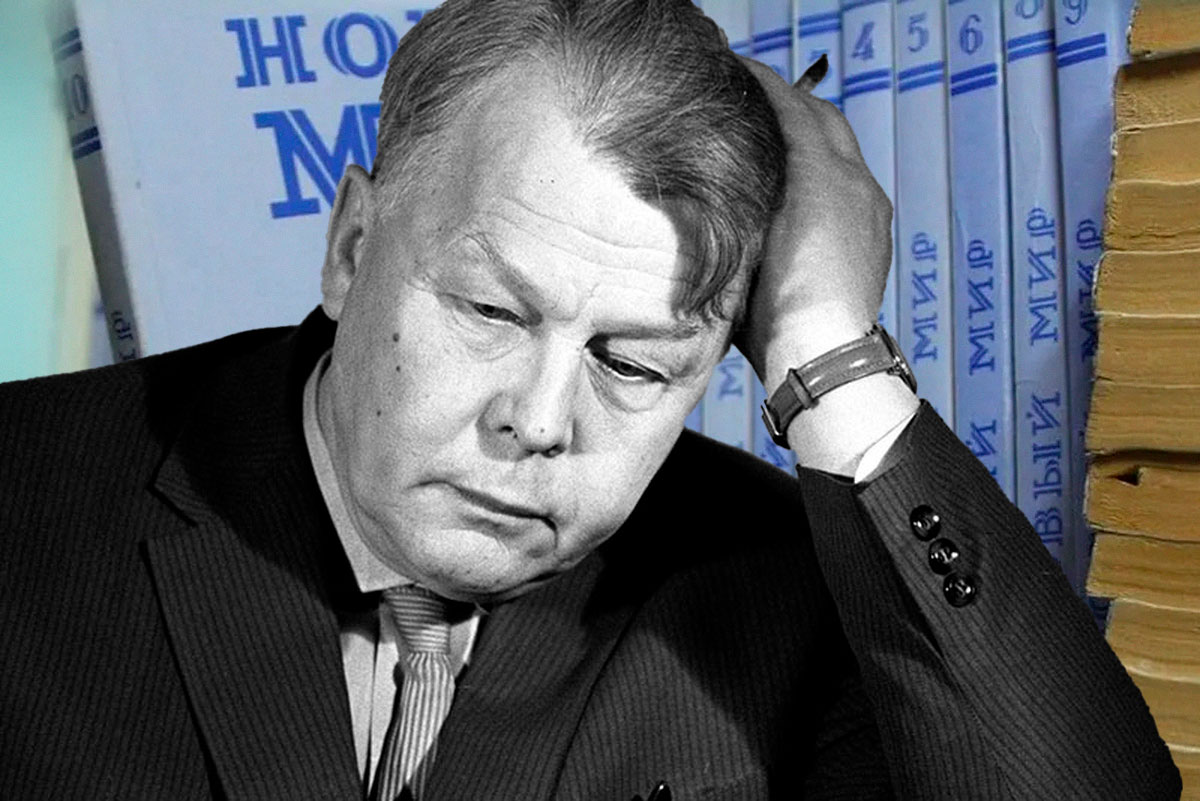
Alexander Tvardovsky. Photo: «Culture.RF»
Alexander Tvardovsky — a large-scale, complex, tragic figure. Mature Tvardovsky — a convinced and consistent anti-Stalinist, a person who painfully experienced the drama of the degradation of the Soviet regime and its fundamental ideas. He admired Andrey Sakharov, hand-copied his «Reflections on Progress...», opposed the «Yepishevs», the orthodox and pathos force that did not allow the truth to be told in the Great War. He fought with censorship, and it cost him his health. Is it necessary to remind who pushed Solzhenitsyn with his «Ivan Denisovich» into print.
Of course, his «Novy Mir», if it found itself in today's circumstances, would not have survived even a few days after February 2022. The current ideology of the Kremlin is based on «the Russian idea», on Russian exclusivity, nationalism, imperialism, and messianism. This political and ideological direction, which during the Soviet years found an outlet in literature and journalism, was Tvardovsky's main enemy: he himself — a peasant (called himself a «villager») defined them as «peasant-like» and «fascist-like». It was they — with the help of the political nomenclature — who crushed the magazine, which, by the way, was already then contemptuously called «liberal», and drove Tvardovsky to the grave.
And now their direct descendants will be awarded the medal named after Alexander Trifonovich. During his lifetime, he was accustomed to such cynicism, he had no illusions. But to do such a thing postmortem...
He wrote and spoke about all this — the testimonies are scattered in his diaries and daily records of «Novy Mir» employees, especially detailed notes were made by Tvardovsky's deputy Alexey Kondratovich. About such officials, who have now turned him into a banner — Alexander Trifonovich's entry from May 23, 1965:
«...Complete bureaucratic irresponsibility towards this very «people», on whose behalf they speak, — responsibility only to those «above», although it seems that there have already been lessons that from above can come stupidity, ignorance, and greed...»
Greedy ones — the very national-patriots who today determine the general line of power. They are — the second meaning of the word — anti-Semites.
On August 10 of the same year, after listening to a speech by Pyotr Demichev, Secretary of the Central Committee, Tvardovsky writes with disgust about the triple citation of Stalin and the key thesis of the then main person for ideology and culture in the Central Committee — «preparation for war — the main thing in educating youth».
April 2, 1966 — Tvardovsky's reaction to Sholokhov's famous speech at the XXIII Congress of the CPSU mentioning Sinyavsky (an author of «Novy Mir», whose name the editor-in-chief courageously left in the publication catalog for 1965) and Daniel: «shameful-servile, ghoulish meaning», «depraved old man», «bitter and shameful».
November 6, 66:
«... And not to see their faces —
Lively servants of any era:
A chatterbox-scoundrel,
A silent rogue,
An authorized brute,
A group leader-fool,
An assigned jester
And an unofficial informer...»
A complete list of passive and active conformists who make up the social base of dictatorships.
1968 — continuous pain, physical suffering from the injustice of the invasion of Czechoslovakia, shame, intensified battles with Stalinists and censorship, because the «thaw» complicated the existence of the magazine, and Tvardovsky's poems and his prefaces to various collections of colleagues' works were censored.
And in the name of this person, the descendants of Tvardovsky's tormentors are going to award authors of «creative projects during military actions»! He — is not yours.
December 5, 1966 — Tvardovsky's political and human credo, a lesson to «unofficial informers» and «chatterbox-scoundrels»:
«...Undisputed, sacred is the right of those who fell in the war for the motherland to memory... True, and in all this there is a considerable admixture of «educational policy», state consideration for guiding the moods of the «masses»... like the recently organized tomb of the unknown soldier — God forbid he turns out to be... a known soldier — extra trouble, just like it was completely out of place when 5 and 6 of 28 [Panfilov's men] turned out to be alive (it seems, Medinsky called those who doubted the myth of Panfilov's men «utter scum» — so Tvardovsky is among them. — A. K.)... But what about the memory of those who were deprived of the opportunity to deserve its signs, the nationwide attention to it?.. no army in the world has ever had such losses in the command staff as our army suffered on the eve of the war and partly after the war. What about this memory... The same memory, as these last ones, undoubtedly deserve, and those who died on the eve of the war and during the war not in the war, but in prisons and camps, in the dungeons of a mad regime...»
Now the right to such memory is being contested: either individual characters propose to remove the Solovetsky Stone from Lubyanka, or places of memory are desecrated in various geographical points of the country, or «Last Address» plaques are uprooted, or the whole country is littered with monuments and bas-reliefs of Stalin and at the same time a statue of Ivan the Terrible is erected...
In Tvardovsky's diary, the last entry is from June 2, 1970. He mentions the sending of Zhores Medvedev to Kaluga to a psychiatric hospital. As if a prophecy from his terrible poem of 1965 came true: «But the sleep of heart patients and psychos is light / Behind the windows of hospital buildings». Alexander Trifonovich, together with Vladimir Tendryakov, rushes to the rescue — immediately rushes to Kaluga, sends a protest telegram to Podgorny. That is, he behaves like a human rights activist and already, perhaps, a dissident. After this story, Tvardovsky's health deteriorates. Medvedev will soon be released...
At the end of the diary, there is an insert — an old poem, which is indicative — from 1938, about his father — dispossessed. About his dream, which, perhaps, coincided with the idea of happiness of Alexander Trifonovich himself, the economic «villager»:
«...An orchard on the slope, a house with a porch,
Well-fed livestock with trunks,
Thick clovers in the field,
Warm honey in bright combs...»
* The Ministry of Justice of the Russian Federation considers Andrey Kolesnikov a «foreign agent».