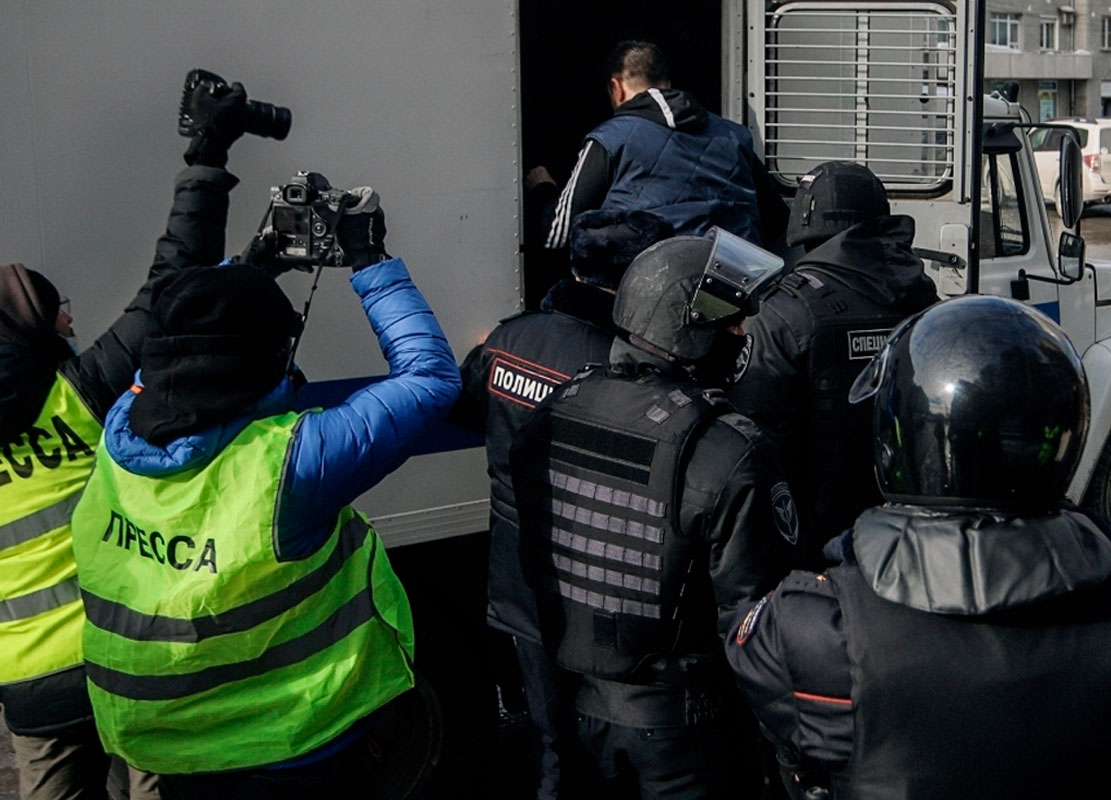
Archive photo. Anti-war rally in Novosibirsk, February 2022. Photo: Sibnet.ru
Evgenia Albats*: On May 3, journalists around the world celebrated Press Freedom Day. The beginning of May is generally a time for marking various journalistic dates. On this day, we usually remember our heroes and our fallen. We have many to remember. Dmitry Kholodov from "Moskovsky Komsomolets", Mikhail Beketov, Yuri Shchekochikhin, Anna Politkovskaya. This is a very short list of those killed and maimed who could be mentioned here. Nikita Tsitsagi, a correspondent for the censored "News.ru", was killed in June 2024 in the Donetsk region, a drone struck his car. He wrote reports from the aggressor's side. He wrote well within the permissible rules set by the regime. Military correspondent for "Kommersant" Alexander Chernykh wrote a large text about life in a border village in the Kursk region when parts of the Ukrainian Armed Forces entered and when for more than half a year these people were abandoned by everyone. The "Redkollegia" award jury noted this text, but Chernykh refused the award. Both the text and the award, and the refusal of it, are the terrible mix in which those who remained in Russia and write from the aggressor's side, and those who chose other topics, such as the murder and funeral of Alexei Navalny**, like Antonina Favorskaya, who received five years in camps for this, and those who preferred to leave Russia so as not to write under control or threat of prison.
Question to you, colleagues: is journalism under control in conditions of censorship journalism?
Elena Kostyuchenko: Yes, it is journalism. Because it tries to fulfill and often fulfills its main goal - to convey to people what is happening, despite censorship, despite restrictions, despite the Aesopian language that Russian media increasingly resort to. This is a very painful but very important part of journalism. It is not propaganda.
Ilya Barabanov: It is, of course, journalism. Those who remain in Russia face the laws that have been passed there, trying to maneuver and tell the true story, while not ending up in a pre-trial detention center. Of course, not only Z-journalism remains there. There are also normal people who try to tell about the horrors of this war. Okay, in Aesopian language, not mentioning the word "war". But they try to continue working and honestly do their job.
Evgenia Albats: Masha Slonim, you were an activist of the dissident movement in the 70s. In particular, you distributed the underground "Chronicle of Current Events", were forced to leave the country, and then returned in the late 80s when perestroika and glasnost were already in Russia. I'm interested in your opinion, Masha.
Maria Slonim: We know journalists who stayed in Russia, who write despite the risks, and very often go to jail for it. Of course, it is journalism. I remember, Zhenya, that you really, really didn't want to leave because you also believed that the place of a Russian journalist is in Russia. Some stayed for various reasons but work honestly in the given circumstances with maximum dedication.
On the Side of People
Evgenia Albats: I left Russia at the end of August 2022. Both then and now, I believed that when journalists fled in February and March, it was wrong because at that time it was still possible to protest, it was still possible to write. Unfortunately, on March 5, 2022, laws were passed that made normal journalism almost impossible. By the end of August 2022, after Ilya Yashin was imprisoned for his videos on YouTube, it became completely clear that further arrest and prison were inevitable. Nevertheless, I believe that journalism from afar does not exist.
Assessments of Alexander Chernykh's work in the war between Russia and Ukraine, working from the aggressor's side in Mariupol and now in the Kursk region, vary polarizingly. Some claim that Chernykh is a propagandist who glorifies this war unleashed by Russia, others thank him for telling about the lives of ordinary people in wartime conditions. In particular, for the report from the Kursk region. What do you say about this text?
Elena Kostyuchenko: It is a great text, very necessary, very important. I do not believe that Sasha works on the side of the aggressor, Sasha works on the side of people. Anna Politkovskaya said that in war, there are always not two sides, but three. There are two warring armies and there are civilians who are trying to survive.
Evgenia Albats: Anna Politkovskaya did not write a single piece from the side of the Russian troops.
Elena Kostyuchenko: That's not true, Anna Politkovskaya wrote a lot about soldiers and investigated their deaths, investigated the chaos in command. That was also part of her work.
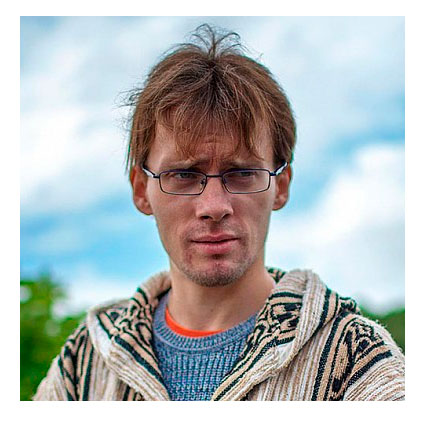 Ilya Barabanov: We studied together at university with Sasha Chernykh, I've known him for a million years. We understand the conditions he is forced to work in and the restrictions and frameworks all Russian journalists are driven into. But I agree with Lena that indeed he primarily describes not the combat operations, not the actions of the Russian army or the Ukrainian Armed Forces. He tries to write about people. Sometimes it turns out less successfully, as in the case of Mariupol, in my opinion. Somewhere it turns out very well, as in the case of the Kursk region, it is indeed a brilliant text, and he absolutely deservedly received the "Redkollegia" for it.
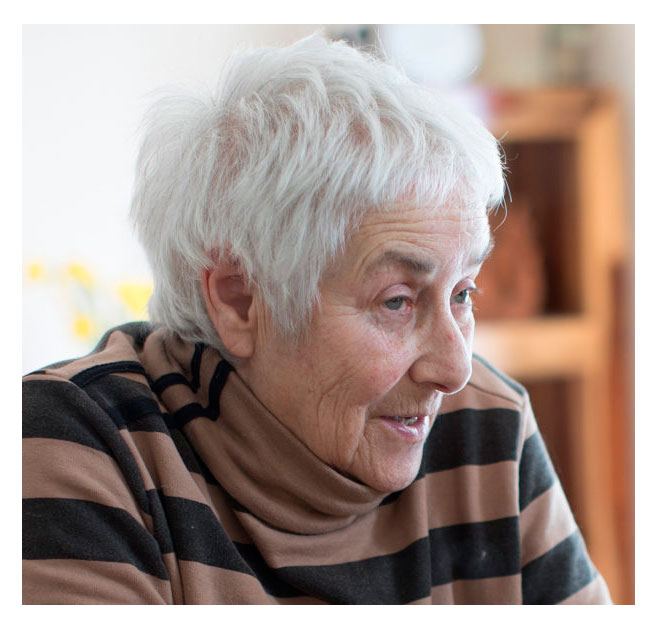 Maria Slonim: This is an essay about people - what I believe a journalist should do when covering such a terrible thing as war. Yes, this hackneyed quote, attributed to Aeschylus, and repeated by an American senator in 1917, that "the first casualty of war is truth." I am not a war journalist, but I can imagine how difficult it is when you are a citizen of your country and you are in a situation where you must try to neutrally describe what you see. And it seems to me that Alexander does this remarkably well. I even wrote down a quote, as one of his characters says: Ukrainians shoot at ours, ours at Ukrainians, and we are in the middle. The journalist is also in the middle. And, for example, I saw through his eyes what is happening in this village. This despair, this hope. Ukrainians are not beasts, and it is amazing that he managed to convey this: Ukrainians both feed and do not grab everything. Okay, the conditions of war are absolutely terrible. And he writes about how people were abandoned, their own government abandoned them. He quotes one of the heroines, who says that if someone had told me that this could happen, because I had only seen war on television, I would not have believed it. And now I think, but those on the other side, they are just like us, you know?
And this is read in Russia. This is much more important than what journalists living in exile write. Because, firstly, not everyone reads these journalists in Russia. And still, "Kommersant", I think, and Chernykh have a certain audience that learns a lot from him about what is happening. Not to mention that he pronounces the word "war", his characters pronounce the word "war". The text is very human. And it doesn't matter from which side the journalist wrote it. He wrote it honestly.
Propagandists work primarily for the state and defend its informational interests. Journalists are people who defend the interests of readers
Evgenia Albats: Let me play devil's advocate. In this text, there are at least two paragraphs that unpleasantly surprised me. One, in the last part, where it is told how Ukrainian soldiers allegedly shot residents somewhere on the other outskirts of this village. It feels like an inserted piece. And the second, which is not inserted at all, but what simply amazed me. You, Masha, talk about how Ukrainians brought food to the occupied villages, helped deliver water, as Chernykh writes. And then, when Russian troops retake this village, one of the residents, one of those who received help from Ukrainians, points to a house in the village where Ukrainian soldiers were hiding, and accordingly, they went there, threw grenades, killed everyone. You see, the thing is, it's hard for me not to compare this war with the war of 1941-1945, because my parents both fought in that war. My father, in particular, fought in that very Nikolaev, from where Lena Kostyuchenko led her reports about how the Russian army bombed the city. I imagine what kind of reports should have been written from the side of the German troops by their journalist-propagandists. Probably, they wrote something like that too?
Elena Kostyuchenko: Let's maybe immediately separate journalists from propagandists. I understand that they also like to call themselves journalists, but we understand the difference. Propagandists work primarily for the state and defend its informational interests. Journalists are people who defend the interests of readers. The interest of readers is usually to know the truth. And this truth can be any, including the one Sasha writes about. The piece about the shooting of residents did not seem inserted to me, it seemed completely inherent to the text. Yes, it could have happened. This is war.
Evgenia Albats: He didn't see this with his own eyes.
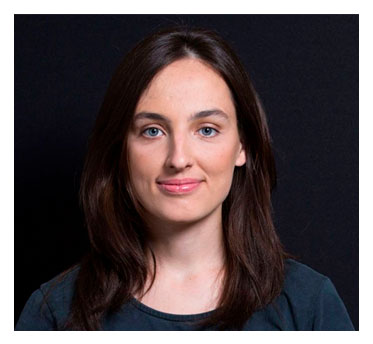 Elena Kostyuchenko: The text quite accurately describes the sounds that the person heard, he was such a hearing witness to the shooting. Regarding the candies that Ukrainians brought to the houses, everything is also described in detail. Including when it seems like a Ukrainian soldier throws a grenade into the basement. And thank God, everyone remains alive. I have no doubt that this could have happened because I was at war, and I understand that at war everyone loses their mind, war crimes are committed on all sides. And this is recorded in reports of international organizations, this is not the truth of Chernykh that I must defend.
But for me, the most important thing in the text was the refusal of the heroes from hatred. People who survive the war, who go through the unimaginable, who bury their neighbors, their loved ones in gardens, who do not know whose drone is flying and whose "Grad" is flying and landing in their house... And in the end, these women say: "What we went through, we would not wish on the enemy". For them, this is a very specific phrase. It's not the common expression "you wouldn't wish it on your enemy". These are people who lived through this and refused hatred. Masha already quoted, but I want to repeat. One of the women says that when the war was on television, she did not understand what it was. "But when the war came to us, I realized that on the other side there is exactly the same village, where exactly the same people live, who die exactly the same way". I think this is a very important truth, and I am glad that it reached Russian readers.
Sasha, as a journalist, I believe, did everything possible so that we could at least slightly feel what these people went through and what war really is. War is not what they say on television. War is when you bury your husband in the garden and think about how to evacuate your daughter.
Maria Slonim: Lena is right, there is no hatred there, on the contrary, it is empathy in some sense. They begin to understand what war is for another country. And how they relate to war. It destroyed their lives. And it was not at all necessary for the author to say: "and this damned war started by Putin". Everything is obvious there.
Confrontation with Censorship
Evgenia Albats: Now I have a question for Ilya and Lena. You worked on the first Ukrainian war in Donbass when the Russian authorities claimed that Russian-speaking supporters of unification with Russia were fighting in eastern Ukraine, but there were no regular Russian units there. We were told that military vacationers were going there, and that Pskov paratroopers were fighting there, we were, of course, not supposed to know. Ilya, you were then a war correspondent for "Kommersant", and you, Lena, worked at "Novaya Gazeta". And you, like the correspondents of New Times, were looking for evidence that the Russian army, that is, the army of your country, is an active participant in this conflict. What were your limitations? What censorship did you consider acceptable for yourself then, and what not?
Elena Kostyuchenko: I did not encounter censorship then, at "Novaya Gazeta" you could write absolutely everything. There were no laws yet that now restrict journalists remaining in Russia. I received accreditation from the DPR to enter Donbass, for which Ukrainians included me in the "Myrotvorets" list. True, they later excluded me, apparently for cumulative merits. But now, maybe after our conversation, they will include me again. I received DPR accreditation like this: I came to the city council, they took a photo of me, pasted it into a laminated ID, and that's it. After I interviewed Dorzhi Batomunkuev, this burned tankman, my DPR accreditation was revoked. That was all the bureaucracy I encountered.
From our reports of 2014-2015, the authorities drew conclusions about how they would behave in the future. Therefore, when the invasion began in 2022, laws on "fakes", on "discreditation" were so quickly prepared and introduced. Because everything must be maximally prohibited and tightened
Ilya Barabanov: The nature of the war was fundamentally different then than it is now. It is hard to imagine now that any journalist works on both sides of the front line, but then, due to the unclear nature of everything happening, due to this hybridity, there were several Russian media outlets that were allowed into Kyiv, and we could afford to spend half of the assignment with the Ukrainian Armed Forces, then cross the front line and spend half of the assignment in the self-proclaimed DPR, writing from both sides, which is now, of course, simply impossible to imagine. Times were much freer then. I think it was from those reports of ours in 2014-2015 that the authorities drew conclusions about how they would behave in the future. Therefore, when the invasion began in 2022, all these laws on "fakes", on "discreditation", and everything else were so quickly prepared and introduced. Because everything must be maximally tightened, prohibited, and clamped down.
I cannot say that in the "Kommersant" publishing house it was as free as in "Novaya Gazeta". Of course, they asked to be careful in assessments. But it's amazing to remember now how in September 2014 I was on air, forgive me, with Andrey Norkin, who was then not on NTV, but on "Kommersant-FM", and was still a relatively adequate person. I was telling him live that Russian tanks were advancing on Novoazovsk from the Rostov-on-Don side, and he was telling me that "maybe, after all, these are miners". I say: well, you understand, there is one road, it leads to Rostov, tanks are coming from there, and miners have nothing to do there. Therefore, I am afraid that I still see Russian tanks in the field now. To imagine in 2025 that we are discussing something live with Mr. Norkin is, to put it mildly, impossible. Therefore, it was difficult, but it was possible to work, it was possible to publish all this. I also had one of the first texts about Buryats in the "pampas of Donbass", after Debaltseve we also wrote about it. How many of us were there? Timur Olevsky from "Dozhd", "Novaya Gazeta", literally 3-4 media outlets that continued to be allowed into Kyiv, given accreditations, and allowed to travel from that side. At the time when after Crimea, most Russian propagandists were cut off from the opportunity to work from the side of the Ukrainian Armed Forces, our texts were read, they saw that we were not lying, that we were not distorting reality, not engaging in propaganda, and we were given the opportunity to work. Now this is, of course, impossible.
Evgenia Albats: Ilya, do I remember correctly that when you indeed were one of the first to obtain evidence that the regular Russian army was fighting in Donbass, you could not publish everything in "Kommersant", for example, you could not indicate the unit number, although you spent a lot of time to show that such and such a specific unit was stationed there. Were you already being cut in "Kommersant" then?
Ilya Barabanov: It was more a question with the lawyers. Now we have left and allow ourselves to ignore Russian legislation. But then at some point, a decree was adopted prohibiting writing about losses in peacetime or something else. Then we had to go through every line with the lawyers because something was cut then based on considerations of compliance with the law.
Evgenia Albats: So it was not the editor-in-chief of "Kommersant", but the lawyer?
Ilya Barabanov: The editor-in-chief of "Kommersant", to his credit, never interfered in my texts. I worked with Gleb Cherkasov, my boss, and everything usually came out in the form I sent it to Gleb.
Maria Slonim: What Ilya is describing reminds me of the difference between the first and second Chechen wars. In the first Chechen war, journalists could work on both sides, and generally covered quite freely what was happening. But by the second Chechen war, the authorities realized that it was unprofitable for them for journalists to work so freely from both sides. And I just remember that we - I worked with both BBC and Channel 4 - never received accreditation for the second Chechen war. But in the first, the military even gave us a lift by helicopter somewhere from Mozdok to Grozny, and so on. Then they realized that journalists were not needed. They interfere.
Evgenia Albats: Then there was already fear not only of getting caught by Russian troops, as it was in the first war when the scariest thing was to fly into a Russian post, and it was unclear whether you would get out of there or not, and how you would get out... The fear was already much greater before the Chechens, after our colleagues Elena Masyuk and others were in the zindans. And after we saw what they did to people and how they treated them. In the second Chechen war, we already faced completely hating Chechens.
News from There
Evgenia Albats: None of you reacted to my quite provocative question about the comparison with the fact that probably reports from the side of the German troops, who were marching on Soviet soil and killing everyone in their path, were also about how hard it was for the German troops. And it was the aggressor. And it was indeed the fascist troops that attacked the Soviet Union on June 22, 1941. Do you categorically refuse analogies?
Elena Kostyuchenko: I think any analogy is inaccurate, but here specifically, even on some basic points, it doesn't match. Nikolaevo-Daryino, a village in the Kursk region, from where Sasha wrote the report, is Russian territory, which in response to Russian aggression was occupied by the Ukrainian army, and then re-occupied by the Russian army. If you're looking for an analogy, it should probably be 1945, but in 1945 the situation was already completely different with the fascist press and the super-fast retreat of the fascist troops. Therefore, I am afraid that we will simply fall into this historical mix.
Evgenia Albats: But Nikita Tsitsagi wrote from the Donetsk region. He was killed by a Ukrainian drone when he was driving to write about monks hiding in a monastery. At the same time, he wrote for the censored publication News.ru and complained in his diaries that he was being cut, his materials were being rewritten, and so on. So in this sense, okay, I accept your remark about the Russian village and Chernykh's report, although I can remind you of Chernykh's report from Mariupol. We know what happened when Mariupol was taken.
Elena Kostyuchenko: We know very little about what happened in Mariupol, and very little about what is happening in the territories of the self-proclaimed republics. Therefore, for me as a reader, any information from there is very valuable. And of course, I always, as an experienced reader, make an allowance for the conditions in which the author worked. And who this author is - a journalist or a propagandist.
Evgenia Albats: Who was Nikita Tsitsagi?
Elena Kostyuchenko: I am sure he was a journalist.
Evgenia Albats: Because he was killed?
Elena Kostyuchenko: No, not because. Anyone can be killed, regardless of profession. In fact, you explained why he was a journalist. Because he was going to the monks in the monastery - to talk to civilians experiencing the war. And according to his diaries, which you also referred to, he was not in agreement with censorship, he was not ready to work for the state. And again, a censored publication is not the same as a state or propaganda publication. I would separate these two concepts. I was not personally acquainted with Nikita, I later realized that at some points we were in the same places, but we never crossed paths. But I read his texts, and they are good, important texts.
What can I say? I also did reports from the self-proclaimed DPR. I could not enter the LPR, there was another power structure controlling it, and they hung my portraits on poles. But I worked in the DPR, and from the point of view of many Ukrainians, I was probably deservedly on the "Myrotvorets" list. Then, when the big war began, I crossed the front line and worked in occupied Kherson. I worked illegally. If I had been caught, perhaps we would not be talking now. I crossed the front line, I worked in a city under occupation. But for the people I met there, it was important to convey to the outside world what was happening to them. And there I managed, for example, to establish a secret prison where kidnapped Ukrainians were taken and tortured by Russian special services. I managed to establish its address and managed to establish a list of 44 people who disappeared there. I think this is important work. And it is clear that it may hurt someone, such work, and it is painful for someone that you can enter somewhere that a person who, for example, lived there for 20 years, but was forced to flee from occupation and cannot return, cannot enter. But it is also important for this person to know what is happening to his home.
Dots and Brackets
Evgenia Albats: Lena, I remember your brilliant reports from Nikolaev, from Kherson, from Odessa. But I also remember that you could not fully publish your report from Kherson. Do I remember correctly?
Elena Kostyuchenko: Yes, of course. I'll tell you how it all was. When these laws were passed on March 5, 2022, we discussed with the editorial office...
Evgenia Albats: Unconstitutional, I note, laws that violate the Russian Constitution.
Elena Kostyuchenko: We contacted the editorial office of "Novaya Gazeta". It was important for me whether they would continue to publish my texts. Because, as you know, these articles are collective, that is, if anything, not only you sit, but also your editor, your typesetter, that is, a "group of persons" can go to court and prison. They said they would publish it. And "Novaya Gazeta" developed a system of visible censorship. I don't remember now what brackets meant what, but intuitively it was clear that here a word was cut out, here a paragraph was cut out, and we briefly say in brackets what this paragraph was about.
Instead of the word "war" there are some dots. And at the same time, the "New Poland" publication, which was not blocked in Russia, published the full text of the reports for those who wanted to read them. And I, accordingly, gave links to both texts in my social networks, to the censored and uncensored one.
But it turned out that the Russian language is arranged in such a way that if you remove one word from a sentence, you can still understand what it was. Therefore, quite soon a letter came to the editorial office of "Novaya Gazeta" from Roskomnadzor and the Prosecutor General's Office demanding to delete the reports from Nikolaev and Kherson, which were cut, with dots, with brackets. "Novaya Gazeta" deleted them, and the Streisand effect began, because all other, uncensored media began to reprint these reports, and not with brackets and dots, but the version that was originally published on "New Poland". So I don't think that in my case these laws fulfilled their purpose. They didn't. But they caused a lot of trouble.
Answer for Putin
Evgenia Albats: When I left Moscow and arrived in the United States, Ukrainians constantly attacked me at various conferences, at discussions, accusing me of everything Putin did, does, and will do. And I suddenly realized - although it was very painful for me because I never voted for him and fought against him all my life - why am I offended? I am like that German journalist who could have ended up in London in '43 when Luftwaffe was endlessly bombing London and people were constantly dying. Well, how would the British have treated me then? Well, just like Ukrainians treat me in this war. For me, the analogy is exactly that.
Independent journalists, who ultimately now sit in exile, are unlikely to be able to return home. Lost everything there, and yet guilty of everything here. But what to do? Times are not chosen
Ilya Barabanov: I suspect that all these historical analogies are fundamentally incorrect because neither in the totalitarian Soviet Union nor in the Third Reich did any independent journalists exist. And in Russia in 2022, despite more than 20 years of Vladimir Putin's rule and the tightening of all possible screws, we still remained, and other independent publications were not blocked. Yes, we were harassed and oppressed all these 20 years, but independent journalism in Russia existed. Military experts I now communicate with for work compare what is happening now more with another large-scale regional conflict when Iran and Iraq fought all through the 80s and killed each other for 8 years. Also, tens of thousands of people died, in the end, they parted at the old borders. But I doubt that there were any independent journalists in Iran or Iraq who reflected on the fact that they were citizens of an aggressor country. In this sense, we found ourselves in a probably unique role because independent journalists, who ultimately now sit in exile, are unlikely to be able to return home. Lost everything there, and yet guilty of everything here. But what to do? Times are not chosen. They live and die in them. We found ourselves in exile and must try to honestly do our work in exile, as much as possible. And understand that those of our colleagues who remain there are forced, trying to tell us some stories, to follow unconstitutional laws. We deny these laws, we do not accept them, we do not agree with them, and therefore, in the end, we are not in Russia, therefore we have the "foreign agent" label, and then there will be criminal cases and wanted lists. And those people who remain in Russia and want to work there are forced to act below the radar, comply with these censorship restrictions, be more careful with the word "war", but try to tell about what a horror this war is. And if you want propaganda, read about the "Gostomel heroes" performed by Alexander Kots in "Komsomolskaya Pravda". Or military correspondent Sladkov, many others.
Elena Kostyuchenko: Marina Akhmedova. Yes, yes, yes. Who was a very good reporter in her time.
Ilya Barabanov: And what we now see in place of Marina Akhmedova... I think this war is a very big test for both those who left and those who remain. And I think there remains a huge number of our colleagues who are honest people, who try to professionally fulfill their duty and for whom everything happening for the fourth year is a huge personal tragedy, as it is for each of us.
Maria Slonim: War affects everyone, journalists are no exception. I understand how difficult and hard it is for journalists like Ilya and Lena to suddenly find themselves in exile, to cease being part of that Russian journalistic environment. But it is difficult, and often more difficult for those who stayed and try, continue to be journalists. I understand that there are three paths: to leave, to try to write, as Lena tells, bypassing the bans - we knew how to read between the lines - and someone goes into stoking, into archaeology, and so on. Everyone has their own choice. I just really admire those who continue to work and try not to betray the profession.
Minefield of Journalism
Evgenia Albats: Very recently, journalists Antonina Favorskaya**, Artem Kriger**, Sergey Karelin**, and Konstantin Gabov** were sent to prison for five and a half years. They were accused of collaborating with a "banned", "undesirable", "terrorist", "extremist" - add all the words from the lexicon of the Russian Investigative Committee - organization, namely the Anti-Corruption Foundation*** of Alexei Navalny. Antonina Favorskaya, for example, wrote from all the prison trials over Alexei Navalny when Alexei was via video link from prisons. She wrote from Kharp, where Navalny sat in an arctic colony, where he was actually killed. She wrote from Alexei Navalny's funeral. So we clearly understand that there is different permission. Journalism, which Favorskaya, Kriger, Karelin, and Gabov were engaged in, ends with years in prison. And the journalism that the same Alexander Chernykh is engaged in and that the late Tsitsagi was engaged in, ends with the "Redkollegia" award. Can you formulate what these rules are in Russian life, according to which some journalists go to prison, and others are applauded on both sides of the barricades?
By and large, all Russian journalism and publicism now represent a huge minefield
Ilya Barabanov: You listed those guys who recently received sentences. In fact, there are significantly more of our imprisoned colleagues there. Remember Misha Afanasyev from Khakassia, who was imprisoned back in '22? And how many, how many more of these names. During the war, no rules of the game exist in principle. People try to balance. Some succeed, some don't. But by and large, all Russian journalism and publicism now represent a huge minefield. We walk on this minefield from abroad, receiving statuses, criminal cases, and new protocols. Some people continue to walk on this minefield, staying inside Russia. Some get sentences, and some are still dodging, but this absolutely does not guarantee that a person will not receive a foreign agent status next Friday, and then a criminal case. Therefore, I would not say that there are any rules of the game. In our professional field, there is huge anarchy, in which the state walks with a club. You have not been noticed yet, you walk below the radar, and you have stuck out a little higher, which means you immediately get hit on the head.
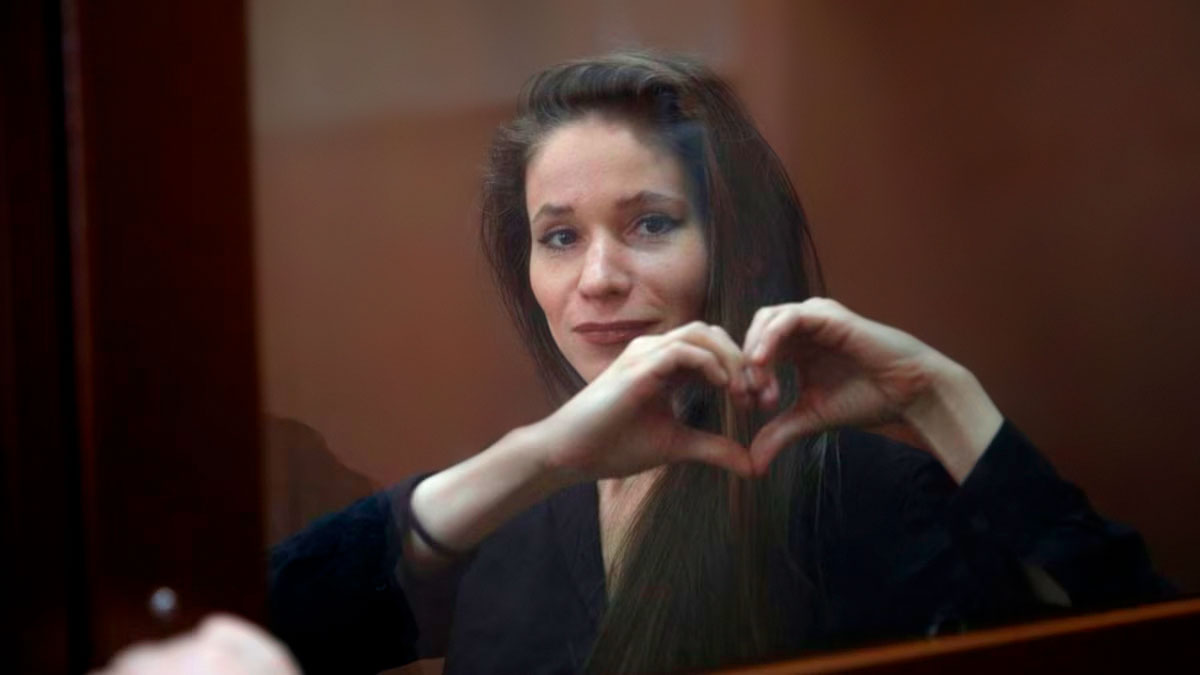
Antonina Favorskaya in the courtroom, March 2024. Photo: Alexandra Astakhova / Mediazona
Maria Slonim: I agree with Ilya. In some sense, this is a false opposition because we do not know what will happen next with Chernykh. We do not know because there are no rules of the game. Probably, he is a more experienced journalist who knows how not to get into trouble, to avoid sharp corners. He is older. Favorskaya is from a generation of heroic journalists, she walked on the minefield, regardless of anything. This is a different generation of people.
Elena Kostyuchenko: Why is Chernykh in the Kursk region, and Favorskaya in prison? Because Chernykh has not been imprisoned yet, and Favorskaya has already been imprisoned. There are no rules. No one can guarantee their safety. I just talked to my colleague who remains in Russia and does absolutely brilliant things, many of which are published, and many are not. She got a dog, and she says: you know, I go for a walk with the dog, come back home, and there is a man standing at the entrance, smoking. My first thought is he's after me, and the second thought is whether they will allow me to bring the dog into the apartment before they arrest me. Another girl, with whom I also recently spoke, says that now, if you work in Russia, the planning horizon is a day. You woke up in the morning, and if you woke up not because cops are banging on your door, but by the alarm clock, you think - okay, you have a day, what can you manage to do in this day, what do you want to do in this day? You leave the house and do not know if you will return home. But if you returned home and fell asleep, and woke up the next morning again by the alarm clock, and not because someone is banging on the door, you have another day. And that's how people live and work. I would not devalue their efforts because they are not in prison yet. Many of them will sit, many of them will die. It's very scary because these are all close, dear, living people.
Evgenia Albats: I want to ask you, Lena, and you, Ilya, and Masha about this. We all four preferred to leave. Lena left after doing her reports from Nikolaev and occupied Kherson at the time. Ilya, the war caught you, as I remember well, in Kyiv, you were reporting for BBC, and when Russian troops approached Kyiv, you had to get out of there with difficulty. And you also left not for Russia, but for emigration. And I left, and Masha left even earlier. The question I keep asking myself endlessly: do you now, in May 2025, think you did the right thing by leaving? Or should you have stayed and tried to work in Russia somehow?
Maria Slonim: I definitely couldn't work. There was simply no one to work for. It was clear to me that my journalistic career was over.
Evgenia Albats: Nevertheless, Steve Rosenberg from BBC continues to work in Russia.
Maria Slonim: Heroically, of course, yes. One of the very few foreign journalists.
Evgenia Albats: Yes, and asks Putin questions that no one can ask at a press conference. And does a brilliant interview with Lukashenko.
Maria Slonim: Yes, but not a fact that he will not be expelled tomorrow.
Evgenia Albats: Well, expulsion is not the worst option. There is the option of Evan Gershkovich.
Ilya Barabanov: Our life is a series of coincidences of different kinds and accidents, so you correctly said that I never planned to leave, I did not plan any emigration, I left Moscow on February 4 for a business trip to Kyiv, thinking it was for a couple of weeks, no more, and I would return to Moscow to my apartment. But then there was no particular choice. It was the fourth or fifth day when, let's say, informed people came and warned that all Russian journalists who met the war on the territory of Ukraine, upon returning to Moscow, could be accused of treason. Then it was 20 years, and now, I think, it's life imprisonment. And it became clear that there was no option to return. There were not many of us in Kyiv, Russian journalists, no one eventually returned. It was not our choice, we were put before the fact. If on February 24, 2022, I had been in Moscow, maybe I would have made a different decision, tried to hold out as long as possible. But the situation just turned out the way it did, there was no free choice. There was no alternative.
Elena Kostyuchenko: I also did not leave the country, I went on a business trip to Ukraine. I was sure it was a business trip for a week. Not because the Russians would take Kyiv in three days, but because the Russians would refuse to shoot at Ukrainians. I was completely sure of this. But it turned out that I knew life much worse than I thought. Do I regret not returning from Ukraine to Russia? Honestly, yes, I regret it. <Editor-in-chief of "Novaya Gazeta" Dmitry> Muratov asked me not to return for a while. We then thought it was some foreseeable time that could be waited out and returned. Now, when it became clear that this is for a long time, I would like to be inside. I am not sure that I would have had the courage, skill, ability to work for a long time, most likely I would have sat down quite quickly, and it is unknown how I would have survived prison. But with these thoughts, you only torment your heart and change nothing in reality. I really want to go home. I don't see anything more interesting for myself as a journalist than what is happening in Russia now.
Evgenia Albats: Yes, I agree with you, Lena. Because there is no journalism in exile, in fact.
Elena Kostyuchenko: I think it exists, but it also has its limitations. They are different in nature, essentially different. Not those faced by our colleagues in Russia. We live in a different world, and journalism is changing. I also recently spoke with an elderly person who worked as a journalist in America all his life. I came to him in a distressed state, everything is terrible, and I started asking how he sees the future of journalism. And he says - the future will be awesome, awesome! Because we now have tools that we not only did not dream of, we could not even imagine them. What OSINT researchers, Open Source Intelligence, are doing now, data analysis from open sources, allows investigating crimes that would otherwise remain uninvestigated. What Insider**** does, what "Meduza"**** does, what "Novaya Vkladka" does, what "Glasnaya" does. This is very cool work. This is very cool work. But what "Novaya Gazeta" does in Moscow, this is also very cool work. And I am very glad that "Novaya Gazeta" is in Moscow. Moscow would be different without "Novaya Gazeta".
Video version:
* Evgenia Albats, Ilya Barabanov in Russia are declared "foreign agents".
** Alexei Navalny, Antonina Favorskaya, Artem Kriger, Sergey Karelin, Konstantin Gabov are included in the list of "terrorists and extremists".
*** FBK is recognized as an "extremist organization" and banned in Russia.
**** Insider, "Meduza" in Russia are declared "foreign agents" and "undesirable" organizations.