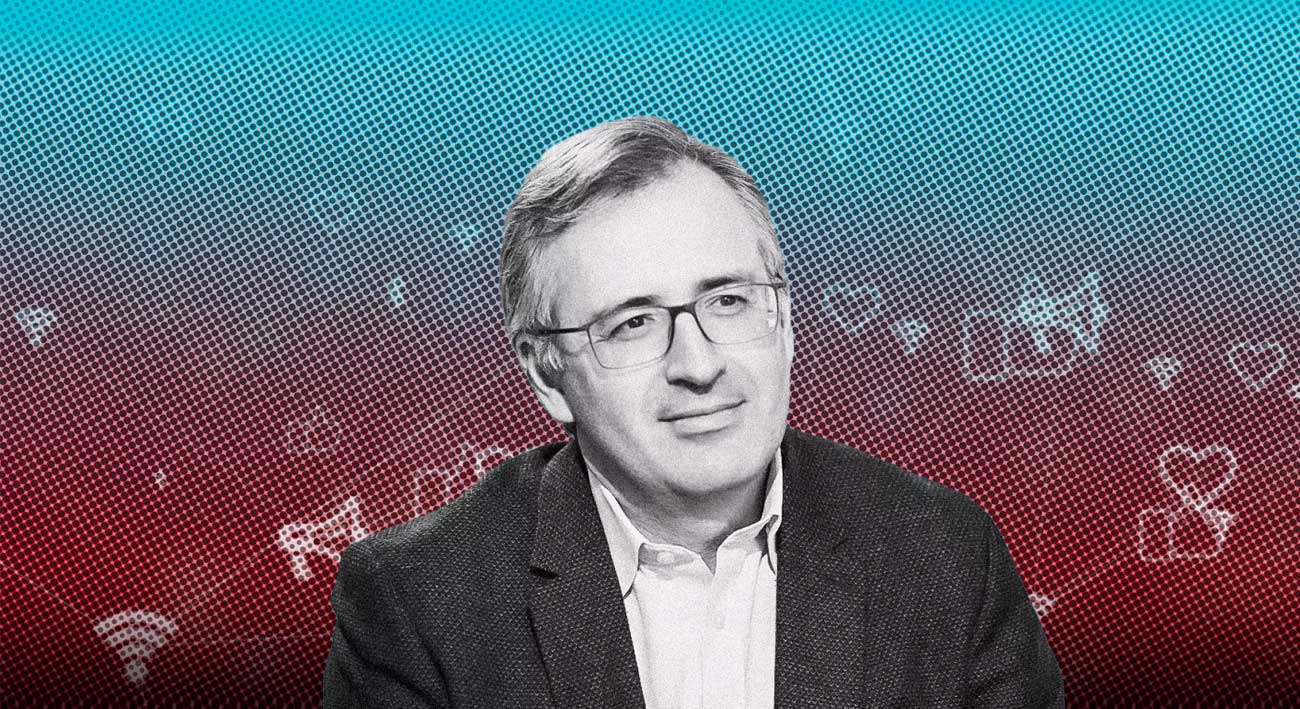
Sergey Guriev
Yevgenia Albats*: The internet and social networks are now in the spotlight not only in Russia but worldwide. Sergey Maratovich, you and Ekaterina Zhuravskaya*, a professor at the Paris School of Economics, have been studying the effects of social networks and social media on politics and political behavior for over a decade, if not longer. Professor Zhuravskaya's work with colleagues showed, in particular, that the algorithms of network X (formerly Twitter) influence the promotion of a right-wing political agenda. This emerged after Elon Musk became the owner of network X, and it truly affects political choice. One of your latest works was based on the example of elections in Argentina, and it showed that minorities should not be discounted. I was immensely pleased by this.
Another work — an analysis of the influence of social networks on the elections in the USA in 2022 and 2024, as I understand it, allows you to propose a comprehensive concept for formulating political measures aimed at curbing disinformation. The work is called Curtailing false news, Amplifying truth. I translated this as curbing fake news, amplifying truth. The essence is that fake news, fake stories, and disinformation can be fought. And this is another very interesting part of your work. Sergey Maratovich, did I translate it correctly?
Sergey Guriev: Yes, correctly. We tried different tools to slow down the spread of fake news, fakes, as they say in Russian. In English, I prefer false news, fake news, but the essence doesn't change. The idea of this work is to compare different mechanisms, different tools for curbing the spread of fake news, while not slowing down the spread of real news, real truth. Because, strangely enough, most information on the internet is more or less truthful. And for platform companies, for social media, for social networks, it is very important that their business model works. If we reduce the speed of spreading any information, it will be unprofitable for them. Therefore, it is better to propose solutions that fight fake news but do not disrupt the circulation of truthful news.
Yevgenia Albats: For us, the question of the active minority's ability to influence election results, which you showed on the example of Argentina, is extremely relevant. I mean, for Russian people, for those who plan to return to a beautiful future Russia, if it ever exists. Because, as you well know, liberals and democrats have long been in the minority, losing everything since the early 2000s.
Disinformation has become the most important tool of the entire Putin regime and especially during this terrible aggressive war in Ukraine, which has been going on for five years. Explain, if for the security services, spreading disinformation, these false news, turned out to be an effective tool, why then do they cover the internet, block all free media, YouTube. Why are they so much more successful than the opposition in manipulating social networks and information in general?
Majority and Minority
Sergey Guriev: One of the articles in our book with Daniel Treisman, «Spin Dictators», explored the impact of censorship in traditional media and the internet on the popularity of autocratic leaders. When you say that liberals, democrats, pro-European or pro-Western forces in Russia are in the minority, this statement is not unconditional. It is conditioned by the regime of information dissemination and consumption that the Russian authorities have been practicing for 25 years. And, by the way, in this work, we say that if there were no internet censorship in Russia (we wrote this work in the mid-2010s, it was published in 2020 in the journal World Politics), Putin's rating of 70% at that time would have turned into 35%.
Therefore, when we talk about majority and minority, we should not forget that this is a majority or minority under the existing institutions of information dissemination and consumption.
And, in addition, repression. Even in this spin dictatorship, which Russia was until 2022, repression played an important role. They were hidden, they were not displayed, but journalists knew that spreading independent information was dangerous, engaging in opposition politics was dangerous. Therefore, we should not discount people who seem to us to be a minority. Many people are now dissatisfied with what is happening. And the more dissatisfaction, the more stringent censorship Putin needs. Yes, he would prefer to govern the country as he did in 2010 or 2015. But the level of dissatisfaction of citizens with the war and the decline in incomes is such that even the limited censorship that existed before does not provide the results he would like to have. Adam Przeworski (Polish-American political scientist, professor of European studies at New York University. — NT) says that autocratic equilibrium is based on three pillars: economic performance, fear, and lies. The balance between these three tools works differently. If your economy is doing poorly, it is difficult to convince people that you are a good leader. And therefore, you must either lie or intimidate people. Putin has no economic prosperity left that he could sell to the population. Accordingly, there are two tools left — lies and repression. And the worse the economy works, the more lies there will be, the more repression there will be. It is not surprising that today there is much more control over the internet than 10 or 15 years ago.
Yevgenia Albats: Do you mean that the security services have stopped considering the internet as a tool of their policy, and now it poses a threat to them even in its limited form?
Sergey Guriev: The internet has always been a threat. Ekaterina Zhuravskaya, Nikita Melnikov, and I have a paper that talks about how broadband internet affects the level of approval of the authorities. Broadband internet, especially when traditional media are censored, delivers information to citizens about how poorly the authorities are performing. Broadband internet informs citizens about corruption. The journal editors asked us to provide several examples of how this works in different regimes. And as one of the examples, we used the story about the film «He Is Not Dimon to You» by Alexei Navalny**. The film was shown on YouTube, spread on the internet, and was not shown on television, of course. It was a much smaller blow to the authorities than the film about Putin's palace, which was released later, in 2021, but in 2017 this film sharply affected the approval of the authorities, especially Dmitry Medvedev personally. It actually buried him as a politician.
Therefore, of course, the internet has always played an important role for the Russian authorities, and they have been fighting it in one way or another since the Bolotnaya protests. In the 2000s, the authorities controlled television and were not very worried about the internet harming them. But starting with LiveJournal, bloggers, and then YouTube, the authorities began to worry. Recently, the security services realized that even Telegram poses a huge danger to them. Putin, to put it mildly, has nothing to boast about. The war is not going very well for him. Most Russian citizens want it to end. Even state polls show that Putin's rating is declining. Therefore, means of communication that tell that everyone is dissatisfied with Putin are not needed by him.
Russian citizens somehow know that the internet is a source of information, continue to use it. And so far, the Russian authorities have not been able to block the «extremist» social networks
Yevgenia Albats: I don't know if you are following the clash between blogger Victoria Bonya, who addressed Putin about too many bans and that «everything is hidden from you, Vladimir Vladimirovich», and television propagandist Vladimir Solovyov. An interesting thing, the latter seems to be losing in this clash. Blogger Bonya, who said that everyone is tired of the bans, suddenly found support from Putin, who from the rostrum of the State Duma repeated roughly the same thing, saying that we need to act more subtly, we shouldn't ban everything. It's very funny, as if the State Duma acts on its own, not by order. Nevertheless, Vladimir Solovyov came under investigation by Roskomnadzor for using foul language. What do these battles tell you, as an expert on the influence of social networks on political behavior?
Sergey Guriev: This is a very important sign that Victoria Bonya has enormous influence in Russia. This means that a lot of people use VPN. If the banned network Instagram*** was not used by anyone, probably no one would pay attention to her video. But it turns out that Bonya is watched by tens of millions of people. And this shows that Russian citizens somehow know that the internet is a source of information, continue to use it.
And so far, the Russian authorities have not been able to block these very «extremist» social networks. I must say that I follow this scandal so closely that I even saw how Vladimir Solovyov not exactly apologized, but said that the questions raised by Victoria Bonya are reasonable. That is, in fact, he changed his point of view, apparently precisely because the internet is an important megaphone for the authorities themselves. At the same time, Putin spoke not only in the Duma, before that he said that it is necessary to restrict the internet because it is a tool in the hands of terrorists, and it must be restricted for security reasons. And therefore, it is not yet clear who makes such decisions, who restricts, who believes that it is necessary to act more subtly. But for Putin, the internet is an important threat. All other means of delivering information he managed to block. The internet not yet. And he postponed this for later precisely because the internet is popular. And besides, it is an important economic factor. If you turn off broadband mobile internet, you also undermine the ability of businesses to operate and earn.
Direct and Reverse Result
Yevgenia Albats: In the study on the presidential elections in Argentina, you conclude that an angry minority can change the course of elections. Thanks to social networks, when people communicate with each other and pass on information, an active minority becomes a majority at the expense of neighbors, friends, relatives, acquaintances. But then you say that if already known information is added, the trend cannot be changed. Did I understand you correctly?
Sergey Guriev: Yes. This is a study where social networks mean not the internet, not social media in the English sense of the word, but social networks in the usual sense: neighbors, friends, relatives. This study is not about the internet, but literally about paper leaflets distributed by an Argentine NGO during the 2023 elections in rural areas, in the poorest Argentine province of Salta.
And the story here is that if these leaflets are convincing enough, they influence voting in the direction we want. But in political science, this is not such a well-established fact. There are several articles that talk about how political information campaigns can influence elections. When researchers try to look at the array of all data from all political campaigns, they see that in fact, the influence is very small, sometimes even reverse. For example, you try to oppose some presidential candidate, and as a result of your campaign, it turns out that he gains more votes. You inform people. It seems to you that your leaflets are convincing. Moreover, if you do a focus group, you will see that on average, the person you give the leaflet to will vote the way you want. But it turns out that this is only on average.
And even if the majority who read your leaflet become your supporters, there is a minority that may strongly dislike what you are telling them. And if the minority is outraged by your political campaign, it can tell its neighbors, friends, that here some people are trying to offend our wonderful candidate. And in the end, this leads to your campaign having the opposite effect of what was desired. This is very difficult to document, but in this case, it was possible thanks to the peculiarities of the Argentine elections. In other words, if the minority is well organized, if it is very active, it can create an effect that will differ from the desired one.
Yevgenia Albats: Interesting. So this way you explain why sociological polls in the US elections repeatedly missed the mark?
Sergey Guriev: Not quite. We rather say that when you try out some idea on a focus group during a campaign and see that the idea works great, it does not mean that it will work the same way during voting, or even work in the opposite direction. Why? Because in real life, there may be a minority that will be outraged by what you are trying to impose on them. And this active minority can convince others that it is necessary to fight against this proposal. Rather, this explains why political campaigns, information campaigns often do not work as intended or give the opposite result.
As for the use of new, unexpected information and already known information. In the same Argentine campaign, there were two types of leaflets. Some talked about Javier Milei's proposal for education reform. This was a relatively unknown aspect of Milei's campaign, and people apparently did not know that Milei proposed to remove state funding for schools, switch to a voucher system, which would have led to serious negative consequences for these poor citizens living in rural areas of the Salta province. On the other hand, there was a proposal to switch Argentina from pesos to dollars, and this was a very well-known part of Milei's campaign.
This proposal was widely discussed, so the leaflets had no effect at all, since people already knew what it was about and did not change their point of view on the presidential candidate Milei. But the leaflets about education really had such an important effect, which I just talked about. Therefore, campaigns that repeat what is already known are likely to have less effect than those that talk about some new proposals and new ideas. And some campaigns do not bring any result, neither the desired nor the opposite of the desired, simply because this information is already public knowledge.
After the film «He Is Not Dimon to You» and the investigation about Putin's palace, what else can surprise Russian citizens? That the governor stole several times less or several times more than the minister? Another thing is to tell about how expensive the Putin regime and the war are for them personally
Yevgenia Albats: If this is transferred to our Russian soil, it turns out that the decline in interest in anti-corruption investigations and their influence on people's political views in Russia is explained by the fact that everyone has long understood: Russia is a terribly corrupt country, so what are you telling us again about how much they stole. We already know they stole. So the opposition needs to look for completely new explanations and new slogans?
Sergey Guriev: Yes, in general, that's right. After the film «He Is Not Dimon to You» and the investigation about Putin's palace, what else can surprise Russian citizens? That the governor stole several times less or several times more than the minister? Another thing is to tell about why people live poorly, how expensive the Putin regime and the war are for them personally. Such a conversation is probably lacking. At the same time, it cannot be said that the opposition is not trying to have this conversation, but the authorities, of course, are doing everything possible to make it harder for the opposition to reach ordinary citizens. Including introducing censorship on the internet.
Yevgenia Albats: But what to do if, when signing a contract, the family of a serviceman immediately receives 2 million rubles? How to explain to people that they should not take money for murder? This is a moral category.
Sergey Guriev: This is a separate issue. We talked about this, it seems, in 2023. I then said something that I still consider correct. Putin was saving money in the National Welfare Fund. Could he have dealt with poverty in the country? He could. But he preferred to spend money not just on supporting poor families, but on buying men from these poor families to send them to a foreign country to kill and be killed. Such a conversation, I think, is lacking. About the fact that families could have been given more money without any war, without destroying a neighboring country, and now even Russia itself. At the same time, I will say the following. Millions of people have probably gone through the war in Ukraine, but not tens of millions. For most Russians, this is a story that yes, perhaps the poorest part of Russian society receives money for the fact that members of these families are fighting, wounded, or killed in the war. But most Russians — no. And therefore, it is not surprising that any polls now show that Russians would like the war to end. Simply because everyone sees rising prices and increasing loan rates, they see that the war is costing them dearly in terms of income levels, consumption levels, living standards. Fortunately, most Russians do not participate in this war.
Censorship — a Barrier to Truth
Yevgenia Albats: Returning to your work on Argentina and the possibilities of an active minority — do I understand correctly that these considerations, which you substantiated in your work, drove the Kremlin when they did not allow Alexei Navalny to participate in the 2018 presidential elections? That is, they intuitively understood that the minority that stands behind Navalny could eventually turn into a majority?
Sergey Guriev: Undoubtedly, they did not receive in any polls that Navalny's supporters would gather a majority. But they remembered the 2013 elections, where Navalny initially had a 3% rating in the Moscow mayoral elections, and then it ended with him gaining 27%, and it almost came to a second round. They remembered this well and understood that a minority could turn into a majority because Navalny was conducting a real presidential campaign, traveling all over Russia.
This is a very important argument in our book «Spin Dictators». We talk about how society under such a regime can be divided into the majority of citizens who receive information mainly from the authorities and do not know that the country is going in the wrong direction, and a minority that understands everything, that knows the regime is undemocratic, corrupt, and leading the country in the wrong direction. And the minority would like to tell the majority about this. The task of the regime is to put a wall between them, not to let the informed minority tell the rest of the citizens what is really happening in the country. And there are several ways, several barriers. One is censorship. In such regimes, as was the Putin regime until 2022, in «spin dictatorships» censorship was hidden, implicit. There were no laws on military censorship, there were some independent media with a very limited audience, and there were mechanisms, including through targeted repression, to ensure that independent media could not reach a large audience. In addition, targeted repression is applied to very successful opposition politicians or activists. And, of course, massive propaganda to block the flow of information from the active opposition minority.
It is very important that in 2017 and 2018 there was a breakthrough. Alexei Navalny began to actively use YouTube, his Thursday show «Beautiful Russia of the Future» (later «Russia of the Future») began to successfully compete with TV programs. We saw that millions of people watched this show. And that is precisely why Alexei was not allowed to run in the elections. That is why they tried to poison him in 2020. You remember that Alexei was flying from Siberia to his regular Thursday show, which he never missed, because he understood that this is what the authorities fear most.
Many highly paid people work in the presidential administration. They need to prove their importance to the regime. If the combinations are too simple, the security services will come to Putin and say: «Why do we need the internal policy department? We can handle it ourselves». Therefore, combinations are needed
Yevgenia Albats: Why didn't they just ban Navalny from participating in the presidential elections, but instead put Sobchak in his place, who eventually gained 1.68% of the vote? Why did they decide to make a more complex option? After all, she was noticed in the protest movement, she was supported by Demyan Kudryavtsev*, who then published «Vedomosti», and even Ilya Yashin*. Why did they choose the Sobchak option?
Sergey Guriev: Well, many highly paid people work in the presidential administration. They need to prove their importance to the regime. If the combinations are too simple, the security services will come to Putin and say: «Why do we need the internal policy department? The second service can easily ban everything itself, without any departments of the presidential administration». Therefore, such combinations are needed. As far as I remember, Alexei believed that <according to the authorities' plan> liberal voters were supposed to receive a signal about how few of them there are, the goal of the combination was precisely this: to tell liberal voters that you have 1 or 1.5 percent. The same logic drove the presidential administration in 2013 when Alexei Navalny was allowed to run in the Moscow mayoral elections to prove: «Look, here you have the most popular politician, he will gain 3%». And the story about Sobchak was that she then had a high anti-rating. Yes, she participated in the protest movement, but there were other aspects of her biography that led to the fact that no one wanted to vote for her, no one believed that she, as she put it, came into politics forever. And we see that this promise turned out to be truly unfulfilled, not that Ksenia Sobchak continued to fight the regime after these elections and became an important opposition politician, as she promised during the campaign. Yes, sometimes the internal policy department tries to create more complex combinations so that Putin can tell, including his partners in the West, that look, we have opposition candidates and some kind of independent media, we have no censorship, it is prohibited in the constitution, and so on.
Yevgenia Albats: If the task of the security services is to put a barrier between the opposition politician and the population so that the population does not know that there are some alternatives to what the authorities say and propose, then why did they kill Navalny? What's the point? He was already in a colony beyond the Arctic Circle, lawyers had difficulty getting there, letters took several weeks. What was the logic of his murder?
Sergey Guriev: It's hard for me to answer this question. Firstly, letters still reached, and Navalny's letters from prison carried special weight. Alexei wrote a column in the Washington Post from prison about the comparative advantages of a presidential and parliamentary republic. In February 2023, Alexei wrote a programmatic document, 15 points of a Russian citizen, where he clearly outlined his position on Russia-Ukraine relations, which remains an important moral tuning fork, including because it is written from behind bars. Of course, the Russian authorities did not like all this. Indeed, they sent him to Harp to increase the barrier, to make the fence higher. But nevertheless, letters continued to reach. That is why Navalny's lawyers were tried. All this is to create a barrier, obstacles. And why was he killed at this moment? Probably, Putin decided to use the idea of exchanging political prisoners for his spies, not to give up Navalny, but at the same time get Krasikov and other spies and killers. That's how he turned it, if you will. I was supposedly ready to give you Navalny, but Navalny died, it's not my fault, so let's continue the exchange. And the exchange could not be stopped because any Western politician and any Western citizen understands that political prisoners deserve freedom. If we can rescue at least 10 or 20 Russian political prisoners, let's do it. And for Putin, it is important that his killers, spies return to Russia. This helps him hire new killers and spies and tell them: «I will exchange you for political prisoners anyway». Such a strategy.
How to Stop Lies
Yevgenia Albats: Returning to your work on the elections in the United States. You propose measures to limit disinformation. In particular, at the very beginning of the article, you write that voters need to be prepared for the injection of fake news. How to prepare them?
Sergey Guriev: In this case, we are talking about a warning. When you buy a pack of cigarettes, it says that cigarettes are dangerous to your health. There is also a warning on a bottle of alcohol. Generally speaking, social networks bring a lot of benefits. Information spreads, you become more informed, you maintain contact with friends, acquaintances, colleagues. But it is useful to write such a warning: do not forget that fakes are also spread. It turns out that such a warning is extremely effective.
People turn on their heads, and instead of clicking without thinking, they quickly realize that yes, there is something suspicious here: the message that the tweet wants to push seems doubtful to me, I better not share it. And on the contrary, another message looks absolutely reasonable and truthful, I want to share it. We show that such a warning really makes people think and turns out to be more effective than other means we try. We used to think that to slow down the spread of anything, you can simply add a click for confirmation. This reduces the spread of any information on the network by about four times, in our work, we got such an estimate. On the other hand, this slows down the spread of not only fakes but also truthful information.
And we would like to separate the wheat from the chaff — so that truthful information continues to spread, and fakes would not spread. And it turned out that such methods as an additional click, an additional requirement to confirm the choice, become too crude. And a warning that there are many fakes on the network makes people think and works surprisingly well. Note that such a warning is content-neutral. We do not say that there is a lot of Republican disinformation on the network or a lot of Democratic disinformation. We do not say that this particular piece of content is spread by some right-wing or left-wing bloggers, we simply say: think about the fact that there is a lot of disinformation on the network.
Yevgenia Albats: Voters often do not like to spend time searching for information. They prefer to be given this information in a ready-made form. This to some extent explains the existence of information bubbles because people prefer to watch or read what they kind of agree with in advance, and reject information that is unpleasant to them or portrays them in an unpleasant light. How do you overcome this problem?
Sergey Guriev: We explain our result by the fact that people care about having a reputation as a reliable source. When you share information, you want those you send it to consider you a source of more truthful information. The reputation of a reliable source is quite important.
The main problem is what you said, that people often perceive information without thinking. And the whole idea of social network algorithms is to push information as quickly as possible and make people perceive it or share it «quickly», without turning on the analytical apparatus. And the more people think about what information they receive, the better social networks work in terms of spreading the truth.
Yevgenia Albats: It seems to me that Russian-language YouTube does not really support these observations of yours, well, maybe with the exception of Yuri Dud* and Katerina Gordeeva*, whose reputation influences the fact that their interviews, their work are watched by many millions of people. Nevertheless, many people «sell» good news: tomorrow Ukraine will win, Putin is in the freezer, everything will be fine, society will consolidate and overthrow the security regime. These news sell very well. At the same time, people do not really like to watch serious analytics.
Sergey Guriev: That's true, it fully agrees with what you said. People don't want to spend mental energy processing the news. Political choice always requires effort. Going to vote takes 15 or 30 minutes. And this in itself is an effort. To vote meaningfully, you really need to think a lot, analyze information, read candidates' programs. It's much more than 15 minutes. In this sense, it is absolutely normal that many citizens choose rational ignorance, in English it is even called «rational ignorance», rational ignorance: «I just don't have the strength to figure it all out». And this is not only a problem in Russia, it is a common problem.
The question is whether it is possible to make people think in one way or another. We do put warnings about the harm of tobacco and alcohol on packs and bottles, we believe it works. Therefore, there is no contradiction here. The problem is very serious, and we need to try to solve it. We just need to remember that a person by definition does not want to spend mental effort on what seems to him not the most important. Therefore, screaming headlines work, short messages, very short tweets work. That is why Twitter has been so successful, because it has a character limit: short ones work more effectively. But this does not mean that people who think cannot overcome this barrier and focus on some information.
Network Trap
Yevgenia Albats: In the article, you mention that a number of countries propose introducing various restrictions on the internet. And you write that in the United States, thanks to the existence of the First Amendment to the Constitution, this is impossible.
Any restrictions are a violation of the constitution. At the same time, we see that in Australia a law has already been passed that restricts access to the internet, to social networks for teenagers under 15 years old. The same law is going to be adopted in France. Ekaterina Zhuravskaya, when she was at my seminar at New York University, when asked how she assesses these prohibitive measures, said that yes, it is a proven fact that social media threatens the development of teenagers. How do you feel about restrictions, do you think in principle that any restriction on information brings more harm than good?
Social networks are addictive, like drugs, tobacco, and alcohol. And in this sense, they also need to be regulated
Sergey Guriev: I believe that social networks are indeed addictive, just like drugs, tobacco, and alcohol. And in this sense, they also need to be regulated. What I was talking about is different. I was talking about issues related to the spread of fake news, disinformation. In social networks, they can be regulated differently. There are laws on this in the European Union. Digital Markets Act, Digital Services Act. Digital Markets Act — this is antitrust legislation against platforms. Digital Services — just about the spread of fake information, where companies are required, among other things, to disclose algorithms.
Of course, the Facebook*** or Twitter algorithm itself is a trade secret, and therefore it is probably not worth publishing it on the website. Although sometimes Elon Musk publishes pieces of algorithms. But the laws in the European Union require that experts can familiarize themselves with the algorithms and understand how these algorithms work. You talked about the work of Ekaterina Zhuravskaya with co-authors about the Twitter algorithm, which is now called X. She shows that this algorithm has significant non-neutral political consequences, shifting users' political preferences to the right, to far-right positions at the moment of inclusion, and then, after turning off the algorithm, these people do not return to the center, they remain in far-right positions. This is also a mechanism for luring people into a trap. And the whole ecosystem works so that people remain in this trap.
But as for children, this is a completely different issue. This is a question of addiction and negative impact on development, on cognitive abilities, on the mental health of teenagers. It is proven. We do not sell alcohol and cigarettes to people under 16 or 18 years old, and in some American states even 21. And limiting the use of social networks for people who are still forming as individuals is perhaps a useful thing. The most interesting thing about this is the stories of the leaders of leading tech companies about how they raise their children: «We don't give our children smartphones because we want them to develop as individuals, read books, and all that». This is an important argument, I am okay with such regulation.
You mentioned the First Amendment to the American Constitution. A lot of interesting things have happened in recent months. Some American courts have made decisions that say platforms should not be protected by the First Amendment because the algorithm is still an active change of information. And there are very important legal precedents. A woman who is now 20 years old sued social networks because, starting at 6 years old, she used social networks, could not give them up in any way because they are addictive. This led to mental problems, and the court sided with her. The court said that the platforms harmed this person. There are quite a few such decisions. And it is quite possible that not only France or Australia are going to ban social networks for teenagers. There are individual American states that are also going down this path.
Yevgenia Albats: But nevertheless, don't you think that this is a dangerous road — to introduce restrictions on information? For example, the same Ekaterina Zhuravskaya taught me how to turn off the social network X algorithm. That is, you can choose which posts will be shown to you. By default, these will be popular posts, but you can choose, for example, the latest posts. Then, as Ekaterina Zhuravskaya said, you kind of stop being under the influence of this algorithm. I didn't know about this before. So there is a tool for turning off the algorithm. But if you start banning... X is a private company, how can you ban something from a private company, how to demand from a private owner to introduce some restrictions? He can simply take and cut off this social network from distribution, right?
Sergey Guriev: Absolutely. But in fact, these opportunities that you received did not come just like that, but precisely because, among other things, the European Union tried to regulate the work of social networks. People know little about this, but for example, Facebook*** is obliged to offer Europe a model without ads. You can subscribe to Facebook, pay 10 euros a month, and you won't have ads in your feed. Another thing is that no one does this because people like the algorithm that is offered to you with ads, and everyone is sorry for 10 euros. No one banned Facebook in Europe, but European regulators demanded that users have a choice. And Elon Musk, in the end, does this not only in Europe but around the world. This is the result of public pressure on Elon Musk — that I have the right to turn off the algorithm. And we should thank Musk for going along, saying: «I have a wonderful algorithm, but if you want to turn it off — turn it off».
That's great! We regulate cars, we regulate planes, we don't say that alcohol should be banned, but we tell companies: «Don't sell alcohol to children». This is an absolutely normal approach if the product has a public danger. A car is a vehicle of increased danger. We try to reduce this danger. Here it's the same. We need to understand the risks, problems well and fight them.
Yevgenia Albats: Last question. Do you think Russia will introduce a complete ban on the internet, as was done in Iran?
Sergey Guriev: I don't know. I think the Russian authorities see how unpopular they are, they are frightened by this. On the other hand, the events of recent days show that they are afraid that, firstly, the people around Putin do not want the internet to be canceled. Secondly, indeed, Victoria Bonya is supported by tens of millions of people. And banning the internet will lead to problems in the economy. Therefore, I cannot answer this question...
Sergey Guriev — economist, specialist in development economics, contract theory, and internet communications. From 2004 to 2013, he was the rector of the Russian Economic School (RES). He was forced to leave the country after searches, interception of his mail, and the threat of criminal prosecution. He was the chief economist of the European Bank for Reconstruction and Development, vice-rector and professor at Sciences Po University in Paris. From 2024 — Dean of the London Business School.
Video Version
* Yevgenia Albats, Sergey Guriev, Ekaterina Zhuravskaya, Demyan Kudryavtsev, Ilya Yashin, Yuri Dud, Katerina Gordeeva are declared «foreign agents» in Russia.
** Alexei Navalny is on the list of «terrorists and extremists».
*** Instagram, Facebook belong to Meta, declared «extremist» in Russia.
Photo: forklog.com.