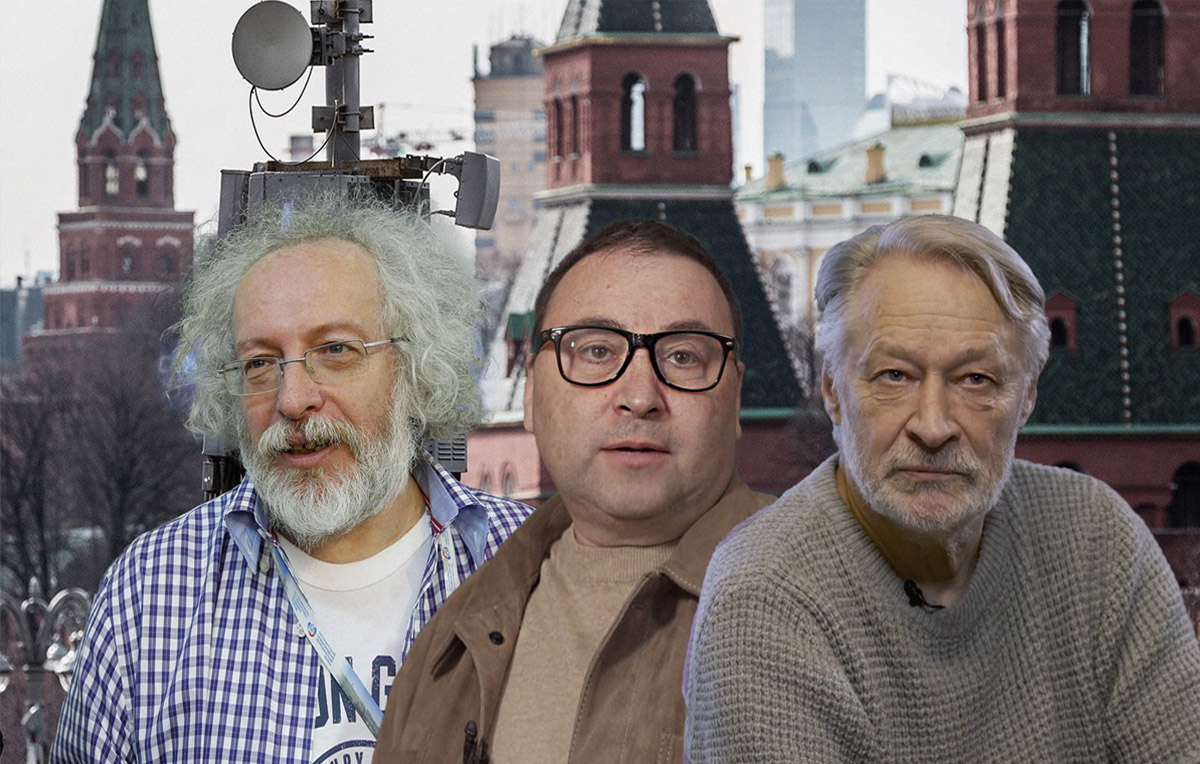
Alexei Venediktov*, Maxim Glikin*, Dmitry Oreshkin*
Evgenia Albats*: Alexei, is it true that there is no internet in the center of Moscow?
 Alexei Venediktov: Well, that's an exaggeration. It's there, but it's... flickering. It appears, then disappears, sometimes only Wi-Fi is available, then Wi-Fi disappears, sometimes you can access Telegram through workarounds, sometimes without them. So you constantly have to connect this with that. But today, I can say, it was really impossible to work because every half hour for about 40 minutes everything disappeared, despite being at home, in the very center, and neither workarounds nor Wi-Fi, nor even wired internet, which we have at home, helped. It's not just in Moscow. The day before, a very strong blow was dealt to St. Petersburg. It was relatively stable there until recently, but now some Wi-Fi networks have started disappearing, Telegram has started disappearing, and people were texting me. So means of information, means of communication disappear, including, importantly, chats about knitting hats or, I don't know, gladiolus enthusiasts. This is done, in general, very centrally and for a long time.
The entire modern Putin model is built on lies. People who tell the truth are not needed
Evgenia Albats: What is the Kremlin afraid of? Why are they turning off the internet?
 Dmitry Oreshkin: It was predictable. The only thing that might be unexpected is the speed of the process. Suddenly they intensified now, by spring. And there can be different assumptions here. Either elections, or some changes at the front, or something else. Why are they closing down? Because the entire modern Putin model is built on lies. They don't need people who tell the truth out of simplicity or for some other reasons. People write that practical life around them breaks out of the proposed framework. For a person who lived in Soviet times, there is nothing new here: in one reality we are marching towards a bright future, and in another - there is no meat in the stores, for example, and butter is not always available, and writing about it was not allowed. Well, now too much is appearing about too many people dying senselessly. Or - why are you destroying cows? People shouldn't know about this, it's harmful to them. Therefore, the internet in Russia, like the free press, was doomed. I don't need to tell you about this. The process has been going on quietly for more than 20 years, but now it has come to an avalanche-like decline, it seems to me.
The Iranian Example
Evgenia Albats: What is the Kremlin afraid of? 1500 political prisoners in the country. People have clearly learned that as soon as you think about protesting, you are immediately taken. And as is known, in authoritarian regimes there are no widespread mass repressions, because a few examples are enough for people to be scared. We see how they got scared. Maybe it's because there were Iranian protests in January, when thousands, maybe tens of thousands of Iranians were killed. And despite the war, executions of those who protested continue. Maybe the Kremlin saw these protests, saw that people were going out into the street despite being shot at, and got completely scared?
 Maxim Glikin: In the Kremlin, it's not like three people sit there and decide what to do next. There are many, as Volodin says, 'faculties', where each solves its own tasks. There is a faculty, let's call it the security service, which solves the tasks of protecting Putin and senior officials from drones. And they directly say that we are afraid that these drones will fly to our residences or directly at us. Just the other day it was said that drones were hunting the governor of Belgorod. And not so long ago, Putin threw a real tantrum that drones were flying directly to his residence in Valdai. And he called Trump about it in an offended manner. So some faculty should deal with this specific issue. What are they doing? They are installing 'Pantsirs'. This is a system that protects against missiles, but practically it now specifically protects against drones, unlike the S-300, S-400, which protect against missiles and which are also being installed, some system was even seen in Losiny Ostrov. Near the Kremlin, 'Streltsy' appeared, these are such vehicles on which people with firearms sit, literally in the Ukrainian style, they should also track drones. This should also, they directly say, serve as communication jamming. Many drones will not be able to reach where they need to. This faculty solves such a task.
And another - the Kiriyenko faculty, will solve it in another way. Including probably also with communication jamming for protest prevention, but rather for this it is necessary to destroy Telegram, for example. Not just jam communication, but destroy Telegram. So everyone solves their own task.
Regarding the internet shutdown, the security officers received a decisive argument on February 28, when, as is known, with the help of various technical devices, the top leadership of Iran was killed
Evgenia Albats: Alexei, since you are directly at the scene, do you see what Maxim is talking about?
Alexei Venediktov: Yes, snipers are already visible on the roofs. When two days ago Putin, for example, went to the Prosecutor General's Board, vans were brought out on Tverskaya, in which a radio signal suppression machine was installed. But I wouldn't speak in such terms: afraid, scared, it's all the magazine 'Crocodile'. It should be understood that the team in power are control fanatics. They put everything under control from the very beginning: the State Duma, the Constitutional Court, created various movements. But the internet was out of their sight, or they thought it was some nonsense. Then they gradually began to put it under control, create special accounts, then began to jam what they couldn't control. It was a long process, I absolutely agree with Dmitry Oreshkin. And in the Kremlin, there was a struggle between departments, as Maxim correctly said. Only it wasn't a struggle between security officers, as I call them, and Kiriyenko's people, who now quite belong to the security officers. And it was a war between, so to speak, 'traders' and security officers. Because the digital economy has long been a huge economy in Russia. And therefore, those people who deal with the economy, from Nabiullina and Siluanov to Shadaev and the heads of large companies, participated in discussions about what to do with the internet. Therefore, the internet was not immediately turned off in twenty-two, as many expected. They resisted, they said:
'...On one side, a large economy, and on the other a loyal Putin minority, according to polls about 40%, they actively use messengers. This will hit them...'
They discussed this among themselves. And they discussed not at Kiriyenko's, but at the head of the presidential administration Anton Vaino, where endless meetings were held. And everything collapsed on February 28 of this year. The security officers received an argument because both sides went to Putin as an arbiter. On February 28, as is known, with the help of various technical devices, the top leadership of Iran was killed.
Evgenia Albats: Do you mean surveillance cameras?
Alexei Venediktov: Including surveillance cameras. They used them to gather information, and transmitted it using the internet, although it was believed to be turned off, but not for themselves. And the leaders of the Iranian state were killed. This was an argument for the security officers who, as I understand it, came to Putin at a meeting and said: we are not responsible for the economy, we are responsible for your safety, the safety of the General Staff, etc. And they received the consent of the Supreme Commander. And of course, what Maxim talked about - 'the attack on Valdai'. So the story is quite long, and to this day 'traders' go and say: we need to restore, the budget is losing, most importantly, the banks that built everything remotely have lost, and this is now impossible, everyone is switching to black cash, which means taxes are leaving.
'Traders' in the Kremlin understand this. Therefore, this is such a real 'black swan'. The third 'black swan' for the authorities, when they make a mistake in relation not to you, not to me, but to their loyal electorate. The first was mobilization, September twenty-second. The second is the story of livestock destruction. Now the internet shutdown. In Moscow, one business office conducted a survey for its purposes: 37 percent are extremely negative about this, another 37 percent are simply negative, 16 are positive (safety first) and 10 don't know how. 74 against in Moscow, and this is a city that now votes for Putin, because the anti-Putin ones have left, and the military have come here, who receive certificates to live in Moscow. So this is now a city of bureaucracy, military pensioners, and loyal intelligentsia. Again, they hit their own.
A Million Deaths
Evgenia Albats: In short, a blow to Putin's support. Could this have any influence on the protest activity of Russians? I lead a seminar on Russian politics at New York University, inviting various people who are somehow closely connected with the study of Russia, or worked in Russia, or were conductors of American policy towards Russia. Including Victoria Nuland, Deputy Secretary of State of the United States in the Biden administration. She is neither a Democrat nor a Republican, she is a classic official. And when I talked to her about what the Biden administration did wrong, she said:
'...Can you explain to me how it could be that the losses on the Russian side are more than a million people, and yet Russia is silent?...'
This became especially evident against the backdrop of the protests in Iran, where there is a very harsh regime, where 150 thousand Islamic Revolutionary Guards, who were just shooting at people. Nevertheless, hundreds of thousands went out. We saw how in Serbia hundreds of thousands went out to protest, how they went out against Orban in Hungary, where elections are soon. What is happening in Russia?
Maxim Glikin: Soviet education taught us to be silent, indifferent to any politics, and everyone was silent. But the same people, when it became possible not to be silent, in ninety-one went to the White House, despite the tanks. In eighty-six, no one would have gone even to a small protest action, 100 people would not have gathered, and in ninety-one hundreds of thousands went out. Yes, now no one will go out, but it accumulates, young people see and understand everything, I communicate with them, they are also in shock, they just can't speak. But when the time comes, if it comes, hundreds of thousands will go out again.
Evgenia Albats: They will answer you with those who dealt with the last years of Soviet power, that then there was the effect of the absence of sausage, the stores were empty and people were completely driven...
Dmitry Oreshkin: In the Soviet Union, there was a combination of many factors. Ideology, first of all, was exhausted. Already at the level of the Central Committee departments, people in a free environment talked not about building communism, but about making living standards like in the West. The elites were disappointed, the economy was collapsing, everything was getting more expensive, international isolation, and then there was also the Afghan war. Alexei Alekseevich very competently listed three black swans. In principle, the dance of little black swans consists of four swans. So, one more is missing. It seems to me that to expect some upheavals, you need, firstly, to have a communication environment so that people can communicate, convey dissatisfaction to each other. In the Soviet Union, surprisingly, it was at the level of rumors. Secondly, there must be a leader. In Hungary, there is Magyar, an alternative leader, and Putin very carefully exterminated leaders. Absolute mutual distrust, people do not trust each other. And even more so, they do not trust those who say that something needs to be done. Go, we know everything, you want to exploit us. There is no trust in either the authorities or the critics of the authorities.
We should not compare with the nineties, not with the Gorbachev years, and not with the tsarist ones, but with the Stalinist ones, when millions survived being killed, why can't a million be survived now?
The second 'swan' is demography. Before the revolution of seventeen, the urban population was rapidly growing, and it was dissatisfied with being restrained in its expectations. Now there is no demographic pressure. The losses in the war are great, but they are incomparable with the Stalinist ones. During the Chechen war, mothers protested, there was Boris Nemtsov, who collected letters and signatures against the war, but then everyone understood that nothing would happen for this. Different time, different system of priorities. Therefore, it seems to me, waiting for mass protests now is not relevant. We should not compare with the nineties, not with the Gorbachev years, and not with the tsarist ones, but with the Stalinist ones, when millions survived being killed, why can't a million be survived now?
Even more important is the absence of an institutional environment in which leaders can only appear. And expecting that the population will rise by itself and a revolutionary wave will go, it seems to me, is a delusion.
Evgenia Albats: Indeed, in such regimes, grassroots political mobilization usually does not occur. The question is why in Iran, under very harsh conditions, could this happen?
Dmitry Oreshkin: Well, firstly, in Iran, they have been going towards this for 50 years. It's like the Soviet Union, it also went to the end for 70 years. Secondly, the situation in Iran is much worse, there is no water, wild inflation, there are more little black birds, I would say, flying around. And there is a large number of young people who no longer want ayatollahs, they don't really want the shah either, most likely they want to live like in Europe. But in Russia, I don't see such massive demographic pressure from below. Thanks to the 'cursed reforms' of the nineties, the economy became market-based. There is much more money in the country. There is enough not only for theft but also to pay people. So in Russia, the situation is significantly better than in Iran. By all innovative parameters.
Recovered from Shock
Evgenia Albats: Alexei Alekseevich, you are in Moscow, you communicate a lot with the Russian nomenclature. Are they still satisfied with the situation they found themselves in?
The beginning of the negotiation process with the Americans caused the nomenclature to expect that now we will make peace, the losses are great, but Russia has withstood economically, Trump will somehow agree, and we will begin to gradually emerge
Alexei Venediktov: The nomenclature is very, I would say, diverse. Well, and the situation is not the same as four years ago. I remind you that it is toxic for the nomenclature to communicate with a foreign agent, communication has decreased, and my view has narrowed. Initially, 99% of them were in shock because no one knew or believed that there would be full-scale military actions.
And about three months later, one very high-ranking comrade from the economic field told me:
'...Do you understand what happened? On February 24, a nuclear explosion occurred. First, it burned people, laid someone down, nothing can be done here. The second story is the economic shock wave. We will build a wall, we will try to hold back this wave...'
So the economic part got the role of building a wall, relying, as Dmitry Borisovich rightly said, on market reforms, entrepreneurs began to bypass sanctions, leave, evade, etc. And then, he says, radiation will come - then we will be screwed. But, he said, we have nowhere to go. Because Western sanctions have been imposed against me, my family, my friends. I can't leave. So, I'm either here or there. This is not me speaking, this is him: 'They united us around Putin'. And it continues. The beginning of the negotiation process with the Americans caused them to expect that now we will make peace, the losses are great, but Russia has withstood economically, Trump will somehow agree, and we will begin to gradually emerge, a second chance, etc. This is what the nomenclature is doing now. Mostly I'm talking about the economic one. And regional, because the unfortunate governors, who are squeezing the last juices out of themselves, out of their population, also understand everything. They are responsible for this. Therefore, there is no delight in the fact that military actions are taking place. Of course, there is the general staff, there are security officers, there are people who do business on the war, make a political career, try to enter the number of heirs on this. They exist, but they are an absolute minority. No one wants to live in a state of emergency.
Evgenia Albats: But at the same time, no one can afford, as Kozak or Naryshkin did, to come to the boss and say: 'We need to stop this.'
Alexei Venediktov: Well, they said it once, they were told: no, don't stop, go and work. They went to work, where else can they go? What alternative does the conditional Siluanov have, the conditional Belgorod governor Gladkov? The elite is waiting for agreements, the elite is waiting for the end, I won't even say the war, because the elite as a whole associates all extraordinary measures with the military situation, which, in my opinion, is not quite correct. Here the military actions will end, and the nationalized enterprises will be returned to the owners. No way, they won't return. Moreover, they will continue to nationalize. Here the military actions will end, and then they will turn on the internet for us. No way, they won't turn it on. Why? The same team is in power, control fanatics with the same vision, they won't do any of this. This is a story about them waiting for some relief, where there will be more understandable rules. Dmitry Borisovich correctly said about the split of the elites. There is none because - what is the alternative?
That's His Craft
Evgenia Albats: The story with the Kremlin informer, propagandist Remeslo surprised everyone because he suddenly began to appear on air with talks about the bad Putin. After that, it became known that he was taken to a psychiatric ward. The principle of Soviet power: if you speak against the authorities, you are mentally deficient. Do you have an explanation for this case?
Maxim Glikin: We see this story not only from his side. We see that open indignation, grumbling, and even some terrible words are heard from various patriotic corners. Maybe this is also somehow connected with Iran, or maybe with the internet or Telegram, I don't fully understand. Even the 'Moskovsky Komsomolets' unexpectedly spoke very sharply. Surprisingly, they roughly repeated your narratives. In short, there is fermentation and bubbling in many channels. There is such a wave, he picked it up, and interestingly, the same patriots defend him.
Evgenia Albats: Do you think he is of sound mind and memory, just felt that it's time to stake out a platform for himself when this regime falls?
Maxim Glikin: His personal motives are unknown to me. If he wanted, for example, to be pulled out as a political prisoner to Europe or somewhere in the USA, he didn't deserve it, they clearly won't pull him out. Besides, you still need to live to see those wonderful days. But he certainly didn't seem crazy to me...
Mr. Somewhat
Evgenia Albats: A film was released - and not just released, but received an 'Oscar' - 'Mr. Nobody Against Putin', a film based on video materials of a teacher from Russia, who was an organizer of some events and a videographer in a provincial school. The most curious thing is how divided the attitude towards this film is here, in the USA, in the West in general, and among people with liberal views in Russia. I watched the film and remembered, of course, that we also marched like that, and we had all this, all these 'Zarnitsa', which did not prevent us from reading banned books from about the eighth grade. The film didn't particularly impress me, but I'm probably not the target audience for this film. What do you think about it? Why such a different reaction?
Dmitry Oreshkin: I watched it, I would give it a four, maybe with a plus, understanding that it's not for us, it's for a Western audience. Very professionally, cold-bloodedly, reasonably made film for Americans, for the British, probably for the Germans. For Soviet people like us, there is no revelation.
Evgenia Albats: Well, the film was made by a Western director. He edited it. But for us, it is perceived as a revelation from the depths of Russia. And there is no revelation.
Dmitry Oreshkin: It is for the Western viewer and made for them. And we watch and ask ourselves the question: 'Who was filming you at that moment when you were filming someone? Who told you what to shoot and what not to shoot?' And it creates the feeling that it's not quite staged, as the footage is documentary, but not quite reliable. And this causes highly spiritual Russian dissident people to want to break their fingers and be indignant. They want everything to be 'honest'. And here is professional work with a specific audience, correctly constructed. That's why it received the award. Not only because it's against Putin, as they try to tell us. It's a good movie. Criticizing it is easy, that's why it's not worth it. It still showed the breaking of young human lives. And we see how these guys grow, how they change, how they go to war, how they see off friends to war, how one of them dies. This piece of life is documentary. And therefore, I think the movie is good, well-made. For the Russian intelligent viewer, especially if he is excessively sensitive, the film causes a feeling of indignation: well, how come, it's not quite honest, or the children were not asked, or there was some pre-thought-out scenario. Well, there was, of course, what do you want. I think this is squeamishness, 'white-coatism', extremely characteristic of a part of our intelligentsia, especially foreign. In my opinion, everything was done correctly. The guy did well.
Evgenia Albats: Alexei, you are a school teacher. How do you think this film reflects the situation in schools across the country?
People from the Ministry of Education talk about history lessons: no alternative views, you must learn the names of the heroes of the SVO and answer on the exam, otherwise, we will not credit the exam
Alexei Venediktov: I am indeed a school teacher, so I have a squeamish view. Sorry, Dmitry Borisovich, your omnivorousness does not please me. I would look at you if your child was filmed there and then shown to the whole world in the form they are. Consider me a squeamish person. But that's not the point. Of course, there is a problem of militarization of the school. Disgusting militarization, I would add, clumsy militarization. A lot is done for the sake of a checkmark. We had all this, it's not normal, but it was and is. In this sense, it is very important that this film, here I will put a plus, raised this topic. This is the first. Second: there are staged scenes. Fake.
Evgenia Albats: For example, the flag removal.
Alexei Venediktov: Yes, went to the roof, removed the Russian flag on camera. Or the story with taping windows with the letter X, because it's a symbol of resistance. Have you heard that X is resistance? And we now know that this task was given to him by an American director. You, Dmitry Borisovich, said that the film is for the West according to a Western template. I would look if Western children were filmed like that and shown on the big screen without written parental permission!
Evgenia Albats: Well, Moore shot documentaries about school shootings.
Alexei Venediktov: That's right. And now ask him if he took permission to show the children? I remember, they blurred the children, apparently those whose parents did not give consent. There are certain rules. Therefore, I will not review this film, I feel uncomfortable.
But the topic is very important because, I draw your attention, today no less important are two interviews, they were taken for the newspaper 'Kommersant' by Alexander Chernykh from people who are promoting a new history textbook. This, and not a marching song contest, is scary. Monstrous, because the child must learn it and answer. People from the Ministry of Education say: no alternative views, he must learn the names of the heroes of the SVO and answer on the exam, otherwise, we will not credit the exam. I would talk about this, what literature is now and how history is. That is, what remains and how children should report, even not believing in it.
And I have my own view on the story with Remeslo. I think it's connected with Alexei Navalny**. The Kremlin is still afraid of Navalny because nothing can be done with him anymore. The living can be scared. Killed, bought, finally. But with a mythological hero, nothing can be done, but he can be smeared. In an interview with Plyushev, Remeslo absolutely initiatively returns four times to the story that Navalny worked for the presidential administration. He throws this in, and then I see that among people who always wrote well about Navalny on social networks, he sowed doubts. I'm not saying he did everything for this, but I can't agree with you, Maxim, that he did it because there is such a trend. To say about Putin what he said is not in this trend. Even Prigozhin did not allow himself to say such things about Putin. Yes, we are going to save Vladimir Vladimirovich from Shoigu and Gerasimov, said Prigozhin. And the same was said by Girkin. And Remeslo says something completely different. He speaks in the words of Garry Kasparov. Do you believe me that Putin is like that? Then you should believe about Navalny. It seems to me that this element should also be remembered because for the presidential administration Alexei Navalny is already a mythological figure, he is still scary because he unites the most diverse opponents of Putin. Since I was a witness and participant in two episodes that Ilya Remeslo talks about, Navalny was never an agent of the presidential administration. He never worked with the administration himself. Yes, he tried to use the administration, and the administration tried to use him, but to say that he was the same as Ilya Remeslo, 'we even worked in the same tower', according to him, is simply actually brazenly lying. And the question is, wasn't all this started for this?
Evgenia Albats: Curious. Of course, Alexei Navalny never worked with the presidential administration. Moreover, he avoided any contacts, both with ambassadors and embassies, and with the presidential administration. This was a completely conscious political position so that no one could hang any speculations on him. And the fact that the deheroization of Navalny began from the first moment he crossed the border of the Russian Federation in twenty-one, when he returned after treatment from poisoning from Germany to Russia, is a fact. They are afraid of him because he is an example of incredible courage and resilience.
Dmitry Oreshkin: I am surprised by the mass noise about this story with Remeslo, it seems to me the plot is not worthy of it, because, as far as I understand this gentleman, for him the situation with leaks, with informational operations is a habitat. He feeds there. This is a nourishing environment for him, he will never say anything just like that. I know many smart people who say that maybe the person got fed up, but they project themselves, their worldview onto him: he tore his vest and decided to tell the truth. If it were so, he would now be sitting next to Girkin in prison. And I am absolutely convinced that this is some kind of operation. For what? I can assume that a very serious role is the littering of the information space. That no one can be trusted, everyone sells out, everyone buys. I think Alexei Alekseevich may not have caught the biggest fish in this murky water, but probably not the smallest either. Indeed, the discrediting of Navalny is felt there. Such a line is being conducted that both Remeslo and Navalny are people of the same scale. Firstly, the scale is different, firstly, and the goals are different. Navalny had serious, big political ambitions, and Remeslo just earns a little bit. His task was, as it seems to me, maybe to bury Navalny, maybe just to litter the information field, to say that everything here smells disgusting, everyone sells out, everyone buys, and to discredit this very information field, to disrupt the communication space. The Kremlin is very consistently engaged in this so that people cannot rely on anyone. In this situation, leaders cannot grow. In this situation, only such mushrooms as Remeslo can grow.
Video Version
* Evgenia Albats, Alexei Venediktov, Maxim Glikin, Dmitry Oreshkin are declared 'foreign agents' in the Russian Federation.
** Alexei Navalny is included in the list of 'terrorists and extremists'.
Photo: Russian Look, Maxim Glikin — author's social networks, 'Current Time'.