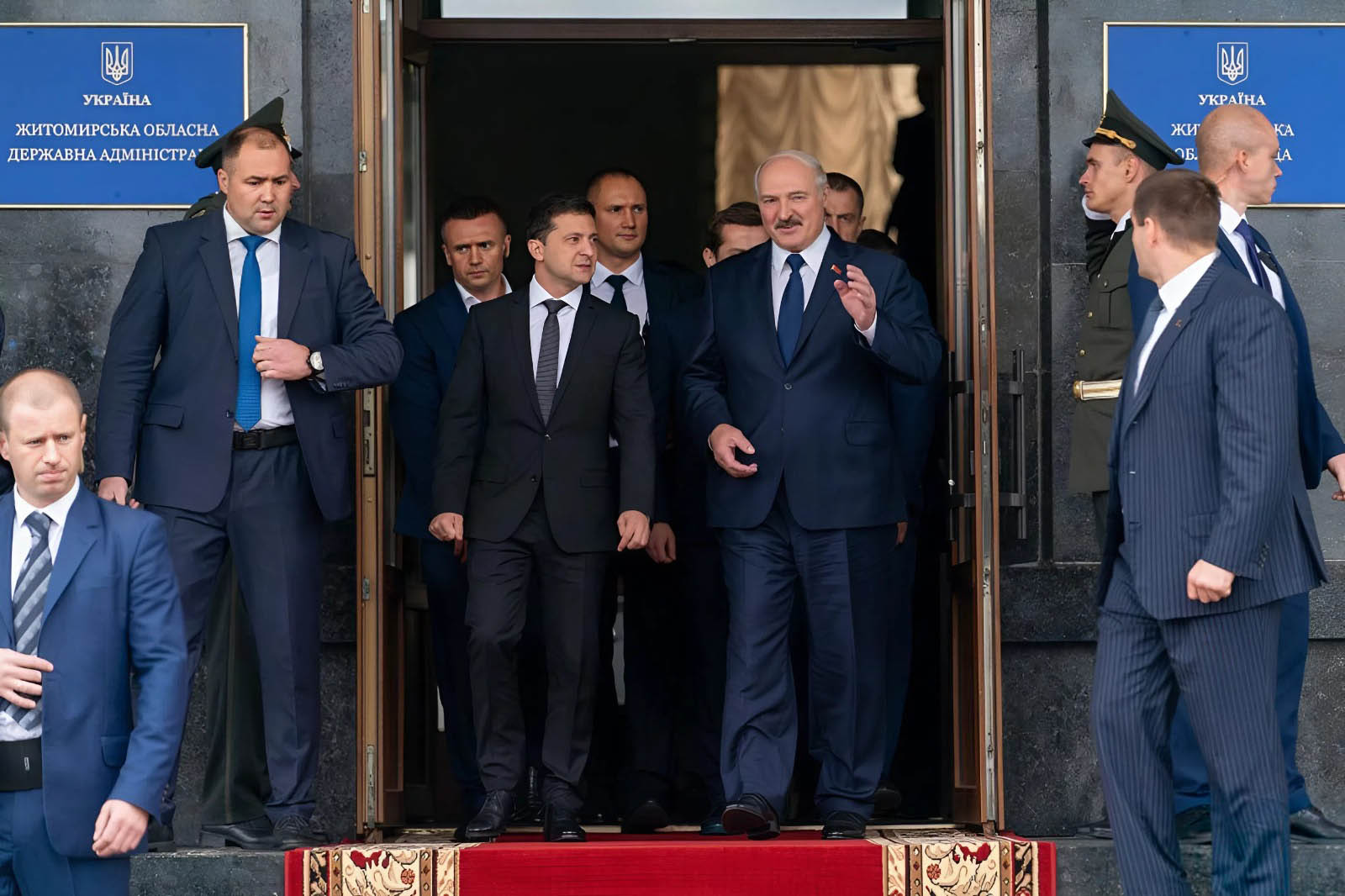
Volodymyr Zelensky and Alexander Lukashenko. Photo: Press Service of the President of Ukraine, 2019.
Yevgenia Albats*: The American press wrote about the pressure on Zelensky to force him to agree to peace terms on Putin's conditions.
Trump stated that it was time for presidential elections in Ukraine. Quote:
«...They use the war to avoid holding elections, but I think the Ukrainian people should have this choice. Maybe Zelensky will win, but they haven't had elections for a long time. They talk about democracy, but it gets to the point where it's no longer democracy...»
Do you expect Zelensky to go to elections? Is it time, and is it possible to hold them, considering that 12 million Ukrainians are abroad, a couple of million are on the front, people are scattered across the country?
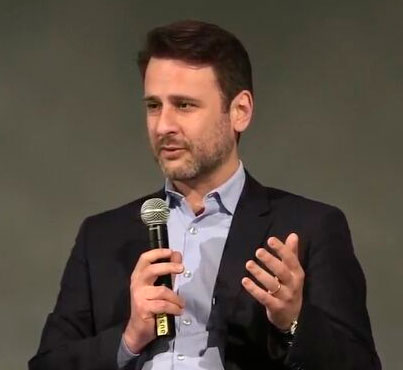 Simon Shuster: Yes, Zelensky said he is ready to hold elections. The headline I saw: «60–90 days». «Zelensky is ready to hold elections if partners ensure security». The phrase «if partners ensure security» is key here.
I spoke with Zelensky about his views on holding elections during wartime. He is against it. There are interesting debates among his advisers and administration members. During the full-scale war, they debated: maybe now is a good time to hold elections? Usually, this happens when Zelensky's popularity is high. They say:
«...Hey, boss, if we hold elections now, we'll secure success, you'll win. There are no competitors with such popularity. You'll have another five-year term, and we'll get rid of the questions Trump raised today...»
These debates arose periodically. There was a moment after the well-known Oval Office spat between Trump and Vance on one side and Zelensky on the other. Everyone saw that video. Zelensky's popularity in Ukraine soared like crazy after that. In Ukraine, they thought he held his ground, made the country proud. Didn't let himself be pushed around.
Then people in his circle said: «Seems like a good time for elections». His consistent answer — I heard this indirectly through advisers and spoke with him directly: «No. No way. You can't hold elections during a war». He gives several reasons. First: martial law. The text of the martial law prohibits elections. It's illegal. Presidential elections? No. There must be a Supreme Court decision... The law mentions the Rada, not the president.
President Zelensky clearly feels that presidential elections will not be allowed under martial law. He would have to lift martial law to hold elections. Lifting martial law means that men of conscription age (25–60 years) are no longer restricted from leaving the country. There will be all sorts of consequences, but one of them is that anyone who fears conscription (and there are many) will leave the country. That's not good if you haven't finished fighting yet.
The second point he talks about is unity. What allowed Ukraine to survive is the unity of people coming together against aggression. He argues that if you switch from a state of war to an election campaign, you can forget about unity. It will activate competing political forces, and they will start fighting each other for power. It's destructive to the nation's unity.
And the third point is security. How to vote if on election day Russia launches fighters with missiles? Everyone has to go to shelters. How to hold elections?
The question of citizens in occupied territories. There are millions of them. They won't be able to vote. You won't hold elections in occupied territories. This has legal consequences: you legitimize the occupation by saying these parts of Ukraine vote, and those don't. You abandon them.
It's easy to say: «Hold elections». But he always says: «Let's think about how this looks in practice». He is very sensitive to legitimacy issues. He hates this question. But he makes serious arguments.
Yevgenia Albats: Do you think if elections are held, Zelensky can win? Some say he will win in the second round.
Simon Shuster: His rating has been volatile throughout the war. March 2022 — 90%. Then a decline. Now, due to a corruption scandal, it will be much harder for him.
We need to look at competitors. Zaluzhny. In my book about Zelensky, two other prominent figures are the First Lady Olena Zelenska and the Commander-in-Chief of the Armed Forces Zaluzhny. For the first 2.5 years of the war, he was the Commander-in-Chief and the most popular political figure after Zelensky. Now he is an ambassador in London. In polls before the scandal, they were neck and neck. After the scandal, I believe Zaluzhny might be ahead.
I spoke with Zaluzhny about the possibility of running. He is a bit secretive. He says: «People are always trying to drag me into politics. Leave me alone».
But I know he has considered it. He is not a political animal; it's not his comfort zone. But he has taken steps resembling a political platform. At the end of November, when the scandal was gaining momentum, he published a couple of columns — in The Daily Telegraph and in a Ukrainian publication. Then he went silent. I contacted him: «It seems you want to present a platform». He replied: «Simon, glad to hear, but I've said my word».
There is internal struggle in Kyiv. There are clans. There are teams that hate each other. In the very early days of the full-scale war, rivalry evaporated, and the sense of danger united people. But then internal struggle returned. People started fighting for positions again
Zelensky is under pressure from all sides. Often pressured to fire very high-ranking people who have not been found guilty by a court but are under suspicion or accusation. As soon as someone is accused of misconduct, Zelensky is pressured to fire them.
I know that even very high-ranking officials in the Biden administration told Zelensky: «This guy is under suspicion <in corruption>, you need to fire him». Up to the former Minister of Defense. Zelensky doesn't like it. He says:
«...Well, let's at least let the judicial process work. I can't just fire the entire Ministry of Defense leadership in the middle of a war, are you crazy? I need to find new people to lead the Ministry of Defense. It's an important ministry...»
I am somewhat mimicking the tone and message of President Zelensky. I am not quoting him verbatim, but giving you an idea of what arguments he is trying to make.
I have seen — spending a lot of time in the president's offices in Kyiv — that there is internal struggle. There are clans. There are teams that hate each other.
In the very early days of the full-scale war, all this rivalry evaporated, everyone worked side by side, the sense of danger united people. But after a few months, internal struggle returned. People started fighting for positions again. Some of this I saw: people came to me as a journalist and said: «Hey, Simon, that guy is corrupt». — «Why do you think so?» — And they didn't provide evidence.
This happens — insinuations, attempts to use accusations to push a rival aside in the administration. This is not unique to Ukraine. It's common for any power structure. Where there are clans, different centers, rivalry among people who want power over some part of the state function. So it's a mess. And Zelensky's job is to try to make this giant machine work properly.
He asks for patience when I talk to him about this:
«...We will deal with these problems, but I can't fire everyone because then I'll be left here alone trying to lead this war...»
Trump — Lukashenko — Putin
Yevgenia Albats: You were one of the very few Western journalists who managed to get a big interview with Alexander Lukashenko. Thanks to this interview, we learned about the existence of a secret communication channel between the Kremlin and the White House through Minsk. Lukashenko is happy to talk about his role in organizing the meeting between Trump and Putin in Alaska, allegedly first Putin called him and asked for help in organizing a summit with the American president, and then Donald Trump, the President of the United States, also called him and asked for help. Simon, you know the story from both sides, and you have spoken with many American officials — how did it happen that Lukashenko became a mediator between Donald Trump and Putin?
Simon Shuster: I think it was happening throughout the year since Donald Trump took office in January 2025. One of his main campaign promises was to end the war in Ukraine in 24 hours. And they used various channels to try to achieve this.
The main one at an early stage, and to this day, can be called the Steve Witkoff channel — it worked with varying success throughout the year. But by the summer of last year, it became clear that it wasn't working. Witkoff was returning from Moscow after his repeated trips without much progress on a peace deal. He was listening to detailed lectures from Vladimir Putin on medieval Slavic history but wasn't getting any concessions or compromises from the Russian side. So a group of officials in the State Department and the White House began looking for alternative channels to reach Putin and try to get him to cooperate or negotiate in good faith to try to end the war. And one of the channels, I would say the main alternative channel they used, became Mr. Lukashenko. They started reaching out to him very early. The idea to use a secret communication channel with the Kremlin through Belarus was suggested by State Department official Christopher Smith, a very experienced diplomat. One of the few career diplomats who remained in his position and retained significant influence after Trump took office and began a "purge" of many experts, professionals, and career politicians from the State Department. Chris Smith stayed. And he very quietly negotiated with the Belarusian envoy to the UN in New York. They talked about what could be done. How to restore relations between the US and Belarus? What could be done with Ukraine? And over time, Chris Smith managed to attract officials from the White House who sympathized with this idea and thought it could be more productive than the Witkoff channel. One of them was Keith Kellogg, a retired US Army general, Trump's envoy to Ukraine. Another was a close associate of General Kellogg, John Cole, a former lawyer for President Donald Trump. The three of them began working on this idea.
As for Lukashenko, when he heard the signals that reached him through his envoy to the UN, he saw a good opportunity to do several things. First of all, to weaken American sanctions against Belarus, which were very intense even before the full-scale invasion of Ukraine, in which Belarus was an accomplice. Namely, starting from 2020, when Lukashenko staged his last re-election and very brutally suppressed the popular uprising. He is under very strict sanctions from Europe and the US. Therefore, he wanted to achieve their weakening, at least through cooperation with these American officials who were reaching out to him.
I want to emphasize that this was not Lukashenko's idea. The Americans reached out to him to open this secret channel. And then he discussed this idea with Putin. He and Putin are very close and communicate very often. Again, they are both responsible for the invasion of Ukraine. Belarus helped Russia carry out this invasion.
So he called Putin and, as far as I understand, said:
«...You know, the Americans are reaching out, they want to make some kind of deal or negotiate on Ukraine...»
Putin also saw some opportunity in this secret channel. And then they began to talk more seriously. Now I don't remember exactly, I think in February <2025> Chris Smith went to Belarus personally. He was the first representative of the Trump administration to go there. One of the first, if not the first, to make an official visit to Belarus since 2020 when the opposition was crushed. He went there and opened this secret channel.
Yevgenia Albats: Why choose Lukashenko? Why couldn't they just use the Russians at the UN or in the embassy to call Putin? Not to mention that Putin hates Lukashenko... They both pretend to have good relations, but they hate each other because Lukashenko is critically dependent on Putin, and Putin knows that Lukashenko will betray him the first minute Putin becomes weak. In general, what's the point of using Lukashenko?
The American administration was disappointed with the Witkoff channel, official diplomatic talks between the US and Russia also weren't working, leading to confusion and disappointment on Trump's part. So they asked Lukashenko: «What does Putin want?»
Simon Shuster: Through the Witkoff channel and publicly, Putin was saying: «I want to make a peace agreement with the Americans. I want to negotiate. We need to end this war and address its root causes», and all that. But at the same time, he not only continued but intensified the horrific bombings of civilian areas in Ukraine. And this discrepancy was very difficult for the Americans, and Trump personally, to understand. Why does Putin say one thing and do the exact opposite? Why didn't he agree even to a two-week pause in the bombings to allow the negotiation process to strengthen and start?
They were really confused. No one could give them a good answer, so they were asking various people who they thought understood or understand Putin, and Lukashenko was one of them. Yes, they have a "frenemies" relationship. But if you need someone to explain Putin to you, — Lukashenko is a pretty good candidate. He was available to them, and for this reason, they went down this path.
I think it was mainly out of disappointment with the Witkoff channel, official diplomatic talks between the US and Russia also weren't working, leading to confusion and disappointment on Trump's part. So they asked Lukashenko: «What does Putin want?»
This is the eternal question my editors have been asking me for 20 years: «What does Putin want?»
And they came with this question to Lukashenko.
Yevgenia Albats: Donald Trump in his social network Truth Social praised Lukashenko as, I quote, «a strong leader» and «a highly respected president». What made the US president sympathize with Lukashenko so much? And what do you think of Lukashenko after the interview with him in July 2025?
Simon Shuster: It's important to understand the context in which Trump made this statement.
He was flying on his plane to Alaska for a meeting with Putin when he published this statement. Basically, he was thanking Lukashenko for his role in organizing the summit.
I revealed this secret channel and Lukashenko's role in it in my article in Time a few days, about a week before that. But when Trump posted on social media, it became a sort of official acknowledgment. Trump essentially acknowledged that yes, the «highly respected leader» of Belarus clearly played an important role. So he was just thanking him for organizing this summit in Anchorage, for which at the time, when Trump was flying there, he had high hopes — that it would be a breakthrough, that it would look very good, that it would bring him closer to the Nobel Peace Prize and everything he wants. He was excited, and his advisers were telling him that Lukashenko was directly involved in this.
Yevgenia Albats: Somehow Lukashenko's people came either to you or to Time Magazine and expressed a desire for you to personally come to Minsk <for an interview>.
Why did they reach out to you, and why weren't you afraid of ending up in the position of our friends arrested in Russia?
Simon Shuster: In May 2025, an American businessman who had long worked in Belarus contacted me. I know him not in connection with his work in Belarus, let's say. He contacted me and said: «I want to talk, it's urgent». And when we got on the phone, he said: «I want to help you arrange an interview with Lukashenko». I had never been to Belarus, wrote about it a little, mainly in connection with the popular uprising in 2020 and the subsequent repression, but I didn't consider myself an expert on this country specifically. And I didn't take this first approach very seriously. I said: «Okay, sure, go ahead, try». My initial assumption about why they were reaching out to me (and this is to your question about what I think of Lukashenko) was that perhaps Lukashenko was uncomfortable with his dependence on Russia and was again trying to open channels to the West, including through the media, through interviews. He has done this repeatedly over his more than 30 years in power: oscillating between the West and Russia, trying to gain favor and benefit from both sides and often playing on the contradictions of the sides. So my guess was that he was trying to do this again. I considered it in the context of various situations that had occurred a year before, where Russia showed itself to be a bad ally of its vassal states. An example is Syria. The Russian regime protected Assad with horrific bombings of civilian populations and opposition forces at least from 2015 to 2020. Then, when the war in Ukraine began, the assistance began to dry up. And when Bashar Assad's regime came under direct attack from opposition forces in December 2024, Russia did not come to his aid. It offered him only a pension in Moscow and an evacuation flight.
Another example is Armenia. Armenia is a treaty ally of Russia. It had a war with Azerbaijan, which it very quickly and completely lost to Azerbaijan, an ally of Turkey.
Russia, according to the mutual defense treaty that Armenia has with Russia, was obliged to come to Armenia's defense, to help somehow. And Armenia really begged Russia to help in the war against Azerbaijan. But Putin was so busy and tied up with Ukraine that he did nothing. And Armenia as a result suspended its participation in this mutual defense pact <CSTO>, because it was quite justifiably outraged that the "big brother" did not come to help.
The succession plan in Belarus is quite clear, unlike in Russia. Putin's succession plan is very vague. Lukashenko's — here's my boy...
Yevgenia Albats: Returning to Lukashenko... What's happening with the secret channel now?
Simon Shuster: Good question. The secret channel fulfilled its function with the summit in Alaska. And it seems to have exhausted itself. After the summit, it went quiet. Discussions are still ongoing about the release of political prisoners and the lifting of sanctions. Belarus received some sanction relief shortly after Alaska — spare parts for aviation. If you don't have spare parts for Airbus, they break down. The head of state's plane doesn't work. The Americans gave a concession for the purchase of spare parts, and it's clear that these parts will also go to Russia to fix Putin's "Air Force One". I was surprised that when we talked about sanctions, the first thing he mentioned was "Belavia", the national airline.
Yevgenia Albats: Is there a horizon for how long he has left to rule, and are there any names being talked about for possible succession?
Simon Shuster: Kolia. His youngest son. He is now 20, maybe 21 years old. Since he was 5–6 years old, his father has been taking him on all trips. He met Obama, the Pope, Xi Jinping.
Lukashenko's team suggested I talk to one of the sons. They chose Kolia. Lukashenko encouraged this. It was fascinating, I talked to him for a couple of hours. It's clear he is being groomed for power. It's unclear when. Lukashenko hinted in the interview that maybe he won't run for the next term (in 2030?), maybe he'll step aside.
The succession plan is quite clear, unlike in Russia. Putin's succession plan is very vague. Lukashenko's — here's my boy...
Reference
Simon Shuster is a staff writer for the American magazine The Atlantic. Specializes in events in Russia, Ukraine, and other parts of the former Soviet Union. His political reports and analytical articles have featured Vladimir Putin, Dmitry Medvedev, and other high-ranking Russian officials. He has written political portraits of the last three presidents of Ukraine, starting with Viktor Yanukovych. As a correspondent for Time, he covered the Russian invasion of Ukraine, traveled three times with President Zelensky to the front line, and spent months reporting from the presidential complex in Kyiv. Author of the bestseller "Showman: Volodymyr Zelensky and the War in Ukraine".
Born in Moscow. Grew up in San Francisco. Graduated from Stanford University. Worked for several years in Moscow as a foreign correspondent.
* Yevgenia Albats is declared a "foreign agent" in the Russian Federation.
Photo: transitloungeradio.net.