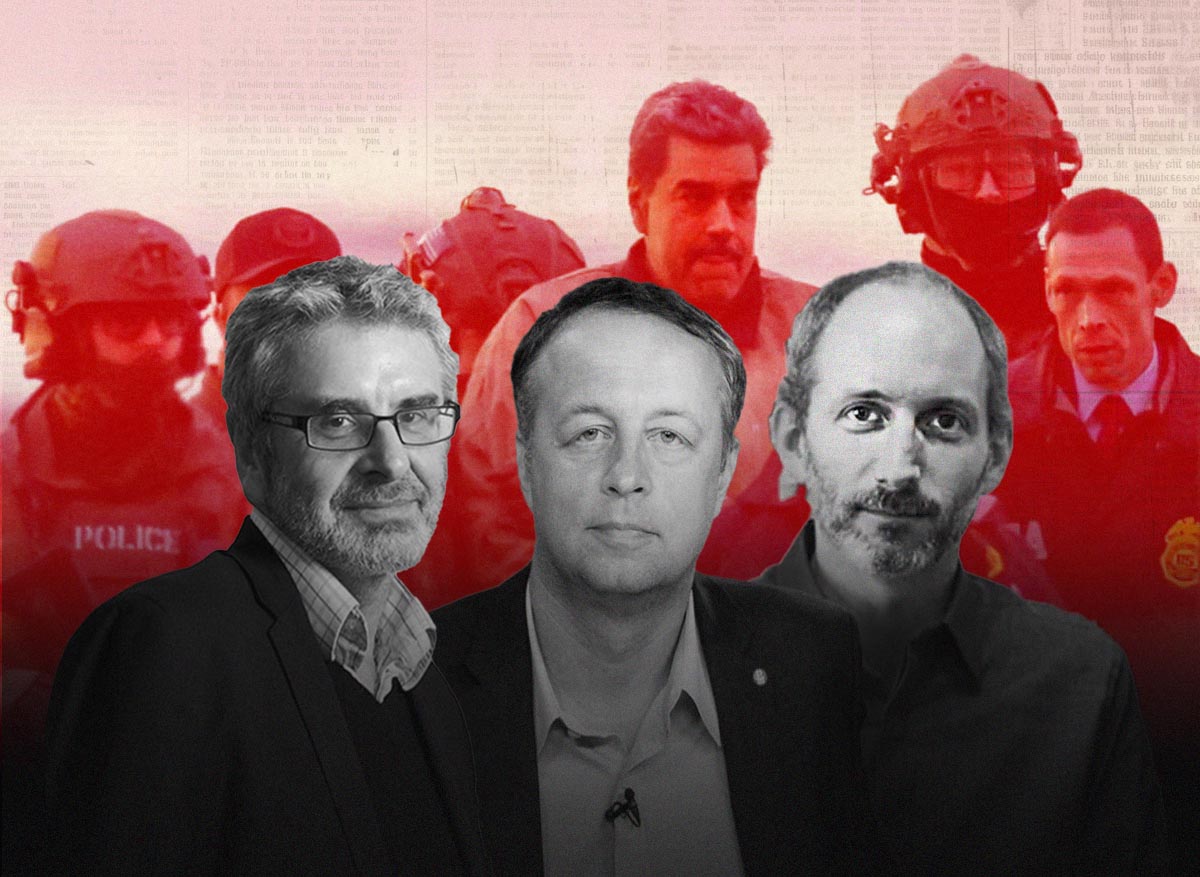
From left to right: Alexander Etkind, Konstantin Sonin, Samuel Greene
Yevgenia Albats*: On the night from Saturday to Sunday, the United States conducted a special operation to capture and detain Venezuelan President Nicolas Maduro and his wife, Venezuelan Attorney General Cilia Flores. During this operation, bomb strikes were carried out on a military base in Caracas. The Russian Federation, of course, condemned this act by the United States, calling it aggression against Venezuela. At a UN meeting, the representative of the Russian Federation, Nebenzya, called this US operation a "bandit act." But interestingly, none of us heard any comment from Putin. And as we know, Vladimir Putin, like the Chairman of the People's Republic of China Xi, are major sponsors of the Maduro regime. A conspiracy theory immediately emerged, referencing former Russia advisor on the National Security Council during Trump's first term, Fiona Hill, who said during the 2019 impeachment hearings that Trump and Putin had agreed on a deal. They would exchange Venezuela for Ukraine. That is, the US would gain control over Venezuela, and Russia would gain control over Ukraine. What do you think about this? And why is Putin silent?
What to Say When There's Nothing to Say
 Konstantin Sonin: I don't think Putin has anything to say. It's generally characteristic of him not to react immediately to events, but I think his worldview is temporarily disrupted: he was convinced that the money Russia spends on Venezuela, and Venezuela purchased a lot of weapons on credit, receiving credit from the Russian Federation, meaning Russia financed Venezuela's weapons purchases, — that this gave it some protection from the US. In November and December 2025, Russian propaganda media actively promoted this topic — how our air defense systems, our specialists would protect the Maduro regime. It turned out that all this could be bypassed without losing a single American soldier's life. I think Putin needs some time to cope with the humiliation and disappointment. But we also know from observing Putin that after some time, he will come out and repeat the same things he said before.
The normalization of aggression justified by oil interests is an extremely bad omen for the near future
 Alexander Etkind: I have several opinions on this matter. They partly contradict each other, I must say, in this case. On one hand, I have no regrets about dictator Maduro. I am especially glad that he was not killed, which would have been technically much easier, but that he will stand trial. And whatever the modern problems of American justice, we will learn a lot about his own crimes and how the American judicial system handles such a complex case. Under what laws will he be tried? Under international laws — then they need to be recognized, or under American laws — then it's unclear why he should obey them. It's unlikely he will be tried under Venezuelan laws, although there would be arguments in that direction. And this opinion of mine contradicts another view that this is direct aggression against another state. And this act of aggression normalizes what is happening in the 21st century, normalizes other acts of aggression, particularly Russia's invasion of Ukraine. And much more that I think we will see in the near future. The normalization of aggression justified by oil interests (scientifically called petro-aggression) is an extremely bad omen for the near future.
 Samuel Greene: I think Putin usually says something when he can consider it his achievement or can hint that he did something promising obvious success. And where he can be indignant, but this indignation will not lead to anything useful for him, his words will not return Maduro to his place, will not change Trump's policy, — he usually remains silent. So here, in my opinion, there is nothing unusual.
You referred to some hints, whether there was some deal between Trump and Putin on this matter. Why did Maduro give up so easily, effectively surrendering the regime? And why did the US agree that even though this regime is illegitimate from top to bottom, it still remains in place. Power is transferred to the vice president, and the opposition has no chance with American support to take power, despite the fact that this opposition, from the official American point of view, won the previous elections. Therefore, there is reason to believe that this is not a competition between the US and Russia for influence in Latin America, but some hint of collusion between the great powers. And this is precisely the main danger that may await us. If for the last 10–11 years we feared the emergence of a large-scale war due to the competition of great powers, now we face a completely different danger. Namely, a deal between great powers, which could lead to the deterioration of the status of all non-great powers, including Venezuela, including Ukraine, and many others.
Gunboat Diplomacy
Yevgenia Albats: Sam, please enlighten us about the Monroe Doctrine, the mid-19th-century doctrine that talks about dividing spheres of influence. According to the doctrine, Europeans were supposed to refrain from colonizing Latin America and leave Latin America to the United States. Trump referred to this at his press conference after the operation in Caracas and said that now it's the Donro Doctrine, thus adding his name to it.
Samuel Greene: I'm not a great historian. I assume Trump even less so. But look, the Monroe Doctrine is one of the oldest aspects of American foreign policy, James Monroe was the fifth president of the United States, who stated that the US did not want to see Europeans on the American continent. At that moment, somewhere in the second and third decades of the 19th century, European empires in the Eastern Hemisphere began to collapse. The first Bolivarian movements appeared, including in South America. The US's desire was not to see the further development of European colonies on the territory of new or relatively new independent countries that appeared on the American continents. At the same time, the US was weak at that moment. They had neither military nor other levers to prevent Europeans. The British, French, Portuguese continued to develop their policy in the Western Hemisphere. The Americans made some statements but remained rather toothless until the end of the 19th century and the beginning of the 20th century — with presidents like Teddy Roosevelt, who introduced the concept of gunboat diplomacy, "gunboat diplomacy," that is precisely what we have seen in recent months from the Trump administration, when he starts sinking ships and chasing vessels carrying Venezuelan oil around the world, allegedly under Russian cover.
If you look superficially, it was indeed an attempt to first exclude European powers from the US's "security zone," but at the same time not to create an American order in this part of the world because the Americans did not have such an opportunity. Then, starting from the 20th century, there were repeated attempts to use this as a justification for imposing American interests, especially during the Cold War, but also after. During Trump's first presidential term, we also saw a keen interest in what was happening in Cuba and other places. Now everyone has forgotten that it was some kind of liberation doctrine. Trump does not think and certainly does not speak in these terms. It is a doctrine of imposing American commercial, mercantile political interests in the Western Hemisphere, starting from Venezuela and Panama, possibly ending with Greenland.
Who Will Govern Venezuela?
Yevgenia Albats: The United States did not appeal to the UN Security Council, Trump did not go to Congress, which is the only body that can declare war. True, there was no declaration of war here, but he did not even inform Congress that such an operation was planned. The operation was supposed to take place on December 31, but the weather was bad, so it was postponed to the past Saturday. Konstantin, what do you think about all this?
Maduro was removed — and to hell with him. But this was done without any plan for the future. And what President Trump plans to do next with Venezuela is pure fantasy
Konstantin Sonin: Maduro was, of course, an illegitimate president and a thug, he held on to power with bayonets, Venezuelans dreamed of getting rid of him, there's no question about that. He was overthrown, and to hell with him. But here's what surprises me about all this. The abandonment of gunboat diplomacy happened not because the US suddenly thought gunboats were immoral, but because it turned out that this policy didn't work. In the 20th century, the US couldn't control or even protect its interests in Latin America with military force. Many projects supporting regimes in small unimportant countries ended in failures. In most Latin American countries, regimes were rather anti-American, maybe weakly anti-American, but control was not the issue. And it seems to me a strange illusion that you can control another country this way, without sending soldiers with an occupation administration. It seems to me a completely theoretical idea. The entire experience of the 20th century, the 21st century shows that this is completely impossible. Maduro was removed — and to hell with him, but this was done without any plan for the future. And what President Trump, according to his words, plans to do next with Venezuela is pure fantasy. Maybe it's a good idea, maybe it will appeal to voters who support Trump, but it is completely impractical, and it puts the US in a very risky situation regarding what will happen in Venezuela in the future.
Yevgenia Albats: Trump said that the United States would govern Venezuela until a legitimate government is formed there. Meanwhile, the reins of power have now been taken by the Vice President of Venezuela, who immediately declared that the only president of Venezuela is Nicolas Maduro. Alexander Etkind, if I understood you correctly, you compared Russia's full-scale aggression in Ukraine with the US operation in Caracas. Thus, you equated <legitimately elected> President of Ukraine Volodymyr Zelensky and Nicolas Maduro, who had no right to run for elections in 2018, and in 2024 completely stole the results: the Venezuelan opposition managed to collect protocol data in all electoral districts of Venezuela, and thus they proved that in fact, 72% of the votes were cast for the opposition candidate. As for the Maduro regime, there is quite a lot of statistics showing the dire state of Venezuela's economy, which was once the richest country in Latin America, with the largest oil reserves in the world. People fled the country because there was no food, no medicine, nothing to feed the children. The regime robbed the country and deprived people of basic rights. I'm not even talking about freedom. Can these two stories be compared?
Trump, in many ways, learns from Putin, imitates him, follows him, deeply respects him, as he has said many times. And tries to do the same, but better
Alexander Etkind: I equate these acts of aggression, but not these two presidents. There are no analogies between Zelensky and Maduro. Between the acts of aggression, the analogies are deep. Today we are at the very beginning of US aggression against Venezuela. And this is roughly what, as we know today, Russian leaders tried to accomplish against Zelensky. They tried to arrest him, they tried to take him away, they tried to find him, they tried to kill him. All this took not three days, as they planned, but has been ongoing for almost four years. But in the early days, it was roughly the same as what happened recently in Venezuela. The analogy between the early days is deep. Moreover, I think it's not an analogy. I think Trump, in many ways, learns from Putin, imitates him, follows him, deeply respects him, as he has said many times. And tries to do the same, but better. And in this case, I must say, he succeeded. But it succeeded not because he did it better, but because Venezuela was unable to defend itself with Russian weapons and Cuban soldiers, whereas Ukraine under the leadership of Volodymyr Zelensky brilliantly managed to defend its sovereignty.
We are at the very beginning of this unfolding situation. Ahead are weeks, months, and years. Judging by what we know from snippets of statements by American officials, they have no plan, no program. They mean something large-scale — to govern Venezuela. This is only possible by what in previous centuries was called colonization of the country. For this, tens of thousands, if not hundreds of thousands of soldiers on the ground are needed. America has these soldiers, has this money, but we see no signs that this will happen. Marco Rubio, who apparently had key influence in this situation, does not talk about colonizing the country or landing on a proper scale in Venezuela. What they say sounds absurd. They removed one dictator, another appeared. If this other dictator behaves well, they will support him (her). If she behaves badly, from the American point of view, they will do something even worse with her, remove or kill her. And what next? Third dictator, fourth, fifth? If this is the action plan, it is doomed to catastrophic failure. This is a direct path to full-scale war in Latin America.
Konstantin Sonin: Delcy Rodriguez was elected together with Maduro, meaning she also has only 30% of the real votes. She is not supported by the majority of the population, she will also be forced to rely on bayonets, repression, and the anti-American core in the security forces. Why would these people suddenly, just because of Trump's words, start doing what President Trump would like? Imposing democratic elections, where probably <Nobel laureate> Maria Machado would win, and dealing with this new democratic government — there is at least some logic in this. But the idea that you can just install another leader and he will become a puppet seems fantastic to me. And not for theoretical reasons, this has been tried many times, and each time it completely failed.
Yevgenia Albats: In the history of world politics, there is experience of several regime changes with the help of external forces. In recent times, this includes Iraq, Libya, and earlier Lebanon. Unlike Iraq and Libya, Venezuela has a fairly homogeneous population in terms of religion, meaning there is no religious division like in Iraq and Lebanon. In Venezuela, third-party involvement is difficult, as it was in Lebanon, where Syria and Iran played a very large role and actually led to the complete devastation of this once very beautiful country. Venezuela has experience with democratic institutions, there was a period when power was transferred from left to right more or less democratically. Even during early Chavez, elections were more or less fair. Finally, we do not yet see the military, who were the main beneficiaries of both the Chavez and Maduro regimes, rushing to defend Maduro. Why do you exclude the option where the opposition forms a temporary government in Venezuela, holds legitimate elections, and tries to somehow address the economic recovery?
Samuel Greene: I do not exclude any options. But we do not yet see any hints of such a scenario. We see Trump's policy, which is to exclude the opposition from power. There were some words, referencing the opposition, about the illegitimacy of Maduro himself. But then power is transferred from the dictator to the vice-dictator, who decided to facilitate or at least not resist the change of the regime's top while maintaining the regime's structure itself. If the Americans indeed intend to extract resource rent from Venezuela, then they need an authoritarian system to remain in power to ensure this. Because any democratic government that comes to power based on general elections will not want to see Venezuela as a resource colony of the US. That is why, it seems to me, we do not even hear words from the American side about involving the opposition in governance. Not to mention that this very active opposition is now very weakly represented on the ground. It did not participate in the coup, it was not ready to take on any role. It exists solely in exile. They have no material base to govern the country now, to seize the opportunity, even if the US were favorable to this. Therefore, most likely, we will see the continuation of the same regime, only with a different leader and possibly a different attitude from the US. For this, the elite needs to say goodbye to Maduro, so that sanctions are lifted, so that oil can be traded, to start solving food and medicine problems. Why not? No one there harbored special love for Maduro himself, everyone there is concerned about their own power.
The situation in Venezuela is so bad that even a somewhat reformist government or even just a government that will steal less can change something for the better
Yevgenia Albats: It is reported that it will take years to bring the Venezuelan oil industry back to a more or less alive state. Nevertheless, Konstantin, do you think Trump's mercantile interests are paramount here?
Konstantin Sonin: Those who constantly analyze President Trump's actions have already gotten used to the fact that it's never clear what exactly is meant. And when Trump says that American companies will get back the oil that was seized there, it sounds abstractly good, but it's completely unclear what it means in practice. Can someone give up oil or some money without a fight? Or can some material value be taken away just by saying that we are now taking it back? This is all pure fantasy. On the other hand, as an economist, I can say that the situation in Venezuela is so bad that even a somewhat, even slightly reformist government or even just a government that will steal less, communicate less with Cubans, repeal the wild socialist measures adopted by the Maduro regime and before that Chavez — can change something. If they simply open access for trade, negotiate the lifting of sanctions — this can already greatly ease the lives of Venezuelans. And in principle, huge profits can appear for both Venezuela and American companies if the situation begins to return to normal. The potential for this exists. It's just unclear how what Trump proposes moves towards unlocking this potential.
What Should People Do?
Yevgenia Albats: Research on authoritarian regimes shows that the longer a dictator stays in power, the harder it is to get rid of him, it becomes very difficult to fight him. Because the dictator gains control over the electoral system, over the media. What should people do who suffer under the rule of these dictators, who make them poor, powerless, deny their children a future? What to do when it's impossible to remove a dictator electorally? We saw this in Venezuela, and we know how it was in Russia, when the opposition can be either in exile, underground, or simply killed, as Putin killed Alexei Navalny**. When a dictator has enough resources to consolidate people in uniform and with rifles around him, what to do in this situation? And at the same time, you, Alexander, believe that using external actors to remove such a regime is aggression. I remind you that after World War II, changes in Germany and Japan became possible precisely because these countries were occupied. So how then to fight dictators?
Alexander Etkind: What should people do? Protest, take to the streets, rebel, be heroes, engage in self-sacrifice. Very few are capable of this. Many more people flee such a country. Like us. The same happened with millions of Venezuelans. Unfortunately, we will not come up with anything new. But at least what we can and should do here, I think, is adequately reflect the realities — economic, cultural, political, military.
Konstantin Sonin: What should people in Venezuela do? I think, for example, the Venezuelan opposition — Maria Machado, the leader of the Venezuelan opposition Edmundo Gonzalez, who replaced her in the elections and, apparently, received more votes than Maduro in 2024, — they need to convince the security forces, convince part of Maduro's regime that they will be better leaders for the country, that they can negotiate better with President Trump, with the US, with other partners than the previous administration. That is, they need to engage in politics to the fullest. In fact, Maria Machado was in Venezuela until December, she was there illegally, but it must be understood that in Venezuela, the central government does not control all municipalities and cities, as Putin's government controls everything in Russia. That is, the opposition or semi-opposition controlled quite a few cities, controlled the mayor's office of Caracas until the very last years. And I think that the successful military operation also indicates some kind of split among the military. Perhaps among the military, there were people who would be more than happy to hold their posts under a democratically elected government rather than under such an unpopular military dictatorship. I think Venezuelans need to engage in politics, return their country to normalcy. And for them, what happened is certainly good. The situation for them has changed for the better. It's not as good as it would be if President Trump supported the idea of holding elections and dialogue with a democratically elected government. But they need to push in this direction.
A general strike is the economic lever that ordinary people, workers, ordinary citizens have to tell the rulers that a different system is needed
Samuel Greene: I agree, such regimes are indeed resilient. They are resilient because they build a system of expectations for everyone. Everyone begins to understand how to arrange their lives in such a way as to minimize dangers and maximize benefits. Even if this benefit is quite meager and the danger remains quite high. This applies to both ordinary citizens and elites. These regimes fall when expectations are no longer met. When expectation transitions to a stage of such increased uncertainty that other solutions have to be sought. Most often this happens at the elite level. Many democratic systems emerged precisely because the elites decided that it was still better to somehow compete civilly among themselves than to wander from crisis to crisis, and quite often with a fatal outcome for important participants in this process. But this does not mean that ordinary people are completely useless. On the way to effective mobilization, there are many obstacles. Nevertheless, we often forget about those strategies that were quite effective in Latin America — these are general strikes. This is the economic lever that ordinary people, workers, ordinary citizens have to tell the rulers that a different system is needed, which will ensure the interests of people differently than they do.
Unleashed Hands
Yevgenia Albats: One of the views of the opponents of the White House and Donald Trump regarding this operation is that Trump thus unleashed the hands of both Putin and Xi, and other dictators who will now begin to resolve their issues by force. They say that now Putin will try to kill Zelensky (as if he hadn't tried to do this before). And that Putin may try to capture another small country in Europe. And Xi, accordingly, receives an indulgence to capture Taiwan (as if he didn't have it before). What international risks do you see?
Konstantin Sonin: First, I want to say that risks also decrease. Because the same Putin, for example, saw that just as they took Maduro, they can take him too. The same generals, exactly the same S-300 complexes, the same people — that's his defense, and it turns out that taking him is very easy. I don't know what Xi Jinping thinks, he, of course, heads the largest army in the world, but this largest army in the world has never fought anyone, never had 130 planes fly to them. So maybe the risks have decreased. Maybe the Cuban leadership will now be more cautious because what was done in Caracas can be done there too. I'm not saying this is in the best interests of the US, but we shouldn't think that all risks have sharply increased. We know that for Ukraine, for example, the risks have not increased, because it was not international law that protected Ukraine in February 2022, but Ukrainian soldiers, Ukrainian volunteers, and the strength of state organs — that protected them, not some abstract international law. In this sense, countries that may fear invasions from Russia, from China, also know that they will be protected not by abstract international law, but by how their soldiers will fight, how their government will stay in place, how it will negotiate with other countries to help them, that will protect them, not abstract international law. So for the US, I think the risks have increased. But whether the risks have increased overall in the world, I'm not so sure.
Alexander Etkind: I have no doubt that the headquarters and governments of many countries — Europe, Asia, Africa, especially Latin America — all of them are rewriting their security protocols and procedures. All generals, as is known, prepare for the last war. Here it happened. Now they are preparing for exactly such an "Operation Delta." Now everything is being done to mobilize all security measures, everything is escalating. The idea that we are on the brink of World War III is not new. But Mr. Trump's special military operation has brought the possibility of war, I think, many times closer. And what will happen more specifically now is a sharp rise in anti-Americanism around the world. And first of all, this will begin in Latin America, which has been full of this for decades. But what happened to Maduro, no matter what he was, will cause massive protests from leftist movements, students, intellectuals. And in this case, what is new, even all sorts of bureaucracy. The world's bureaucracy will also become anti-American.
Trump did not discuss this with allies. Trump did not discuss this with Congress. Trump does not consider it necessary to be accountable in terms of either domestic or foreign policy. Thus, the US becomes a very unpredictable element in international politics
Samuel Greene: You are right that neither Putin nor Xi needs anyone to untie their hands. I don't think the risks in this regard have increased. Risks may increase, from what I started our conversation today, if there was indeed some collusion or there is some agreement between Moscow and Washington, possibly with Beijing, about dividing the world into zones of privileged interests, in which countries can do what they want. This is a big risk. But I don't know about it. You don't know about it. We don't know about it. Therefore, I don't want to speculate about what is happening in rooms we don't have access to.
What bothers me here is something else. Trump is by no means the first to overthrow the leader of some regime, we can recall Allende in Chile, Noriega in Panama, the same Hernandez, who was helped to be removed in Honduras, and for crimes far worse than those Maduro is now accused of. Let's remember Saddam, Gaddafi, and others. The problem is not that America did something it hadn't done before, but that it did it in a way it hadn't done before. I don't mean the technical side of the operation. I mean that Trump did not discuss this with allies. Trump did not discuss this with Congress. Trump does not consider it necessary to be accountable in terms of either domestic or foreign policy. Thus, the US becomes a very unpredictable element in international politics. And now we all have to guess what else we need to prepare for. And therefore, when Finns and Balts rush to assure their Danish friends that they will somehow support them in an American offensive on Greenland, this is no longer a joke. This is already a situation like after the Georgian campaign in 2008, when my Ukrainian friends called and asked: are we next? I think many of us then said no, of course, this is a completely different situation. Colleagues from Western European countries now also say that we need to remain calm, not rush to conclusions. But they begin to play exactly the game that they played with Putin for a long time, to minimize the psychological perception of those risks that an unpredictable element brings into the lives of all of us. When the largest world power in military and economic terms becomes the main source of uncertainty and unpredictability — this is a very big risk.
Reference
Samuel Greene — Professor of King’s College London. Graduated with a bachelor's degree from Northwestern University in Evanston and a doctorate from the London School of Economics. Speaks Russian well. Before moving to London in 2012, he lived and worked in Moscow for 13 years, notably as the director of the Center for the Study of New Media and Society at the New Economic School and deputy director of the Carnegie Moscow Center. He wrote a book about the protests on Bolotnaya and how the protest movement was formed in Russia. Author of the book "Putin vs. People," in which he explored the attitude of primarily the internet audience towards Putin. Teaches Russian politics, he is also the editor-in-chief of the journal "Russian Politics and Law."
Konstantin Sonin graduated from the Faculty of Mechanics and Mathematics at Moscow State University, defended his Ph.D. thesis, received a master's degree from the Russian Economic School, was a professor at the Russian Economic School, and vice-rector of the Higher School of Economics. Author of over a hundred publications on political economy. Was forced to leave the country. In 2024, he was sentenced in absentia to 8.5 years in prison in Russia for publishing materials about the killing of civilians by Russian occupation forces in the Ukrainian city of Bucha.
Alexander Etkind taught at universities in Europe and the UK, including the University of Cambridge. Currently a professor at the Central European University in Vienna. Author of several monographs, the latest book is titled "Russia against Modernity."
Video Version
* Yevgenia Albats, Konstantin Sonin, Alexander Etkind have been declared "foreign agents" in Russia.
** Alexei Navalny is listed in the register of "terrorists and extremists."