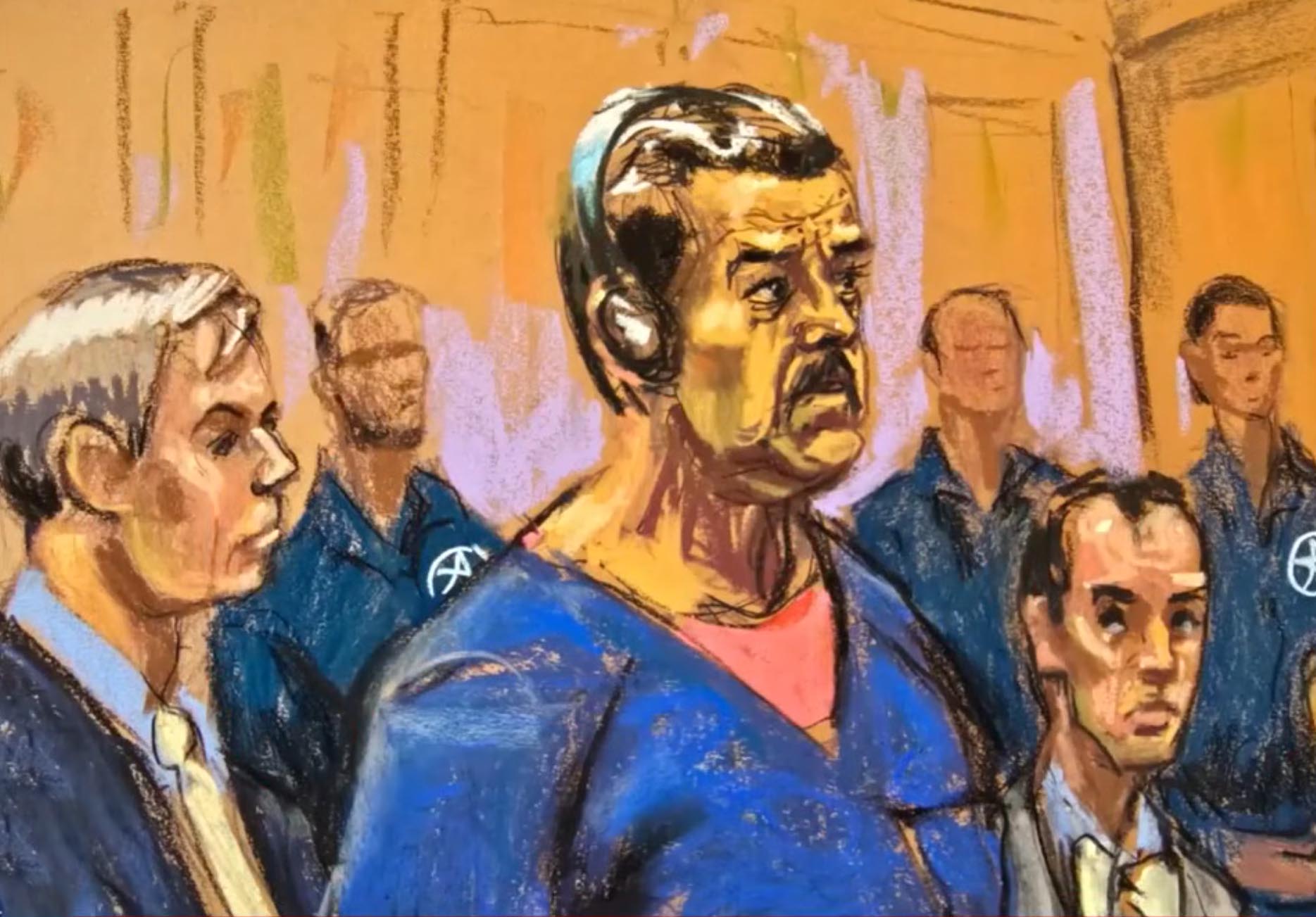
Court sketches. Source: LiveNOW from FOX
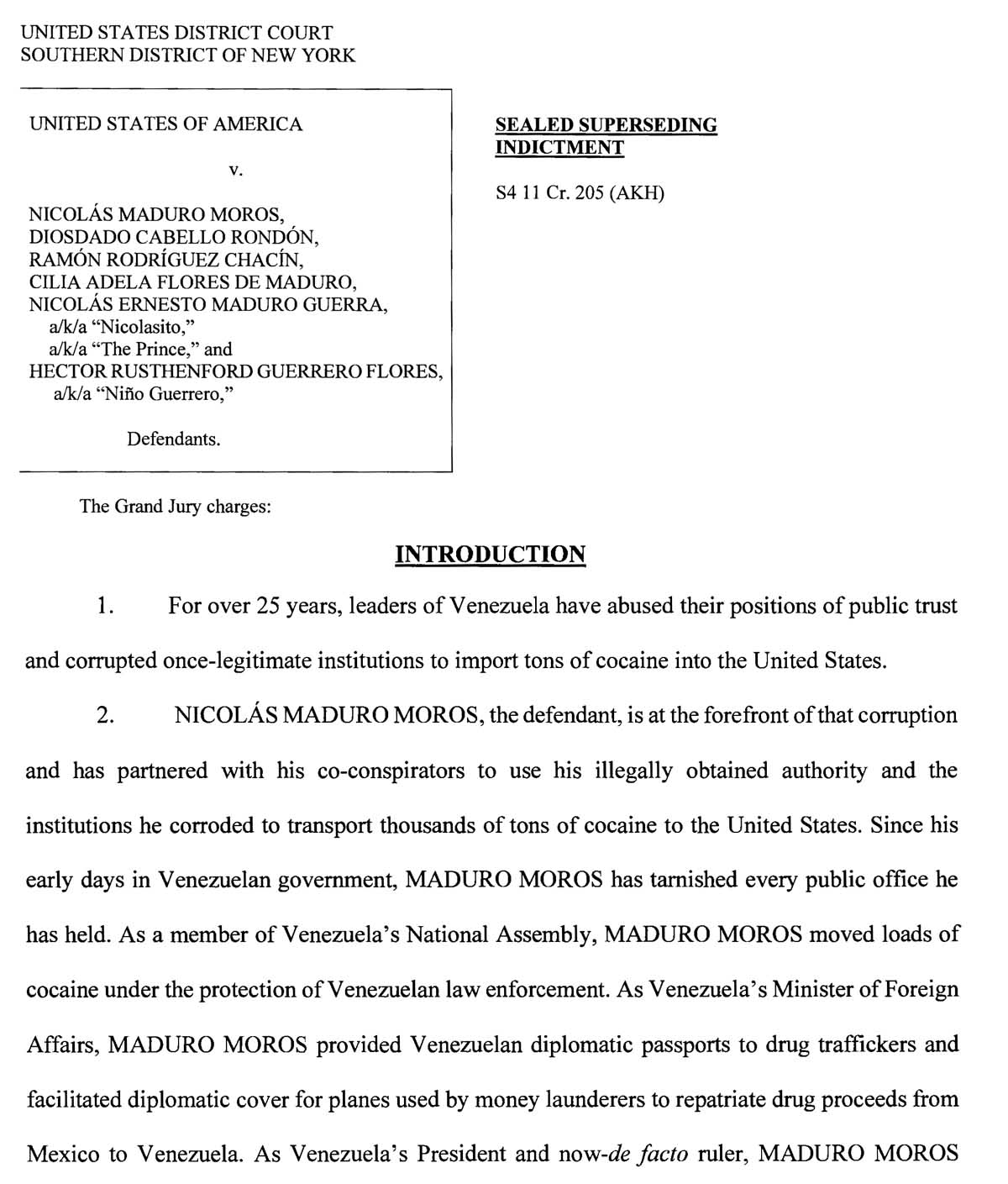
FEDERAL DISTRICT COURT OF THE SOUTHERN DISTRICT OF NEW YORK
SEALED SUBSTITUTE INDICTMENT
S4 11 Cr. 205 (AKH)
UNITED STATES OF AMERICA v. NICOLÁS MADURO MOROS, DIOSDADO CABELLO RONDÓN, RAMÓN RODRÍGUEZ CHACÍN, CILIA ADELA FLORES DE MADURO, NICOLÁS ERNESTO MADURO GUERRA, also known as “Nicolasito,” also known as “Prince,” and HÉCTOR RUSTHENFORD GUERRERO FLORES, also known as “Niño Guerrero,”
Defendants.
The Grand Jury charges:
INTRODUCTION
1. For over 25 years, the leaders of Venezuela have abused their public trust and undermined once-legitimate institutions to import tons of cocaine into the United States.
2. NICOLÁS MADURO MOROS, the defendant, is at the forefront of this corruption and conspired with his accomplices to use his illicitly obtained power and bribed institutions to transport thousands of tons of cocaine to the United States. From the beginning of his career in the Venezuelan government, MADURO MOROS has tainted every public office he has held. As a member of the National Assembly of Venezuela, MADURO MOROS transported cocaine shipments under the protection of Venezuelan law enforcement. As Venezuela's Minister of Foreign Affairs, MADURO MOROS provided Venezuelan diplomatic passports to drug traffickers and facilitated diplomatic cover for planes used by money launderers to repatriate drug proceeds from Mexico to Venezuela. As President of Venezuela and the current de facto ruler, MADURO MOROS allows cocaine-fueled corruption to thrive in his interests, the interests of members of his ruling regime, and the interests of his family members.
3. NICOLÁS MADURO MOROS, the defendant, currently heads a corrupt, unlawful government that for decades has used state power to protect and promote illegal activities, including drug trafficking. This drug trafficking has enriched and strengthened Venezuela's political and military elite, including the Minister of Interior, Justice, and Peace DIOSDADO CABELLO RONDÓN, the defendant, and former Minister of Interior and Justice RAMÓN RODRÍGUEZ CHACÍN, the defendant. The large-scale drug trafficking has also concentrated power and wealth in the hands of the MADURO MOROS family, including his wife, the alleged First Lady of Venezuela CILIA ADELA FLORES DE MADURO, the defendant, and MADURO MOROS's son, a member of the National Assembly of Venezuela NICOLÁS ERNESTO MADURO GUERRA, also known as “Nicolasito” and “Prince,” the defendant. This cycle of corruption, based on the drug trade, fills the pockets of Venezuelan officials and their families and benefits violent narco-terrorists who operate with impunity in Venezuela and help produce, protect, and transport tons of cocaine to the United States.
4. At various times since around 1999, Venezuelan officials, including NICOLÁS MADURO MOROS, DIOSDADO CABELLO RONDÓN, and RAMÓN RODRÍGUEZ CHACÍN, the defendants, have cooperated with narco-terrorists from the Revolutionary Armed Forces of Colombia (FARC), Ejército de Liberación Nacional (“ELN”), the Sinaloa Cartel, the “Zetas” group, and Tren de Aragua (“TdA”), including TdA leader HÉCTOR RUSTHENFORD GUERRERO FLORES, known as “Niño Guerrero,” who is one of the defendants. Thus, MADURO MOROS and his accomplices have collaborated for decades with some of the most violent and prolific drug traffickers and narco-terrorists in the world and relied on sympathetic officials throughout the region to distribute tons of cocaine to the United States.
DEFENDANTS
5. NICOLÁS MADURO MOROS, the defendant, a citizen of Venezuela, was previously the President of Venezuela and currently, remaining in power despite losing the last election, is the de facto but illegitimate ruler of the country. MADURO MOROS also previously held a seat in the National Assembly of Venezuela from 2000 to 2006, was Venezuela's Minister of Foreign Affairs from 2006 to 2013, and Vice President of Venezuela in 2013. MADURO MOROS became President of Venezuela after the death of former President Hugo Chávez in 2013 and during his presidency continued to engage in illicit cocaine trafficking with drug traffickers and narco-terrorist groups. Around 2018, MADURO MOROS declared his victory in a disputed and internationally condemned presidential election in Venezuela. Around 2019, the National Assembly of Venezuela invoked the Venezuelan constitution and declared that MADURO MOROS had usurped power and was not the legitimate president of Venezuela. Nevertheless, MADURO MOROS continued to exercise the powers of the President of Venezuela, resulting in more than 50 countries, including the United States, refusing to recognize MADURO MOROS as the head of state of Venezuela. Around 2024, another presidential election was held in Venezuela, which was again widely criticized by the international community, and in which MADURO MOROS declared himself the winner despite widespread condemnation.
6. DIOSDADO CABELLO RONDÓN, the defendant, a citizen of Venezuela, is the Minister of Interior, Justice, and Peace, a member of the Venezuelan armed forces, and Vice President of the ruling United Socialist Party of Venezuela. CABELLO RONDÓN is widely recognized as one of the most influential officials in Venezuela. CABELLO RONDÓN previously served as Chávez's Chief of Staff in 2001, Vice President of Venezuela in 2002, Governor of the state of Miranda in Venezuela from 2004 to 2008, and Chairman of the National Assembly of Venezuela from 2012 to 2016. From 2017 to 2020, CABELLO RONDÓN was a member and then Chairman of the illegally created National Constituent Assembly of Venezuela, which stripped constitutional powers from the National Assembly of Venezuela and further strengthened the MADURO MOROS regime. After the dissolution of the National Constituent Assembly around 2020, CABELLO RONDÓN became a member of the National Assembly of Venezuela from around 2021 to around 2024.
7. RAMÓN RODRÍGUEZ CHACÍN, the defendant, is a Venezuelan politician and former member of the armed forces who served as Minister of Interior and Justice from 2002 to 2008. From 2012 to 2017, RODRÍGUEZ CHACÍN was the Governor of the Venezuelan state of Guárico.
8. CILIA ADELA FLORES DE MADURO, the defendant, is the de facto First Lady of Venezuela, having married NICOLÁS MADURO MOROS, the defendant, in 2013. FLORES DE MADURO has a long political career. FLORES DE MADURO served as Chairman of the National Assembly (from the time MADURO MOROS left this position to become Minister of Foreign Affairs) from 2006 to 2011, as Attorney General of Venezuela from 2012 to 2013, and has been a member of the National Constituent Assembly since 2017.
9. NICOLÁS ERNESTO MADURO GUERRA, also known as “Nicolasito” and “Prince,” is the son of NICOLÁS MADURO MOROS, the defendant in this case, and a well-known Venezuelan politician. MADURO GUERRA entered politics after his father, MADURO MOROS, became President of Venezuela around 2013. At that time, MADURO MOROS appointed MADURO GUERRA as the “head of the Presidential Special Inspectors Corps,” a position created specifically for MADURO GUERRA. Around 2017, MADURO GUERRA joined the National Constituent Assembly of Venezuela, and around January 2021, the National Assembly of Venezuela, where he continues to hold his position.
10. HÉCTOR RUSTHENFORD GUERRERO FLORES, also known as “Niño Guerrero,” the defendant, has been the leader or co-leader of TdA for over a decade, during which members and associates of TdA committed a wide range of crimes, including extortion, kidnapping, murder, drug trafficking, arms trafficking, prostitution, sexual exploitation, robbery, bank robbery, and money laundering in Venezuela, the United States, and other countries.
NARCO-TERRORIST ORGANIZATIONS OPERATING IN COOPERATION WITH THE DEFENDANTS
11. Since its founding in 1964, FARC has become one of the largest cocaine producers in the world. FARC received significant revenues from cocaine trafficking, which it used to finance its activities, including, for example, large-scale arms purchases and terrorist attacks. FARC also committed acts of violence against U.S. citizens and property in foreign jurisdictions, including, among others, Colombia. For example, at least from 2003 to 2008, FARC leadership ordered FARC members to kidnap and kill U.S. citizens and attack U.S. interests to deter the U.S. from continuing its efforts to destroy and suppress FARC's production and distribution of cocaine and cocaine paste. In accordance with these actions, around 1997, the U.S. Department of State (State Department) designated FARC as a Foreign Terrorist Organization (FTO) under Section 219 of the Immigration and Nationality Act (INA). On November 30, 2021, the State Department removed FARC from the FTO list and simultaneously designated two FARC successor organizations under Section 219 INA: FARC-EP and Segunda Marquetalia, which remain on this list at the time of filing this substitute indictment.
12. Since 1965, ELN has operated as a Colombian terrorist group seeking to violently overthrow the democratically elected government of Colombia. As part of its anti-government activities, ELN engages in kidnappings, bombings, and other violent attacks targeting civilians and Colombian law enforcement. Additionally, ELN annually exports tons of cocaine to the United States and other countries to finance its terrorist activities and has at various times collaborated with other Colombian guerrilla groups to carry out its cocaine trafficking and violent activities. In connection with this activity, around 1997, the U.S. Department of State designated ELN as a Foreign Terrorist Organization (FTO) under Section 219 of the Immigration and Nationality Act (INA). At the time of filing this substitute indictment, ELN remains on this list.
13. The Sinaloa Cartel, based in the Mexican state of Sinaloa, traces its origins to the late 1980s when the so-called Mexican Federation functioned as a council with representatives of respective drug trafficking organizations led by its main leaders. In the late 1980s and 1990s, members of the Mexican Federation collaborated with Colombian suppliers to transport drugs through Mexico to the United States. In the early 2000s, Joaquín Archivaldo Guzmán Loera, known as “El Chapo,” and Ismael Zambada García, known as “El Mayo,” formed a partnership that led to the transformation of the Mexican Federation into the Sinaloa Cartel, becoming the largest drug trafficking organization in the world. Currently, the Sinaloa Cartel is a highly organized structure and operates in more than half of all Mexican states. With a sophisticated and well-armed security system, the Sinaloa Cartel exercises power through fear, threats, and violence, including killing police officers, civilians, and members of other criminal groups who invade their territory without permission. Members of the Sinaloa Cartel may also be killed for alleged disloyalty, disobedience, or to send a message. To advance and protect its drug trafficking interests, the Sinaloa Cartel engages in other criminal activities, including bribery, extortion, and arms trafficking. As an additional source of income and profit, the Sinaloa Cartel engages in illegal immigration and human trafficking. In connection with this activity, in February 2025, the U.S. Department of State designated the Sinaloa Cartel as a Foreign Terrorist Organization (FTO) under Section 219 of the Immigration and Nationality Act (INA). The Sinaloa Cartel remains on this list at the time of filing this substitute indictment.
14. Zetas, later known as Cártel del Noreste (CDN), is a violent and prolific transnational drug organization based in northeastern Mexico, engaged in drug trafficking, kidnapping, extortion, illegal immigration, and other illegal activities. “Zetas use violence to establish criminal control, including attacks on government officials in Mexico. Approximately from 2000 to 2010, “Zetas” formed an alliance with the Gulf Cartel, a group of drug traffickers based primarily in northern Mexico, under which “Zetas” acted as the armed military wing of the Gulf Cartel to maintain control over drug trafficking routes throughout Mexico. “Zetas” recruited members of Mexican special forces, as well as drug traffickers who had never served in the military or police. In the summer of 2010, the alliance between “Zetas” and the “Gulf Cartel” broke down after a period of intense violence between the organizations. At that time, “Zetas” operated as an independent drug trafficking organization that imported tons of cocaine into the United States. In connection with this activity, in February 2025, the U.S. Department of State designated CDN, formerly known as “Zetas,” as a Foreign Terrorist Organization (FTO) under Section 219 of the Immigration and Nationality Act (INA). CDN (referred to as “Zetas” in this substitute indictment) remains on this list at the time of filing this substitute indictment.
15. TdA is a violent transnational criminal organization that originated as a prison gang in Venezuela. TdA has expanded its criminal network throughout the Western Hemisphere and established its presence in the United States, including in New York. TdA's criminal activities include illegal immigration and other unlawful actions. TdA has developed additional sources of income through a range of other criminal activities, including drug trafficking, firearms trafficking, commercial sexual exploitation, kidnapping, robbery, theft, fraud, and extortion. TdA members also commit murders, assaults, and other acts of violence to secure and advance the organization's criminal activities. TdA has established connections with other criminal groups operating in the Western Hemisphere and is sometimes willing to cooperate with other criminal groups and organizations locally and in specific cases. In connection with this activity, in February 2025, the U.S. Department of State designated TdA as a Foreign Terrorist Organization (FTO) under Section 219 of the Immigration and Nationality Act (INA). At the time of filing this substitute indictment, TdA remains on this list.
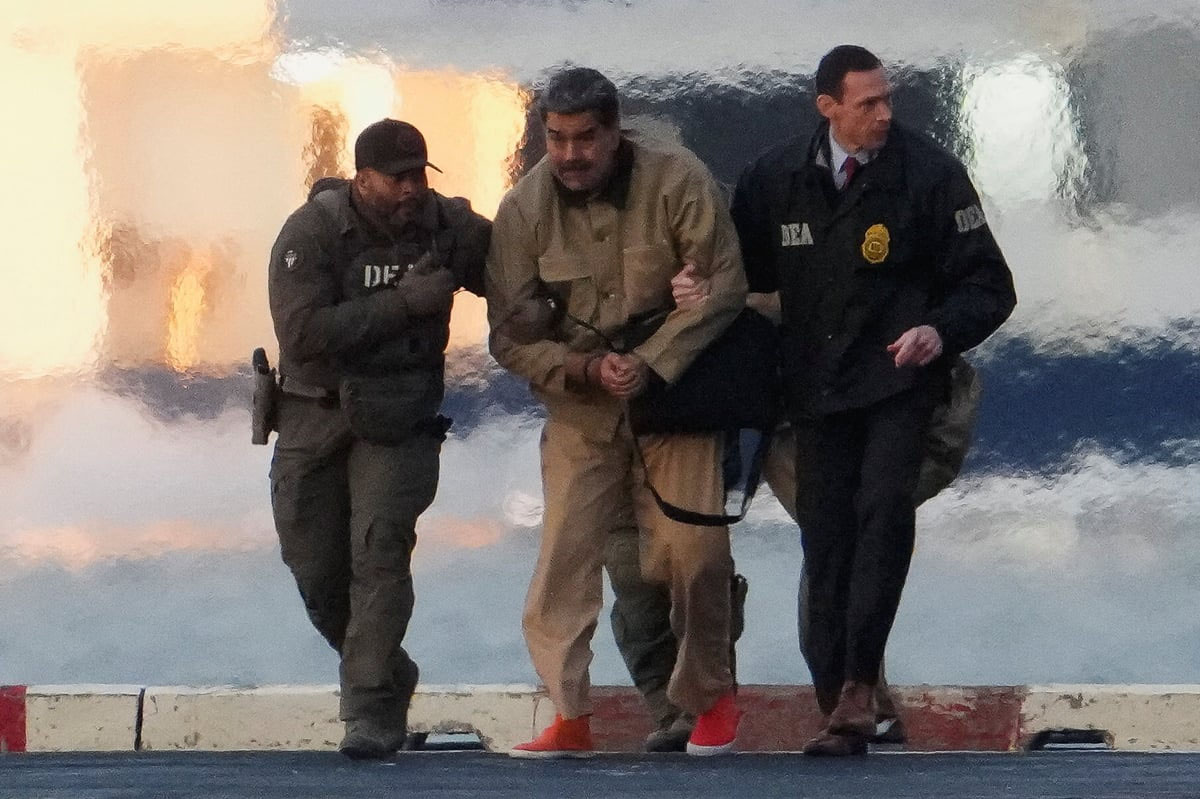
Maduro being led to court in prison attire. Photo: ADAM GRAY
CORRUPTION OF DEFENDANTS, DRUG TRAFFICKING, AND CONNECTIONS WITH NARCO-TERRORIST GROUPS
16. NICOLÁS MADURO MOROS, the defendant, like former President Chávez before him, engages in a corrupt culture in which influential Venezuelan elites enrich themselves through drug trafficking and protect their drug-trafficking partners, supports it, and protects it. The profits from this illegal activity go to ordinary civilian, military, and intelligence officials who operate within a patronage system managed by the top leadership, known as the Cártel de Los Soles or Cartel of the Suns, which refers to the sun insignia attached to the uniforms of high-ranking Venezuelan military officials.
17. Venezuela is geographically advantageous for drug traffickers: to the north, it has access to the Caribbean Sea through several major ports, and to the west, it borders the mountainous regions of Colombia, where coca is grown and most of the world's cocaine is produced in the jungles. Since around 1999, Venezuela has become a haven for drug traffickers willing to pay for protection and support from Venezuelan civilians and military who operated beyond the reach of Colombian law enforcement and armed forces, supported by U.S. anti-narcotics assistance.
18. Under such conditions, the cocaine trade flourished. Venezuelan officials and their family members, including NICOLÁS MADURO MOROS, DIOSDADO CABELLO RONDÓN, RAMÓN RODRÍGUEZ CHACÍN, CILIA ADELA FLORES DE MADURO, and NICOLÁS ERNESTO MADURO GUERRA, also known as “Nicolasito” and “Prince,” the defendants, in partnership with drug traffickers and narco-terrorist groups, sent processed cocaine from Venezuela to the United States through transshipment points in the Caribbean and Central America, such as Honduras, Guatemala, and Mexico. According to State Department estimates, by 2020, between 200 and 250 tons of cocaine were transported through Venezuela annually. Maritime shipments were sent north from the coast of Venezuela using speedboats, fishing vessels, and container ships. Air shipments were often sent from clandestine airstrips, usually made of dirt or grass, as well as from commercial airports under the control of corrupt government and military officials.
19. Thanks to this drug trafficking, the defendant NICOLÁS MADURO MOROS and members of his regime involved in corruption facilitated the spread of drug trafficking-fueled corruption throughout the region. Transshipment points in Honduras, Guatemala, and Mexico also relied on a culture of corruption, in which drug traffickers operating in these countries gave part of their proceeds to politicians who protected them and helped them. In turn, these politicians used the payments received from cocaine to maintain and strengthen their political power. The same happened with politicians along the “Caribbean route,” who received bribes from drug traffickers who paid them for protection from arrest and to allow selected drug traffickers to smuggle cocaine from Venezuela north to the United States with impunity. Thus, at every stage—relying on producers in Colombia, carriers and distributors in Venezuela, and recipients and redistributors at northern transshipment points—drug traffickers enriched themselves and their corrupt patrons who protected and helped them.
20. Similarly, NICOLÁS MADURO MOROS, DIOSDADO CABELLO RONDÓN, RAMÓN RODRÍGUEZ CHACÍN, the defendants, and other regime accomplices facilitated the strengthening and growth of violent narco-terrorist groups by funding their organizations with proceeds from cocaine sales. These narco-terrorist organizations not only directly collaborated with high-ranking Venezuelan officials and directed profits to them but also benefited from the rising value of cocaine at each transshipment point on the way to the United States, where demand and, therefore, the price of cocaine are highest. These organizations include FARC and ELN, which control cocaine production in the mountainous regions of Colombia; the Sinaloa Cartel and Zetas, which control routes in Central America and methods of transporting cocaine from Mexico to the United States; and TdA, which controls a criminal network capable of facilitating cocaine transportation within Venezuela and along the Venezuelan coast.
OVERT ACTS IN FURTHERANCE OF THE NARCOTRAFFICKING AND NARCO-TERRORISM CONSPIRACIES
21. The defendants, together with others, throughout the period specified in this substitute indictment, conducted a ruthless campaign of cocaine trafficking, resulting in thousands of tons of cocaine being delivered to the United States. Throughout this time, the defendant NICOLÁS MADURO MOROS, along with members of his family and other officials, provided law enforcement protection and logistical support for the transportation of cocaine through Venezuela, knowing that their drug trafficking partners would transport the cocaine north to the United States. Although such actions were regularly and repeatedly committed throughout the defendants' time period, below are some examples of actions taken by the defendants to facilitate drug trafficking, including in cooperation with narco-terrorist groups:
a. Approximately from 2006 to 2008, while serving as Venezuela's Minister of Foreign Affairs, MADURO MOROS sold Venezuelan diplomatic passports to individuals whom MADURO MOROS knew were drug traffickers to assist drug traffickers seeking to transport drug proceeds from Mexico to Venezuela under diplomatic cover. When drug traffickers needed to transport drug proceeds from Mexico back to Venezuela, MADURO MOROS facilitated the movement of private planes under diplomatic cover to ensure that flights were not subject to scrutiny by law enforcement or military. In these cases, MADURO MOROS called the Venezuelan embassy in Mexico to inform them that a private plane would arrive on a diplomatic mission. Then, while the drug traffickers met with the Venezuelan ambassador in Mexico under the guise of MADURO MOROS's diplomatic mission, their plane was loaded with drug proceeds. The plane then returned to Venezuela under diplomatic protection.
b. Around 2007, the defendant CILIA ADELA FLORES DE MADURO participated in a meeting where FLORES DE MADURO received a bribe of several hundred thousand dollars for arranging a meeting between a major drug trafficker and the director of Venezuela's National Anti-Drug Office, Néstor Reverol Torres. Subsequently, the drug trafficker agreed to a monthly bribe payment to Reverol Torres, in addition to approximately $100,000 for each flight carrying cocaine, to ensure the safe passage of the flight, part of which was then paid to FLORES DE MADURO. Around 2015, Reverol Torres was indicted on drug-related charges in the Eastern District of New York and is wanted.
c. From 2003 to 2011, when defendant Diosdado Cabello Rondón held various official positions in Venezuela, the “Zetas” organization collaborated with a group of Colombian drug traffickers, sending containers on container ships with five to six tons of cocaine in each, and sometimes up to 20 tons, from Venezuelan ports to Mexican ports and ultimately to the United States. Tens of thousands of kilograms of cocaine sent by this group were guarded in Venezuela by Venezuelan military officials known as “generals.”
d. From 2004 to 2015, MADURO MOROS and FLORES DE MADURO jointly engaged in cocaine trafficking, much of which was previously seized by Venezuelan law enforcement with the assistance of armed military guards. During this time, MADURO MOROS and FLORES DE MADURO maintained their own groups of gang organizations, known as colectivos, which were state-funded, to facilitate and protect their drug trafficking activities. MADURO MOROS and FLORES DE MADURO also ordered kidnappings, beatings, and killings of those who owed them money for drugs or otherwise undermined their drug trafficking activities, including ordering the murder of a local drug lord in Caracas, Venezuela.
e. Around 2006, Venezuelan officials sent over 5.5 tons of cocaine from Venezuela to Mexico on a DC-9 aircraft. CABELLO RONDÓN; then-Director of Venezuelan Military Intelligence Hugo Armando Carvajal Barrios, known as “El Pollo,” who pleaded guilty in June 2025 in this district to narco-terrorism, drug trafficking, and arms trafficking in the first substitute indictment in this case, SI 11 Cr. 205 (AKH); and Captain of the Venezuelan National Guard Vasily Kotosky Villarroel Ramírez worked with other members of the Venezuelan regime to coordinate the transportation. More than 5.5 tons of cocaine were transported in approximately five vans to a hangar reserved for the President of Venezuela at Simón Bolívar International Airport in Maiquetía, Venezuela (“Maiquetía Airport”). At Maiquetía Airport, members of the Venezuelan National Guard loaded the cocaine onto the aircraft, which took off using a flight plan that Villarroel Ramírez approved in exchange for bribes. Despite these bribes, when the aircraft landed at Ciudad del Carmen Airport in Campeche, Mexico, Mexican authorities seized more than 5.5 tons of cocaine. Shortly after the seizure, Villarroel Ramírez informed the Venezuelan drug traffickers working with him that they needed to pay a bribe to CABELLO RONDÓN so that those who assisted them at Maiquetía Airport would not be arrested. Villarroel Ramírez then arranged a meeting with CABELLO RONDÓN, after which the drug traffickers paid CABELLO RONDÓN approximately $2,500,000 through a family member. Around 2013, Villarroel Ramírez was indicted on drug-related charges in the Eastern District of New York and is wanted.
f. Approximately from 2006 to 2008, HÉCTOR RUSTHENFORD GUERRERO FLORES, known as “Niño Guerrero,” worked with one of Venezuela's largest drug traffickers, Walid Makled. Members of the Venezuelan regime helped protect Makled's cocaine shipments, which were transported from San Fernando de Apure (Venezuela) to Valencia (Venezuela) and then flown from Valencia International Airport to Mexico and other locations in Central America for subsequent distribution in the United States. From 2008 to 2009, GUERRERO FLORES also provided protection for cocaine shipments transported through Venezuela to another major Venezuelan drug trafficker, including providing armed men who carried, among other things, automatic weapons, including AK-47s, MP5s, and AR-l5s, as well as grenades. Sometimes GUERRERO FLORES personally accompanied large cocaine shipments, which were guarded by groups of armed men, on their way to airports or airstrips for transportation north and subsequent distribution in the United States. GUERRERO FLORES was compensated for each kilogram of cocaine transported or received, and sometimes instead of payment, he received a share of these large cocaine shipments. The drug traffickers GUERRERO FLORES collaborated with transported thousands of kilograms per shipment, several times a month, resulting in hundreds of tons of cocaine reaching the United States. Around 2009, Makled was indicted on drug-related charges in this district and is currently wanted.
g. Around 2008, the defendant RAMÓN RODRÍGUEZ CHACÍN owned a large estate in the state of Barinas, Venezuela, where there was a large FARC camp and training center, with approximately 200 armed FARC members with automatic weapons at any given time. During this time, RODRÍGUEZ CHACÍN accepted tens of thousands of dollars in bribes for using his corrupt influence to protect a major drug trafficker from arrest and extradition. During subsequent meetings with the drug trafficker from 2008 to 2010, RODRÍGUEZ CHACÍN discussed smuggling multi-ton cocaine shipments with other Venezuelan officials, including Carvajal Barrios.
h. Around 2011, then-leader of the Sinaloa Cartel Joaquín Archivaldo Guzmán Loera, known as “El Chapo,” financed cocaine production laboratories in Colombia. The cocaine produced in these laboratories was then transported under FARC protection to Venezuela and received protection on the way to the airstrip from Carvajal Barrios, a close associate of MADURO MOROS and CABELLO RONDÓN.
i. Around September 2013, just a few months after MADURO MOROS took office as President of Venezuela, Venezuelan officials sent approximately 1.3 tons of cocaine on a commercial flight from Maiquetía Airport to Paris-Charles de Gaulle Airport. French authorities confiscated the cocaine. After the confiscation, MADURO MOROS convened a meeting attended by, among others, CABELLO RONDÓN and Carvajal Barrios. During the meeting, MADURO MOROS told CABELLO RONDÓN and Carvajal Barrios that they should not have used Maiquetía Airport for drug trafficking after the 2006 seizure in Mexico and that they should use other well-established routes and locations for cocaine shipments. Shortly thereafter, MADURO MOROS and others sanctioned the arrest of some Venezuelan military officials to divert public and law enforcement attention from the involvement of MADURO MOROS, CABELLO RONDÓN, and Carvajal Barrios in the transportation and its concealment.
j. Approximately from 2014 to 2015, a captain of the Venezuelan National Guard on Margarita Island coordinated accommodation, transportation, women, and meals for visits by Venezuelan officials, including NICOLÁS ERNESTO MADURO GUERRA, also known as “Nicolasito” and “Prince,” the defendant, who visited Margarita Island approximately twice a month. MADURO GUERRA arrived on a Falcon 900 aircraft owned by Venezuela's state oil company Petróleos de Venezuela, S.A. (“PDVSA”). Before departing the island, the PDVSA aircraft of MADURO GUERRA was loaded, sometimes with the help of armed sergeants, with large packages wrapped in tape, which the captain believed contained drugs. MADURO GUERRA was present during the loading of the PDVSA aircraft and once stated that the aircraft could fly anywhere, including to the United States.
k. From October 2015 to November 2015, Efraín Campo Flores and Franqui Francisco Flores de Freitas—two relatives of MADURO MOROS and FLORES DE MADURO—during recorded meetings with DEA confidential sources, agreed to send several hundred kilograms of cocaine from MADURO MOROS's “presidential hangar” at Maiquetía Airport. During recorded meetings with the sources, Campo Flores and Flores de Freitas explained that they were in a “war” with the United States, described the Cártel de Los Soles, discussed a connection with a “FARC commander” who “allegedly held a high position,” and indicated that they sought to raise $20 million from drug sales to support FLORES DE MADURO's campaign in connection with the Venezuelan National Assembly elections in late 2015. Campo Flores referred to MADURO MOROS as his “father” and stated, “we want him to regain control... of the National Assembly.” Around November 2016, Campo Flores and Flores de Freitas were convicted in this district court of conspiracy to import cocaine into the United States.
l. Around 2017, MADURO GUERRA was involved in sending hundreds of kilograms of cocaine from Venezuela to Miami, Florida. During this time, MADURO GUERRA discussed with his drug business partners, among other things, sending low-quality cocaine to New York because it could not be sold in Miami, arranging the unloading of a 500-kilogram cocaine shipment from a cargo container near Miami, and using scrap metal containers to smuggle cocaine into New York ports.
m. In 2018 and 2019, RODRÍGUEZ CHACÍN made several trips from the state of Barinas to Caracas with one of the key FARC leaders for meetings with MADURO MOROS. These trips were part of a long history of regular meetings between RODRÍGUEZ CHACÍN and members of FARC and ELN both in their jungle camps and in Barinas, as RODRÍGUEZ CHACÍN was appointed by MADURO MOROS to provide FARC and ELN with protection and support. RODRÍGUEZ CHACÍN also brought FARC leaders to meetings with MADURO MOROS in Miraflores, the presidential palace in Caracas, as well as in Fuerte Tiuna, the main military complex in Caracas and the headquarters of the Venezuelan Ministry of Defense.
n. Around July 2019, shortly after some FARC leaders publicly returned to armed struggle despite signing recent peace agreements with the Colombian government, MADURO MOROS and CABELLO RONDÓN participated in a press conference that was filmed, during which MADURO MOROS announced that FARC and its leaders were welcome in Venezuela.
o. Around 2019, TdA leader GUERRERO FLORES discussed drug trafficking issues with a person he believed was working with the Venezuelan regime. During several phone conversations, GUERRERO FLORES offered escort services for drug shipments, explaining that GUERRERO FLORES and TdA control the coast of the Venezuelan state of Aragua. GUERRERO FLORES, speaking from TdA's operational base in Tocorón prison, explained that TdA could provide logistics for all aspects of drug trafficking, including the use of storage facilities, which GUERRERO FLORES called “cribs,” located on the beach in the state of Aragua. Thus, GUERRERO FLORES confirmed TdA's ability to provide protection for more than one ton of cocaine.
p. Around 2020, MADURO GUERRA participated in a meeting in Medellín (Colombia) with two FARC representatives. During the meeting, MADURO GUERRA discussed arrangements for transporting large shipments of cocaine and weapons through Colombia to the United States over the next six years, until around 2026. MADURO GUERRA also discussed paying FARC with weapons in connection with cocaine shipments.
q. Around 2007, at the direction of Carvajal Barrios, Venezuelan General Clíver Alcalá Cordones delivered four boxes of weapons from the Venezuelan government to FARC leadership, including 20 grenades and two grenade launchers. Around June 2023, Alcalá Cordones pleaded guilty in this district to conspiracy to provide material support to FARC, a foreign terrorist organization, under the third substitute indictment in this case, S3 11 Cr. 205 (AKH).
r. From 2022 to 2024, CABELLO RONDÓN regularly visited clandestine airstrips controlled by ELN near the Colombia-Venezuela border to ensure the safe delivery of cocaine into Venezuela. From these airstrips, cocaine was sent from Venezuela on flights approved by Venezuelan military officials and on clandestine flights intended to avoid detection by law enforcement or military in South and Central America.
s. In late 2024 or thereabouts, CABELLO RONDÓN received proceeds from cocaine trafficking, and around 2025, Colombian drug traffickers discussed with a CABELLO RONDÓN partner plans to continue cocaine trafficking through Venezuela.
LEGISLATIVE CHARGES
FIRST CHARGE (Conspiracy to Commit Narco-Terrorism)
22. Paragraphs 1–21 of this substitute indictment are restated and incorporated by reference as if fully set forth herein.
23. From at least 1999 to 2025 inclusive, in the course of a crime begun and committed outside the jurisdiction of any particular state or district of the United States, NICOLÁS MADURO MOROS, DIOSDADO CABELLO RONDÓN, and RAMÓN RODRÍGUEZ CHACÍN, the defendants, and other known and unknown persons, at least one of whom was and will be first brought and arrested in the Southern District of New York, willfully and knowingly combined, conspired, confederated, and agreed together and with each other to violate Section 960a of Title 21 of the United States Code.
24. Part and object of the conspiracy was that NICOLÁS MADURO MOROS, DIOSDADO CABELLO RONDÓN, and RAMÓN RODRÍGUEZ CHACÍN, the defendants, and other known and unknown persons, committed and commit acts punishable under Section 841(a) of Title 21 of the United States Code, if committed within the jurisdiction of the United States, namely: distributing and possessing with intent to distribute five kilograms and more of mixtures and substances containing a detectable amount of cocaine, knowing and intending to provide, directly or indirectly, anything of value to a person and organization that engaged and engages in terrorism and terrorist activity (as defined in Section 8 of the United States Code, Section 1182(a)(2)(B)), or terrorism (as defined in Section 22 of the United States Code, Section 2656f(d)(2)), namely the following organizations that were designated by the United States Secretary of State as FTOs under Section 219 INA, during the period relevant to this substitute indictment: FARC, FARC-EP, Segunda Marquetalia, ELN, TdA, the Sinaloa Cartel, CDN, also known as Zetas, and members, agents, and associates of each of these organizations, knowing that such organizations and persons engaged and engage in terrorist activity and terrorism, in violation of Section 21, United States Code, Section 960a. (Section 960a, Title 21, United States Code; and Section 3238, Title 18, United States Code).
SECOND CHARGE (Conspiracy to Import Cocaine)
25. Paragraphs 1–21 of this substitute indictment are restated and incorporated by reference as if fully set forth herein.
26. From at least 1999 to 2025 inclusive, in the course of a crime begun and committed outside the jurisdiction of any particular state or district of the United States, NICOLÁS MADURO MOROS, DIOSDADO CABELLO RONDÓN, RAMÓN RODRÍGUEZ CHACÍN, CILIA ADELA FLORES DE MADURO, NICOLÁS ERNESTO MADURO GUERRA, also known as “Nicolasito” and “Prince,” and HÉCTOR RUSTHENFORD GUERRERO FLORES, also known as “Niño Guerrero,” the defendants, and other known and unknown persons, at least one of whom was and will be first brought and arrested in the Southern District of New York, willfully and knowingly combined, conspired, confederated, and agreed together and with each other to violate the provisions of Section 21, Chapter 13, Subchapter II of the United States Code.
27. Part and object of the conspiracy was that NICOLÁS MADURO MOROS, DIOSDADO CABELLO RONDÓN, RAMÓN RODRÍGUEZ CHACÍN, CILIA ADELA FLORES DE MADURO, NICOLÁS ERNESTO MADURO GUERRA, also known as “Nicolasito,” “Prince,” and HÉCTOR RUSTHENFORD GUERRERO FLORES, also known as “Niño Guerrero,” the defendants, and other known and unknown persons, knowingly and intentionally imported into the United States from outside the country a controlled substance in violation of the provisions of Section 952(a) and 960(a)(1) of Title 21 of the United States Code.
28. Additionally, part and object of the conspiracy was that NICOLÁS MADURO MOROS, DIOSDADO CABELLO RONDÓN, RAMÓN RODRÍGUEZ CHACÍN, CILIA ADELA FLORES DE MADURO, NICOLÁS ERNESTO MADURO GUERRA, also known as “Nicolasito,” he also “Prince,” and HÉCTOR RUSTHENFORD GUERRERO FLORES, he also “Niño Guerrero,” the defendants, and other known and unknown persons, intended and did manufacture, distribute, and possess with intent to distribute a controlled substance, intending, knowing, and having reasonable grounds to believe that such substance would be unlawfully imported into the United States and into waters within 12 miles of the coast of the United States, in violation of Section 959(a) and 960(a) of Title 21 of the United States Code.
29. Additionally, part and object of the conspiracy was that NICOLÁS MADURO MOROS, DIOSDADO CABELLO RONDÓN, RAMÓN RODRÍGUEZ CHACÍN, CILIA ADELA FLORES DE MADURO, NICOLÁS ERNESTO MADURO GUERRA, known as “Nicolasito,” also known as “Prince,” and HÉCTOR RUSTHENFORD GUERRERO FLORES, also known as “Niño Guerrero,” the defendants, and other known and unknown persons, on board an aircraft registered in the United States, manufactured, distributed, and possessed with intent to distribute a controlled substance, which is a violation of Section 959(c) and 960(a)(3) of Title 21 of the United States Code.
30. The controlled substance that NICOLÁS MADURO MOROS, DIOSDADO CABELLO RONDÓN, RAMÓN RODRÍGUEZ CHACÍN, CILIA ADELA FLORES DE MADURO, NICOLÁS ERNESTO MADURO GUERRA, known as “Nicolasito” and “Prince,” and HÉCTOR RUSTHENFORD GUERRERO FLORES, known as “Niño Guerrero,” the defendants, conspired to (i) import into the United States and into the customs territory of the United States from a place outside that territory, (ii) manufacture and distribute, intending, knowing, and having reasonable grounds to believe that such substance would be unlawfully imported into the United States and into waters within 12 miles of the coast of the United States from a place outside that territory, and (iii) manufacture, distribute, and possess on board an aircraft registered in the United States, five and more kilograms of mixtures and substances containing a detectable amount of cocaine, in violation of Section 960(b)(1)(B) of Title 21 of the United States Code. (Section 963, Chapter 21 of the United States Code; and Section 3238, Chapter 18 of the United States Code).
COUNT 3 (Possession of Machine Guns and Destructive Devices)
31. Paragraphs 1–21 of this substitute indictment are restated and incorporated by reference as if fully set forth herein.
32. From at least 1999 to 2025 inclusive, in the course of a crime begun and committed outside the jurisdiction of any particular state or district of the United States, and in connection with which at least one of two or more co-conspirators was and will be first brought and arrested in the Southern District of New York, NICOLÁS MADURO MOROS, DIOSDADO CABELLO RONDÓN, RAMÓN RODRÍGUEZ CHACÍN, CILIA ADELA FLORES DE MADURO, NICOLÁS ERNESTO MADURO GUERRA, known as “Nicolasito,” known as “Prince,” and HÉCTOR RUSTHENFORD GUERRERO FLORES, known as “Niño Guerrero,” the defendants, in the course and in connection with a drug trafficking crime for which they may be prosecuted in a United States court, namely for MADURO MOROS, CABELLO RONDÓN, and RODRÍGUEZ CHACÍN, the controlled substance offenses charged in Counts 1 and 2 of this substitute indictment, and for FLORES DE MADURO, MADURO GUERRA, and GUERRERO FLORES, the controlled substance offense charged in Count 2 of this substitute indictment, knowingly used and carried firearms, and in furtherance of such crimes, knowingly possessed firearms and aided and abetted the use, carrying, and possession of firearms, namely: machine guns capable of automatically firing more than one shot without manual reloading by a single pull of the trigger, as well as destructive devices. (Section 18, United States Code, Sections 924(c)(1)(A), 924(c)(1)(B)(ii), 3238, and 2.)
FOURTH CHARGE (Conspiracy to Possess Machine Guns and Destructive Devices)
33. Paragraphs 1–21 of this substitute indictment are restated and incorporated by reference as if fully set forth herein.
34. From at least 1999 to 2025 inclusive, in the course of a crime begun and committed outside the jurisdiction of any particular state or district of the United States, NICOLÁS MADURO MOROS, DIOSDADO CABELLO RONDÓN, RAMÓN RODRÍGUEZ CHACÍN, CILIA ADELA FLORES DE MADURO, NICOLÁS ERNESTO MADURO GUERRA, known as “Nicolasito” and “Prince,” and HÉCTOR RUSTHENFORD GUERRERO FLORES, known as “Niño Guerrero,” the defendants, and other known and unknown persons, at least one of whom was and will be first brought and arrested in the Southern District of New York, willfully and knowingly combined, conspired, confederated, and agreed together and with each other to violate Section 924(c) of Title 18 of the United States Code.
35. Part and object of the conspiracy were NICOLÁS MADURO MOROS, DIOSDADO CABELLO RONDÓN, RAMÓN RODRÍGUEZ CHACÍN, CILIA ADELA FLORES DE MADURO, NICOLÁS ERNESTO MADURO GUERRA, also known as “Nicolasito,” also known as “Prince,” and HÉCTOR RUSTHENFORD GUERRERO FLORES, known as “Niño Guerrero,” the defendants, and other known and unknown persons, in the course and in connection with a drug trafficking crime for which they may be prosecuted in a United States court, namely for MADURO MOROS, CABELLO RONDÓN, and RODRÍGUEZ CHACÍN, the controlled substance offenses charged in Counts 1 and 2 of this substitute indictment, and for FLORES DE MADURO, MADURO GUERRA, and GUERRERO FLORES, the controlled substance offense charged in Count 2 of this substitute indictment, knowingly used and carried firearms, and in furtherance of such crimes, knowingly possessed firearms and aided and abetted the use, carrying, and possession of firearms, namely machine guns capable of automatically firing more than one shot without manual reloading by a single pull of the trigger, as well as destructive devices, in violation of Section 924(c)(1)(A) and 924(c)(1)(B)(ii) of Title 18 of the United States Code. (Section 924(o) and 3238 of Title 18 of the United States Code).
FORFEITURE ALLEGATIONS
36. As a result of committing the controlled substance offense charged in Count 1 of this substitute indictment, NICOLÁS MADURO MOROS, DIOSDADO CABELLO RONDÓN, RAMÓN RODRÍGUEZ CHACÍN, the defendants, shall forfeit to the United States, pursuant to Sections 853 and 970 of Title 21 of the United States Code, any and all property constituting or derived from any proceeds the defendants obtained, directly or indirectly, as a result of the offenses, and any and all property used or intended to be used, in any manner or part, to commit and facilitate the commission of the offense charged in Count 1 of this substitute indictment.
37. As a result of committing the controlled substance offense charged in Count 2 of this substitute indictment, NICOLÁS MADURO MOROS, DIOSDADO CABELLO RONDÓN, RAMÓN RODRÍGUEZ CHACÍN, CILIA ADELA FLORES DE MADURO, NICOLÁS ERNESTO MADURO GUERRA, known as “Nicolasito” and “Prince,” and HÉCTOR RUSTHENFORD GUERRERO FLORES, known as “Niño Guerrero,” the defendants, shall forfeit to the United States, pursuant to Section 21 of the United States Code, Sections 853 and 970, any and all property constituting or derived from any proceeds the defendants obtained, directly or indirectly, as a result of the offenses, and any and all property used or intended to be used, in any manner or part, to commit and facilitate the commission of the offense charged in Count 2 of this substitute indictment.
38. As a result of committing the firearms offenses charged in Counts 3 and 4 of this substitute indictment, NICOLÁS MADURO MOROS, DIOSDADO CABELLO RONDÓN, RAMÓN RODRÍGUEZ CHACÍN, CILIA ADELA FLORES DE MADURO, NICOLÁS ERNESTO MADURO GUERRA, known as “Nicolasito” and “Prince,” and HÉCTOR RUSTHENFORD GUERRERO FLORES, known as “Niño Guerrero,” the defendants, shall forfeit to the United States, pursuant to Section 924(d) of Title 18 of the United States Code, all firearms and ammunition involved in the commission of the offenses charged in Counts 3 and 4 of this substitute indictment, and used in their commission.
Substitute Asset Provision
39. If any of the above-described forfeitable property as a result of any act or omission of NICOLÁS MADURO MOROS, DIOSDADO CABELLO RONDÓN, RAMÓN RODRÍGUEZ CHACÍN, CILIA ADELA FLORES DE MADURO, NICOLÁS ERNESTO MADURO GUERRA, also known as “Nicolasito” and “Prince,” and HÉCTOR RUSTHENFORD GUERRERO FLORES, also known as “Niño Guerrero,” the defendants:
a. cannot be located upon the exercise of due diligence;
b. has been transferred, sold, or deposited with a third party;
c. is located beyond the jurisdiction of the court;
d. has been substantially diminished in value; or
e. has been commingled with other property which cannot be divided without difficulty;
The United States, pursuant to Section 853(p) of Title 21 of the United States Code and Section 2461(c) of Title 28 of the United States Code, intends to seek forfeiture of any other property of the defendants up to the value of the above forfeitable property.
(Section 924, Chapter 18 of the United States Code; Section 853 and 970 of Title 21 of the United States Code; and Section 2461 of Title 28 of the United States Code).