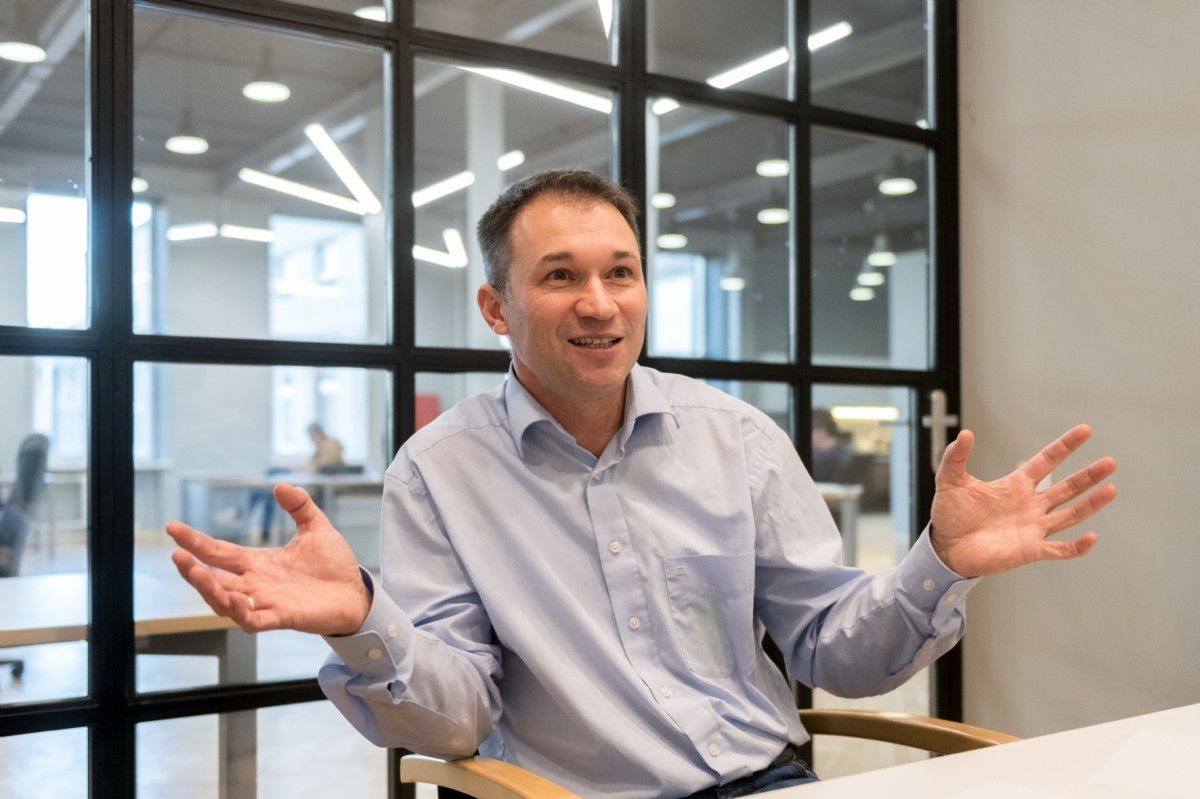
Grigory Kunis. Photo: PhotoXPress.ru
Yevgenia Albats*: On July 25, 2025, you were detained, sent to a pre-trial detention center, and charged under Article 282.3 Part 1 of the Criminal Code of the Russian Federation. This is "financing extremist activities," up to 8 years of imprisonment. You yourself stated in court that you transferred money to the Anti-Corruption Foundation** because you believed it was the right thing to do, because you liked Alexey Navalny's investigations***. But miraculously, the court, despite the prosecution's demand, fined you 350 thousand rubles, and you were released from custody, if I remember correctly, in the courtroom. The prosecutor's office immediately filed an appeal, as they usually do. A similar story happened, for example, with Boris Kagarlitsky*, a very famous political prisoner and left-wing politician. On appeal, Kagarlitsky was sent to a colony. It was clear that you were facing exactly the same thing. You did not wait to be sent to a colony, crossed the border, and are now outside the Russian Federation. Here's a brief summary of this story.
Now I want to ask you in detail. How did it happen that the security services got information about your transfers to the ACF? And for what period of time did they have these transactions?
Grigory Kunis: It's quite simple. My situation in this regard is typical for all cases that are now arising and will arise. They somehow managed to find the merchant ID, that is, a certain digital identifier on Stripe, on the internet. Stripe is a payment system. Tinkoff, for example, has a payment system called Cloud Payments. There is the MIR payment system, and so on. So there are many payment systems. Stripe is one of the widely developed commercial systems in America.
The FSB doesn't need to prove anything, the Russian law enforcement system will accept quite far-fetched evidence
Yevgenia Albats: So their hosting is located outside the Russian Federation?
Grigory Kunis: Yes, but it doesn't matter. Stripe simply has a good system for small and medium-sized companies that allows you to quickly set up the ability to accept payments. There is a very simple integration. The problem for the ACF turned out to be that there are very, very few Russian merchants, that is, merchants with potentially Russian roots there. Therefore, in fact, more than half of the base on Stripe, which comes with payments from Russia, is associated with the ACF. They downloaded this base, calculated where there are the most identical merchant ID. This is quite open information, probably not even much hacking is needed. And so they got this identifier. Naturally, it doesn't say that it's the ACF, it's just some organization in America. But the FSB doesn't need to prove much, the Russian law enforcement system will accept quite far-fetched evidence. In April of this year, they found out that payments were made from such and such an account to the ACF for 3.5 thousand rubles. 7 payments of 500 rubles from August 21 to February 22. They initiate a criminal case. A month later, they identify through a bank request who owns this account and that I, Grigory Kunis, am the owner. After that, they declare me a suspect. The criminal case is conducted not against an "unidentified person," but specifically against me. All other cases, or most cases, related to donations to the ACF work according to this same scheme.
Evidence for the court
Yevgenia Albats: Did you understand when you transferred the money that you could be so easily identified?
Grigory Kunis: Well, I understood that it couldn't be hidden... But I was sure that there was no legal connection, it's a completely different organization that has nothing to do with the liquidated one. Moreover, if a company is liquidated, the organization is liquidated, then it cannot a priori accept money. It's gone, it doesn't exist. I'm not paying it, but some other legal entity. Even if there are coincidences in the name, these are completely different legal entities that have nothing to do with each other. They exist in different legal fields, under different legislation. Neither one established the other.
Yevgenia Albats: So in a normal court, if the security services brought this data, it couldn't be proven that the company you transferred money to and the liquidated Anti-Corruption Foundation are the same entity? Nevertheless, the security services presented this in court. And your lawyer probably said: guys, what does all this have to do with the Anti-Corruption Foundation?
Grigory Kunis: We discussed this. Yes, I'm not a child, I understand that... I read the examination, it was done at the level of a junior school student, when the result is adjusted to the task.
Yevgenia Albats: And who conducted the examination?
Grigory Kunis: Well, some... You know how sometimes examinations are done here. And what's the difference? If the so-called expert is dependent on the state machine, he will do whatever is needed.
Yevgenia Albats: Why did you decide to admit in court that you transferred money for the needs of the Anti-Corruption Foundation?
Grigory Kunis: Because it's the best strategy to get out of this situation. If I denied guilt, there would be no chance of hoping for a fine. You know how our judicial system works. Nothing can be proven. Simply if you admit guilt, it's a mitigating circumstance, but if you deny guilt... We discussed it—full or partial admission of guilt? We decided that it should be full because if partial... It's an aggravating circumstance that significantly reduces the chances of getting a fine, which is provided by law under this article.
Yevgenia Albats: Did you really say, or is it already a myth, that you transferred money to the ACF because you considered Alexey Navalny's investigation into corruption a good thing for the country?
Grigory Kunis: I said that they did their work very professionally. As a journalist, I evaluated this work as very high and voted with my ruble for their professional work.
As a journalist, I always distanced myself from politics. And I proceeded from this—that I did not try to evaluate the activities of the ACF from a political point of view. I evaluated exclusively from a professional point of view
Yevgenia Albats: And what was the reaction, firstly, of the judge, and secondly, of the prosecutor?
Grigory Kunis: The judge was satisfied with it. It's an understandable motivation. Well, I emphasized at the same time that as a journalist, I always distanced myself from politics. It's honest. I have such DNA, from managing journalistic teams, that politicians cannot be trusted. None. You need to ask them the right questions, but treat them as objects that a normal media should write about as objectively as possible. And I proceeded from this—that I did not try to evaluate the activities of the ACF from a political point of view. I evaluated exclusively from a professional point of view. I also emphasized that I even sometimes supported my competitors because I believe that pluralism of opinions and different points of view are very important.
Yevgenia Albats: And you received a fine of 300 thousand rubles.
Grigory Kunis: I received a fine of 500 thousand rubles, which was reduced to 350 because I spent more than 4 months in a pre-trial detention center.
Yevgenia Albats: Agree, it's an incredible situation that in Russia, where people are imprisoned for nothing, suddenly a person who honestly admits that he considers the anti-corruption investigations of the ACF good professional work is released from prison. They understand that this is even scarier than many other cases because you are a person who ideologically supports what the ACF did and does.
Grigory Kunis: According to statistics, most sentences in the first instance now end with fines. The exception is the city of Moscow, where more than half of court cases under this article, in similar cases, in the first instance end with prison terms. But in appeal, the situation will be worse.
Yevgenia Albats: So in appeal, the security services achieve their goal, and the person goes to a camp, right?
Grigory Kunis: Well, as a rule, yes. But I don't have statistics.
Prelude to the Crosses
Yevgenia Albats: Tell us how you were detained.
Grigory Kunis: I was at the dacha with my family 120 kilometers from St. Petersburg. At 8 in the morning, the phone rings. I'm still asleep, I haven't gotten up yet. They tell me: we are from the police, we came about the case of financing extremist activities. I didn't even immediately hear these words. I think, wow, the scammers have become impudent, calling at 8 in the morning. And I say: what are you hanging noodles on my ears for? They say, look out the window, we're standing at your gate. Well, okay, I got up, looked out, and they were indeed standing there. I realized that the matter was more serious than scammers. I got dressed, went to them. They started showing a piece of paper.
Yevgenia Albats: And how did they introduce themselves?
Grigory Kunis: An operative from the Economic Security and Anti-Corruption Department of the Petrogradsky district, I didn't even remember the surname, what difference does it make to me.
Yevgenia Albats: The department for combating extremism, I see.
Grigory Kunis: No, for economic crimes, the ESACD.
Yevgenia Albats: So you thought something happened to your company?
Grigory Kunis: Well, at first. But then I realized they were talking about financing the ACF. I understood everything. Of course, I thought about it, reading the news about how this one was convicted, that one was convicted, here they arrested, here a new case arose. Of course, I knew it was a dangerous thing. But for some reason, I was sure that I made payments before this dangerous period. That is, I transferred donations to the ACF for many, many years. And I was sure that my payments no longer fell into the dangerous period. Memory sometimes plays a cruel joke on people, I didn't even check, I was so sure that I had such payments in that period. And I didn't protect myself at all in this regard.
Yevgenia Albats: Did you already know that the security services had found the keys to Stripe? Was this already written about on the internet?
Grigory Kunis: Of course, I knew. Stripe payments started in August 2021. Before that, payments were made through another system. So if I had realized that I was making payments starting in August 2021, I would have known they would get to me. I wouldn't have doubted it for a second.
Yevgenia Albats: So, they put you in a car, take you—where, to the Crosses?
Grigory Kunis: No, first they took me for a search in my apartment in St. Petersburg, then to the investigative department of the Petrogradsky district. The first interrogation was in the apartment. Accordingly, two hours later, the second interrogation was already in the investigative department. Then the investigator says, now we need to agree on a preventive measure: either a recognizance not to leave, or a ban on certain actions, or something else. After half an hour of some calls, he invites us with the lawyer to the office and says—I have bad news for you. The Main Investigative Department demanded to close.
Yevgenia Albats: And where were you sent?
Grigory Kunis: First, they sent me to the temporary detention facility in the same building. Because the next day there was to be a court hearing on the preventive measure. Arrests are either confirmed or not confirmed. The case should be considered here, in the Petrogradsky district, at the place of the crime. As if it happened from home, and I live in the Petrogradsky district. I spent the night in the temporary detention facility, the next day the court confirmed the preventive measure at the investigator's request, they took me back to the temporary detention facility: the court was on Friday, on Friday they couldn't take me, on Saturday and Sunday there is no convoy, so they took me to the Crosses only on Monday.
Pre-trial detention center: a useful experience
Yevgenia Albats: When we were arranging this interview, you told me very interestingly that being in the pre-trial detention center was useful to some extent because you learned a lot about how digital surveillance works. Am I right in understanding that in today's Russia, any money transfer is tracked, that nothing can be done so that the security services do not see and do not know?
Grigory Kunis: Impossible, but this has been the case for quite some time. In the pre-trial detention center, there were other revelations—about the extremely effective facial recognition system today.
Yevgenia Albats: By cameras?
Grigory Kunis: Yes, by surveillance cameras. I met people who had been wanted for many years, they couldn't be found. At the end of last year, they updated the facial recognition system. A person arrived in St. Petersburg literally for one day, and he was immediately arrested. Another example, just so people understand the scale of surveillance. A man about my age, worked in St. Petersburg, doing odd jobs. He finds a bank card, carries it with him for two weeks, does nothing. Then he decides—I'll try to pay in the metro. He pays a small amount. Then again and again. In total, he made payments in stores and the metro for 8 thousand rubles over several days. And after that, he successfully leaves for his native Petrozavodsk. In Petrozavodsk, two weeks after moving, he goes to a store, and as he leaves the store, the police pounce on him, twist his arms, and into the paddy wagon. They take him without checking any documents, take him to the pre-trial detention center, and he ends up in the Crosses in St. Petersburg, at the place of the crime. That is, they figured out in literally two weeks who this person was, that he was in Petrozavodsk, that he was currently in a store. And they don't even need to check his identity. They know it's him. They put him in the pre-trial detention center without any documents. That's how it works now.
Yevgenia Albats: Why can't they fight phone scammers who extort money from people in this way?
Grigory Kunis: They catch couriers who come for the money. I identified at least a dozen couriers in the pre-trial detention center. They are caught very easily. Mostly these are young guys, 18–20 years old, they are hired as if officially. Of course, they are fools, they think they are paid 30 thousand a day just like that, that they can earn so much for honest work.
Yevgenia Albats: And what do they do?
Couriers who come to deceived pensioners for money are caught very easily. It's impossible to identify the real scammer
Grigory Kunis: They come to these deceived, usually elderly people. They take the money from them, take it either to an ATM or hand it over to some conditional place. Then the so-called droppers pass the money along the chain. In this situation, only the courier's face is exposed. They are caught very easily right on the street.
Yevgenia Albats: But these couriers probably receive assignments from someone?
Grigory Kunis: All electronically, without personal contact. Through Telegram, for example, they are recruited. Of course, all accounts are fake. It's impossible to identify the real owner. And these guys simply carry, conditionally, a million rubles, keep some amount for themselves, and put the rest in the right place.
Yevgenia Albats: Investigators can ask them about this right place?
Grigory Kunis: Well, by the time the investigator appears there, this place is already completely empty. If it's a card, it's also empty. Because the money is transferred along the chain and withdrawn through some ATM, and you can't catch the real person who is the organizer. That is, not a single organizer of this scheme is in the pre-trial detention center. But there are plenty of couriers. Droppers who give their card for transfer sometimes also get caught. But their function is only to give the card, they only receive some commission from this.
The opposition has no chance
Yevgenia Albats: If there is such digital surveillance, then it turns out that no opposition activity in Russia can be conducted?
Grigory Kunis: Really impossible. Well, because everything is very, very transparent. I don't know, maybe "Signal" is not tracked because there is encryption at the device level. You change the device, and your past correspondence disappears along with the phone. But everything else... Telegram is completely transparent, except maybe for secret chats. What is under lock and key. I don't know about WhatsApp, I can't say.
WhatsApp is too big a system. No system can process such a colossal amount of information. The special services have large resources, but not enough to track everything
Yevgenia Albats: Then why do they block WhatsApp or threaten to block Telegram if they can monitor it? I thought the security services wouldn't block YouTube because for them it's a form of surveillance. So they are not sure that they can track it?
Grigory Kunis: WhatsApp is too big a system. These are tens of millions of messages a day. No system can process such a colossal amount of information. Yes, they have large resources, but not so large as to track everything. Why are bank transactions easier? The scales are still not as large as in communication—it's one, two, three a day per person. These are completely different scales of activity.
Word crimes
Yevgenia Albats: The Russian judicial system has begun to use a term like "ongoing crime." If you ever wrote something or had an article, for example, an interview with Alexey Navalny on the "New Times" website, and it was 10 or 15 years ago, it doesn't matter. They come after you, they fine you. We received a fine of 23 million rubles like this. Because they say: it started in the past, but it still continues, it's still accessible on the internet. Google remembers everything.
Grigory Kunis: If we are talking about archives, then this is not an "ongoing crime." But if on Facebook**** I had publications that could be recognized as extremist or support for extremism, I had to delete them to avoid falling under "ongoing crime." That is, if I continue to keep this publication today, which I made 10 years ago, it means that I am publishing it today. It's available on my page. This is an ongoing crime from the point of view of jurisprudence logic, no matter how unpleasant it is for us. That's why I, of course, deleted such things.
Yevgenia Albats: You can't call an opinion you expressed 10 years ago an ongoing crime. These are words! This is not an action! Are you saying that you can be imprisoned for words? This is not law, this is lawlessness. Just like recognizing the law of Article 58 of the Stalinist criminal code—from this point of view, the millions of people who were shot, if you formally follow the logic of jurisprudence you are talking about, were shot correctly because they were engaged in anti-Soviet activities.
Grigory Kunis: No, it's not right. Nevertheless, I removed my anti-war posts from Facebook when the law on fakes was passed. I didn't want to go to prison.
Yevgenia Albats: Understood. But this means that no resistance to the regime is possible. This is an ideology of submission to a lawless, absolutely courtless, and unlawful authority, headed by a person who violated the Constitution of the Russian Federation, then canceled this Constitution, committed what we call autogolpe, a self-coup. This whole system is absolutely outside the law, jurisprudence, and law.
Grigory Kunis: I agree with you that these are unjust laws, they should not exist. But now they are laws.
Yevgenia Albats: They are not laws because they violate the Constitution.
Grigory Kunis: But people are imprisoned under them.
Yevgenia Albats: And the people you were with, were they mostly criminal cases? There were no political prisoners with you?
Grigory Kunis: Very few, literally a few.
Yevgenia Albats: What do they think about the war, about the Putin regime?
Grigory Kunis: Most just don't think about it, they detach themselves from it. Another approximately the same part are victims of propaganda, they echo the TV. And for me, it was insanely difficult psychologically not to comment on their statements. Otherwise, I had a chance to get another criminal article already about fakes. There was complete nonsense, it was very difficult to restrain myself.
Yevgenia Albats: You confirmed my fear that no real resistance in today's Russia is possible.
Grigory Kunis: From my point of view, no.
Escape to freedom
Yevgenia Albats: It seems to me you were lucky that you were fined?
Grigory Kunis: Definitely lucky.
Yevgenia Albats: Why then did you decide to leave Russia?
Grigory Kunis: I understood that in appeal my sentence would not stand. And I definitely don't want to sit. The fear of ending up where I was for several months is so strong that I was ready to leave literally with a light backpack, a couple of changes of underwear, and a very small amount of money. To leave everything for the sake of freedom and safety.
Yevgenia Albats: Didn't they take your foreign passport during the search?
Grigory Kunis: I don't know, by some miracle, they returned both my Israeli passport and my Russian foreign passport. This again was some kind of miracle.
Yevgenia Albats: Was this after the court decision?
Grigory Kunis: No, still in the process. After the investigation ended, the investigation returned the seized equipment to the company I headed. Because there was a search, they were looking for traces, whether my financing of the ACF was related to the company's activities, of course, they found nothing. The investigation ended, they returned the equipment, and also returned my passports, which surprised my wife and me, of course. Well, we were happy.
Yevgenia Albats: Didn't they try to recruit you?
Grigory Kunis: No.
Yevgenia Albats: So there were no recruitment approaches at all?
Grigory Kunis: No, no. They tried to recruit me in '88 when I was one of the organizers of protests against the military department at the university. But apparently, they put some kind of checkmark there that it's useless, and since then they haven't touched me.
Yevgenia Albats: Didn't you see any surveillance before the arrest? And now, when you were leaving?
Grigory Kunis: No, there wasn't. I, of course, checked. I took precautions, I know how to check this.
Yevgenia Albats: And what will happen to your business now?
Grigory Kunis: I no longer have it. Because the partner took advantage of the situation and took the business to his companies. But he didn't just cheat me, he cheated all the minority shareholders. That is, everyone who had small shares, he left them out. I had an option for 10% of the company. I can't use it in any way because the company is now conditionally bankrupt, there are no financial flows, no contracts, no software, which is the main asset.
Yevgenia Albats: Don't you want to name the person who robbed you?
Grigory Kunis: Roman Yavorsky.
Yevgenia Albats: Roman Yavorsky robbed you while you were in the pre-trial detention center.
Grigory Kunis: Not just me. And my brother, and the company's employees who had options, investors in iGoods. He deceived everyone. Cynically took advantage of the situation. Those people who were supposed to take specific actions to transfer all contacts, he convinced that we would now be closed due to extremism, everything needs to be urgently transferred. People believed him, did everything as he said. Although some people were just option holders, and they should have raised the alarm. But they didn't do anything, in a panic they committed these actions and also ended up with nothing.
Yevgenia Albats: And Roman Yavorsky continues the business he stole from you and others. He will go bankrupt on this business.
Grigory Kunis: I have no doubt.
Yevgenia Albats: Such things are not forgiven. People who have any dealings with Roman Yavorsky should know that dealing with thieves is not allowed. And stealing from those who are sitting is already the lowest of the low.
Grigory Kunis: It's definitely not worth dealing with him.
When I return
Yevgenia Albats: Do you think you will ever return to Russia? Is there any chance at all?
Grigory Kunis: I think not. That's why I wrote on Facebook that I seem to have left forever. In my estimation, what is happening now will last a very long time in Russia. Without the risk of going to prison, I will not be able to return to Russia for the next 10–15, or even 20 years.
Yevgenia Albats: You are an entrepreneur, a businessman, you started your companies from scratch. So you're probably not afraid. And yet, will you start your own business or enter someone else's?
Grigory Kunis: I have 35 years of entrepreneurial experience and leadership of fairly large companies. The turnover of iGoods was more than 300 million dollars, and the last valuation was more than 100 million dollars. More than two thousand people worked. Of course, the experience of developing a complex IT system related to offline business is a good, quite unique experience. Technologically, we were market leaders. I, of course, want to apply this experience to bring some good idea to life. My brother and I have good ideas, I even voiced one of them in my closing statement in court. It can benefit tens, if not hundreds of millions of people.
Yevgenia Albats: Can you voice it here too?
Grigory Kunis: Of course. There is such a problem in many countries, and in Russia too: these are huge losses of electricity sales companies from incorrect data from electrical appliance meters, because these readings are transferred manually. There is fraud, there are user errors, there are delays in receiving data, there is simply a lack of data. Official figures for so-called commercial losses range from 30% to 40%. In America, the problem is solved, there online meters transmit readings in real time. And in Russia, there are very few of them. The losses of electricity sales companies in Russia, Pakistan, India, Brazil, and a number of other countries, I just named the largest markets with the biggest losses, are about one-third of the bill that subscribers pay. Colossal money. My friend developed a very effective data recognition system, the highest security and verification systems. The cost of the issue for Russia alone is at least 50 billion rubles a year. This is one of the hypotheses that I will solve not for Russia, but in India or Brazil. There are approximately the same scales of losses.
Yevgenia Albats: I wish you success. And I hope that you are wrong in your forecast, that in a few years we will meet again in Russia.
Grigory Kunis: I will be very glad if I was wrong.
Reference
Grigory Kunis — entrepreneur, businessman. Studied at the Faculty of Chemistry of Leningrad State University. Was a co-founder of the newspaper "My District," which published serious investigations and articles. When this opportunity closed, in 2014 he became a co-founder of the food delivery company iGoods. After the court fined him for donations to the ACF, he was forced to go abroad.
Video version
* Yevgenia Albats, Boris Kagarlitsky are declared "foreign agents" in the Russian Federation. Boris Kagarlitsky is also included in the register of "terrorists and extremists."
** The Anti-Corruption Foundation (ACF) is declared an "extremist organization."
*** Alexey Navalny is included in the register of "terrorists and extremists."
**** The company Meta, which owns Facebook, is declared "extremist" in the Russian Federation.