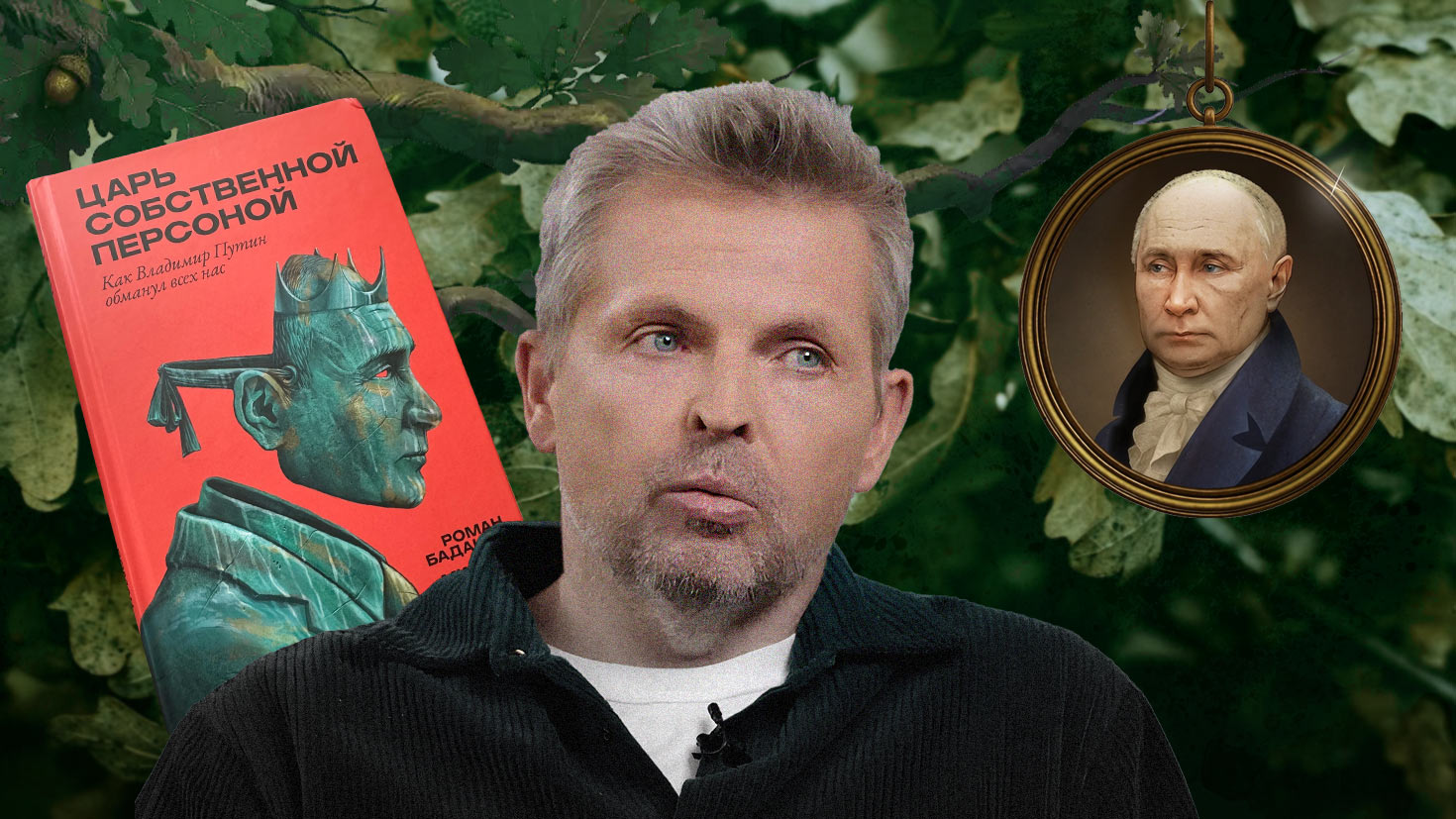
Roman Badanin
Evgenia Albats*: The latest major work of «Project» — an investigation into the richest and most influential families in Russia. Over a year and a half, the team studied the biographies of 1300 representatives of the Russian ruling elite and their relatives. That's about 10,000 people. Investigative journalists concluded that Russian state power is plagued by nepotism. More than two dozen families, according to «Project», own the main assets of Russia, both state and quasi-private, because they control the most important institutions of power. This is how it is arranged in today's Russia, where assets are a direct function of bureaucratic position. And family, families are not just figures of speech mentioned in the large study. These are literally entire families — parents, children, uncles, aunts, nephews, who hold very lucrative positions in various power structures — in the government, in the presidential administration, in law enforcement agencies, and so on, thus accumulating power and money. What discoveries did the journalists of «Project» make?
Roman, of course, I read everything. Since we at NT ran a column for several years called «The Best for Children» and wrote a lot about how the children of high-ranking officials take high positions in state banks, corporations, and power structures, much of it was known to me. Your study has a lot of reading, a lot of watching, a lot of very interesting artistic work, by the way. And you have a very good artist. What is most important to you in this investigation?
There were times when the Russian press wrote about something openly and impartially. And we realized that over these 25 years, besides placing their relatives everywhere, they also simultaneously cover their tracks
Roman Badanin: You touched on the most important thing. We are also qualified observers of the political and business process in the country and, by the nature of our work, know a little more than the average person. And, it would seem, we should be prepared. But I will share my shock with you. How did it look from the inside, from our side of the aquarium? For example, I was responsible for reading and editing most of the biographical notes written about the heroes and their families. That is, I passed them all through myself. And I have two impressions. The first — this is, damn it, everywhere. I was not ready for this. Honestly speaking. Reading each new batch of notes that was handed to me, I was amazed that they literally go in alphabetical order. In the sense that we almost do not see those who dropped out of the list because we did not find their relatives. By the way, if we did not find them, it does not mean they do not exist. That is the first impression.
The second is no less important, but it is another facet of the same problem. I read the notes of people whose entire political career, it would seem, passed before my eyes as a journalist. That is, they became senators, deputies, administration employees in the 2000s, in the early 2000s. It would seem that as a qualified observer, I should remember and know everything about them. And I read and see much as if for the first time. This is about another phenomenon. First, human memory. We saw our goal, among other things, to tell people who did not observe all this about it. And secondly, it is evidence of how «worn out» the past is. We often plunged into debates within the editorial office. I will now explain the nature. Here is some official, it does not even matter the name, and we suddenly discover that we are forced to quote some fact of his biography, let's say, from the site «Compromat.ru». This is such a collection of compromising materials in a broad sense. There may be pure compromising materials, or there may be real notes, reprinted investigations. And I, as an editor, and my colleagues immediately have a stance. Why is it so? And we delved deeper, and it turned out that, for example, the original texts could not be found. Although quite serious and respected press wrote about this. There were such times, you will not believe, when the Russian press wrote about something openly and impartially. And so we realized that over these 25 years, besides placing their relatives everywhere, they also simultaneously cover their tracks.
You will not believe how many testimonies about criminal pasts are erased, for example. Well, who now can even remember that deputy Skoc, who has been in parliament for 25 years, is a real Solntsevsky bandit who «knocked the boss», as they said, on the entire Tverskaya Street, from the State Duma to Mayakovka. Literally walked, collected tribute from the first floors. Of course, this is erased. And of course, Skoc has a huge family, and everyone is involved. And in general, Skoc, for a moment, is a relative of Denis Manturov, the first deputy prime minister of the Russian Federation. It would seem that in the entire civilized world, everything about the family and entourage of the first deputy prime minister should be in view. Most of it should be in the official biography on the government website. Here there is nothing. If it is about hiding the past of such large figures, what to say about 450 deputies of the State Duma? There the hair stood on end when we remembered, read, and re-described their biography.
How the Secret Becomes Apparent
Evgenia Albats: The Soviets thought they would own the country forever. And therefore they were not afraid that «top secret» documents were sent, for example, from intelligence to the Central Committee of the CPSU, to the Politburo of the CPSU Central Committee, placed in so-called special folders, in brown sealed envelopes, on which it was written «do not open». And they thought no one would ever see this. The Putinists survived the early 90s and remember how some part of the archives was opened and it became known that, for example, in the bureau of famous Soviet newspapers, two out of three people were from the KGB, or the entire TASS was entirely KGB, and so on. And a lot of other information was revealed. The Putinists who came to power understood that information is a terribly dangerous thing. Do you think they are only cleaning up the accessible internet? It's not just them, rich people can order the cleaning of the internet. Or are there still documents lying somewhere?
Roman Badanin: Well, of course, there are documents. Where else would they go?
Evgenia Albats: Do you think they do not burn documents?
Roman Badanin: That is, will we find something, and if we find it, what will it be, in the KGB archive, when and if some good event happens in our life, and we get the opportunity to work there? I have no answer to this question. Undoubtedly, Putin and the power system he built inherit what was during the Soviet era. You remember no worse than I do that there were, for example, two such powerful biographical secrets in the late Soviet Union: the origin of Yuri Andropov and what he did during the war, why this powerful statesman did not fight properly? Everything was swept under the rug. But the 90s happened, and at least to the second question, we got an answer thanks to eyewitnesses. I will not go into details now, but there was a famous interview with an Andropov colleague from Karelia, who said that Andropov, by and large, dodged the war. This is to say that I do not know if this was preserved in the archives or it was destroyed during the Soviet era. But as long as people who saw at least something, remember, are still alive and ready under certain circumstances to tell — this, at least, is not completely lost. That's what I count on.
Evgenia Albats: Memorialist Nikita Petrov wrote a large biography of Yuri Andropov, which was published last year. What struck me most there was that part of the book was devoted to finding out whether Andropov was Jewish or not.
Roman Badanin: Because it was a Soviet secret.
Evgenia Albats: It turns out he was not Jewish, although in the KGB they thought he was. I remember an interview with Oleg Kalugin, who said: «Well, we all knew that Andropov was Jewish», — something like that. This is just a reflection, it seems to me, a characteristic of both the office and the country.
The Putin elite over 25 years has done the maximum to make work in the public sector or near the public sector comparable in its profitability to private business
Returning to your investigation. What was their motive for bringing their children and relatives into power structures? In the 90s, many preferred to create their businesses, move abroad and create firms there, engage in Soviet state property abroad, and make money from it. Then, when Putin came to power, it was very interesting to observe how the outflow from private structures to the state began. What was the motive for bringing all their children, grandchildren, aunts, and uncles into power structures?
Roman Badanin: The Putin elite over 25 years has done the maximum to make work in the public sector or near the public sector comparable in its profitability to private business. Well, look, today we released one of the news based on the investigation. Andrey Kostin, head of VTB, employed eight various relatives in his state bank. And more than twenty other offspring from other important families, ranging from the Putin family to the Patrushev family and further down the list. They all work at VTB in positions from middle and senior managers to vice president. And we, by the way, do not know what their remuneration is there, even the legal one. Not to mention what they have additionally. I can say for sure that he would not have employed them there, they would not have gone there to work if it were not profitable.
We all saw searches at FSB employees, who had billions. In the sense that positions guarantee no less than legal earnings in a private structure in the 90s. Secondly, an obvious thing — the selection process is hollowed out. In the sense that competitive procedures do not work. If you can ask a person to hire yours, then why bother? It's easier than launching a process of selecting the most effective, evaluating professional qualities, conducting surveys, interviews. Well, the third, probably the most important and most obvious. When we did the part dedicated to Kadyrov (and he is the absolute record holder, he has nearly a hundred only obvious people found by us, and I suspect that there are certainly more if the word «kinship» is applied in a broad interpretation in the Caucasus), we asked one Caucasian person, a businessman, why so. He said that he took his wife as the chief accountant in his firm: this is the most sensitive part of our business, who else can I trust? And now imagine what secrets Kadyrov has compared to my business! Of course, it's a matter of trust. And this answer is very important — in principle, they do not have many people they trust. These are either relatives or very tied by something bad, something criminal. Like in the mafia. That is, you can trust someone who either has blood on their hands or who is your close relative. Ideally, both. I think these three reasons describe most cases.
Evgenia Albats: Half the trouble, I think, if Russia were just a mafia. The trouble is that it is a state, and this mafia state has functions that belong only to the state. The right to legal violence.
Roman Badanin: Well, yes, mafia and police in one person.
Evgenia Albats: Absolutely. That is, the institution of the state is built like a mafia, but at the same time, it has what the mafia does not have. But here's what I want to ask you. Working in government structures, as we see now, creates great risks. Across the country, there are arrests of vice-governors, retired governors, mayors, and so on. Why are they not afraid of these risks?
Roman Badanin: Truly serious people have never been touched by risks. Serious — meaning relatives of the ruling dynasties. We all remember, for example, the story of Igor Putin, not the closest and not the most beloved relative of the president, who for years literally traveled from one laundering bank to another. Moreover, in one of them, in the main one, in Masterbank, he sat with a relative of Patrushev. They were there as talismans. They sat, guarded this business. Although everything about this business was clear from start to finish, it was just a big laundering office. The bank eventually fell, fell hard, some are still wanted, some were imprisoned. But it did not affect either Igor Putin or Patrushev's relative. We give many such examples in our biographical notes. Undoubtedly, further down this chain, someone might have been affected. But this is a high-margin business for them. Becoming an official or becoming a manager, say, in a state corporation or even in a private business dependent on state contracts — this is a high-income business for them. In their world, of course, this risk is worth it. And their chance to fend off risks in case of something is much higher than that of an ordinary Russian. Therefore, they play this game. It's a bit of Russian roulette for them too, but incomparable with anti-war activists, with independent journalists, and so on. Therefore, I certainly will not worry about their fate.
Exceptions Confirm the Rule
Evgenia Albats: You write about <Viktor> Cherkesov, who worked with Putin in ideological counterintelligence. Cherkesov led one of the last dissident cases in Leningrad. They were obviously very close to Putin. And when Putin headed the FSB, Cherkesov followed him and became his first deputy. It was a colossal leap in his career. But then Cherkesov wrote his famous article in «Kommersant» about the «Chekist hook» on which Russia is hung. After which his career effectively ended, he lost his position, became a State Duma deputy from the CPSU, and died in 2022. A classic example. Went against the master and got slapped.
Roman Badanin: History is beautiful because it always has deviations from the general rules. Cherkesov, in my opinion, because I was interested in his fate even outside the «Fathers and Grandfathers» project, is one of such deviations. The story of this kind of fall, stretched over years, began in 1999 when Putin was being transferred from the chair of the office director to a more important chair. And he was looking for his successor, who would take his place in the office. Cherkesov was the first candidate. And they, as they say, had a conversation, during which Cherkesov — now it's hard to believe — refused. Putin generally does not like refusals. And here from his first deputy. As a result, Patrushev became the head of the FSB, and Cherkesov was indeed invented... Well, he was a presidential envoy for a while, and then they created some nonsense, the State Drug Control, for him. What it is, no one knew, that's why it disappeared as it appeared. Because the only purpose of its creation was to give Cherkesov new epaulettes.
And he violated subordination a second time. He brought to light, apparently due to some personal trait — he liked to write, no wonder he married a journalist — the topic of confrontation within the office. This was not his first article, but at least the third of those we know. He wrote one under a pseudonym back in the 80s, another — in the early 2000s, I think, in «Komsomolskaya Pravda». And here's the third. Well, it was already a personal story, written partly in Aesopian language, but at the same time, notice, they imprisoned <former subordinate of Cherkesov> General Bulbov, but did not imprison Cherkesov himself. There were no serious consequences for him in terms of repression. Yes, he was upset, became a deputy from the CPRF, then he was asked to leave there, drank a lot, as they say, and it ended as it ended. Again, there is no compassion.
On the other hand, this is only the end of Putin's second term. This was still possible. Can you imagine that someone at the very top today would think of bringing such problems to the public? This says a lot about the path we have traveled since then. They are much more afraid, they understand that this will definitely lead to nothing, that there is no place even for such Aesopian competition. It's much easier to solve everything under the carpet. This says a lot about Russia over the past 15 years.
Putin, Kadyrov, Chechnya
Evgenia Albats: «Project» made a very detailed account of Kadyrov. He brought more than 90 people into power.
Roman Badanin: With him, the clan consists of 96 people.
Evgenia Albats: It is known that Kadyrov always had complicated relations with the FSB. FSB officers leaked information about Kadyrov and what was happening in Chechnya. He allowed himself to kill his enemies, who were often agents of the GRU or FSB there. Why, nevertheless, did such a number of Kadyrov's people enter the federal government?
Roman Badanin: In each individual case, I think there are individual reasons. But in general, he has a powerful lobbying resource. In terms of access to the tsar — one. Secondly, in terms of money. This cannot be underestimated, Kadyrov is a master at solving issues with money. Where does he get it? This is a separate huge question. Both from the state budget and through business protection. He is probably the largest of those who provide services for illegal cashing. That is, he has enough sources of money. I think he is incomparable in his wealth with any other not just a governor, but almost any other federal district figure. We tell in «Fathers and Grandfathers» the story of Suleiman Kerimov, which in many episodes intersects with Kadyrov's story. There is one episode showing how everything happens. We tell the story of how «Uralkali» absorbed the company «Silvinit». In short, Kadyrov's people intimidated the main shareholder of «Silvinit» so that he would merge his asset. Roughly speaking, they pushed him to the deal by non-legal methods. For which they received some hypothetical, written on a napkin, but in that world absolutely real share in the united «Uralkali». That's how it works. They can provide such a service to a conditional official, a conditional FSB officer, quite a real even Zolotov. Of course, this is a resource. Kadyrov, among other things, hooks on money. And if both fear and money, then this is a golden asset. I think this explains everything.
Chechnya and Kadyrov — this is the needle in the egg of Putin. To play back with Kadyrov will not work for him, the entire current Putin is built on the foundation of a pacified Chechnya. And a pacified Chechnya in Putin's worldview is inextricably linked with the Kadyrov surname
Evgenia Albats: But at the same time, it is obvious that Kadyrov trades access to the master's body. The master, that is, Putin, knows this. And yet he treats Kadyrov indulgently. What is forgiven to Kadyrov is not forgiven to others. You write about the famous shootout over «Wildberries» in the center of Moscow, in Romanov Lane, 200–300 meters from the Kremlin. Kadyrov's men killed two Ingush from the security there, and one was wounded. Nevertheless, he was forgiven for everything. Why?
Roman Badanin: The answer is obvious to me. It goes beyond the «Fathers and Grandfathers» investigation because it concerns the entire history of Russia and Chechnya under Putin. I came up with a term for this for the book. Chechnya and Kadyrov — this is the needle in Putin's egg. Not in the sense that it painfully pricks in the groin, but in the sense that this is the secret of his success. To play back with Kadyrov will not work, the entire current Putin is built on the foundation of a pacified Chechnya. And a pacified Chechnya in Putin's worldview is inextricably linked with the Kadyrov surname. This is his promise <stability>, this is his bet and much more. Putin was young as a politician then, and he took a risk. And it so happened that this bet played out. With the help of the office, with the help of terrible things, but it played out. Therefore, Putin cannot, apparently, does not want, and is very afraid to play back, even when Kadyrov commits the most terrible things. The most terrible even from the point of view of the FSB. This is forgiven because it is his needle in the egg. Putin is afraid to remove Kadyrov because he fears that Kadyrov holds Chechnya and Dagestan in his fist. At least what was once called «Wahhabi Dagestan». And that if there is no Kadyrov, no one else will hold this situation.
Evgenia Albats: But hasn't Kadyrov squeezed out not only from Chechnya but from Russia all his opponents and killed those who opposed him in any form or resisted, including Chechen commanders?
Roman Badanin: Well, firstly, not all. Secondly, even living abroad, many of them retain influence in the republic. Well, and it is impossible to kill the entire population of Chechnya. And I do not think that among the ordinary population of the republic, there are so many sincere supporters of Kadyrov. Therefore, Putin fears the violation of the status quo and potential instability there. And besides, if you admit that Kadyrov as a project failed, it is a powerful image blow to Putin himself.
Seizure and Redistribution
Evgenia Albats: Putin and his entourage destroyed property rights in the country. This is the risk that all people have, including all these clans, families, and so on. Previously, they could at least invest in real estate abroad. They did not do this by accident because they understood the risks of owning property in Russia. And what will they do? Well, Putin will die. Even though initially, people from his entourage, some kind of junta in epaulettes, are more likely to come to power, they will still take away. Redistribution is inevitable. Or not?
Roman Badanin: Redistribution is inevitable, but in their view, the chances of being redistributed are still less than those of an ordinary person from the street. I completely agree with the idea that the very idea of private property is put under a huge question. But Putin took away not only from those who are enemies in his worldview, who left Russia, let's say. The problem went much wider. Every prince inside the office, for example, strives to take away, redistribute under the guise, even what does not belong to enemies. There are many such cases. But imagine what the chances of being redistributed are for Ivan Ivanov from Moscow, a businessman who on his own risk and fear started some business, and for some nephew of Patrushev, who started all the same, let's say, even independently. These chances are incomparable. Therefore, why refuse what can be obtained now, fearing some hypothetical risks in the future? Moreover, these risks are much lower than those of the average Russian businessman.
Evgenia Albats: But Putin will still end someday, there is no eternal life.
Roman Badanin: Well, this is venture business for them. Just their venture is like this.
Even the most expensive apartments on Sofiyskaya Embankment opposite the Kremlin — this is a trifle in their assets. We do not imagine what interests the Russian ruling elite has in crypto, for example. They are colossal
Evgenia Albats: You show a lot of photos in the investigation: they bought dachas both in Serebryany Bor and on Rublevka, and an endless number of apartments. By the way, at the beginning of Putin's term, as you rightly said, Putin raised the financial well-being of bureaucratic positions, and apartments in the center of Moscow were simply given away. The entire center of Moscow — this is the residence of Putin's bureaucracy. Initially, it was formalized that they were supposed to buy it out, but then it was immediately forgiven, and in general, these were just free apartments, as under Soviet rule. But the Soviets acted more carefully. Well, okay, you show these incredible mansions in various complexes, some «Golden Key», apartments on Sofiyskaya Embankment opposite the Kremlin. An endless number of apartments. But they will be taken away when others come. It would seem they need to buy stones, as the aristocracy of the Russian Empire did. Which the only thing they managed to take out — is stones.
Roman Badanin: I want to upset you. Even the most expensive apartments on Sofiyskaya Embankment opposite the Kremlin — this is a trifle in their assets. We do not imagine what interests the Russian ruling elite has in crypto, for example. They are colossal, judging even by the little that can be pulled out of this sphere now. Therefore, do not think they are so naive. Crypto stones — one. Secondly, do not forget about closed jurisdictions. Arab countries, China, we have not even come close to understanding how much is there. And apparently, all this is very much in use. Apartments — this is, well, to live, to bring girls.
Hypocrisy
Evgenia Albats: You write about the harem system, which exists not only with Kadyrov and Kerimov but is also widespread in the quite Slavic part of the Russian government, take the same Putin, etc. I remember how it was customary among the bureaucracy in epaulettes to say that you must go on vacation with a young mistress. And there was such a feature, they appeared at various big receptions always with a new girl, who were usually all the same face, with the same legs, the same type. How does this fit in their heads with bonds, with the fight against LGBTQ, with the endless state with candles — some kind of schizophrenia.
Roman Badanin: I use another term. Hypocrisy is all, lies. Everything fits well with them. It's like with Patrushev, who is the most bland of them. As if bonds, Soviet grayness, cardboard folders. He holds the «ideological» image better than all the others. And then suddenly, there is some minor slip. Here he came to the Security Council, and he has a «Breguet» sticking out from under his shirt cuff for $30,000. Well, not the most terrible amount from the point of view of Russian officials. But such a small detail. Normally, he gets up in the morning and puts them on. Just this time he forgot that he would be caught on cameras, put on not for that event, not commander's, but these.
Evgenia Albats: So you have no doubt that Patrushev is just as corrupt, just as commercial a person as everyone else?
Roman Badanin: And we did not dedicate a whole separate episode of this investigation to the Patrushev family for nothing, to dispel this myth that Patrushev is «not about money». It turns out that this is probably the richest family among the security forces. And there are strong competitors, there is some kind of Murov (general, director of the FSO in 2000–2016 — NT), and so on. 14 billion only in real estate for the entire Patrushev family. They, however, hide them under skirts, all these houses, they are registered to Dmitry Patrushev's wife, the son who is considered the successor of our main one. And to the wife of the eldest Patrushev himself, and to the wife of the second son. That's how they are.
Evgenia Albats: You say that you did not expect that at all levels of power, in the center and in the regions, there is such a level of nepotism. Everywhere in the leadership and in lucrative positions work children, grandchildren, nephews. Which, of course, indicates that the level of trust in the country is below the plinth. They prefer to trust only relatives. Everyone else can betray-sell. No civil society, not to mention a democratic regime, can exist in conditions of such a low level of trust. But there is a very curious American book about the 300-year history of bureaucracy in Russia, tsarist and Soviet. It says that when the government changed, the heads of orders, services, ministries, etc., the entire corps of bureaucracy, immediately changed. I read your investigation and thought that the question is not about people. The question is about the institution, about how bureaucracy is arranged in the Russian Empire, in the Soviet Union, and now under Putin.
Roman Badanin: Well, yes. Because in the interval we practically did not have a democratic experience. There was an attempt in the 90s, ultimately failed.
Evgenia Albats: Is there anything left beyond your investigation that we need to wait for and follow the project's website?
Roman Badanin: Yes. This is not the first major project I release as a journalist and editor, but it is definitely the most serious in terms of response. I mean substantive responses, when people tell us what we did not notice when we worked. We already told that the day after the start of the publication of materials, we learned about a new relative of Putin right in the government. Fisenko, the first deputy minister of health, as it turned out, married Putin's niece a couple of months ago. And many such stories surfaced right now, when we were already releasing texts. And something we just did not have time to do, which clearly deserves attention. So yes, there will be a continuation.
Reference
Roman Badanin — editor-in-chief of the publication «Project», which he created in 2018. Since 2001, he has worked at «Gazeta.RU», Forbes, «Interfax», «RBC» and the TV channel «Rain»* as editor-in-chief. When Badanin and the «Project» team conducted an investigation into the Minister of Internal Affairs Kolokoltsev in 2021, searches were conducted at the editorial office, and after some time «Project» was declared an «undesirable organization». Journalists were forced to emigrate, where they created the «Agency»* and subsequently restored the «Project».
Video Version
* Evgenia Albats, Roman Badanin, «Project», «Agency», «Rain» are recognized in the Russian Federation as «foreign agents». «Project» and «Rain» are also declared «undesirable organizations».
Photo: Lenta.ru / «Project».