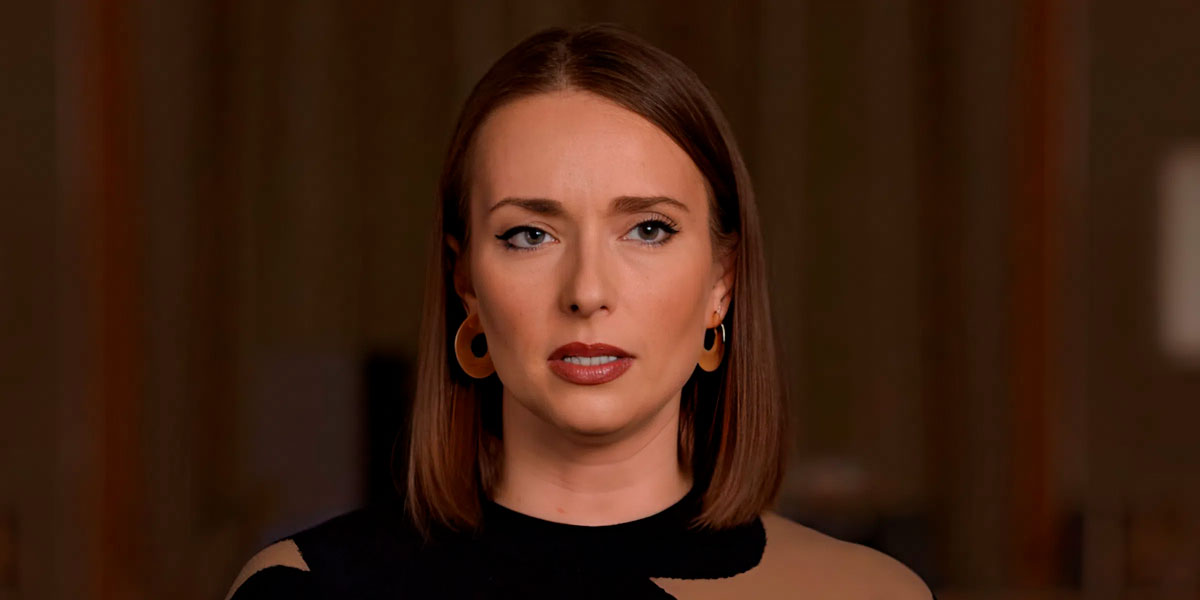
Julia Ioffe. Photo: grabien.com
Evgenia Albats*: My first question to you: why do so few scholars and journalists address this topic — the lives of women in Russia? I would recall Sheila Fitzpatrick and her book "Everyday Stalinism," Henry Smith — "The Russians," the former head of the Moscow bureau of CNN Jill Dougherty with her latest book — memoirs of student life in Leningrad in the late 1960s. And now your book "Motherland: A Feminist History of Modern Russia, from Revolution to Autocracy." Why was there so little interest in this topic?
Julia Ioffe: I think the short answer is: look who dominates academia and journalism. It's men, and men write about other men, men are the people in power. So when you write about power, you usually write about men. I had moments of deep frustration when I was researching and writing this book — I don't know if my anger sometimes seeps onto the pages. Especially when I tried to write about Beria's victims and called prominent historians.
Evgenia Albats: Let's remind, Beria was the head of the NKVD under Stalin, then he was responsible for the Soviet atomic project.
Julia Ioffe: He also oversaw the Gulag. He was a terrible, frightening man who, among other things, used his control over a vast repressive machine to literally grab girls off the street or actresses from movie screens, raped them, and forced them to keep silent about it. Most male historians of that period brushed me off and said — we don't know if this was systemic. We don't know if there is evidence. We don't know if we can trust these testimonies (I took some testimonies from Beria's secret case when he was arrested after Stalin's death in 1953 and executed). But then I thought: Robert Conquest in his book about the Great Terror quotes testimonies from these cases with the necessary reservations that many testimonies were obtained under torture. He doesn't take them at face value, but he uses them as a historical source. And I didn't understand why I couldn't do the same with the stories of women who testified against Beria in this case. For me, this was the most obvious case where male historians ignored it because it was about women, it was about rape, it was about sex. That is, it was something dirty, scandalous, tabloid, and therefore unserious.
And I realized to what extent I myself fell into this trap as a journalist, reporting on Moscow, on Russia. You want to be taken seriously. And then you are drawn to topics that you consider serious and everyone around you considers serious. This is high politics, the military, the economy, numbers, weapons. And social topics are something "soft" and unserious. Women, although they make up half the population, are not represented at the highest levels of power, and this topic is perceived as secondary.
Paradoxes of Emancipation
Evgenia Albats: In the preface to your book, you write that shortly after the revolution, literally a couple of years later, Soviet women gained freedoms and rights that their Western contemporaries had to fight for, in most cases, for several more decades. Soviet women gained the right to vote earlier than their Western peers. They had the right to divorce and alimony, paid maternity leave, and free higher education, including in the sciences, in 1918. By 1920, they had the right to abortion, provided by the state for free.
And when I read this, I remembered that my parents had problems in 1951 because my older sister was born out of wedlock. And this despite the fact that they were both a little over thirty. They both went through the Great Patriotic War. Dad was a scout who worked in Nazi-occupied Ukraine, even though he was Jewish. And mom was an actress in a front-line theater. But the point is that it was not "allowed" to have a child out of wedlock. It was frowned upon.
Julia Ioffe: That's exactly why I laid out in the introduction what struck me with its revolutionary nature. And it is still striking that in 1918, 1920, one of the largest countries in the world granted women rights that we are still fighting for in the USA. Which we still don't have. And some of which have been taken away.
Reforms turned from revolutionary into either irrelevant or burdensome for the very women they were supposed to emancipate
Nevertheless, the implementation of these rights and freedoms in circumstances where men were "at the top" very quickly led to reforms turning from revolutionary into either irrelevant or burdensome for the very women they were supposed to emancipate. One of the reforms that the Bolsheviks introduced in 1918 was the removal of the stigma for children born out of wedlock as "illegitimate." Theoretically, you could receive alimony from a man you considered the father of your child, even if you were not married. I think in some states in the USA this is possible, but in Russia in 1918 it was revolutionary. And by the time your parents got married, about 50 million Soviet people had been killed between 1940 and 1945, and losses needed to be replenished. And then a birth fever swept the country (an echo of which we hear from Putin to this day, all these talks about the demographic crisis). Then a series of reforms were carried out to provoke a baby boom in the Soviet Union. The divorce procedure was significantly complicated. People who had no children or few children were taxed. The concept of a single mother was introduced, whom the state was supposed to replace a husband, apparently, and a child a father. All to make women have more children. I didn't know that they were punished for having children out of wedlock when they were trying to make people have more.
Evgenia Albats: I can say more. Sex before marriage was not encouraged. In my time, when I was growing up, partners were not allowed into any hotels or dormitories. The first lessons of love took place on the windowsills in the entrances of houses. University students could not visit each other's rooms in the dormitory. Many early marriages were caused by the fact that there was no other way to meet except by legalizing the relationship. Accordingly, many then divorced.
Julia Ioffe: The rollback from revolutionary freedoms began almost immediately. It started with Kollontai and her works. I didn't know about her when I started writing this book. Alexandra Kollontai was from nobility. A socialist, a Menshevik. She sided with Lenin in April 1917 and voted with him in the Central Committee for the seizure of power in October 1917, for which he made her the People's Commissar of State Welfare. She was one of the few Marxist theorists who described in detail how socialism was supposed to emancipate women. Because men, including Karl Marx and others, just said that socialism would liberate everyone, and therefore it would liberate women. And Kollontai wrote very specifically about the specific needs of women and the steps that needed to be taken for their emancipation. She wrote about love, about sex, about female pleasure in such a radical way that she is associated with the "glass of water theory." But the "glass of water theory" is a distortion of what she actually wrote. She considered work the defining aspect of life, what gave life meaning and purpose. And she saw love as a respite from work. And she wrote that a woman can drink from the cup of love until she feels satiated. Then she can say: "That was nice" — and return to the work that gave her life meaning. It could be a one-night stand. It could be a relationship for a year. But the point was not in this. When she wrote this in 1913, the point was not that everything should end in marriage, or that sex was, as it was in the 19th century and early 20th century in Russia and most of the West, the prerogative of either marriage or prostitution, and she was trying to free it from these frameworks. Of course, she lived like that: she left her husband and child to go build socialism in the West. Then she married a man much younger than herself. She had many lovers, men in the Bolshevik Party and the Politburo constantly gossiped and, in fact, shamed her. Eventually, she was made an ambassador to Norway, then to Sweden. It was not an honorary appointment, but a way to remove her from the country and political debates because she opposed Lenin several times when he was consolidating control over the party.
The Bolsheviks very quickly turned this upside down and said: "Oh, this just encouraged promiscuity" and "this attempt to untie sex from marriage is very harmful". And they came up with the theory that a person has only a finite amount of energy. And any time a person spends on sex is a waste of energy that could be directed towards the revolution and building socialism. A certain Aron Zalkind wrote the "12 commandments" of sex, and this is what Soviet youth were then taught. You need to save yourself for marriage, sex before marriage is unacceptable, the more partners you have, the worse for your health, too many partners are also harmful to health, undermines your revolutionary zeal. All these very reactionary, conservative, sexophobic views he then codified and they were passed on to your generation in the Soviet Union.
"Women's" Professions
Evgenia Albats: When I read your book, I thought about how Soviet society was extremely immoral. I seriously mean, it was extremely immoral. It was well known and documented in various books that orgies took place in bureaucratic offices and the offices of the highest party leadership. And at the same time, everything was forbidden. And there was the code of the builder of communism.
You write about your family, about how your mother, your grandmother, and great-grandmother were all doctors. They had careers that were almost impossible for women in the West. It's true. But at the same time, their lives were extremely hard.
The revolution first made promises to women and then betrayed them. Women were given obligations, but they did not receive privileges, did not receive the support they needed to be fully emancipated members of society
Julia Ioffe: Yes. That's what the book is about. About how the promises made to women by the revolution very quickly turned not just into a betrayal of those promises, but into the exploitation of women. Particularly in medicine. By the time my mother became a doctor in the late Soviet period, 70% of doctors in the Soviet Union were women. By the way, why? Americans say: "Wow, that's incredibly progressive". I answer: no, women were concentrated in primary health care specialties. Family medicine, gynecology, pediatrics — heavy types, with a lot of work, a lot of stress, and very little pay. These professions were considered feminized, therefore less prestigious. They were paid little, these women worked to the bone. Men were surgeons, researchers, chief doctors of hospitals. Women, as in any other field in the Soviet Union, were workhorses.
Moreover, medicine in the USA is not medicine in the Soviet Union. In the Soviet Union, medicine had scarce resources, abortions were "scraping" and performed without anesthesia. Because why give anesthesia to women? If we have a shortage of anesthesiologists and drugs, why waste them on women who can endure severe pain anyway, because that's just our nature.
My father recalls how an American acquaintance, when he learned that my mother was a doctor and my father was a computer programmer, said: "Wow, you must have been very well off." My father said: "No. Our salaries together were less than a bus driver's".
My book is about how the revolution first made promises to women and then betrayed them. Women were given obligations, but they did not receive privileges, did not receive the support they needed to be fully emancipated members of society. Their lives were hard, and the book tells about this.
Evgenia Albats: You write about how women had two jobs. One at the workplace, another at home.
Julia Ioffe: On average, according to statistics of those times, the average Soviet woman spent seven hours a day on housework. This is also because there were no household appliances or resources that her Western contemporaries had. There were not enough vacuum cleaners, there were no refrigerators in many cases. There was no washing machine. Women on communal kitchens washed clothes by boiling them in a pot on the stove, where others did the same.
Evgenia Albats: I boiled diapers for my daughter until she was probably two years old because there were no diapers.
Julia Ioffe: Women were also the only ones responsible for raising children. And this after a full working day, and then standing in lines at grocery stores. Clothes, shoes had to be "obtained." As I write in the book, a woman could have a degree, but she spent the evening darning socks for her husband and children after everyone fell asleep.
Evgenia Albats: There are many misconceptions about life in the Soviet Union. Like, there were bad leaders, but the system was great. No! Socialism was a perverted system, extremely humiliating for women. They didn't even produce normal underwear. There were no hygiene products. There was no normal contraception. Soviet birth control pills had so many side effects that Soviet doctors said: "We won't prescribe this".
Julia Ioffe: "Women's rights are human rights," as Hillary Clinton said. But I don't think the Soviet Union really believed in human rights, in anyone's dignity, especially women's. The idea was that women are pack animals, they are hardy, resilient, strong. They can do everything. And therefore they can be made to do everything. While men are some kind of fragile day-flying butterflies. An endangered species, and we must take care of them. What outraged me the most when I was writing this book was the idea (now we see this in the USA too) that we have done enough for women, but look how miserable men are. So lonely, so sad. Since women are stronger and more resilient, they will figure it out. They always do. But let's worry about men. That's why one of the few chapters in my book that is about men is called "The Weaker Sex," because that's how society views them in Russia.
Baby Boom
Evgenia Albats: You write a lot about post-war policy towards women and family.
Julia Ioffe: The country lost 27 million in the war, and one could expect that the nation was in dire need of children. So Khrushchev, whom Stalin tasked with addressing this problem, set about organizing a baby boom. And he developed these measures in 1944, they borrowed, for example, from Nazi Germany, particularly the concept of medals for women who had many children. He introduced, essentially, the idea of "maternity capital" — paying women for having children. They introduced a childlessness tax. They recognized that a woman could have children out of wedlock and be protected as a legal and social category because most of the 27 million people killed in the war were men. And there were many stories, both anecdotal and dramatic, about how one man would return to the village, and his wife would "pass" him to all the other women so they could have children. The state essentially encouraged men to stay married but impregnate many other women who were not their wives, freeing them from consequences. So unmarried women could not write their names on the birth certificate and could not ask him for alimony.
All this burden was essentially shifted to the state, which said: have children by any means necessary. These measures were successful. The baby boom happened, but a third of the children were born out of wedlock. A whole generation of Soviet people appeared who had no fathers. And this largely shaped the gender consciousness of a person in the Soviet Union, in Russia. But it was also related to the fact that men's life expectancy was much lower than women's life expectancy. There were 35 million alcoholics in the Soviet Union. They were essentially absent from families because they drank. But culturally, socially, men were also not encouraged to be present in the family because housework was women's work, raising children was women's work, and men's work was to go to the service.
But what work can you do in a totalitarian society that brings meaning and dignity? Especially if there is no truly meaningful career path or self-realization. Men were marginalized politically and socially. And, given the traumas of war, many of them became addicted to drinking, they just turned into these withering, disappearing, fragile creatures. Mikhail Denisenko, a demographer at the Higher School of Economics in Moscow, said that after the war there were no antidepressants, there was no concept of post-traumatic syndrome. But there was vodka, there was alcohol. And many of these men, returning from the front, drank in the courtyards with young guys who had no fathers. So they taught the younger generation to the bottle.
The Attraction of Russia
Evgenia Albats: You left Russia with your parents in 1991. You were seven years old. But then, already being a journalist, you returned. Why? What was attractive about Russia?
Julia Ioffe: I have always been interested in Russian literature and Soviet history. Soviet history was better than any literature. No one could make this up out of their head. What actually happened in real life was better than any novel. And then, I lived in New York after college and couldn't find anything to write about. I didn't want to write about art. I didn't want to write about finance. I didn't want to write about fashion. I wasn't interested in it. And I was increasingly interested in what was happening in Russia. Russia at that time was captivating. There was really a feeling that Russia would go a different way. And fulfill the potential that we all thought it had. Night sittings in "Jean-Jacques" or "Mayak," talks about democracy and what kind of democracy would suit Russia. And what it meant to be a journalist in this society. You felt not just a witness to the unfolding history. You were part of this history. A history that I had always read about, which I was so intoxicated by. And I never wanted it to end.
Evgenia Albats: Why did you leave?
Look at Russian men. They are a disaster. The same disaster is the Russian healthcare system
Julia Ioffe: Because I didn't want to be a woman in Russia. I didn't want to marry a Russian man. I didn't want to raise children in Russia. And I was almost 30, it was time to do this. But I don't want to marry a Russian man because look at Russian men. They are a disaster. Besides, I saw what the Russian healthcare system was like. I can give a whole lecture about all the crazy Russian medical stories I heard.
My mom is a pathologist, her narrow specialization is breast and gynecology. And so she diagnoses breast cancer, she diagnoses ovarian cancer, cervical cancer, and so on. She organized a small conference in Moscow. And pathologists share difficult cases with each other. They send each other slides around the world to consult and say: "I had difficulties with this. Can you tell me what you think?" And a pathologist she met in Moscow sent her some slides and said: "This woman has aggressive breast cancer. We have already done a mastectomy. She is about to start chemotherapy and radiation, but we are having trouble determining the stage. We are having trouble understanding if it's stage two or something else". And my mom looks at this and says: "This is not cancer. This woman never had cancer. Let's call and talk about it". That person never called her back. Then they sent a second case and said: "We are almost sure this is nothing, but can you confirm?" She replies: "This patient has aggressive breast cancer". After that, they stopped sending her slides. That's why I'm afraid of Russian medicine.
In Russia of that time, it was interesting, I think, for many of us, "repatriates," as I called us. But actually canceling what our parents did by leaving and settling there was too much. It was considered a kind of betrayal of our parents and their choice.
Evgenia Albats: You write about these so-called children's rights commissioners under the President of the Russian Federation. Maria Lvova-Belova, for whom the ICC issued an arrest warrant for kidnapping Ukrainian children, recently talked about an adopted boy from occupied Mariupol. Complained that he was "difficult," that he sang Ukrainian songs, read Ukrainian news channels on his phone, and tried to speak Ukrainian.
Julia Ioffe: She built her entire career on the image of a new Russian woman under Putin and his military regime, where she was supposed to look like a priest's wife with 87 children and promote conservative values. Her predecessor was her friend. Her name is Anna Kuznetsova. She was married to a priest, gave birth to her seventh child while in office, and promoted the theory of telegony. This is pseudoscience about how a woman who has had several partners, her womb retains the genetic memory of her previous partners, and any children she bears from her husband will be genetically spoiled because her womb will have all this conflicting information.
Evgenia Albats: 21st century, right?
Julia Ioffe: 21st century. But this is exactly what is being promoted as a kind of ideal of Russian femininity.
Evgenia Albats: Let's talk about traditional family values. Why did Putin get into this? After all, he served in Germany. For quite a long time, it was said that Putin was the only European in Russia. As is customary in Russia: the tsar is always the most European. Why did he decide to get into traditional values?
Julia Ioffe: I think it's about supporting a shrinking population, and partly about social control and the view of the family as the cell on which society and government are built. If you control people through conservative family values, where they obey the church, then they obey the state. I think that's what it's about.
Evgenia Albats: It's also about attempts to increase the birth rate. He kills hundreds of thousands of men in the war, and at the same time holds a TV contest "Large Family."
Julia Ioffe: But women are not listening. The birth rate in 2024, in the "year of the family," was the lowest ever since Putin came to power in 1999. Because people see that the economy is unstable, they see that a war is raging. Men are being sent to fight. Why have a child in such circumstances? Moreover, what's interesting, there is all this prenatal theme that the church is trying to lead with the help of American evangelicals. They are trying to encroach on the right to abortion in Russia. They are restricting them more and more. But this is still a Rubicon that the Kremlin cannot cross because they understand that women and men will not allow it. Because people have been used to this for 100 years. They know people will just turn to underground abortions again.
And also, speaking of traditional family values, they are now trying to encourage teenage girls to have children. This is also kind of family values, but in fact, they just need more people, more soldiers.
Diana Loginova, Naoko — this is part of a long tradition of Russian women, Soviet women, opposing the state or trying to do so
Evgenia Albats: As we speak, there is information for a new chapter of the second edition of your book. Diana Loginova, Naoko, an 18-year-old street singer from St. Petersburg. Her group Stop Time sang songs banned in modern Russia by "foreign agents." The whole group was arrested, and Diana is likely facing a prison term. How would you comment on this? A young girl in a country that is engulfed in fear because there are already more political prisoners here than there were under Brezhnev, or Andropov, or Chernenko. I mean, in post-Khrushchev times. There are more than 1500. Many have died. And suddenly young guys all over Russia started going out on the streets and singing the same songs.
Julia Ioffe: I think her performance of the songs was better than the originals. And I think she is incredibly brave. I think this is part of a long tradition of Russian women, Soviet women, opposing the state or trying to do so.
But what worries me is the expectation that women will save the country. I remember when Russia started its full-scale invasion in February 2022, everyone was asking me: "Well, of course, you know, when the body bags start coming home, the soldiers' mothers and wives will take to the streets and make them stop the war". And my question was: why hope for them? They have no political power. They didn't start the war. Why should they save the country from itself again?
Evgenia Albats: And you write about them.
Julia Ioffe: Yes. Why should women risk their lives, health, and freedom, why don't men just stop their nonsense, and then women won't have to do it. But there is this kind of additional burden that is constantly placed on Soviet women, or Russian women — to be more moral than the rest of society, braver, more... thinner, in the end. You can't just be a person. You have to be some saintly version of a person. But at the same time, you, as I said, are a pack animal. I don't think this is a fair expectation.
So Naoko is incredibly brave, and I wish there was a way to help her from here, from America. But... the expectation that women will save... It's kind of like the Parkland shooting here in the USA, in Florida, and the fact that students started to unite and protest in Washington, and people said: "Oh, the kids will save us". And I say: "How about the adults save us?" They have the political power. They created this problem. Why don't they save us — instead of children who are learning how to hide from shooters?
And it's about women too. I'm talking about the public expectation that the least empowered members of society will be the ones to save it from its leaders.
Reference
Julia Ioffe — founding partner and Washington correspondent for Puck News. She was a reporter in the field of American politics, national security, and foreign policy at The Atlantic. Until 2017, she was a guest editor at Politico magazine, as well as a columnist at Foreign Policy. She was the Moscow correspondent for Foreign Policy and The New Yorker. Her articles have also been published in The Washington Post, New York Times, Forbes, and Bloomberg.
Video Version
* Evgenia Albats has been declared a "foreign agent" in the Russian Federation.