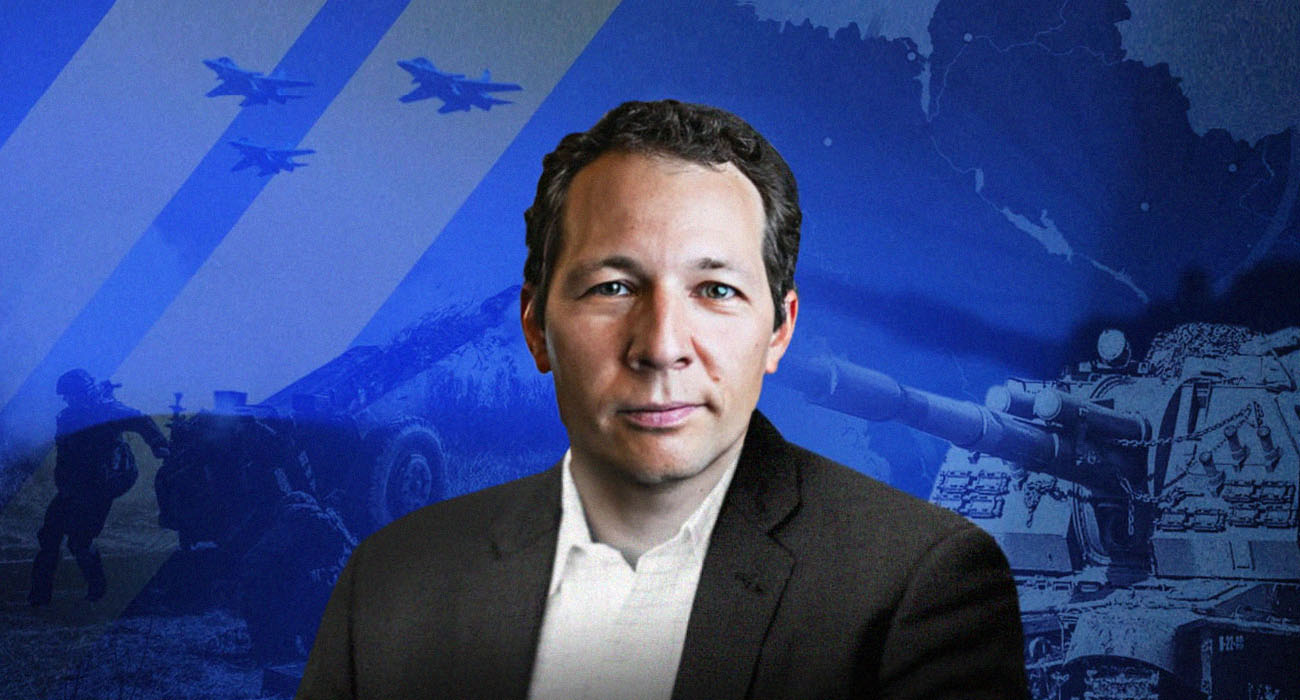
Oleg Itskhoki
Evgenia Albats*: Russia launched a full-scale invasion of Ukraine on February 24, 2022. The war has been going on for three years and 8 months. There were all sorts of forecasts, including this year, that the Russian economy would not last long. In May, for example, we saw that the Russian army was running out of "Kinzhal" and "Iskander" missiles. But in October 2025, in just two weeks, they exceeded the number of missiles sent to major Ukrainian cities in May many times over. This means that the Russian militarized economy is able to bear all these costs. Why is Putin enduring this war?
Russia is big and small
Oleg Itskhoki: As it turns out, many forecasts tended to exaggerate. When things got worse, they predicted it was a disaster. The situation is really bad, but not catastrophic. It cannot be said that it is stable and will remain so forever, but there are no obvious signs that the deterioration of the economy can stop the war. So, in principle, it can continue for quite a long time.
The first question to ask is: Is Russia a big or small country?
There is no doubt that Russia is a big country. It is in the top 10 in terms of the size of the economy, by current GDP in dollars. And in terms of GDP per capita, Russia is still a developing country. Or, let's say, an emerging market, or a catching-up economy.
But in terms of overall size, it is a big country. Nevertheless, there is a difference between big and very big. Here is a simple comparison of different countries by GDP size. The US and China are the largest, the European Union is as big as the US. Russia is about 10 times smaller than the US, China, or the European Union. It is smaller than Canada and even smaller than the state of New York in terms of GDP per capita, New York is the third largest state in the US.
Russia has a lot of nuclear weapons, which may limit the military solution to the problem. But given the size difference, why is it so difficult to solve the problem with economic tools? That is why there was a lot of hope that sanctions could be a powerful tool to stop the war. And the war has been going on for almost four years. And obviously, it hasn't worked.
Russia's war spending is between 150 and 200 billion dollars a year. This is the size of the Ukrainian economy before the war
What is worth noting is that Ukraine is 10 times smaller than Russia. And Ukraine had huge economic problems due to the war. GDP was destroyed. A significant part of the country is occupied. But even if you take the pre-war GDP, if you take the figures that Russia spends on this war every year, it is roughly equal to the size of the Ukrainian pre-war economy. That is, Russia's war spending is between 150 and 200 billion dollars a year. This is the size of the Ukrainian economy before the war.
We summarized the history of sanctions against the Russian economy since 2014, since when the war essentially began. Then the second wave of sanctions from 2022, when the full-scale invasion began. One point of view is that if the problem is military, then the solution can only be military, and trying to pretend that there is an economic solution to the problem may be foolish. This was the complacency of Europe (to some extent the US, but mainly Europe) - trying to think that there are ways to solve this problem without really understanding that it can only be solved by military means.
Of course, if there is a solution that does not require military means, it is probably preferable. But so far, what has been done economically has not played its role. At the beginning of the war, we said that Russia would run out of missiles, given the scale of their use. Now Russia produces more missiles per day than it uses. In three years of continuous war, it has essentially built a military economy.
Meanwhile, Europe has not done this. The US has withdrawn from the conflict, which, in my opinion, is short-sighted, but the US can afford it, they are far away. And for Europe, this is an abnormal result: at a time when Russia and Ukraine have increased military production, Europe, which is right here, nearby, is doing nothing. Even if this war ends, Russia will continue to produce drones and weapons. And this is a problem for Europe that needs to be addressed sooner rather than later. We see that it is starting some military investments. And given the difference in the size of the economies, this is obviously not going to be such a big problem. We remember the times of COVID, when all resources were thrown at solving this problem. If you can set up vaccine production in one year, obviously, you can set up drone and weapon production in one year. And this is part of the military solution that Europe has completely overlooked.
Many wealthy countries during COVID used their resources to support the population. Putin was very fiscally conservative and did not use resources on a large scale, preparing for something more important than the pandemic. This became clear in hindsight
In 2022, the whole world, including Russia, was emerging from the pandemic. But Russia had been preparing for years, if not specifically for this war, then for some other events of this scale. There was a big contrast between the Russian economy and Putin's time in power compared to many other emerging markets and developing economies: for Russia, it was a period of great fiscal conservatism, with a budget surplus, a current account surplus. The Russian budget was designed to break even at $40 a barrel. Oil prices were sometimes lower, but usually higher than $40 a barrel. So when they were higher, resources were accumulated. And when there was a temptation to use resources, particularly during the pandemic, when many wealthy countries used these resources to support the population, Putin was very fiscally conservative and did not use resources on a large scale, preparing for something more important than the pandemic. This became clear in hindsight...
What ensured Russia's macroeconomic stability? It had no large debt. It had a large amount of foreign exchange reserves, partly in the Central Bank, which were frozen, partly in the Ministry of Finance, which had a Stabilization Fund, which is now being used. And this is the result of the previous
15 years of very responsible fiscal conservative policy, which most other countries did not have.
And an interesting question arises: is Putin really such a responsible leader who did this out of the conviction that macroeconomic stability is necessary?
I think it was a kind of populism that was possible given the good macroeconomic conditions for Russia as a major oil exporter with very high oil prices. Oil revenues were high. And this is the main reason why the war lasts so long: Russia approached 2022 in very good economic shape.
What I usually like to say in such cases: it is much better when developing countries with authoritarian regimes do not have macroeconomic stability because it prevents them from starting wars. Having macroeconomic stability is what makes it possible to start a war and sustain it, as we see now, for a long period of time.
The full force of Western sanctions led to an economic downturn in 2022, followed by a fairly rapid recovery, growth, and then a transition to a military economy
Right now, Russia is balancing on the edge of a recession. Most sectors of the economy are in recession. And there are a few sectors related to military production that are still growing. The current IMF forecast, which is always conservative in predicting recessions, estimates growth this year at 0.6%, less than one percent. And there is a possibility that it will be revised to a negative value by the end of the year. This is an economic slowdown that has been going on for about a year. The forecast for next year is about the same. But it is important to emphasize that a slowdown is not an economic collapse. It is not a crisis. It is just a slowdown.
The full force of Western sanctions imposed in 2022 led to a decline of only 1.2%, followed by a fairly rapid recovery, growth, and then a transition to a military economy. This is the year when Saudi Arabia, for example, grew by almost 8%, because the feature of 2022 was extremely high energy prices. And Russia would probably have grown by 5 or 6 percent. And instead, there was a decline. This was a significant effect, sanctions played their role. They "cut off" a large part of the growth, turning it into a decline. But it was not enough to stop the war. And this is what I am talking about: sometimes, maybe, economic means are simply not enough. It may be short-sighted to think that economic sanctions alone in the world we live in can solve all problems. I think this is a big question for reflection outside the context of Russia and Ukraine. We are just moving into a world that may look very different from the one we are used to.
The impact of sanctions can be seen if you look at the figures for Russian imports and exports. The reduction in imports occurred over a very short period, sanctions were in effect for about four months. After these four months in 2022, imports began to recover and returned to their previous level. On the other hand, we see a sharp increase in export revenues driven by high energy prices in 2022. The additional money earned each quarter from the difference between exports and imports is the trade surplus. Over the year, this was about 200 billion dollars. That is, essentially, the additional surplus from trade only in 2022, when the war had already begun, could pay for the next year of war, 2023, without using any reserves. And this is important to keep in mind because the mindset at the time was: if you impose sanctions on imports and do it well, together with financial sanctions, it might be enough. But if the state is a major exporter of raw materials, when it starts a war, it pushes up energy prices, and this is a mechanism that instead of punishing the country for starting a war, compensates it for the restrictions with additional oil revenues. So financially, the sanctions failed to limit the amount of resources that Putin had. But it is important to note that Europe did not actually impose an embargo on Russian energy until the end of the year. So Russia had a whole year to adapt before it faced more important restrictions. Russia could not buy luxury items from Italy, but it could sell energy resources to Europe. And this was probably the most important economic missed opportunity for the coalition of Western countries and Europe in particular.
Just two months before the war began, Europe was buying more than half of Russian oil. I think economists underestimated how quickly substitution could occur. In Europe, there was an industrial lobby that said substitution would kill European industry. But by the end of the year, Russia managed to redirect exports to other destinations, particularly to China. China began buying about half of Russian oil. India became a completely new buyer that did not exist before the war. And Turkey became a significantly larger buyer. And thus, between China, India, and Turkey, most of the Russian oil was placed. The same happened in Europe. Europe managed to find a replacement for Russian gas fairly quickly, and this suggests that if there are large economic forces behind it, everything adapts, and politicians should take this into account. But if there are no economic forces behind it, that is, no one is investing money in expanding, for example, military production, it will not start on its own. It requires conscious policy.
Were the sanctions, and in particular the American sanctions, successful?
The irony is that the sanctions kept the volume of Russian oil very stable. American politicians were concerned about how to reduce Russian revenues without reducing the amount of Russian oil on the market so that oil prices would not rise? And if there was one success of this policy, it was that the volume of oil exports remained stable - about 8 million barrels a day.
And so far, Russia exports the same amount in quantitative terms. What is changing is the price of oil.
In 2022, at its peak, oil was about $120 a barrel. Now the price has actually returned to the pre-war level, to 60. What needs to be remembered? Before the war, Russia had a balanced budget at $45 a barrel. Now it cannot have a balanced budget at 60. This is a serious change. First, there is no longer a budget surplus. Before the war, the ruble was stronger. The ruble is one of the tools in the hands of the Russian government, this should be kept in mind. If oil prices fall, you can expect the ruble to depreciate. Since many domestic expenses are denominated in rubles, this provides a buffer for adaptation that the Soviet Union, for example, did not use because it maintained a fixed exchange rate. But for Russia, this is one of the tools that can and will be used if oil prices continue to fall, and this significantly expands the fiscal capabilities of Putin's government both for waging war and for financing domestic expenses.
How to stop the crisis
Given the initial positions, namely the absence of a budget deficit, the Russian government had enough tools to stop a potential crisis.
But what we have observed since then is a period of inflation, which the Central Bank is trying to fight with a very high interest rate. It has been lowered three times, but it still remains high and does not slow inflation to the target level.
What does the high interest rate reflect? This is another rather crazy picture of what the military economy has done to Russia. It is a combination of many factors. Many people have left the country. Many people have been drafted into the war, many people are employed in military production. The unemployment rate is at a completely unnatural level. No market economy has an unemployment rate of 2%. And what is really happening: the Central Bank is trying to fight the expansion of aggregate demand with a high interest rate, but the government continues to pump budget resources into the economy, into the military sector. As a result, it is difficult for the Central Bank to slow the economy to a normal level of inflation and a normal level of unemployment. And this is the first big problem.
It should be understood that inflation is not what will stop the war. What can stop the war is a serious budget problem. And what we have observed over the past year, already a little over a year, is the presence of budget problems. The situation is unstable, but this does not mean that the economy will collapse today, tomorrow, or in six months. These are the sizes of the budget deficit that can be maintained for quite a long time. And there will be small adjustments in many areas.
VAT will be increased, but a 3% increase is not what will stop the war. There may be more inflation, not 8%, but 12%. The ruble is likely to depreciate. All this increases the fiscal space for the government. There will be some other types of taxes. But we are not talking about a budget problem that will end the war and make it impossible.
What is more important: even if there is a ceasefire or the likelihood of a ceasefire, it does not seem that Russia will cease to be a militarized economy. I do not think that the end of the war will end the budget deficit. The budget deficit will remain. There will be small adjustments here and there in the economy, but military production in Russia will continue. And therefore, it seems that Europe has no other solution but to increase its military production, at least to keep up.
Priorities need to be updated. Economic tools, contrary to expectations, turn out to be much, much less powerful and unable to stop the war
Obviously, the war is completely destructive for Ukraine. But it is also destructive for Russia. And this is not measured in percentages of economic growth. It is not about whether there will be 4% growth in one year and a 2% decline in another. It is about what the war does to the country's population. This is a million killed and wounded in four years, which is an order of magnitude more than in the Afghan war, which lasted 10 years. The common opinion was that the war in Afghanistan in the 80s was one of the reasons that ended the Soviet Union. But Putin is enduring losses an order of magnitude greater.
Another problem is demographic. It is not only Russian. Everywhere in the world, the share of people over 60 years old will soon exceed half of the population. But Russia is now pursuing a completely insane policy of destroying people aged 20-30 years, and therefore those who will not be born as a result of the war. And in the long term, this is probably the main consequence of the war. This is what will manifest in decades and become a serious cost for the country in the future. But nothing we talked about, nor this forecast, gives hope that the economy or some other non-military problems will stop the war. And therefore, the war continues.
I think we need to update our priorities. Economic tools, contrary to expectations, turn out to be much, much less powerful. And ultimately, this is a war of attrition, partly economic, but largely military. And it will end with some negotiations because one of the parties will not be able to endure it on the battlefield. Probably not because of the economy.
Ukraine is heavily dependent on the West in terms of financial resources. But this is a big problem for Europe, which does not have fiscal capabilities. And as a result, a big question arises as to whether economic aid to Ukraine will continue. Everything I say makes sense if we assume that aid will continue. There is a big question about frozen assets, how they will be used. But if we assume that economic aid to Ukraine will continue, then there is no such economic situation in Russia that will put an end to it. The end will come when there is a complete stalemate on the battlefield. And this, I think, is the assessment that can be given, given the current state of affairs.
War in Europe
Evgenia Albats: People who came from Kyiv say that there are many Western military specialists there preparing for a future war in Europe. There is an expectation that Putin will start a war in Europe. And essentially, he has no other choice, according to some experts. A year ago, you talked about the fact that the United States could produce much more oil and bring it to the market. And this was possible if there was a government decision to export much more oil and subsidize some shale oil because shale oil companies are unable to maintain production if the price does not exceed $70 a barrel. If oil prices fall significantly below 60, it will not be profitable for the US to even maintain current oil production levels.
Oleg Itskhoki: True. Therefore, the strategy should be to keep oil prices high enough, at least at the level of 60, while replacing Russian oil with other oil - American or oil from the Persian Gulf countries. There is a scenario in which the US is not interested - when oil prices collapse. If there is a global recession, a slowdown in growth in China, a slowdown in growth in the US, - this will push prices down. But this will not be a conscious US policy because it would lead to the collapse of the oil sector. However, there are events in the world economy that can lead to this. And if Putin's government was ready for this before the war, it had all the resources to smooth out such a collapse, now it will not be ready for it.
There is a more organic situation when oil prices remain around 60, but Russia is gradually being squeezed out of the Indian market. Perhaps from Turkey. Unlikely from China. This can have consequences. Replacing 10-20% of Russian oil will exacerbate economic problems, make the situation less stable.
Evgenia Albats: Can the Trump administration force Europe to impose tariffs on imports from China that will become a fund for Ukraine's victory?
Oleg Itskhoki: Many of these things can have an effect, and all of them need to be done. But none of them is a decisive tool.
Evgenia Albats: 40,000 losses in Afghanistan were a big problem even for such a very consolidated authoritarian country as the USSR. It was assumed that as soon as the losses in the Ukrainian war reached 100,000, it would become unbearable for Putin's Russia. Now, according to Western intelligence, this figure is already much higher. And this does not put an end to the war.
Oleg Itskhoki: If a million losses did not do it, then it is hard to expect that economic sanctions on the periphery, which eat up 10%, 20% of Russia's economic ability to wage war, will do it. This is just a problem of a different order. Therefore, the attempt to find an economic solution contrary to this fact was too optimistic.
Evgenia Albats: A recent report suggests that the United States may go for a regime change in Venezuela. Venezuela was once the third-largest oil supplier on the world market. If Venezuela returns to the oil market, do you expect oil prices to fall?
Oleg Itskhoki: I am not an expert on the oil market, but the common opinion is that sanctions can only be imposed against one or two of the three countries - Venezuela, Iran, and Russia. Sanctions cannot be imposed against all three. So if Venezuelan and Iranian oil appears on the market, they will displace some Russian oil.
75-80% of Russia's exports are natural resources. So the tougher the sanctions on exports, the closer the trade balance deficit. But so far, there is none. A very decisive shift in the oil market is needed to change the situation
Evgenia Albats: Do you think Putin will be able to replace oil revenues with something else?
Oleg Itskhoki: Oil and gas were the two key sources of revenue. The less these sources of revenue, the more pressure on the fiscal situation. There is nothing to replace them with.
There is no industrial production to speak of. Russia still has a trade surplus. However, oil and gas are not industrial goods. 75-80% of exports are natural resources. So the tougher the sanctions on exports, whether prices or volumes, the closer the situation will be to a trade balance deficit. But so far, there is none. A very decisive shift in the oil market is needed to change the situation.
Evgenia Albats: One of the tools we discussed is the ruble. If either oil prices fall or the amount of oil that can be brought to the world market decreases, then the ruble will depreciate. We said that 100 rubles per dollar is a kind of psychological barrier. Putin did everything to keep the ruble below 100 rubles per dollar. Now it is somewhere around 90.
Oleg Itskhoki: He has a 13% depreciation in reserve that can be carried out before the dollar reaches 100. And then, after reaching 100, it can be depreciated by another 20%, but this does not mean that at 120 rubles per dollar there will be a regime change in Russia. The situation for Putin in this sense is quite stable. If the policy of squeezing Russian oil out of the world market is successful, the ruble will reach depreciation faster. And this will be in addition to the current inflation and interest rate that we observe.
Evgenia Albats: Isn't it surprising that after four years of war, Putin still has potential? It's amazing that he was able to endure four years of war while maintaining the macroeconomic situation generally stable.
Oleg Itskhoki: He started the war with a big buffer. But it is no longer there. So any major economic event in the world economy of the order of the 2008-2009 financial crisis or the COVID pandemic could plunge the country into a serious recession.
But no one in the world economy will want to cause such an event to solve the problem of the war in Ukraine.
What is important and what matters is to make Putin look weak. What made Putin look weak? Prigozhin's rebellion. Ukrainian victory on the battlefields in 2022. Decisive sanctions. This is what can change the balance within the country.
Evgenia Albats: Looking back, do you think it was reasonable to impose sanctions against Russian oligarchs? Evgeny Chichvarkin, for example, a famous Russian entrepreneur who was expelled from Russia, says it was the biggest mistake because wealthy people were forced to repatriate money from the West.
Billions returned to Russia, and Putin received support from these business elites. As a result, the opportunity to create a real sustainable opposition against Putin was missed.
Oleg Itskhoki: I think economically it is completely unimportant. It is a matter of justice. One can argue that individual sanctions were unfair in some cases. In other cases, they were insufficient. But I do not think it would have affected the overall macroeconomic conditions. It was easy to do politically. But for Europeans to stop buying Russian oil was difficult to do. Therefore, what was easy was done, and what was difficult was not.
What is important and what matters is to make Putin look weak. What made Putin look weak? Prigozhin made Putin look weak.
Foreigners did not support him, Russians in emigration, except Khodorkovsky, did not support him. This was a serious mistake.
The Ukrainian military victory on the battlefields in 2022 made Putin look weak. Decisive sanctions make Putin look weak. This is what can change the balance within the country. But starting from the moment he killed Prigozhin, he completely consolidated the situation in Russia and he no longer looks weak.
I will add that Prigozhin was not an accident, he was a reflection of the picture when thousands of people were dying a day. Prigozhin was popular because he reflected the discontent that thousands of Russians were dying daily. He consolidated this discontent.
It is surprising that after his death there is no one in Russia who would talk about this problem. There is no anti-war movement, no consolidation of opinion that this is abnormal.
And individual sanctions... Who cares about them, except for those who are affected and who find them unfair?
Evgenia Albats: I understand your point about the absence of a Russian anti-war movement. I just want to remind you that after the war began, more than two million Russians left, but then, according to Professor Auzan, the dean of the Faculty of Economics at Moscow State University, about 640,000 returned because they could not find work in Europe, could not get residence permits. But the most important thing that Putin did was he imprisoned everyone capable of street politics. He put them in prisons. He killed Alexei Navalny** in an Arctic colony, who could energize people with resistance and bring them to the streets. We see people being jailed even for performing banned songs. People are mortally afraid: we have not seen such sentences in Russia as now - 15 years, 20 years, 25 years. The number of people convicted for "treason" is comparable to the number of people convicted for supporting Trotsky in 1937-1938. And the label of "foreign agent" deprives people of political and social rights.
My last question. Informed people in Moscow say that Putin really needs a break, that he himself was looking for some kind of ceasefire because continuing the war in Ukraine requires serious resources, otherwise he will have to start mobilization, and he is afraid of it. Therefore, he is playing a game with Trump because the Kremlin believes that Trump can convince the Ukrainians, Zelensky, to make serious concessions. Do you consider it dangerous to give Putin a break in the form of a ceasefire? So that he can prepare for a big war in Europe? Or is he just bluffing, pretending that he can continue this war forever?
Oleg Itskhoki: Well, obviously, things are not so bad since he ignored the negotiations in Alaska. Maybe he is pretending very well. But when things get bad, we will see it too. It is important to understand that in authoritarian regimes, like in Russia, there are many hidden states, hidden, unobservable things. We do not know what is really happening in the economy - things may be much worse than we see, or things may be perfectly fine, and only some crisis event can reveal these unobservable things.
So it is quite possible that he is starting to hit the limits. It does not seem that the limits are precisely economic because when we talk about the orders of magnitude of economic problems, it is a couple of percent of GDP. Again, it is unpopular to raise taxes. It is unpopular to cut pensions. But if people are satisfied with the war, they will be satisfied with the reduction of the real purchasing power of pensions. And this is not what will stop the war. Therefore, I do not think the situation is critical.
As for the ceasefire, there is no chance that it will change the military nature of the economy. Maybe they will not have to spend 150 billion dollars a year, but they will spend 100 billion dollars and will produce missiles, drones, etc.
The only other country that produces weapons on a comparable scale is Ukraine now. And I think there is an understanding in Europe, especially in Central and Northern Europe, and especially among military experts, that the problem does not disappear with a ceasefire. A ceasefire is very important for people who are dying on the battlefield, but it does not solve the problem.
The US has withdrawn from the war in Ukraine and does not want to be an active participant in it, which in my opinion is short-sighted. This is a big problem for Europeans - and it is not obvious that there is a solution to it. It is a kind of stalemate.
Reference
Oleg Itskhoki is a Doctor of Economics, Professor at Harvard University. He graduated from Moscow State University, holds a master's degree in economics from the Russian Economic School. Before joining Harvard, he held the chair of economics at the University of California, Los Angeles (UCLA) and was a professor of economics and international relations at Princeton University. In 2022, he was awarded the John Bates Clark Medal, the most prestigious award for economists under 40. Included in the list of 25 influential economists under 45 according to the IMF.
Video version
* Evgenia Albats, Oleg Itskhoki are declared "foreign agents" in the Russian Federation.
** Alexei Navalny is included in the list of "terrorists and extremists" by Rosfinmonitoring.
Photo: echofm.online.