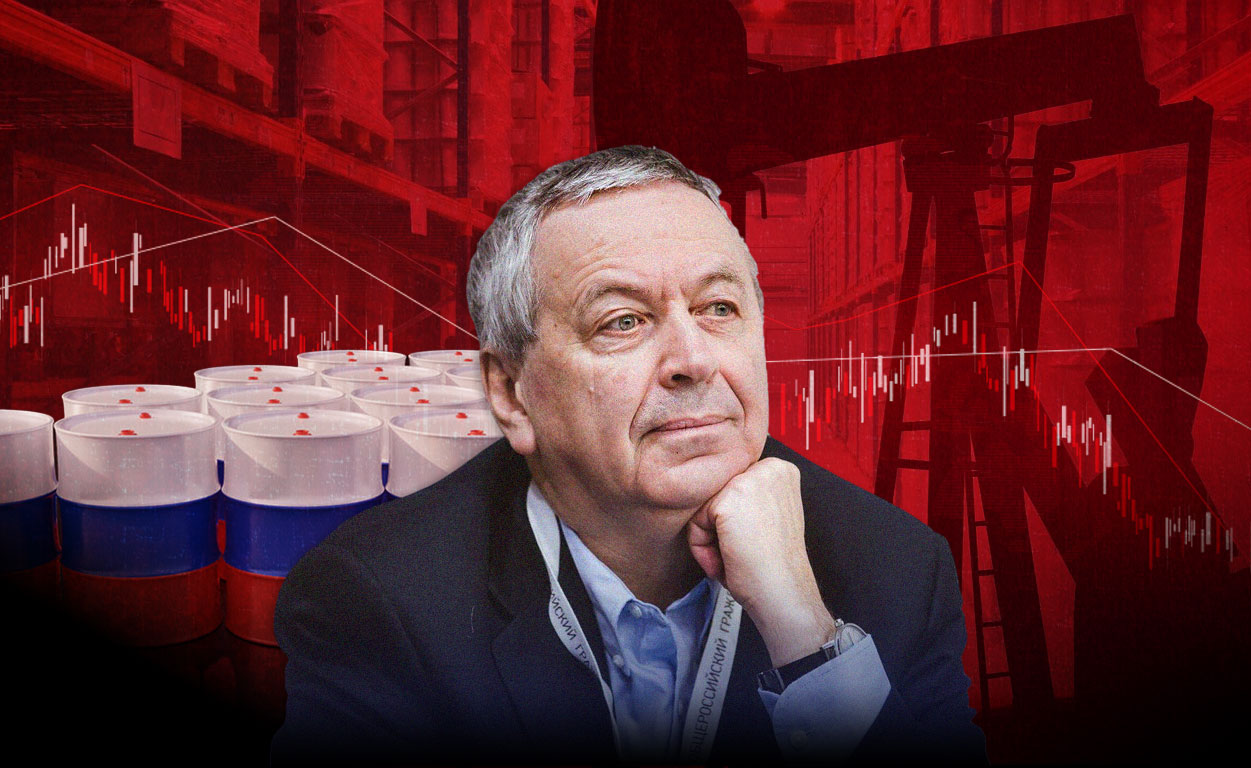
Yevsey Gurvich
Yevgenia Albats*: The main news of recent days is the clash between Donald Trump and Vladimir Putin. As you remember, everyone was initially preparing for a new summit in Budapest. But after Marco Rubio, the US Secretary of State and the President's National Security Advisor, spoke with Russia's Foreign Minister Sergey Lavrov, he explained to Donald Trump that Putin was not ready for any compromises. And then Donald Trump announced that there would be no meeting in Budapest. Instead, he imposed sanctions against two leading Russian oil companies - "Rosneft" and "Lukoil". In addition, secondary sanctions were imposed against banks and organizations that would buy Russian oil, primarily state companies in China and India. Moreover, Trump reacted sharply to Putin's threats related to the "Burevestnik" missile test. This is, of course, a new round of escalation and threats. From an economic standpoint and considering Russia's current situation, what effect could this have?
Yevsey Gurvich: Such spikes in tension have occurred before, when there was an exchange of remarks between Dmitry Medvedev and Donald Trump. This can affect short-term indicators such as stock market fluctuations, which always react sharply to current events. But from a fundamental perspective, I don't think this will have long-term and serious consequences.
Effect of Sanctions
Yevgenia Albats: So this will not affect the situation with Russia's economy? Why am I asking this question - because such threats and exchanges of remarks should probably somehow influence Putin's main allies: China (we know that Donald Trump will meet with Chairman Xi during his Asian tour) and India, which has become the largest consumer of Russian oil.
Yevsey Gurvich: They may have an impact. But I am not a political scientist, I do not undertake to assess how significant, substantial, and long-term this impact will be. Speaking of the economy, here we can expect short-term impacts on the dollar exchange rate in the Russian market, on the stock market, but probably not much else.
Russia adapts to external sanctions. That is, they work for a while, but then learning occurs, and they begin to be circumvented
Yevgenia Albats: What does the imposition of sanctions against "Rosneft" and "Lukoil" mean?
Yevsey Gurvich: This means that the US has prohibited its companies, and the European Union simultaneously introduced similar sanctions, prohibiting their companies from buying oil from these companies and their subsidiaries, prohibiting them from lending to them, and freezing the assets of these companies and their "subsidiaries." The main restriction is that it is prohibited to buy oil from these two companies. If the ban is enforced, the effect will be significant, as these are two leading companies in Russia, accounting for more than half of the oil production. Another question is how well the embargo will be enforced. Our colleague Sergey Aleksashenko* has already expressed doubts about how easy it will be to control compliance. He immediately cited two ways to circumvent these sanctions. The first way is for these companies to start supplying oil only to the Russian market, and the part of the oil they exported will be replaced by other companies, albeit not as large, which together account for 45% of production. The second, more traditional option is deliveries through several intermediary firms, which can be located in different countries, in different jurisdictions, and therefore are quite difficult to control. I can add that we have long been analyzing the effect of international sanctions against Russia with colleagues, since 2014, when the first serious sanctions were immediately introduced after the annexation of Crimea, including restrictions on financial markets, on external markets. And the general conclusion is that adaptation occurs to external sanctions. That is, they work for a while, but then learning occurs, and they begin to be circumvented.
Let's not talk about the past, let's take the latest sanctions that started in 2022. The most serious ones are against oil exports, which are currently being discussed in the new series. These sanctions can operate in two directions: either reducing the physical volume of exports in tons or lowering the price, meaning a discount compared to other oil brands. Speaking of the volumes of oil and oil products exports, the change here is very small: over 4 years, including the current year for which there are preliminary estimates, the export volume decreased by about 3%. This is not a very significant effect, it is also sensitive, considering the large role of oil exports in our economy and especially in the budget, but still not decisive. Sanctions had a much greater impact on prices. In 2021, Russian oil was traded on the world market at $2 cheaper than Brent. Immediately after the sanctions were introduced in 2022-2023, it was already sold much cheaper, at $18-19. That is, additional losses, $16-17 per barrel, are very large losses. But after that, the discount began to decrease. In 2024, it amounted to $13 per barrel, and this year, according to preliminary estimates, it will be about $11 per barrel. The only explanation I see is that paths are gradually being laid that allow circumventing sanctions. And this is the general situation. I think that new sanctions will also have an effect for some time. But not so significantly as to completely stop the supply of oil by these companies to the world market. Then their effect will also begin to fade. The effect will be there, but not deadly for the Russian economy, as some experts currently believe.
Yevgenia Albats: The English-language press, including the economic one, writes that this will be a serious problem for the Russian economy, considering that more than 40% of the budget, and taking into account hidden expenditure items, most likely up to half of the budget goes to the goals of the war in Ukraine, to the military-industrial complex, and to special services. According to your estimates, what percentage of Russian budget expenditures on the war comes from the sale of energy resources?
Yevsey Gurvich: This is not quite an accurate question, since the budget operates on the principle of a common fund, that is, everything is pooled, everything goes into the budget.
Yevgenia Albats: But how important are oil, oil and gas revenues for the Russian budget?
Yevsey Gurvich: Their significance is gradually decreasing. There was a period when oil and gas revenues accounted for more than half of the federal budget. Now oil revenues are already less than a quarter of the federal budget. Oil and gas revenues are decreasing as a percentage of GDP because oil export volumes are slowly but falling. In addition, as I said, there was a discount on oil related to sanctions. Therefore, these revenues have decreased. Raising taxes is precisely an attempt to support, not allow too much of an increase in the budget deficit when oil revenues are simultaneously falling and expenses are increasing.
Who will replace Russian oil?
Yevgenia Albats: I will return to my original question. "Gazpromneft," "Surgutneftegaz," "Rosneft," and "Lukoil" are now under sanctions. That is, the four largest Russian companies. How ready are China and India to give up Russian oil? And if they refuse Russian oil, where will they get another?
In the near future, it seems, an obvious surplus of oil will form in the world. And therefore, from an economic point of view, it will become much easier to find an alternative to Russian oil
Yevsey Gurvich: I think there are always ways to circumvent the ban. From an economic point of view, completely giving up Russian oil until recently was impossible, unrealistic. But now the situation is changing.
Yevgenia Albats: How so?
Yevsey Gurvich: This year, oil production in the world has increased for two reasons. First, OPEC, OPEC plus, including Russia and other joined countries, increased production limits. They significantly increased production. And simultaneously, several non-OPEC countries expanded production. These are primarily the USA, Canada, and Brazil. In total, this led to the fact that production now significantly exceeds global oil consumption. But this has not yet affected the price. Usually, when there is an imbalance of supply and demand, the oil market reacts very sharply: if there is a deficit, prices soar, if there is an excess of oil, they fall sharply because stocks have increased. It is assumed that most likely China was increasing its strategic reserve, and it does not publish its data, so this is just an assumption, but the most plausible one. However, China is unlikely to endlessly increase reserves, so in the near future, it seems, an obvious surplus of oil will form. And from an economic point of view, it will become much easier to find an alternative to Russian oil.
Yevgenia Albats: Do I understand correctly that the imposition of sanctions is quite a lengthy process? Both "Rosneft" and "Lukoil" have contracts, and in order not to incur penalties for non-performance of contracts, they must somehow declare force majeure, which takes a month or two. So the real sanctions will be felt only at the beginning of next year?
Yevsey Gurvich: No, it seems to me that they are put into effect in a month.
Yevgenia Albats: When it was announced that sanctions were being imposed against "Rosneft" and "Lukoil," the oil price initially jumped, but then it seemed to return to previous values. What is happening in the oil market?
Even if the discount compared to Brent remains the same as it was this year, the price of Russian oil will fall to $40 per barrel. And in conditions of an oil surplus, the discount is likely to increase
Yevsey Gurvich: When sanctions were introduced in 2022, world oil prices soared. And for Russia, this more than compensated for the losses. That is, the side effect of the sanctions exceeded the negative direct effect. But now the situation, I think, is different. The direct negative effect of the new sanctions will be limited, but objective processes not related to sanctions will most likely cause a sharp drop in oil prices. Global oil production has increased, which is temporarily going into stocks, and according to forecasts, the market will balance next year, leading to a sharp drop in oil prices. This year, Brent oil costs about $70 per barrel. The American Energy Agency released a short-term forecast in October for the end of this and next year, and they predict that Brent prices will fall by a quarter next year.
Yevgenia Albats: So to $50?
Yevsey Gurvich: Yes, from $70 to $52. Precisely because production has increased. This can seriously hit the Russian budget and the entire economy. Even if the discount compared to Brent remains the same as it was this year, the price of Russian oil will fall to $40 per barrel. And in conditions of an oil surplus, I think the discount is likely to increase because when there is an excess of oil, there is no need to risk falling under US secondary sanctions, and a much larger discount will be taken for the risk. Therefore, the price may be below $40 per barrel.
But there are different forecasts, say, the IMF does not expect such a sharp drop in oil prices. Only the American Energy Agency predicts this. But once I conducted a detailed comparison of forecast accuracy with colleagues, that is, based on many years of data, we compared who predicted what and what actually happened. And we concluded that it is the American agency that gives the most accurate forecasts, much more accurate than the IMF and the World Bank. Therefore, I trust their forecasts. I believe there is a high probability that this is exactly what will happen.
Negative Growth
Yevgenia Albats: What is the critical price per barrel of oil for Russia?
Yevsey Gurvich: I don't think there is a specific price that is critical. I can say differently, that since 2000, the price of Russian oil has only fallen once - during COVID, when it was $40 per barrel. And this was quite sensitive for the Russian economy. If the forecast is realized, it will be a blow to economic activity. That is, the growth that the government estimates for next year at 1.3% (the IMF gives slightly less - 1.1%), I think, will go into the negative, meaning instead of growth, we will get a decline.
Yevgenia Albats: And growth due to the military industry, do I understand correctly?
Yevsey Gurvich: The Center for Macroeconomic Analysis and Short-term Forecasting estimates a decline in civilian industrial output by 5% this year compared to last. So yes, the small growth that remains is ensured by the production of weapons. And the budget will significantly lose revenues, and expenses will probably have to be slightly increased, since with such sharp declines, someone will need additional support. Therefore, if this year's budget deficit is estimated at 3.2%, then with such a drop in oil prices, it will exceed, in my expectations, 5% of GDP. It will exceed the level of 1998. You remember what happened then.
Yevgenia Albats: The financial crisis, August 17, 1998.
Yevsey Gurvich: Yes, when against the backdrop of a large budget deficit, oil prices simultaneously fell.
Yevgenia Albats: Then explain. You started by saying that sanctions against "Rosneft" and "Lukoil" will not have a serious impact. And ended with the fact that oil prices will fall by about a quarter. Either the sanction has an effect, or the sanction does not have an effect?
Yevsey Gurvich: I will repeat again, I think there is a high probability that the scenario predicted by the American agency will be realized, but it is not related to the sanctions against Russian oil. It is related to the fact that most oil-producing countries have increased production this year.
Yevgenia Albats: But they increased production not just like that. Donald Trump met with the leadership of Brazil and made it clear that he was ready to lower tariffs if Brazil pursued an economic policy beneficial to the United States of America. On the same day that sanctions were imposed against "Rosneft" and "Lukoil," a high-ranking representative of Saudi Arabia was spotted at the White House. We both read the brilliant, in my opinion, book by Yegor Gaidar "The Collapse of an Empire," where the mechanism that led to the bankruptcy of the Soviet Union was shown: in 1984, the Americans managed to agree with the Saudis to increase oil supply to the market, resulting in oil prices collapsing, and the Soviet Union ran out of money. How will it be now?
Yevsey Gurvich: First, this is just an assumption about what Trump talked about with the Saudis, what exactly was meant by these discussions. It is the job of political scientists to interpret this. I generally do not like such conspiracy theories. I am not even very sure that in the mid-80s there was indeed an agreement between America and the Saudis to increase production and collapse oil prices. This, first of all, is not beneficial to them. They themselves faced serious difficulties. I believe more in purely economic interests, in economic logic. It seems to me that mainly for economic, fundamental reasons, different countries - the OPEC group for their reasons, America for theirs - increased production. It does not seem to me that America's main problem is Russia. I have no doubt that for the Arab countries of the Persian Gulf, this is also not the main problem. I think they have many other considerations and interests. Therefore, it is very likely that oil prices will fall, and this event will have very serious negative consequences for Russia as an oil-producing, oil-exporting country.
What is expected next year can be compared to the 1998 crisis. That crisis was also quite deep and had political consequences
Yevgenia Albats: But do you allow the possibility of events developing as described by Gaidar? Or has Russia's market economy turned out to be so flexible that it easily survived what the Soviet economy could not?
Yevsey Gurvich: No, I do not think it will be an easy walk for the Russian economy, but still, I would not compare it with the events described by Gaidar in "The Collapse of an Empire." If we delve into history, the fall in oil prices allowed Gorbachev to start perestroika. This was probably an argument: we lived off oil prices, revenues from its export, but now prices have fallen, and we need to reform our economy so that it does not depend on oil exports. Then there was a serious gap between the start of perestroika and the collapse, the disintegration of the empire. During this gap, not very successful economic reforms were carried out, and I would not blame Gorbachev and his advisers for this, among whom were very authoritative, respected economists, probably the best at that time. I think it was determined by the fact that problems that had accumulated for many decades were trying to be quickly solved when a window of opportunity opened. Well, maybe by that time the system was no longer subject to repair, but could only be completely changed, as happens with cars, and sometimes with people. Therefore, it seems to me that what is expected next year can be compared more to the 1998 crisis. That crisis was also quite deep and had political consequences.
Repetition of the Past
Yevgenia Albats: The 1998 crisis is primarily the collapse of the GKO market, government bonds, right?
Yevsey Gurvich: That was the core of the problem. But this was followed by the devaluation of the ruble, a surge in inflation. Prices rose five times, and as a result, salaries and pensions were devalued. That is, the real level of salaries decreased by a third over two years, the real level of pensions by 40%. Then there was the bankruptcy of banks, so it was a very serious crisis. I am sure that it also had political consequences, although the empire did not collapse. But there are many analogies. Yes, $40 per barrel is not $12 per barrel in 1998, but it should be taken into account that during this time the dollar has halved in value. That is, $40 now is $20 in 1998. Still much more, but still comparable. Further. GKOs were short-term securities, borrowing had to be done a lot, not only to conduct new borrowings but also to borrow to repay previous ones, so the government could only borrow very expensively. If now a lot had to be borrowed, it could also only be done very expensively. In particular, because money is expensive now, the Central Bank's interest rate is high. And then there were no budget reserves at all, and foreign exchange reserves were minimal. Now there are budget reserves, but relatively small. The National Welfare Fund has about 2% of GDP in liquid assets, that is, what can be sold on the market and used to cover the deficit. But 2% is clearly not enough to solve the problems. Foreign exchange reserves, more than $300 billion, are frozen by Western countries. Therefore, there are many parallels with 1998. In principle, if this happens, there will be problems for banks, many companies will have problems servicing their debt.
Yevgenia Albats: Will banks have problems because companies will not be able to repay loans or pay interest on loans?
Yevsey Gurvich: In particular. Therefore, I would say that perhaps in a milder form, but something similar to the 1998 crisis is quite possible.
The main source of potential discontent for the population is rising prices. This is precisely the path that can have serious political consequences
Yevgenia Albats: There are two questions. The first is about the budget deficit. You economists say: what problems? You can print money, thus filling the budget. The second question is - Elvira Nabiullina ordered the Central Bank's credit rate to be lowered. Does this mean there is no fear of inflation?
Yevsey Gurvich: The Central Bank can always print money, but this will cause inflation, and inflation worldwide is what the population dislikes the most. In all surveys since 2000, when asked what problem worries you the most, rising prices have always been at the top. And in America, it's exactly the same. The main source of concern, potential discontent for the population is rising prices. That is, this is precisely the path that can have serious political consequences.
Yevgenia Albats: What kind? They imprison everyone. They imprisoned a girl who sang songs on the streets of St. Petersburg. Who will go out on the street?
Yevsey Gurvich: These are different things. One girl sings songs, but all Russian citizens go to the store, and they will all be dissatisfied. And it is impossible to imprison everyone. That is, this is a rather dangerous path, having serious negative consequences not only for the economy. As for Nabiullina, I think the Central Bank made a compromise decision. It is now under pressure, accused of high interest rates hindering economic growth, that they have already led to almost no investment growth, and therefore the Central Bank is seen as an enemy of the people in the eyes of both business and part of the political class. It seems to me that they went for a compromise, that is, they lowered the rate, but only by half a percentage point, this is not a very significant reduction.
Yevgenia Albats: But you do not expect the Central Bank to return to the practice of raising rates?
Yevsey Gurvich: If something sharply negative happens, the issue will be reconsidered taking into account the entire situation. This cannot be taken out of context.
Yevgenia Albats: Frankly, the forecasts are so contradictory... On the one hand, you talk about the possibility of repeating the situation of 1998 to some extent, when the Russian economy collapsed. On the other hand, the sanctions, which are a trigger for many economic processes in the oil and gas market, you, together with Aleksashenko, assess as insignificant.
Yevsey Gurvich: I did not say "insignificant," I said that this is not something that can have a decisive impact on the economic situation.
Yevgenia Albats: Aleksashenko and co-authors assessed the prospects of the Russian economy as generally quite favorable. A number of other economists, including Konstantin Sonin* and Oleg Itskhoki*, were quite critical of this work and this forecast. We will observe whose forecasts turned out to be more accurate. If your forecast or the forecast of the American Energy Agency turns out to be more accurate, then we hope that at least this will make Putin stop the war, which in January will have lasted as many days as the Great Patriotic War. Maybe at least this will make Putin curb his appetites.
Reference
Yevsey Gurvich is a renowned Russian economist. He graduated from the Faculty of Management and the postgraduate program at MIPT, candidate of physical and mathematical sciences. He has worked for many years in various Soviet and Russian research institutes. Head of the Economic Expert Group, member of the Public Council at the Ministry of Finance of Russia. Laureate of the Yegor Gaidar Prize, awarded by the Yegor Gaidar Foundation, "For outstanding contribution in the field of economics" (2014)
Video Version
* Yevgenia Albats, Sergey Aleksashenko, Konstantin Sonin, Oleg Itskhoki are declared "foreign agents" in Russia.
Photo: Wikipedia.