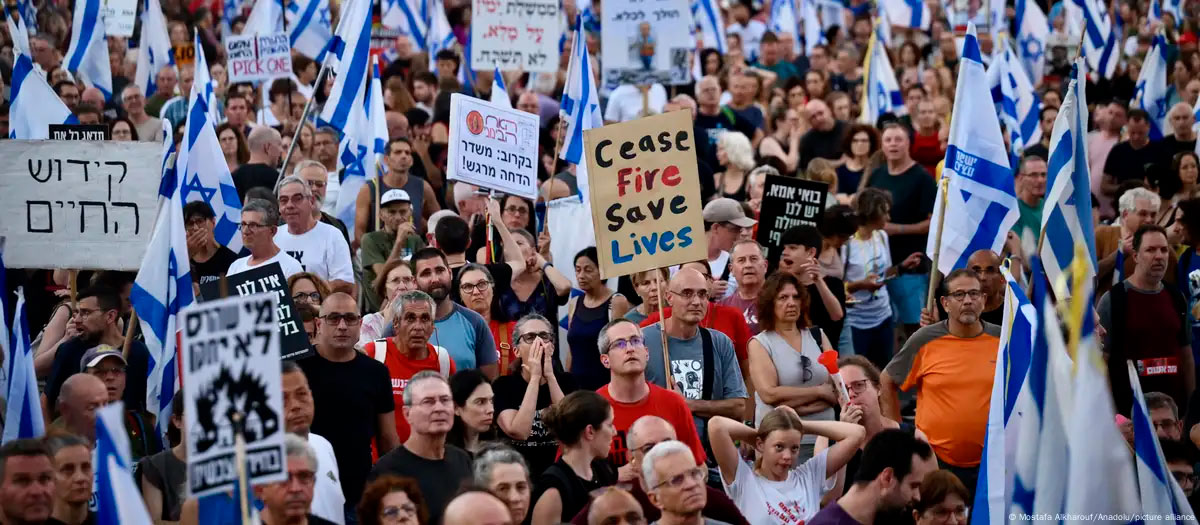
 Demonstration in Tel Aviv, June 22, 2024. Photo: Mostafa Alkharouf/Anadolu
Evgenia Albats*: September 23 — the beginning of the New, 5786 year according to the Jewish calendar. The outgoing year in Israel was a year of ongoing war in Gaza, a 12-day war with Iran, a fantastic operation to defeat «Hezbollah» in Lebanon and — practically a break with Europe. Even in the United States, where support for Israel is traditionally strong, at the 2025 Emmy Awards ceremony, famous actor Javier Bardem came in a keffiyeh and declared that he would not cooperate with those who support Israel. From the Emmy stage, there were calls to «free Palestine». After the past year with its protests against the war in Gaza, this is generally not surprising. In Tel Aviv itself, hundreds of thousands of protest demonstrations are taking place in connection with the Netanyahu government's decision to begin the occupation of Gaza, demanding a deal for the return of hostages.
Did the Netanyahu government have alternatives to waging war with Hamas, which carried out the massacre on October 7, 2023? What does the possibility of recognizing the Palestinian state at the UN mean? How would you characterize this past year?
An Incredible Year
 Marianna Belenkaya*: The year was interesting, I would even say — pivotal for both Israel and the entire Middle East. To the listed events, I would add the fall of Bashar Assad's regime in Syria. This is also connected with Israel. And just now, at the end of the year, an attempt to destroy the Hamas leadership in Qatar, an unprecedented strike on Doha, which changes the rules of the game in the region. And we were «pleased» by Israeli Prime Minister Benjamin Netanyahu, saying that Israel will have to get used to living in conditions of international, including economic, industrial isolation. He compared it to the times of Sparta. Inside Israel, there is turmoil, Israeli society is trying to understand what is happening with the state. And throughout the Middle East, the balance of power is also changing.
Israel demonstrated its incredible military capabilities and completely corrected the image that was largely lost on October 7. But from a political and diplomatic point of view, unfortunately, we have huge problems
 Mikhail Gurevich: This year was indeed a year of some miracles, some operations will go down in history and will be studied. From a military power perspective, Israel demonstrated its incredible capabilities and completely corrected the image that was largely lost on October 7. But from a political point of view, you know, I always remember what Kissinger said after the Six-Day War: that in 6 days the Jews disproved 2 age-old postulates — that they are bad warriors and that they are good diplomats. We continue to disprove this, we are excellent warriors, but as for the diplomatic and political echelon, unfortunately, we have huge problems, and we observe this every day.
After the successful completion of the 12-day war with Iran, we talked about opportunities, prospects for a breakthrough, about the resumption of the Abraham Accords, talked about Lebanon, talked about Syria. We again recalled the possibilities of signing normalization with Saudi Arabia. But today (September 15) in Qatar, the leaders of the Arab world gathered, and it seems to me that with our actions we are making incredible efforts to unite the Arab world, which is generally very difficult to unite, there are many internal contradictions. I remind you that in 2017 most Arab countries severed relations with Qatar, accusing it of aiding terrorism and cooperating with Lebanon. Today, however, all the leaders have gathered there and are ready to sign almost any declaration that Doha proposes. Egyptian President El-Sisi, speaking there, said that the Israelis themselves should think about what is happening because if this continues, then the strategic peace with Egypt may become a thing of the past. And today many Israelis were indeed shocked by the prime minister's statement that our perspective — is turning into autarky, that we must prepare for being isolated from the whole world. And this, in general, looks like a plan. Yesterday it still seemed like a terrible dream. Netanyahu later corrected himself, explaining that it was a discussion with the Ministry of Finance about the need to build underground military factories and that a lot of money is needed for this, so he was trying to persuade the Ministry of Finance leadership. But we heard what we heard. And it is difficult to abstract from this, it is very undesirable to get used to it and agree with it.
Undoubtedly, in Israel, the question will arise, who is to blame? Who is to blame for the fact that the war has been going on for two years, that from the Abrahamic agreements we have come to autarky, and that there is no end in sight. And frankly, what is happening today on the streets of Tel Aviv and other cities, it seems to me, is still a weak manifestation of the sentiments that prevail in society.
Doha Without Result
Evgenia Albats: Let's talk about what will happen with the Abraham Accords, the agreements with some Arab countries around Israel. What was the point of the strike on Doha? I understand they wanted to eliminate Hamas leaders. How successful was it? I understand that it is still unclear who exactly from the leadership was eliminated. Was it a response to the attack in Jerusalem? And from the perspective of the Abrahamic agreements, what was the strategic intent of the Netanyahu government?
Marianna Belenkaya: Yes, the result of the operation in Doha is still unknown. It was announced that six people died. Two people are more or less significant, the rest are guards. There are different versions, but the supposedly surviving Hamas leaders do not appear in public. What is the point of the strike on Doha? Undoubtedly, it is a demonstration that there are no longer safe places for terrorists. Until now, Qatar was untouchable as a US ally, as a country where an American military base is located. So essentially a US ally struck a US ally. And now everyone understands that nothing restrains Israel, the Americans verbally condemn the strike on Doha, but in fact, judging by everything, they did not strongly object.
Evgenia Albats: Will the strike on Doha force Hamas and «Islamic Jihad» in Gaza to return the hostages?
Marianna Belenkaya: There is no answer to this question. Some believe that the terrorists will be more accommodating. By the way, there were reports that some Hamas leaders in Gaza asked for the opportunity to leave the sector. Israel refused some, but allowed others. So there is a certain fear. On the other hand, people like Khalil al-Hayya are considered uncompromising and connected with Iran. And in general, Hamas understands that it has nothing to lose because neither the US nor Israel is ready to allow it to remain in Gaza. The question is how much the political leaders in Doha will now be frightened and how much they can influence those who are directly in Gaza.
As for the Abraham Accords, so far there have been no words about breaking these agreements. It is said that Israel's actions threaten the normalization process. For example, the level of relations between Israel and the Emirates is already decreasing. The Emirates refused Israel's participation in a military exhibition in Dubai, a very important regional arms exhibition. And economic ties, contacts are decreasing. But no one has said about withdrawing from the agreements. Although the situation is on the edge.
Evgenia Albats: As far as I understand, the Arab Emirates are generally very interested in contacts with Israel, as is Saudi Arabia, because Israel is a carrier of technologies, startups, which means oil-producing countries are trying to diversify their economy for the future and believed they could do this with the help of Israel. It seemed that there were absolutely rational reasons under these agreements. Is this now also breaking down?
Marianna Belenkaya: Indeed, everyone hoped for a new Middle East, Arabs and Israel have something to cooperate on — technology, military security, intelligence. Israel cooperated even with Saudi Arabia, with which no agreement is signed. And for two years
Unusual Autarky
Evgenia Albats: You mentioned autarky, but I observe hundreds of thousands of demonstrations in Israel, which is impossible in autarkies. There is an opposition press that sharply criticizes the government. Was there an alternative to waging war in Gaza? There is a clear task to destroy Hamas. But we see pictures from Gaza, we see that it resembles Bakhmut and other cities that the Russian army destroyed in Ukraine. Was there an alternative, Mikhail?
Mikhail Gurevich: It's not me talking about autarky, but the prime minister, and it can be economic, although it is usually accompanied by a political framework, and this is the danger, considering that we have parliamentary elections next year. Was there an alternative? It must be admitted that when October 7 happened, the first natural reaction was — to retaliate. Because it was painful, scary, dangerous, it was a threat to the existence of the state. And we had to show who is the master in the house. This is the desire of an ordinary citizen, an ordinary patriot, any person who understands how life is arranged for us in the Middle East, where, as they say, either you have dinner, or you are dinner. The same feeling arose after the operation in Qatar: we are now analyzing whether it was necessary, how it should have been done, etc. But at the moment when it happens, you say that it is fair. And the natural desire — is to move forward firmly to victory. The problem is that the government is distinguished from an ordinary citizen by the fact that having received the mandate of trust from the population, it must calculate, decide what and how it will implement, what the consequences will be. The people can only evaluate this implementation in elections, protests, etc. Now there is a certain consensus that in the first six months after October 7, probably whatever we did, it would have passed without significant protests from Europe. The Arab world could not have united as it is now. And in general, even President Biden could not put obstacles in the way. Our first problems appeared around February 2024. Before that, I remind you, the Prime Minister of Spain (who recently stated that it is a pity that Spain does not have nuclear weapons to stop the tragedy of Gaza) visited us with a solidarity visit and expressed support and understanding of the threat we faced. The first six months, without a doubt, you could do almost anything. Another thing is that it was necessary to combine military power with political. We came to the conclusion that we have military power, it should solve everything. But can you in principle defeat urban guerrilla warfare, which is Hamas, in two years, in three, in five years? History does not know examples. Perhaps we — we are a nation of startups — have some other unique solution. But we are now coming to the understanding that without political support, by military methods alone, it seems impossible to solve this problem. And whether it was right or wrong, unfortunately, it is too late to talk about it today.
The times are gone when the USA or the USSR said something, and everyone acted according to their word. Now Arab countries, especially Qatar, actively influence life in Europe and the USA
Evgenia Albats: Marianna, you were in Gaza. You reported from a base where food was distributed to the sector. This was shortly after fake footage of an extremely emaciated (actually, as it turned out, seriously ill) child went around the world. Nevertheless, you said in one of the interviews that at least 120 people actually died of hunger in Gaza. Prime Minister Benjamin Netanyahu said (or these words are attributed to him) that he doesn't care how Europe reacts, we are no longer Europeans, we are the Middle East, and here, in the Middle East, the law of the strong applies. Can Israel really afford to break with Europe? In the United States, after Trump, people who are not at all disposed towards Israel are gradually coming to power. Can Israel afford this?
Marianna Belenkaya: You know, no country can afford large isolation, although we see examples. I will not compare Israel with Russia, because these are economically and territorially completely different stories. Iran, North Korea... Of course, I don't want to put Israel in this row, nevertheless, for Israel, this situation is not new, it has gone through this since its founding. Another thing is that in a global world, where everything is intertwined, connected — scientific research, cybersecurity, and Israel was very much integrated into the western economy — it is very difficult to find oneself in isolation. Well, firstly, let's see how this will work and what will come of it. But in principle, Israel should have thought about what it is and who it is. And as for the Arab countries, yes, the law of the strong really matters, and if Israel folded its hands, the Arab countries would conclude that Israel can be trampled on.
Moscow's Political Umbrella
Evgenia Albats: How can they afford to make such a conclusion, knowing that behind Israel stand the United States of America, which allocate very large sums of money and support Israel with weapons?
Marianna Belenkaya: Firstly, the situation in the USA is changing, and we do not know what will happen next. Secondly, now the influence of Arab countries on the West is very strong. The times are gone when the USA or the USSR said something, and everyone acted according to their word. Now Arab countries, especially Qatar, actively influence life in Europe and the USA. Qatar has invested heavily in education in America. You know better that pro-Palestinian demonstrations on campuses — are largely the result of Doha's influence.
Evgenia Albats: First of all, at Harvard University, where Qatar has invested very actively in the Middle East Studies Center.
Marianna Belenkaya: The ruling family of Qatar owns more real estate in London than the British royal family. Plus, in the conditions of the war between Russia and Ukraine, Qatar has become one of the main gas exporters. Plus investments in Europe, there is a very strong Qatari lobby. And Qatar is not the only one, there are the Emirates, there is Saudi Arabia. They can influence not by military force, they can engage public opinion, they can manipulate some politicians up to heads of state. Washington, Trump is still managing to resolve relations between Israel and the Arab countries. US Secretary of State Marco Rubio flew to Israel, met with Benjamin Netanyahu, from Israel he went to Doha, and Doha, which initially said it was ending mediation between Israel and Hamas, now says it continues this path. This is the Trump administration, and what will happen with another administration, we cannot predict.
Evgenia Albats: There are also quite a few very harsh comments in the USA, including from Republicans and the White House, regarding the strike on Doha. You mentioned the Soviet Union and the influence it had on Arab countries. This includes the supply of weapons, financing of Yasser Arafat, and operations that the Soviet Union conducted, supporting the Organization for the Liberation of Palestine against Israel, when the PLO charter stated the destruction of the state of Israel. Much has been said about the fact that the Emir of Qatar is a buddy of Putin, that when it was necessary to solve the problem with the buyout of «Bashneft» in favor of «Rosneft», it was Qatar that was involved. Just recently in Sochi, a meeting of foreign ministers of Russia and Arab states took place. Does Putin have the opportunity to resume the Soviet Union's policy in the Middle East?
Marianna Belenkaya: On October 15, a Russian-Arab summit will be held in Moscow, leaders of different countries will come. This is happening for the first time, despite the fact that already under Putin, Moscow's relations with Arab countries are quite close. Until now, there have been annual forums at the level of foreign ministers, seven of them have already taken place. Now a summit following the example of the Russian-African one, which was in Sochi. This is especially important now because last year after the fall of Bashar Assad's regime there was a lot of talk about Russia's influence in the Middle East sharply decreasing after the loss of Syria. Moscow did everything to achieve the consent of the new, interim president of Syria Ahmed Ash-Sharaa (former head of a terrorist group that Russia bombed for a long time in Idlib) to come to Moscow and participate in this summit. It is important for Moscow to demonstrate that its contacts with Syria continue. And since contacts with Syria continue, influence in the Middle East remains. Not as much as in Assad's times, but it is there. Moreover, in recent times, Arab countries prefer not to put all their eggs in one basket. They are friends with the USA, the economic and trade turnover between Arab countries and the USA is dozens of times greater than that between Russia and the Arab world. Nevertheless, politically, Arab countries continue to use Russia, communicate with Russia, considering that it remains a member of the UN Security Council, and sometimes only Russia supports their position. Now the situation is changing — with the parade of recognitions of the Palestinian state, but for a long time, Russia was practically the only one defending the Palestinian issue as the Arabs wanted to see it. Russia is used as a counterbalance to Washington, and this will continue. Russia remained in Syria, retained its military bases there, however, now it will have to constantly support Ash-Sharaa. But Syria needs Russia, its economic assistance. Who knows, maybe tomorrow the West will remember that Ash-Sharaa is a terrorist. And Russia — a faithful ally.
Mikhail Gurevich: Russia, of course, is a reliable ally, but there are several nuances. I remind you that following the recent twelve-day war in Iran, one of the high-ranking Iranians stated that Russia is not such a good friend because it apparently provided intelligence information to Israel. As far as I hear from those circles, today's Kremlin believes that one of the main mistakes of the Soviet Union was the so-called standing on one leg in the Middle East, that is, breaking diplomatic relations with Israel after the Six-Day War. And this was not in favor of the Soviet Union. Historically, Israel was rather in the western bloc, but now Netanyahu's position maximally shows that we communicate well with both sides.
Marianna Belenkaya: There were different statements. The Syrians said they would like the Russian military police to return to the Golan Heights area. Actually, in Israel, they probably would not object to such a development, because with Russia they feel calmer than with Turkey, for Israel Russia was and remains a counterbalance to Turkish influence in Syria. It was also not easy with Iran. As far as I remember and know, Russian officials were not very pleased with Iranian influence in Syria. Russia believed that Assad could be more flexible in terms of dialogue with the West and changes within Syria, but Iran did not allow this.
Evgenia Albats: But Russia has been waging war in Ukraine for three and a half years. Much of its economy now works for the military-industrial complex, nevertheless, there are problems with weapons and the budget. It is curious that Russia, in fact, betrayed Assad, did not help him. Some say it was a rational choice, some say Russia simply did not have the military or financial capabilities to support Assad. Doesn't this affect the Arab countries? Don't they think that Russia will betray them if it is somehow beneficial to it?
Marianna Belenkaya: I think not, because the Arab countries also have a negative attitude towards Assad.
Mikhail Gurevich: The fact is that in the Middle East, the Arabs do not require the full range of services from Russia. All the countries of the Persian Gulf have the largest US, UK bases. They protect them. Syria is completely under Turkey's umbrella, and the rest — China's. For example, Pakistan today is more of a Chinese ally. Egypt places the latest Chinese-made air defense systems on the Sinai Peninsula. Israeli analysts pay close attention to this because they understand that these are advanced technologies. From Russia, Arab countries need support in the UN, a kind of global South umbrella, and, accordingly, coordination in the sale of resources, this is a common interest that the monarchies of the Persian Gulf have with Moscow. Moscow provides a political umbrella and corresponding rhetoric, and this is the demanded product here.
Journalists as a Target?
Evgenia Albats: Why do the Israeli authorities not allow foreign journalists into Gaza? Were the journalists who recently died in Gaza indeed the target of an Israeli attack? And a question for Marianna. You were in Gaza — did you see starving, dying of hunger children with your own eyes?
Marianna Belenkaya: Let me say right away that all my trips to Gaza, first as a journalist for «Kommersant», and the last ones — as an Israeli journalist, were organized by the press service of the Israel Defense Forces, we did not see the residents of Gaza directly. And even on my last trip to the point where food is distributed, although Gaza residents work there, we were not allowed to talk to them.
Evgenia Albats: So you worked under control?
Marianna Belenkaya: Absolutely. Foreign journalists also went to Gaza repeatedly, and even more trips were organized for them, they were taken to tunnels, shown what Hamas is doing. Naturally, all these trips were under the control of the Ministry of Defense. Actually, this happens in many conflicts. I think they are not allowed, firstly, for security reasons, this is the main thing, and so as not to get in the way. Yes, I would like independent journalists to be there because most of the western and generally world media are staffed by Palestinians themselves, these are stringers who have been in Gaza for years. And the views of many of them, their affiliation is in great question. Some journalists were caught being members of Hamas, participating in the massacre on October 7.
Evgenia Albats: I worked in two wars in Chechnya. It is completely clear what the military is hiding: primarily civilian losses. So when we are not allowed somewhere, it is hiding something not so much from journalists as from our listeners, readers, and viewers.
Mikhail Gurevich: Regarding hunger, you just need to understand how it looks. Gaza is a small territory, densely populated, it is very hot here, plus 30, the last rain was at the beginning of June, the upcoming one will be in October. This terribly affects the human body, it is weakened, it is all understandable. Conditionally speaking, if a woman has two children, and her husband died, for example, he was a Hamas militant, then it is difficult for her to get to the food distribution center. Undoubtedly, physically stronger people take food for themselves in distribution centers and then sell it on the market, and others are forced to buy it. This is a complex situation, probably, we bear responsibility for it, but no less responsibility lies with Hamas. And the world community, undoubtedly, also bears responsibility. That is, I would divide the blame into three parts, but as an Israeli, I cannot demand anything from the world community, I cannot demand anything from Hamas, so I have claims to the Israeli government. Now we are just pushing food there.
Evgenia Albats: Is food used as a weapon of war? As blackmail against Hamas members?
Mikhail Gurevich: Look, today there is no work in Gaza, and Hamas uses food as the only form of payment for Palestinians.
Evgenia Albats: And does Israel use food as a form of payment?
Mikhail Gurevich: Israel could not implement what was intended. There was an idea for food to come from the Palestinians, bypassing Hamas. Israel could not implement this idea.
Evgenia Albats: Trump's idea to relocate 2 million Palestinians to an unknown place and arrange a large resort there, this is apparently a fantasy. Nevertheless, in the West, they believe that the Netanyahu government set the task for the maximum number of Palestinians to leave Gaza. Is this true or speculation?
Mikhail Gurevich: I believe that the Netanyahu government understands, and Netanyahu has repeatedly stated, that there will be no Jewish settlements there. Gaza will not become part of Israel, no matter how much the extremely radical representatives of the government, like Ben-Gvir or Smotrich, want it. Netanyahu has spoken about this openly and several times. Are there forces in Israeli society that want to expel Palestinians from there? Yes. Is this a conscious, understandable, and pursued policy of Israel? No. But at the same time, of course, no one will complain and grieve about it. And indeed the question arises, why do we have the only war in the world where there cannot be refugees? Why does Egypt, where co-religionists, brothers, and sometimes members of family clans live, not provide shelter to their fellow believers during the war? Why is this considered expulsion, and how can you wage war when for some reason all sympathizers of the civilian population demand at the same time that the civilian population continues to live literally on the front line? At the same time, I repeat, there are forces in our government that want the complete deportation, relocation of Gaza. But this idea appeared from Trump's lips, before him discussing this was considered not comme il faut.
As for journalists, there are now a lot of reports that more journalists have died in Gaza than in the First and Second World Wars combined. But in the world wars, there were not so many bloggers. Today, anyone with a phone who films is called a journalist in Gaza. Journalists — not only foreign but also Israeli — are not allowed by the IDF, we have such a tradition. It is believed that we care, firstly, about the safety of journalists, and secondly, which is also important — «we tell the truth», say army representatives. And it must be said that unlike almost all armies in the world, the IDF press service regularly admits that actions were taken here or there that led to civilian casualties, the death of journalists, etc. There is a tradition of admitting mistakes, unlike many other armies in the world. Another thing is that the Israeli army has not yet learned the new laws of war that the Ukrainian war has brought to the world when foreign journalists immediately arrive at the scene, relatively freely move around the theater of military operations, and have insurance. We often say: what if they die? Firstly, there is insurance, secondly, the war correspondent understands what he is getting into. I worked with war correspondents and I understand the logic and internal motives of these people. These are very special people, and they perfectly understand the risks they are taking. But our army still prefers to say that no, we will not do this. And in general, we work very poorly with international propaganda. The best proof of this — at the beginning of this week, our prime minister publicly announced that finally, after two years, we are opening a special department of so-called public diplomacy, which will fight on the information front, explain, debunk fakes, explain what is happening. But now they are fighting over who this unit will report to — the foreign minister or the prime minister. We are already silent about the fact that such a department should have appeared two years ago, and only today, when the prime minister spoke about autarky, he also said that we will have to invest large funds in the information war because we are under attack through social networks and other new media.
Who is Against Hamas?
Evgenia Albats: Marianna, you did an interview with the leader of the so-called people's militia in Rafah. Is internal resistance in Gaza possible?
Once Israel bet on Hamas as a counterbalance to the Palestine Liberation Organization. It considered it less harmful. Now the same thing can happen with Abu-Shabab
Marianna Belenkaya: At some level, it is possible. And we saw separate protests in Gaza, in different areas, but they did not take on a massive character, and they will not, as long as the weapons are with Hamas and other jihadist groups. Whoever has weapons controls the territory. Abu-Shabab, with whom I spoke, has weapons.
Evgenia Albats: Is this the leader of this people's militia?
Marianna Belenkaya: Let's call it a people's militia, but in fact, it is a bandit group. He engaged in smuggling for many years, gathered around him a certain number of people, and took control of a certain territory. A similar thing can happen in other areas where tribal leaders control the territory, but they do not have enough military resources to take control of all of Gaza. There were moments when Israel apparently helped Abu-Shabab with weapons and money, and in theory, he could seize power in Gaza. Would this be better for Israel? This is also a big question because once Israel bet on Hamas as a counterbalance to the Palestine Liberation Organization. It considered it less harmful. Now the same thing can happen with Abu-Shabab. By the way, recently little has been heard about him. There was a lot of talk that if a ceasefire is reached and Hamas remains in Gaza, then Abu-Shabab and his people will simply be cut out. We constantly receive reports from Gaza that Hamas is executing people accused of contacts with Israel.
Mikhail Gurevich: My Russian friends ask me why we don't arrange something similar to Chechnya in Gaza. Like, why don't we buy some leadership there that would be loyal to Israel. You just need to understand that for there to be a Chechen option, the sovereign must be in Israel authoritarian and unchangeable, to whom the head of the armed forces in Gaza or on the West Bank should owe his power and his life. And Israel, despite everything, continues to remain a democratic state and does not abandon this tradition even two years after the start of the war and under the threat of incredible sanctions, almost isolation.
Gaza's Failure
Evgenia Albats: Israel conducted fantastic operations against «Hezbollah», then in Iran, obviously with the help of local forces. Why is this not possible in Gaza?
Mikhail Gurevich: The fact is that Mossad deals with Lebanon and Iran, and Shabak dealt with Gaza. An attack was expected from the north, the threat was considered serious, and accordingly, preparations were made. Regarding Gaza, there was a concept that the militants receive money and, accordingly, indulge in power and the opportunity to manage and get rich, and they will not attack us. It got to the point that they even disbanded the intelligence service, the unit that wiretapped phone conversations. True, they did not think that several years before that we sold telephone cables to Gaza, which they wrapped around the entire sector and communicated with each other by landline phones, not by cellular communication. In any case, Gaza is a failure. It is being investigated and will be further investigated in detail, and we will have to get answers as to why this happened.
Another circumstance is that in Iran, many Iranians consider Israel a natural ally in the fight against the ayatollah regime. And in Lebanon, the population is diverse, there are Maronite Christians, Armenians, Sunnis, Shiites, Druze, Alawites. And they had different attitudes towards «Hezbollah», which essentially seized power, so many of them were ready to cooperate with Israel for internal political reasons. With Gaza, it's not like that. Even at the demonstrations that Marianna mentioned, supporters of Israel did not come out. These are people who are dissatisfied with where Hamas's power has led them.
Marianna Belenkaya: No one expected what happened. We have to pay for mistakes and build everything anew.
Reference
Marianna Belenkaya — journalist, former correspondent of the newspaper «Kommersant», now host of a program on «1st Israeli Radio» and the Telegram channel «Falafel». Graduated from the Institute of Asian and African Studies at Moscow State University, Arabist. After the start of the war in Ukraine, she repatriated to Israel.
Mikhail Gurevich — host of the popular Telegram channel «Kolia Hadashot» (similar to «kol hadashot», meaning «all news» in Hebrew). Known media manager. In Russia, he was the deputy general director of RBC, invested a lot in various startups. In Israel, he hosts the program «Nedelka» on the channel «Sheinkin, 40».
Video Version
* Evgenia Albats, Marianna Belenkaya are declared «foreign agents» in the Russian Federation.