Evgenia Albats*: The beginning of the school year in Russia was marked not only by children going to school with portraits of Putin on the covers of notebooks and diaries, but also by the introduction of a number of repressive laws in Russia regarding the constitutional right of Russians to information. From September 1, the search for "extremist" materials on the internet is officially prohibited, now it is an offense, punishable by a fine of 3 to 5 thousand rubles. For giving your SIM card to another person, a Russian faces a fine and even imprisonment. New smartphones must now have the national messenger Max and the app store Rustore pre-installed. Using VPN is an aggravating circumstance when committing crimes. Advertising is prohibited on sites of "undesirable" and "extremist" organizations. The latter includes, for example, the company Meta** — this is Facebook, Instagram. In kindergartens (though not all) they will start holding "talks about important things," that is, about Putin. "Foreign agents" — this includes me — are prohibited from engaging in any educational and enlightening activities in Russia.
 And a couple more news: the International Baccalaureate (IB) program, which helped Russian high school students enter the best universities in the world, has been canceled in Russia, and the European Union's Erasmus program, which allowed Russian students from the third year to receive scholarships and study on exchange in European universities, has been suspended. Putin is increasingly lowering the curtain and closing the country from the influence of Western civilization.
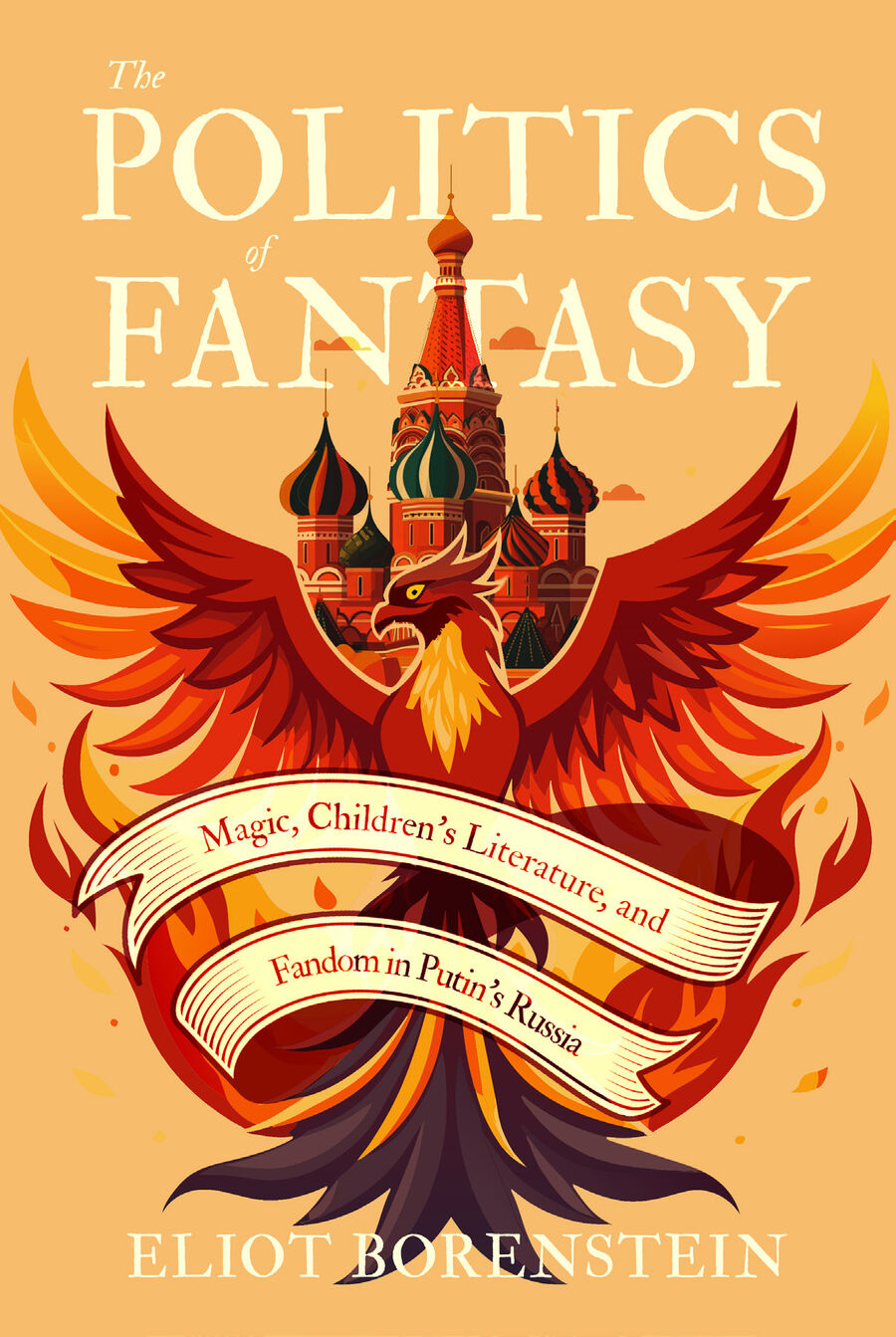
Professor, I read your book Politics of Fantasy with a pencil in hand, so to speak. With great interest, although I am not a fan of J.K. Rowling's books about Harry Potter and his friends. You write that Russia has its own Pottermania, similar and not similar to the fascination with these characters in the West. At the same time, the Russian Orthodox Church opposes Rowling's and Tolkien's books, and the Kremlin constantly raises the issue of the harm these tales bring to the mass consciousness. What, in your opinion, attracts Russians to Harry Potter? And what is the Russian government afraid of?
Fear of the "Other"
 Eliot Borenstein: Russians are attracted to the same things that attract all readers: it's a good fairy tale, an interesting hero, decent language, engaging plots. Basically, these are just good adventure books that can appeal to any reader in any country. The other thing is what alarms the Russian authorities, the church, etc. This is not only about Russia. In the West, conservatives in various Protestant churches also oppose Harry Potter, believing it to be an instance of Satanism. A familiar accusation, we have been accustomed to it in America for a long time because the country is somewhat puritanical. The other thing is that since in Russia Harry Potter is perceived as something that comes from outside, as a product of foreign culture, everything that happens in the book, from the point of view of conservatives, is questionable. Conservative representatives of the Russian Orthodox Church do not distinguish between magic and Satanism; they believe that when any spell is pronounced, it is already like a prayer to Satan. From this point of view, everything that happens in the book is bad and harmful. Another issue is that the book has, as it were, two kinds of people. There are wizards and non-wizards. And among the wizards, there are people, even entire movements, who have a negative attitude towards non-wizards. In general, this is the main idea of this series, that there are some kind of fascists who hate non-wizards and want to conquer the whole world. But critics in Russia, especially 20 years ago, only read the first book and believe that it preaches racism, that these books contain hatred towards normal ordinary people. This is not true. This is either a mistake or deliberately bad reading of the books.
Fan clubs are an excuse for communication, an opportunity to find people who are like you. Moreover, fandom exists not only for Harry Potter, but since it unites people, it alarms those who do not understand the phenomenon
Evgenia Albats: But it is no coincidence that in the subtitle of your new book you talk about fans in Putin's Russia. It is very interesting that a huge number of people on the internet discuss translations of "Harry Potter." There are people who write additional books about Harry Potter. There are people who argue with Rowling's conclusions. And you write that you understand that for the Russian audience this is somewhat foreign literature. But if they discuss translations, if they write additional books, if they look for other endings, then they perceive it as their own, don't they?
Eliot Borenstein: I think those people who write additional books really perceive it as their own. Fan culture, fandom, is precisely a community of people who are so interested in another world that they want to discuss this world, live in this world, write additional stories in this world. It's an excuse for communication, it's an opportunity to find people who are like you — it's a wonderful second and third world for Harry Potter lovers. Moreover, fandom exists for many other films, books, and comics, but since it unites people, it alarms those who do not understand the phenomenon.
Evgenia Albats: Well, for example, the bad character, Voldemort — you write in the book that no matter how bad he is, nevertheless, there are limitations to his power. In Russia, there are no limitations on bad people like Vladimir Putin. Don't you think that the authorities are afraid of this — that all books end with the good defeating the bad, well, more or less.
Eliot Borenstein: Yes, of course, but you can say that about any adventure book because it's a cliché: good always triumphs. I agree that since Harry Potter is so popular, it may seem dangerous to the authorities. But I don't think that's the main thing. Quite the opposite, I think that readers of "Harry Potter" understand that the happy end in the seventh book is unlikely to be repeated in Russia.
Evgenia Albats: And why then under Soviet rule were they not afraid to translate and rewrite books about wizards?
Eliot Borenstein: I think at that time critics or censors looked at these books simply as children's fairy tales. In any fairy tale, you can find a moral that contradicts the ideas of the authorities, but you have to specifically look for it. Maybe there wasn't such paranoia.
Offensive Dolls
Evgenia Albats: What role could the image of Dobby play in the negativity towards the Harry Potter books? He is a free elf, he says so himself. A very popular toy. Putin's admirers considered this image offensive to Vladimir Vladimirovich Putin, that he is somehow subtly similar to the Russian president. Could this have played any role? It is known that Putin is terribly touchy.
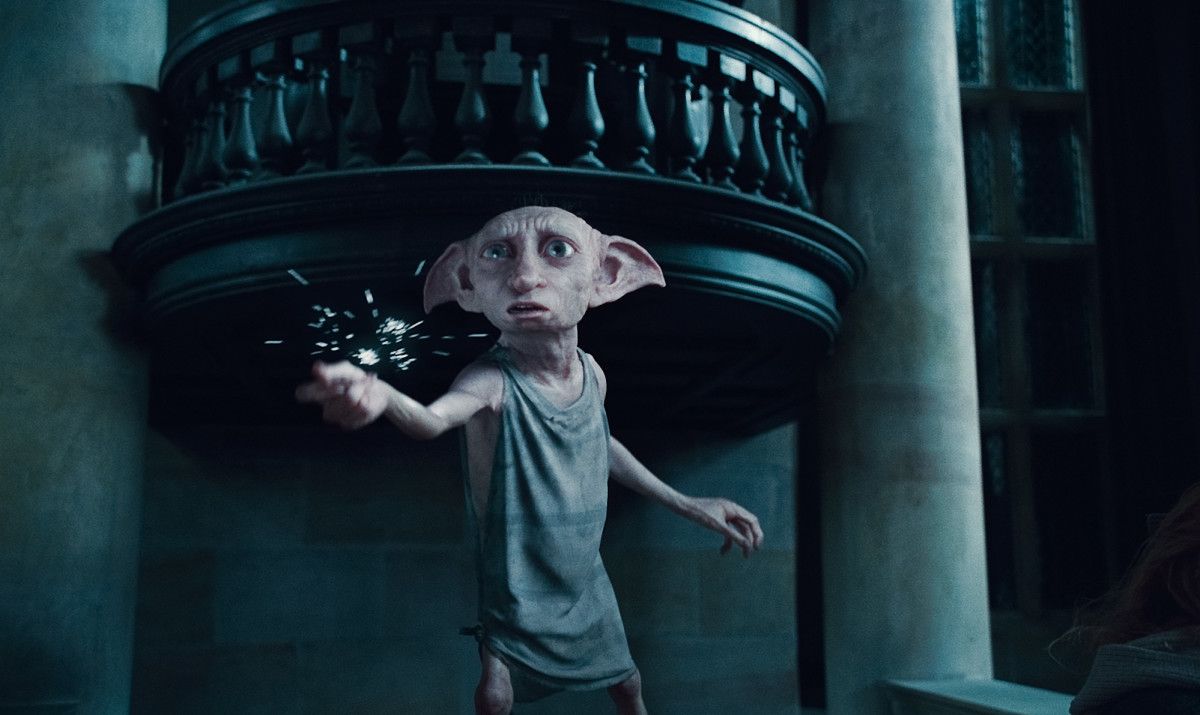
Dobby. A character from the Harry Potter film and book
Eliot Borenstein: Initially, this definitely played a role because it was written about, and someone thought that the image was modeled on Putin. I think this is unlikely, it doesn't match the timeline. Perhaps someone at Warner Brothers saw photos of Putin (whom, by the way, few people in the West knew at the time) and thought it would be interesting to model him. If so, then it's not an insult, but just inspiration. In fact, if it's Putin, then it's the kindest image of Putin I've ever seen, he should thank Warner Brothers for it. But if you consider that the president wants to appear strong, important, and serious, then an elf resembling him does not help this image. Then Putin simply lacks self-irony, a sense of humor. We saw this even when the show "Puppets" was on — how he was offended by his puppet.
Evgenia Albats: On the little Zaches.
Eliot Borenstein: Yes, on the little Zaches. He has some kind of point about this. He doesn't tolerate it.
Evgenia Albats: Another point. You write about this in the book — that, it turns out, in "Harry Potter" there is a theme of homosexual relationships between Professor Dumbledore and the dark wizard Grindelwald. To be honest, I didn't see this at all in the book. But you write that Rowling supposedly said that in their youth they had non-traditional relationships, then Grindelwald wanted to use Dumbledore again, and Dumbledore refused, and this became the cause of the conflict. Is this really so?
Eliot Borenstein: This is indeed the case, but it should be noted when it all became known. She announced that she always considered Dumbledore gay, but announced it after the release of the seventh book, after Dumbledore's death. In the seven books, there is not a hint of Dumbledore's homosexuality, his orientation does not play a role. Later, when she wrote a book about Dumbledore's youth, there was a moment to talk about his relationship with Grindelwald. But this was already several years after the end of the main series.
Proud Orcs
Evgenia Albats: In parallel with your book, Eliot, I was reading a book by American businessman Michael Calvey. He worked in Russia, was always a Putin loyalist, nevertheless, in 2019 he ended up in the "Matrosskaya Tishina" prison because Kremlin-affiliated comrades wanted to take his business. Well, as is customary in Putin's Russia. He talks about this very interestingly in his book. Why did I remember this? Because the video cameras installed in "Matrosskaya Tishina" are called "the eyes of Sauron," this is from "The Lord of the Rings." Putin is often compared in the Russian internet to the bad character from Harry Potter, Voldemort, who is completely devoid of feelings like love and empathy. And today's Russia, the Putin emigration, which fled the country by the hundreds of thousands after the large-scale invasion of Ukraine, calls nothing but Mordor.
This is to say that the heroes of philosophical tales, both Tolkien's and Rowling's, have entered the everyday life of Russians, becoming recognizable memes. How can you explain this effect?
Ultra-rights are not afraid to resemble Nazis, antiheroes, on the contrary, they are proud and openly say — we are like that, we are strong. This is a phenomenon of fascism
Eliot Borenstein: This is insanely interesting, and it started more than ten years ago on the internet when Russians began to be compared to orcs. Moreover, there were Russians on the internet who proudly declared that they were "Russian orcs." It was some kind of idea of national pride. In Ukraine, Russian soldiers began to be called orcs and Russia Mordor after the invasion. I think it's because Tolkien's stories, and later Rowling's, are modern stories that everyone watches and reads. The metaphors are just on the surface.
Evgenia Albats: Not only have memes from Tolkien and Rowling entered the everyday language of Russians, but Putin also used the popularity of these books. Namely, at the end of 2022, when the terrible war in Ukraine was already underway, at an extraordinary meeting of the nine heads of former Soviet republics, Putin gave each one a ring made of yellow and white metal, engraved with CIS symbols. The internet then called Putin Sauron, that is, the leader of darkness. Most importantly, these rings not only had CIS symbols, the Commonwealth of Independent States (which doesn't really exist), but also had "Russia" and a New Year 2023 greeting. Isn't this a direct reference by Putin himself to "The Lord of the Rings"? Don't you think that by doing this, Putin wanted to say that he is the lord of the rings?
Eliot Borenstein: To some extent. I recently read a manuscript in which Putin's regime was called a stebocracy. They wrote that maybe it's connected with Surkov, that at some point in the Kremlin they realized that instead of fighting ironic statements, memes, etc. about the Kremlin and Putin, it's better to use them, then you can disarm opponents. If Putin himself refers to "The Lord of the Rings," then what is there to accuse him of being Sauron. And I see this quite often in authoritarian circles around the world. Ultra-rights are not afraid to be like Nazis, antiheroes, on the contrary, they are proud and openly say — we are like that, we are strong. This is a phenomenon of fascism, it seems to me.
The Enemy Never Sleeps
Evgenia Albats: Your 2020 book is called "Plots Against Russia: Conspiracy Theories and Fantasies After Socialism." How do conspiracy theories differ from fantasies? After all, fantasies are also based on fiction, and there is always some kind of plot there too.
Eliot Borenstein: Conspiracy theorists, people who believe in conspiracies, treat the everyday world like a fairy tale or a novel. I always give this example. You read some novel about how a husband and wife quarrel, maybe they will soon divorce, the husband goes to work, and he works in the World Trade Center, it's September 11, and he dies. What does this have to do with the fact that he quarrels with his wife? In life, not everything coincides, there are events that have nothing to do with what happened before them. But in a novel, everything is connected, this is the law of the genre. And conspiracy theorists treat the real world as a text where everything must be explainable. Someone planned all this, and someone must answer for all the bad things.
Evgenia Albats: But in Russia, all politics is built on endless conspiracy...
Eliot Borenstein: Yes, this is also a question of tradition. If you consider that throughout the 20th century there was little reliable information, the void was filled with theories that there were conspiracies and enemies around. By the way, I think that conspiracy theorists are optimists because they believe that any bad and negative phenomenon has a cause and it has a customer. If you find the customer, you can fix everything. And if you are not a conspiracy theorist and believe that there is no enemy responsible for everything, that everything in life happens randomly, then there is no optimism. It's a terrifying thought that at any time a plane can crash into your tower, that you can lose everything, that there is no God and nothing explains what happens in your life. Conspiracy is a gift. Conspiracy theorists can help a person find meaning in life and not be afraid because you already know who the villain is. Who is to blame.
Evgenia Albats: I would never have thought that conspiracy theorists help find meaning in life. Don't they make the world terribly scary? You can't do anything, there is always some bad guy in the West trying to take all of Russia's resources in Siberia.
Eliot Borenstein: Yes, but at least it's an explanation of why life is scary. And not just that life is scary and everything is bad for no reason.
Soviet Self-Hatred
Evgenia Albats: Your books have telling titles. "Men Without Women. Masculinity and Revolution in Russian Literature 1917–1929." This book came out at the very beginning of Putin, 2001. Another title — Overkill. I don't even know how to translate this. "Sex and Violence in Contemporary Russian Popular Culture," a book from 2008. Another one, for example — "Soviet Self-Hatred." What is this, by the way, about Soviet self-hatred? And how is it used in post-Soviet Russian politics?
Eliot Borenstein: I observe self-hatred by the end of Soviet power when the word "sovok" appeared. Moreover, not only sovok as the Soviet Union, but sovok as a person from the Soviet Union, who can be identified by certain qualities. This is a parody of the Soviet person made by the Soviet person himself. A person from the West, knowing nothing about the Union, would not come up with this image. This is a purely Soviet, then Russian image of a Soviet person. And this is such self-irony: yes, we do everything wrong. Maybe we lack taste, we don't understand mass culture well, our behavior may not be what is expected of us in the West. But that's why we laugh at ourselves, and to some extent, we are even proud of our peculiarity. And then from sovok came a more modern manifestation of this idea in the word "vatnik." Vatnik is the sovok of the 21st century, also a negative image, but this is a negative image that is understandable only to people who live in the same environment. The feeling of backwardness is still there. We are proud of high culture, but we must create such a standard of living and mass culture that meets Western standards. The constant looking back at what the West thinks of us is a ghost that haunts us to this day.
I mentioned earlier that Russian ultra-rights call themselves orcs. It's the same as Putin associating himself with the Lord of the Rings when they try to make something positive out of a negative image. Orcs, like Blok's Scythians, say: yes, we are barbarians, but our sense of energy of life and everything else is much higher than yours in the West, and we will win, and we are proud of our barbarism.
Evgenia Albats: Slavists usually study high culture: Dostoevsky, Chekhov, Tolstoy. Why did you choose to study mass culture? You lived in Russia in the 90s, a very difficult period in Russian history when it was hungry, gangs were shooting in the streets, but at the same time, it was the freest time in Russian history of all centuries. Am I right in understanding that you were impressed by these horrors that were happening in Russia in the early 90s?
Eliot Borenstein: Not the horrors themselves, but the reaction to the horrors. Because it's one thing crime, criminality, and so on. But for me, the most interesting thing was how this was told on television, how it was described in novels and series. Because it may not correspond to reality, but it creates some other image of reality. I was insanely interested in observing what was happening and how it was reflected in mass culture. And I started collecting all this. I didn't think I would write even one book, I didn't think it would be the main thing in my research. But it turned out that once I started observing all this, I couldn't stop. Of course, I still read Bulgakov and Dostoevsky, but I don't write about them. Because now I'm interested in bad literature, bad culture, second-rate, poor quality.
Evgenia Albats: My hypothesis about your interest in mass culture: I read that you were born in the town of Bexley in the state of Ohio. In the same town lived Larry Flynt, who published pornographic magazines. I thought that maybe you, like all young people, looked at these pornographic magazines, and you might have been interested in how everything happens in that part of the world where it was customary to believe that there was no sex.
Eliot Borenstein: There's something to that. The other thing is that I've been reading comics and science fiction all my life. There was a little shop near Ohio University, very bad, dirty, but they sold science fiction, comics, and pornography, all in one bottle. And I bought all this because somehow they didn't notice that I wasn't old enough. And for me, probably, it all remained as one whole.
Crime and Nostalgia
Evgenia Albats: There are many disputes in the Russian opposition about what created the support base for Putin. Not only how it happened that Russia evolved first into an authoritarian regime, and now into a dictatorial one that threatens the security of at least Europe, if not the whole world. People support a war in which mercenaries — not soldiers, not defenders, but mercenaries for money go to kill Ukrainians every day. And there have been many conversations about the fact that after Yeltsin's re-election for a second term in 1996, Soviet motifs began to appear on Russian television, Soviet songs began to be remembered, and so on. Series about cops appeared — "Streets of Broken Lights," "Bandit Petersburg." Finally, films with the famous actor Sergey Bodrov "Brother" and "Brother-2," where the now-famous question "what is strength, brother" is heard, and so on. Bodrov's hero, as you remember, comes to America and does whatever he wants there. In the early post-Soviet period, we were constantly shown Brazilian soap operas about love. These series were deliberately purchased so that people would be distracted by this Brazilian love. And then there was such a reference to the times of a strong power, the Soviet Union, and so on. What do you think about this?
Eliot Borenstein: I think there was a certain pattern to this. Firstly, of course, in the 90s everyone was interested in crime because there was terrible crime. And as for nostalgia for the Soviet, this was to be expected. Because this is what people knew in their childhood and youth. At that time, Russia could not create a good love story, somehow it didn't work out, but violence, crime, and Soviet nostalgia turned out well. And it turned out that there was a demand for this. I think that everything developed by itself, but later, already in our century, the authorities paid attention to this. When I think about why Putin enjoys such support, I return to another question. In the late Soviet times, it seemed to me, people knew that they were being lied to on television. People did not trust television. And now it seems that Russian viewers believe what they are shown. Why?
Evgenia Albats: And how do you answer this question?
Eliot Borenstein: In Soviet times, they wanted to make you believe in what wasn't there, and you saw it with your own eyes. If the store shelves are empty, and on television they show abundance, you know they are lying to you. But under Putin, there is no such blatant mismatch. Moreover, I have the impression that today's political technologists understand their audience, they try one approach, if it is not popular, they try another. When they find what is popular with viewers, they develop it. But this does not explain everything.
Evgenia Albats: Putin just said in China again that Russia attacked Ukraine because Ukraine was going to attack Russia. That the West staged a coup in Ukraine, and therefore Russia had to defend itself. "NATO will attack," which they constantly scare on television — is this, in your opinion, faith or political technology?
Eliot Borenstein: What is the difference between faith and political technology? At some point, it doesn't matter because the main thing is that it is all repeated and that people are made to believe that this is happening. It seems to me that what starts as political technology then turns into faith. I see this now in America in Trump's entourage. I don't think that J.D. Vance believed in all this from the very beginning. And now it seems that yes, he has come to truly believe in the power of ideology. This is a process that, in my opinion, often repeats...
Reference
Professor Eliot Borenstein — author of thirteen books, ten of which are devoted to Russian mass literature and its connections with English-language hits, such as the Harry Potter books or "The Wizard of Oz" (in the Russian version, this is "The Wizard of the Emerald City" by A. Volkov), as well as Marvel comics and superheroes. One of the books is dedicated to memes of the Russian internet. Eliot Borenstein's latest book Politics of Fantasy — Magic, Children’s Literature and Fandom in Putin’s Russia has just been published.
Video Version
* Evgenia Albats has been declared a "foreign agent" in the Russian Federation.
** In Russia, the activities of Meta* are recognized as extremist and banned by the decision of the Tverskoy District Court of Moscow on March 21, 2022.