Mikhail Khodorkovsky. Photo: khodorkovsky.com
Yevgenia Albats*: On the same day, on the NBC channel, U.S. Vice President JD Vance and Russian Foreign Minister Sergey Lavrov gave two fundamentally different assessments of the negotiations on Ukraine. Vance called the “compromises reached as a result of the negotiations” significant. Lavrov said the exact opposite: no meeting between Putin and Zelensky can be discussed until there is an agreement on the occupied territories. In your opinion, Mikhail Borisovich, what did Trump and Putin actually agree on, if anything?
The fact that Putin announced a fundamental agreement on security guarantees for Ukraine was a significant advancement because security guarantees are the main issue for Ukraine today
Mikhail Khodorkovsky*: There was progress. For me, it was even unexpected. The fact that Putin announced a fundamental agreement on security guarantees for Ukraine (and that Lavrov, naturally, started backtracking, saying that these security guarantees should be through Russia), I consider this a significant advancement because security guarantees are, in general, the main issue for Ukraine today. The second issue, no less important, is that Trump obviously took a step forward by confirming Putin's position that negotiations do not require a ceasefire. And judging by everything, Zelensky agreed with this and announced the principled possibility of exchanges, although later, of course, he said that Ukraine does not trade territories. But it is clear that if the conversation is about exchanges, then this is still a change from the previous position. In general, this showed that there is a subject for negotiations. And after this, Lavrov's statement emerged, and simultaneously Putin's visit to Sarov, where he was clearly considering problems not only and not so much with the unfortunate governor he met at the end of the day, who forgot everything except that they are still dumping waste into the Volga. And judging by the telegram channel reports, it was about testing the “Burevestnik.” I want to remind you that the “Burevestnik” is quite a nasty thing, and to this day it is not clear if its tests have ever been successful, although maybe at some point they were.
Yevgenia Albats: Is it a missile?
Mikhail Khodorkovsky: It is a missile, but it is such a nasty missile that can change targets during flight because it uses a nuclear engine. As you understand, it is absolutely impossible to isolate the reactor in a missile, and it leaks radiation in all directions, and if, by any chance, the tests fail, as they have failed more than once, a large area gets contaminated with nuclear waste. So, it’s a very nasty story. And the fact that Putin came to talk about this topic simultaneously with Lavrov’s speech means that something went wrong, and the guys moved to mutual threats. Trump, understandably, to the threat about Ukraine using long-range weapons.
Diplomatic Amateurism
Yevgenia Albats: Are you referring to the talks about the United States supposedly transferring and planning to transfer three thousand long-range missiles to Ukraine?
Mikhail Khodorkovsky: In any case, Trump mentioned Ukraine's right to use American missiles for strikes deep into Russian territory. This is, in general, a serious change; the Americans have not given such an opportunity to the Ukrainians over the past years.
Yevgenia Albats: Sarov was Arzamas-16 in Soviet times. The domain of Academician Yulii Borisovich Khariton, where atomic bombs were made. Now they are dealing with missiles there?
Mikhail Khodorkovsky: I do not know this. But whatever the purpose of his visit to the nuclear center, it is obvious that everyone perceives it as another nuclear blackmail.
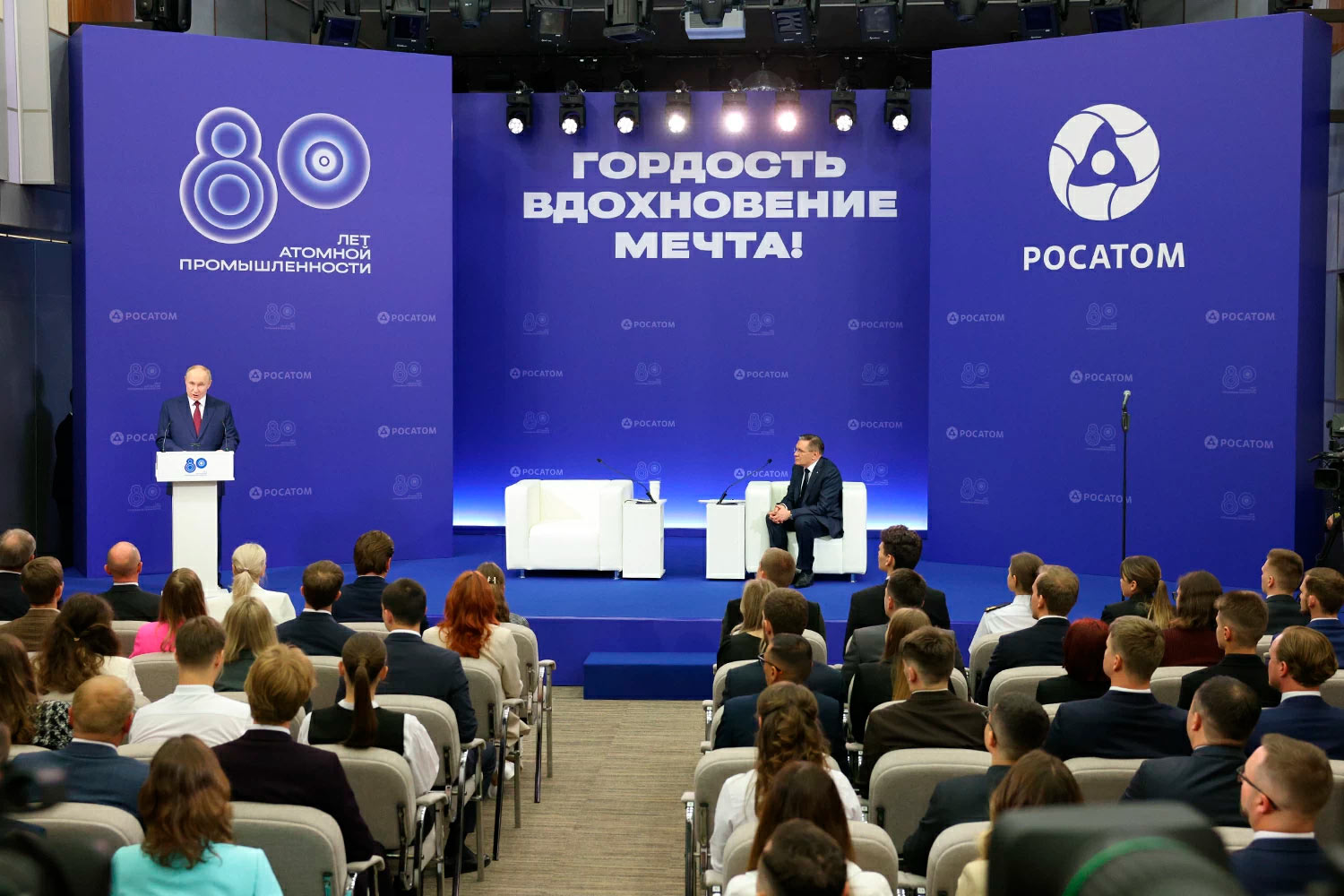
Vladimir Putin visited the Russian Federal Nuclear Center – All-Russian Research Institute of Experimental Physics in Sarov, Nizhny Novgorod Region, on August 22. Photo: Maxim Stulov / Vedomosti
Yevgenia Albats: Financial Times publishes a large article stating that Trump's chief negotiator Steve Witkoff said that in Alaska, Putin agreed that the US would provide Ukraine with security guarantees in the style of Article 5 of the NATO charter, but Ukraine would not be accepted into the alliance, as Trump said. At the same time, Financial Times writes, he either did not know or forgot about Russia's demand to have a veto on these very guarantees. What do you say about this?
Real security guarantees for Ukraine are the supply of weapons worth 100 billion through European financing and the fact that Ukraine can afford to spend about 8% of GDP on weapons and military equipment
Mikhail Khodorkovsky: I can say that Witkoff is probably a good entrepreneur, but he has no experience in diplomatic work. And what he is doing in this sphere lately goes beyond all common sense. If what Financial Times writes is true, then this is the second time recently that Witkoff misunderstands something in negotiations with Putin. This is not healthy; it would be better if the negotiations were conducted in a normal diplomatic manner, as they should be between two global nuclear powers. We are in different weight categories with America on all issues, but on one – the ability to destroy our planet – we are in the same weight category. Normal people in such a situation behave carefully and do not participate in negotiations with a person like Putin one-on-one. Translators are present, other diplomats are present. Witkoff thinks this is nonsense. Well, as a result, such an unpleasant situation occurs for the second time. To be honest, I did not really believe from the very beginning that Putin was ready for real security guarantees for Ukraine because real security guarantees for Ukraine, as we perfectly understand, are American troops on the line of division, as it was in some other cases. But American troops on the Russian border are unlikely what America would want, and unlikely what Russia would want. And all other external security guarantees are something within the framework of the Budapest Memorandum: whether it will be fulfilled or not. Therefore, for me, real security guarantees for Ukraine are the conversation that took place between Zelensky and Trump regarding the supply of weapons worth 100 billion through European financing. And the fact that Ukraine can afford to spend about 8% of GDP on weapons and military equipment. On top of this, of course, you can impose obligations from the United States or Europe to provide air cover, but this is already in favor of the poor.
Playing Blackjack
Yevgenia Albats: We observed that Zelensky, to his credit, managed to organize the leaders of European countries, bring them with him to the White House, where he started the conversation with Trump by handing over a letter from the First Lady of Ukraine to the First Lady of America. Who, in turn, previously wrote a letter to Putin, talking about the need to return the children who were abducted from Ukraine. And we also know from American media reports that Melania plays a significantly larger role than she did during President Donald Trump's first term. It is she, as Trump himself said, who shows him photos of dead children, destroyed Ukrainian cities, and so on. During this same meeting, whether intentionally or not, Donald Trump's microphone was left on when he told French President Macron that Putin is ready to make a deal “for me”, meaning personally for Trump. How do you assess this either slip of the tongue by Trump or deliberate leak?
Mikhail Khodorkovsky: I assess it from two sides. The first is that Trump is clearly trying to translate the conversation with Putin into a human dimension. I am not very firmly convinced that this is possible with Putin today. But it provides some lubrication for further negotiations. On the other hand, what Putin does can be explained by this: he wants to do it for Trump because Trump is the only chance for Putin to exit this wonderful event he organized with minimal losses. At least for some time. That is, Trump is capable, in the situation where Putin ends the war during his tenure, of more or less integrating him into the international community. Of course, it will not be possible to fully achieve this, and it will not be possible to completely lift sanctions. But what Trump can do in this sense, Biden could not do before him, and even Vance after him will not be able to do. In general, Trump is, of course, a very good chance for Putin. But how much Putin understands this, how much he understands that he has, so to speak, 20 on the cards, and does not try to draw another one – I have some doubts about this. An overreach is possible right before our eyes.
Putin in Anchorage received another generous advance from Trump. For him, this is an extremely advantageous opportunity to end the war in a more or less favorable situation for himself
Yevgenia Albats: Do you think that the fact that Putin agreed to a meeting in Alaska is not only a very advantageous PR move for Putin and an opportunity to declare himself again as a player on the world stage, but also an interest in exiting this war or at least getting some respite?
Mikhail Khodorkovsky: I have long given up trying to be a psychoanalyst for Putin. I would put it this way: Putin in Anchorage certainly received another quite generous advance from Trump. In Putin's place, I would consider this situation as an extremely advantageous opportunity to end this war in a more or less successful situation for himself. Because besides what I have already said about the possibility of reintegration only with Trump, there are a number of other parameters by which, from an objective point of view, Putin needs to end the war. This includes the creeping vassalization in relation to China, as Russia may once again find itself in a situation of interaction between Russian princes and the Horde. This also includes the obviously demonstrated, on the example of the Kursk region, the cost of the captured territories of Ukraine. I calculated purely arithmetically the costs that will be required to restore the Kursk region, where about 200 thousand people lived, in relation to the territory of Ukraine that has already been captured. It turns out to be from 200 to 300 billion dollars for minimal restoration. People simply did not understand how much all this destruction costs. And besides this, there are also problems with people. We understand the demographic situation in the regions that are now being captured by Russia. The population there is skewed towards older ages, and there are a huge number of disabled people. That is, these are mostly people who need support and are by no means a potential asset. And if Putin continues, well, he will capture a couple more regions, it will no longer be 300 billion, but 500 billion, and not 3.5 million people, but 5 million. It should also be taken into account that these are people who have not had a 25-year dictatorial vaccination, they are used to interacting with the authorities in a completely different way. Not on political issues – on economic ones. Our nearest such guys are in Kemerovo, which is 4000 km from Moscow. And these are 800 km from Moscow. And the helmets are the same. And they want to eat just as much. And the mines are destroyed, and there is no work. Our fund calculated after Anchorage, and it turned out that Russian society reacted very coldly to Alaska. Not negatively, but coldly. That is, the meeting was not perceived as a chance, as a victory that needs to be somehow consolidated. And Putin, who, like all dictators, only pretends to be independent of society, but in fact always closely monitors public sentiments, realized that he needs to do something. I am not sure that he understood correctly.
Oil as a Factor
Yevgenia Albats: Mikhail Borisovich, we remember how Putin said that he was ready to meet with Zelensky in Istanbul. He said this after another conversation with Trump. Do you rule out the option that Putin was afraid of the introduction of secondary sanctions against countries that buy Russian oil? This is primarily China and India, but not only. Especially since the Ukrainians recently blew up the Druzhba pipeline. Do you not think that Putin had concerns? According to data widely reported in the media, in July, Russia's revenues from energy resources decreased by 27%. Do you not consider this a factor?
Mikhail Khodorkovsky: No, I do not. I believe that sanctions, of course, have a certain impact on the Russian economy, but it has adapted to them to a sufficient extent. And sanctions against India or even more so against China, outside the context of a much broader picture of America's relations with India and China, are more of a blow to America than to Russia, because it is quite obvious that neither India nor China in this situation would not only not want to, but also could not follow America's lead. Because it would be a wild loss of face for the great countries they perceive themselves to be.
Yevgenia Albats: America can provide them with oil. It has enough shale oil reserves.
Mikhail Khodorkovsky: Firstly, there is not much of it. That is, if America completely switched to its own oil, it would last for 7 years. But the problem is not even that. Russian exports amount to about 4–5 million barrels per day. I think it is unlikely to be much less today. Removing 4–5 million barrels from the market without an agreement with Saudi Arabia and the rest of OPEC is impossible. This agreement does not exist, and it is not a fact that these countries have the ability to increase production by 4–5 million barrels per day so quickly. The departure of Russia from the oil market now would lead to oil prices becoming 250–300 dollars per barrel. I think no one even in a nightmare wants this. It is clear that such a threat and complication of relations with the United States gives Indian buyers, Chinese buyers more leverage to blackmail their Russian suppliers and secure some additional discount. Of course, Russian companies and the Russian budget would lose some money from these sanctions. But not significantly. And the fact that revenue fell is understandable. The price fell, hence the revenue fell. If the price falls further, if America is ready to sell its oil for 50 dollars per barrel, then Russia would be in a very cheerful situation.
Yevgenia Albats: No, shale needs 75–80 dollars.
Mikhail Khodorkovsky: Well, they are not ready. There is no other way to do this. But the fact that Putin, of course, would like to talk to America in a much broader context than the war with Ukraine is quite obvious. The Middle East constantly comes up, and much more. And of course, this is only possible with Trump.
Why are they so worried about long-range missiles? Because Putin jumps like a rabbit between his residences, and maybe he can cover himself, but he cannot cover much else. Trump has certain leverage over the Putin regime, and it is by no means sanctions, but direct military capabilities
Besides this, Trump can indeed provide Ukraine with the opportunity to use weapons. Why are they so worried about these long-range missiles? Because Putin jumps like a rabbit between his residences, and maybe he can cover himself, but he cannot cover much else. And imagine, once Ukraine hits someone, twice Ukraine hits someone – the mood in the elite will change sharply. In general, Trump has certain leverage over the Putin regime, and it is by no means sanctions. It is, in general, direct military capabilities. And when Putin hears about them, he immediately starts to get wildly nervous. Hence Lavrov, and Sarov, and so on arise. Because this is what is scary, not sanctions.
Yevgenia Albats: Some interlocutors in Moscow say that Putin, the Kremlin, are actually interested in stopping the war, at least in some version: if, say, Ukraine gives up all of Donbas and there is some decision on the line of contact, approximately the Korean variant. Because if the war continues, mobilization will have to be carried out, it is no longer possible to cover the need for human resources with contractors. 30 thousand are recruited per month, 30 thousand are killed and wounded per month. Accordingly, Russian troops cannot conduct war on several fronts. They have to choose – either Donbas, or Sumy, or Kharkiv. The Kremlin fears and does not want mobilization. And secondly, resources are really running out. What do you think about this?
Mikhail Khodorkovsky: I think that continuing the war is uncomfortable for Putin on many parameters. And some of these parameters we have already listed, some you have indicated now. Indeed, maintaining the current level of troops on the front by various honest, dishonest, and generally wild ways he can. But significantly increasing the number of people on the front without direct and harsh mobilization, which, as we know, is not accepted at all by Russian society, he cannot afford. This is another inconvenience for Putin. Plus, it is clear that the country's resources are being depleted, and nothing good is happening with the economy. But I would say that these are all discomfort issues, not game-breaking ones. As for the situation on the front, I would not want observers or Ukraine to draw the wrong conclusions from the lack of significant breakthroughs. The tactic, or even, one might say, strategy, chosen by the Russian General Staff, is to grind down Ukrainian human resources. If the war started with the ratio of the population or mobilization potential of Russia and Ukraine approximately 1 to 3, now the ratio is 1 to 7. And it will get worse. In fact, this is what they are doing – stupidly grinding down. It is clear that they are grinding down because Russian society turned out to be not very sensitive to the losses of those people whom Russian society currently considers to be fighting for money, that is, the expeditionary corps. And when people have a change in understanding and they realize that in fact, these are no longer expeditionary corps, these are conscripts who were simply forced to sign a contract, at that moment a big trouble will begin. I mean – trouble for the Kremlin. It has not started yet, but it can start at any moment, and this is another discomfort for Putin.
Yevgenia Albats: For Russia to completely occupy Donbas, judging by the dynamics, it will take a year, or maybe even two. You mentioned at the beginning of our conversation that Zelensky spoke about the readiness for territorial exchanges. But what exactly is the exchange? What will they exchange for? Both Zaporizhzhia and Kherson regions are not fully captured, no matter what Putin says, they are part of Ukraine, as stated in its Constitution, as well as Donbas and Luhansk.
Mikhail Khodorkovsky: I do not really know what Zelensky meant. But I can confidently say that in arm wrestling, when two people are wrestling on arms, there is also a dynamic of one athlete pressing the other, and you can also say that he will be able to put his hand on the table in two or three years. And arm wrestling ends very quickly, at some point from the position of opposition, one athlete's hand simply falls. Because he ran out of strength. I am not saying that this will happen. I am talking about the strategy of the Russian General Staff: you, Ukraine, had three million mobilization potential. And we know that after your mobilization potential is ground down by 30%, the rest will start to scatter. And when it is ground down by 70%, the remaining 30% will definitely not fight. Therefore, our task, says the Russian General Staff, is to kill or injure one and a half to two million people. It is not far to this. The consequences will be severe. Besides what Putin has already included in the Russian Constitution, there is also the Sumy region, there is the Kharkiv region, certain captures have also been made there. And what Zelensky meant by the term proportional exchange, I do not know. But what I do know for sure is that Putin should end the war, and Zelensky should end the war. The situation is exactly like this. Yes, after this Putin can start the war again. Yes, after this there is an extremely painful situation for Kyiv that with 8% allocations for military needs and with the aggressor's army looming over your border, you cannot attract investments. And how will Ukraine get out of this?
For Ukraine now, it is important to preserve statehood. And if to preserve statehood it is necessary to sacrifice 20% of the territory, then this is, of course, the decision of the Ukrainians. But they need to understand that they cannot win this war now
There are a number of ways, including those demonstrated by Israel at one time, but this is not an obvious and very difficult way from a political point of view. And “Finlandization” is a very likely development of the situation today. And what do you want? If the West has decided not to help Ukraine defend itself in the necessary volumes, then the war is lost. A lost war leads to severe consequences for the country that lost the war. The fact that Ukraine is not given enough weapons and military equipment to ensure that it can not lose this war is obvious. The fact that Europe has not yet begun to swing its defense industry in the necessary volumes is obvious. Trump has come. And the flow of weapons from that side also begins to be limited. Ukraine is in a very difficult military-political situation. As a result of Putin's adventure, Russia will also be in a very difficult political and economic situation after they count what they have received. They received scorched areas where all territories are filled with mines, unexploded shells, with destroyed infrastructure, with a population that needs to be fed. Well, a wonderful victory, just a wonderful victory for Putin! But that will be later.
For Ukraine now, in my opinion, it is important to preserve statehood. And if to preserve statehood it is necessary to sacrifice 20% of the territory, then this is, of course, the decision of the Ukrainians. But they need to understand that they cannot win this war now. Maybe if the West's position were different, then the situation would be different. But the West's position is what it is. When I talk to the West, I say: guys, you need to understand that Ukraine is not a separate story, it is your forward outpost. If there is no Ukraine, then the forward outpost will pass along another line. You will not like it. Therefore, when you calculate your military budgets, expenses on Ukraine should be considered part of your military budget – if you still want to be an independent and independent political force.
A Man with a Gun
Yevgenia Albats: Mikhail Borisovich, in Russia, under unknown circumstances, another top manager of a large company died. This time it became known about the death of Dmitry Osipov, Chairman of the Board of Directors of “Uralkali,” the world's largest producer of potassium chloride, which owns 5 mines and 7 fertilizer production plants in Russia. Osipov's death was called sudden by the company, the agency writes, without specifying the cause. Before that, Mikhail Kenin, the founder and main shareholder of the state company “Samolyot,” the largest developer in Russia, died. The cause of his death also remained unknown. In total, over the past three and a half years, that is, since the beginning of the war, at least 18 top managers of large companies have died under mysterious circumstances. I do not like conspiracy theories, but when you talk to some interlocutors in Moscow, they say: well, very large assets are being divided. What do you say?
War strengthens those who have weapons in their hands. This is not only the army, but also the special services and generally everyone who has weapons in their hands, they are more needed by the authorities. The authorities can afford to quarrel with them to a lesser extent than in a peaceful situation
Mikhail Khodorkovsky: I also do not want to engage in conspiracy theories, and I perfectly understand that when in my time the average top manager of a large company was 30–40 years old, the probability that he would die was lower than today, when the average top manager of a company is 50–60, or even older. This is on one hand. On the other hand, we perfectly understand that any war strengthens those who have weapons in their hands. I mean not only the army, but also the special services, and generally all the wonderful people who have weapons in their hands, because there are more weapons, they are more needed by the authorities. In general, the authorities can afford to quarrel with them to a lesser extent than in a peaceful situation. All this is happening, which means they are becoming bolder. Besides this, if in a peaceful situation there may be several thousand people in all of Russia who have crossed the barrier, that is, ready to kill, then during the war there are not thousands, but hundreds of thousands of such people. It would be strange if, under such circumstances, the number of conflicts resolved by force did not sharply increase. And it will increase. This is one of those gifts that Putin has definitely already brought to Russia. That is, in the next 2–3–5 years, the number of conflicts resolved by force will grow. And this will affect not only top managers of large companies, but also ordinary everyday situations.
Yevgenia Albats: Has Putin stopped playing the role of mediator between different clans?
Mikhail Khodorkovsky: He has generally largely stopped providing security for Russia. And this is the most important function of the state.
Yevgenia Albats: And the last question, Mikhail Borisovich, I cannot help but ask you about the report, I think, from RIA “Novosti” that bailiffs have initiated proceedings against you for 17 billion, I forgot in what currency, rubles, probably. What are these next 17 billion? And what is happening with what the former shareholders of Yukos sued from the Russian state – 50 billion dollars?
Mikhail Khodorkovsky: This is probably the third or fifth time they have presented these 17 billion. This is the so-called civil claim within the framework of my criminal case. And this is the only case when the European Court of Human Rights, which terribly does not like to say anything specific if a state is involved in the conflict, said very specifically that this civil claim should be canceled because it has no basis. At that moment, this was already 10 years ago, Mr. Peskov stated that I could come to Russia, and I said that if this is really the case, then I am buying a ticket. I decided to see what would happen after I announced this. A week after that, the Supreme Court considers the decision of the European Court of Human Rights. And for the first time at that moment in history, it refuses to apply it. That is, it says that this decision of the European Court of Human Rights we will not apply, the claim for 17 billion remains in place, if Khodorkovsky comes to Russia, he will not be able to leave back because he has such a civil claim. And it should be noted that this was not enough for them. They decided that maybe this would not scare me. Literally a couple of days later, they announced that they were initiating a criminal case against me for murders. It should be noted that since then it has remained in an initiated state. So these 17 billion are not the first time, I do not know what has entered the bureaucratic head again.
As for the Yukos shareholders' claim, I want to note that since 2004 I have not been a Yukos shareholder. Since I was in prison, I decided that it was wrong for me to keep the shares, pressure could be exerted on me. And it is better if I give up these shares. I gave them up and am not a beneficiary of this dispute. Nevertheless, it certainly interests me, I follow it, I understand that as long as Putin is in power, Yukos shareholders will definitely not receive anything. And when he is not in power, then also unlikely, to be honest. Nevertheless, this is a very important legal process, it was the only process in Western courts where the Yukos case was considered on the merits, and not on the form, as it was in the European Court of Human Rights. And a decision was made on all parameters, starting with the assessment of privatization, the “theft” of oil, incorrect tax payments, and so on. The lawyers of the Russian side tried to do everything they could. Today, the questions that certain groups of comrades on Twitter periodically begin to ask were all asked by the lawyers of the Russian government, and all were rejected. Ultimately, in The Hague, a decision was made that the Yukos case was completely politicized, its purpose was the confiscation of the company, and this story had nothing to do with law. That is exactly why Yukos shareholders were awarded compensation, and this compensation today is another troubling element in the list of a thousand troubling elements that Vladimir Putin has. I am extremely glad about this.
Video Version
* Yevgenia Albats, Mikhail Khodorkovsky are declared “foreign agents” in the Russian Federation.