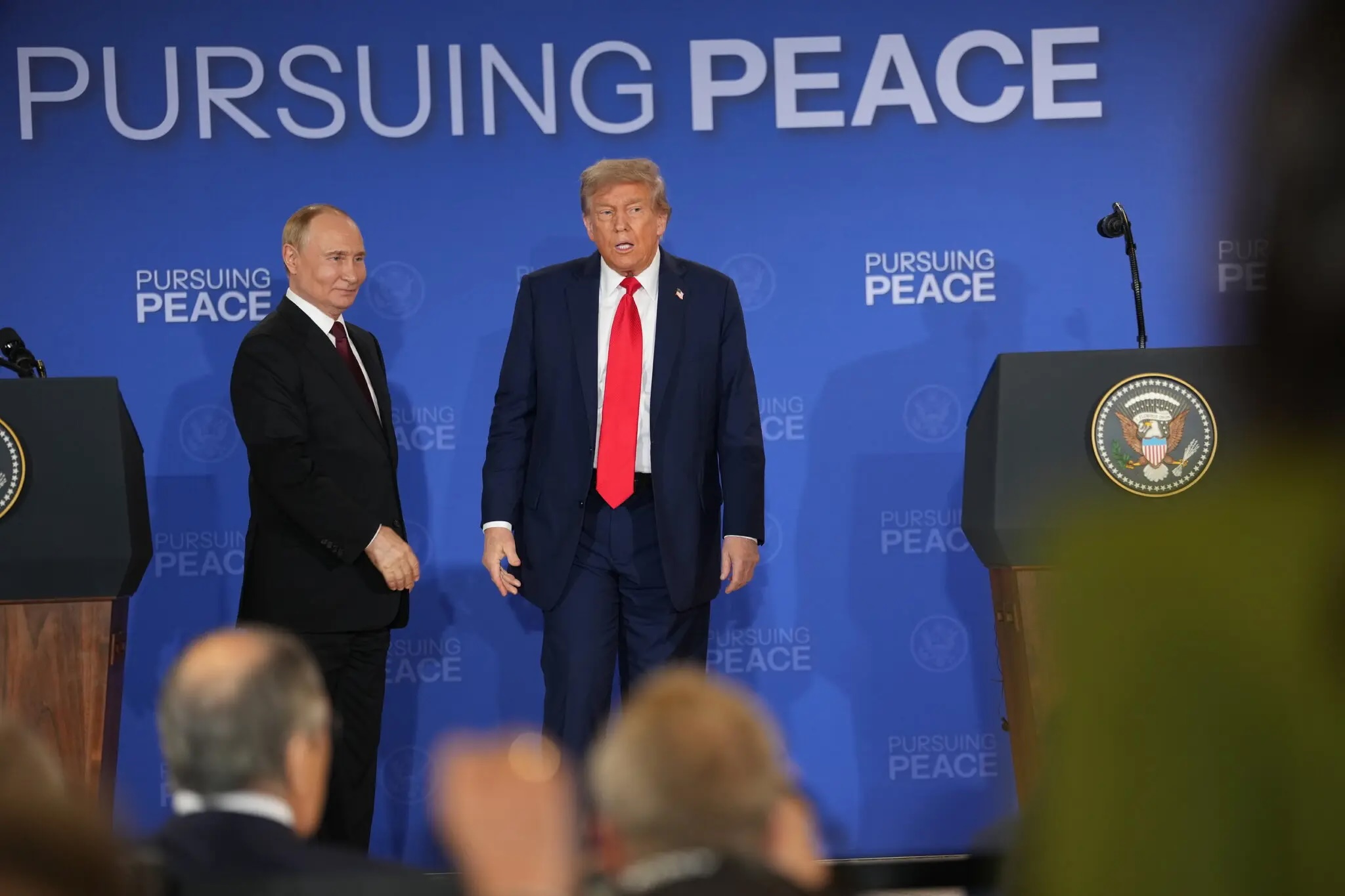
Meeting of Donald Trump and Vladimir Putin in Alaska. Photo: The New York Times
Yevgenia Albats*: Before we move on to today's events — how do you assess what happened in Anchorage, Alaska, at the meeting of the US and Russian presidents?
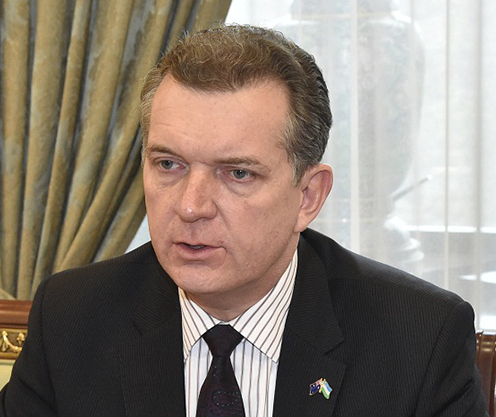 Peter Tesh: I am amazed that Trump is so willing to concede strategic advantage to Vladimir Putin, both in this case and in general. I don't understand why the United States is willing to make compromises despite all the rhetoric in preparation for this meeting.
I see no sense in such an approach by the United States, considering the strategic interests of the US and the role they have played in global politics so far. This, of course, alarms allies not only in Europe but also in the Pacific region, where I am located. Japan, Korea, and Australia are concerned about this approach. As our prime minister recently stated, we stand for the benefits of international law, considering all the obligations that the Russian Federation took upon itself when signing the Budapest Memorandum, the bilateral peace and friendship agreement, and the final settlement of the joint border in 2003, if I'm not mistaken, where all points of the common border between Ukraine and Russia, including Crimea as part of Ukraine, were very clearly defined. As a private individual, I am simply shocked by this and worried about how events will develop further after the meeting in the Oval Office. It is very important that the main leaders of European countries have rallied around Ukraine in this case.
Conversation with the Devil
Yevgenia Albats: Peter, I remember our conversation when you were an ambassador in Moscow, and you once told me that diplomacy is such a thing that sometimes you have to talk to the devil. Is there any sense in Trump meeting with Putin? Although Putin had a prepared speech and it was clear that he knew in advance that he would not agree to anything.
Peter Tesh: Negotiations must be conducted, and one must look at the world as it is. You have to work with those in power. There is no other approach for professional diplomacy, for governments. Considering that disagreements sometimes define bilateral relations, nevertheless, one must remember that not only disagreements should define such relations.
Defeatist sentiments always exist in any country, and this must be treated philosophically. There has always been a minority of people in Ukraine with pro-Russian sentiments, and the war has not changed this attitude
Yevgenia Albats: Yevgeny Kiselyov, what do you hear from Ukraine? We write, and speak, and unfortunately recall the Munich Agreement, when the fate of Czechoslovakia was decided without Czechoslovakia. But Chamberlain could at least return to the UK and say: "I bring you peace." Donald Trump couldn't even do that. And yet, what do they say in Ukraine? Polls show that a significant portion of the Ukrainian public wants the war to end.
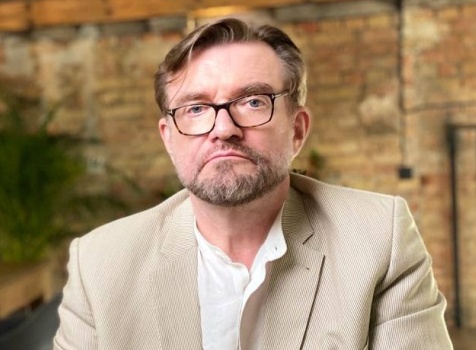 Yevgeny Kiselyov: In a country where martial law is declared, which lives by the laws of wartime, I think poll data should be met with some skepticism. In any case, we should treat them with a certain degree of caution. Nevertheless, the last poll I studied carefully, conducted at the end of July–early August, a representative survey conducted by the Kyiv International Institute of Sociology, KIIS, one of the recognized sociological centers of Ukraine, gives a figure of 75%, so many Ukrainian citizens are not ready to end the war on the terms of a "shameful" peace. They are not ready to agree to a truce at the cost of giving up those territories that Ukraine controls and which the Russian Federation has not been able to occupy in 3.5 years of war. 17% of Ukrainian citizens say they are ready for peace at any cost. I am wary of this figure, but it does not surprise me because defeatist sentiments exist in any country, and this must be treated philosophically. There has always been a minority of people in Ukraine with pro-Russian sentiments, and I am not at all surprised that no war has changed this attitude.
Yevgenia Albats: Sam, you are an American, your parents were born and live there. At the same time, you live in the UK and observe what is happening from the European side. What is the reaction in the UK, in your academic circle, to Trump's steps toward resolution, toward ending the aggressive war in Ukraine?
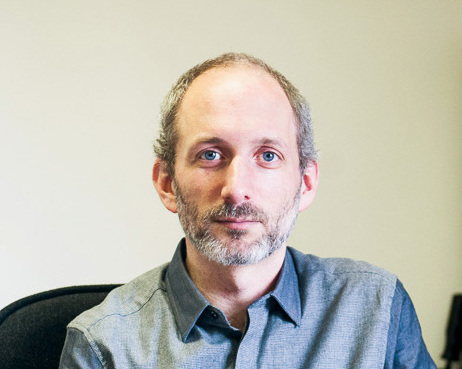 Sam Greene: There were many contradictory statements regarding the exchange of territories, so experts were completely puzzled, the agenda of the meeting in Alaska was unclear. In the end, it became clear that things went badly there, but later there were reports that Trump, in general, agreed to what Putin wanted; that we no longer talk about a ceasefire, do not talk about actions to restore trust between the parties, do not talk about the sovereignty and integrity of Ukraine. There were talks and speculations around the fact that Ukraine should surrender in the way Trump proposed back in February this year in the same Oval Office. There was one interesting report after Anchorage, if this is not another hoax. But if Trump is right when he says that Putin is ready for the presence of some Western forces in Ukraine or in the sky over Ukraine to ensure confidence in European and Ukrainian security after the ceasefire — this is something new. And this would be a rather significant concession from the Russian side. However, I allow myself to doubt that this is a real proposal from the Russian side.
Even the ink that Putin will spend on writing the promise will not be worth it! They can even write it into the Constitution and hold another referendum on stumps for this, it's all worthless
Yevgenia Albats: Also, Witkoff, Trump's special envoy, said that they managed to get Putin to write a written promise not to conquer Ukraine anymore and not to conquer Europe.
Yevgeny Kiselyov: Even the ink that will be spent by Putin on writing this promise will not be worth it! They can even write it into the Constitution and hold another referendum on stumps for this. No guarantees that will be formalized in the form of written, oral, or, as Dmitry Medvedev said, carved in bronze promises of the Russian authorities not to do something, not to attack someone — it's all worthless. Security guarantees, in my opinion, and in the opinion of many people I talk to on this topic, including Ukrainians, can only be the supply of modern types of weapons, aircraft, missiles of various ranges, and other modern means of defense against missiles and aircraft. In general, strengthening the aviation component so that Ukraine finally has its own modern powerful aviation, armed with different types of missiles. Different types of aircraft that could perform the roles of attack aircraft, bombers, interceptors, and flying radars. And, of course, the second component is investment in the reconstruction and recreation of Ukraine's military industry. The third component is the presence of military contingents from countries participating in the so-called coalition of goodwill. Let there be military personnel based on those security agreements that Ukraine has signed with almost all European countries from the end of 2023 to 2025. Ukraine has established bilateral security cooperation relations with 29 European countries. So even NATO, no articles of its charter need to be invoked.
Yevgenia Albats: We see that Russia has not stopped shelling Ukrainian cities. Peter, I have a question for you as a diplomat. If there are peace negotiations, one might assume that the parties should at least stop bombing each other. Isn't it characteristic of those promises that Putin can write and sign that he does not stop the air terror throughout Ukraine?
Peter Tesh: Well, of course. I completely agree with Yevgeny Alekseevich in his assessment of the real weight of the words of a government that says "yes-yes-yes, we will-we will, we promise," and continues to drop bombs. I always try to remind that a ceasefire is not such a difficult thing. Especially since Vladimir Putin himself announced this on the eve of the 80th anniversary of the victory in the Great Patriotic War. By doing so, he showed that he can announce a ceasefire at any moment, but there is no political will, no political intention to go for it. I am amazed that during the meeting in Anchorage, the war continued, yet Trump came to this meeting, having already repeatedly expressed the need to put an end, an end to the killing. It seems he reconciled with the idea that killing would continue. So the fact that the war continues from the Russian side with ever-increasing intensity, in my opinion, is the clearest indicator of the Kremlin's true intentions.
Trump's Love
Yevgenia Albats: Schwarzenegger, the Terminator, and former governor of California, does not express himself so diplomatically. He said he watched the press conference and thought that Trump would now ask Putin for an autograph or ask to take a selfie with him. This is, of course, cruel, but I also watched the press conference live. Do you have an explanation for why Trump behaves this way?
Peter Tesh: Honestly, I don't understand. I do not adhere to conspiracy theories and do not think that there is a dossier, compromising material on him somewhere. In my opinion, it's not about that. It's about Trump's character. He is in love with the concept of an autocrat, a sovereign. For me, this is incomprehensible. I cannot justify it. After all, he is giving up the strategic advantage that the United States has been achieving for eighty years after World War II, without receiving anything in return. I don't understand why he is willing to concede this advantage to the Russian Federation, China, and other unfriendly countries.
Yevgenia Albats: Sam, we see that Trump is breaking the institutional structure that was built in the United States at least after World War II. But at the same time, Trump did not accidentally appoint Marco Rubio as Secretary of State, who was involved in international politics in the US Congress. And probably he has experts who prepare him for negotiations and meetings. I cannot understand what is happening with the academic community of the United States, which has been studying the Soviet Union and Russia for decades, but it is obvious that the current president of the United States does not understand who he is dealing with, who Putin is, what to expect from him and what not to expect, and what his power is based on.
Yevgeny Kiselyov: The academic community is completely unclaimed.
Trump sees foreign policy not as a reflection of national interests, but as a field for playing out his personal interests. Just as Putin and many other authoritarian leaders see it. Plus, he believes that international relations are based on personal relationships
Sam Greene: Not only are we not asked, but recently the entire staff of experts in the State Department dealing with Russia was reduced to one or one and a half people. They were simply "let go" as part of the reductions initiated by Elon Musk and which continue successfully. But we also know that the interagency process, which should be overseen by the National Security Advisor Marco Rubio, who is also the Secretary of State, archivist, and head of international development, does not work. The interagency process is in Trump's head, not at the table with experts and officials who know their business. Therefore, the process does not work as we are used to reading about it or as specialists are used to working. It works differently. But this is not a system error at the moment, but precisely Trump's idea of how it should be. Trump, and this is also part of his admiration for Putin, sees foreign policy not as a reflection of national interests, but as a field for playing out his interests, personal, political, small-political, or materially selfish. Just as Putin, or Erdogan, or Orban, and many other authoritarian leaders see it. But in addition to this, he believes that international relations are based on personal relationships. He sincerely believes that he has deep trustful, as it seems to him, relationships with Putin, built on mutual sympathy and the fact that they see the world in the same way, and they were supposedly together during Trump's first term, were a united team in the fight against the terrible Democrats and the deep state, who were hollowing out American democracy... He sincerely believes that if Putin gave him a promise, then Putin will keep that promise. He was a little irritated, probably not even by the fact that Putin continues to bomb, but by the fact that he has to answer to his wife, explain to Melania why, contrary to his promise, children are dying in Ukraine, why children are being kidnapped from Ukraine. It is unpleasant for him, so he had to put a little pressure on his friend, but from this, we see, the friendship has not gone anywhere. Even I had questions after almost a month and a half of rather negative rhetoric from Trump towards Putin, after his irritation with Putin, why he met him in Alaska as an old friend.
Yevgeny Kiselyov: I perfectly understand the high journalistic intensity of various texts that people in Ukraine are writing now, as well as Russians living in exile who are opponents of Putin and staunch supporters of Ukraine. But professional diplomat Peter Tesh will not let me lie that being rude to your counterpart in negotiations is not the best way to achieve a result. I do not sympathize with Trump and hate Putin, but I understand that in real politics, if Trump believes, for one reason or another, that making peace and restoring relations with Putin's Russia will benefit America, from investments in Arctic oil and gas wells or in the development of rare earth metals somewhere deep in Siberian ores, and really wants to end the war and thus go down in history, then he wants to negotiate and therefore does not break pots. I would very much like Trump to really kick, I mean verbally, Vladimir Putin right there when he got off the plane. But I understand with my mind that this path would lead nowhere. What do we have in the dry residue? At the so-called press conference, various courtesies were expressed towards Putin from Trump's mouth, towards Trump from Putin's mouth, but the key words that were spoken at the very end — there is no deal. No agreement was reached. And Putin flew away, as they say, empty-handed. That's the real result. And what is happening now? While we are talking here, encouraging news is coming to the news feed. There is no repetition of the February quarrel. The President of Ukraine says he is ready for a diplomatic settlement. Trump adds that peace in Ukraine must be sustainable. And he says nothing about the so-called exchange of territories.
Land in Percentages
Yevgenia Albats: Both the American side and some well-known Russian bloggers wrote that supposedly Ukraine, Zelensky for the sake of stopping the war, would be ready to give up the entire Donbas, as Putin demands. That is, to give up the Kramatorsk-Sloviansk agglomeration and the fortifications that Ukraine has been building for 11 years without a fight. This hasn't happened yet. But could it have happened?
Yevgeny Kiselyov: There are different figures. Let's say that about a third of the territory of the Donetsk region is still under the control of the Armed Forces of Ukraine. And fierce battles are being fought for this territory. In recent days, elite units, the best strike units of the Armed Forces of Ukraine, have entered the area that panic-mongers call a "breakthrough." People more knowledgeable in military matters call it the infiltration of individual infantry groups deep into the territory controlled by the Armed Forces of Ukraine. In short, the toughest Ukrainian forces were transferred there, and the infiltration was eliminated. But we must understand that we are not just talking about 30 or 25 percent of the territory of the Donetsk region. We are talking about a huge urban agglomeration, densely built-up and densely populated, for which, as military analysts say, if battles began, these would be street battles over a huge area that could stretch not just for months, possibly for years. That is, there is still a lot of fighting to be done. And Putin proposes to simply concede this territory.
Let's fantasize. Okay, says Zelensky, let's consider the option of our withdrawal from these territories. I need a year for this — to properly organize the resettlement of the civilian population, the withdrawal of civilian structures and services. A year is needed to build new fortifications where the new border will pass or, let's say, the new line of contact. Investments are needed to carry out the withdrawal of troops, their redeployment, and the relocation of the civilian population in these tight deadlines. Agreements are needed with the governments of EU countries that the approximately one million Ukrainian refugees currently living there will receive additional benefits under the policy of granting temporary protection to those fleeing the war. There are rumors that this policy will be phased out at the beginning of 2027. Guarantees are again needed that immediately after we leave the territory of Donbas, military contingents from those countries that previously declared this will be stationed there between us and the Russians. Well, here's a diplomatic path in response to Vladimir Putin's demands, theoretically, Ukrainian President Volodymyr Zelensky can enter into such a very sophisticated, extended diplomatic game. And besides, simultaneously enter into a conversation: are you ready to leave somewhere? Let's clarify where. You said you are ready to leave the territory you control in the Sumy and Kharkiv regions. Listen, this is not serious. There you control a significantly smaller part of the territory. Let's, return something else to us. After all, Trump said that Ukraine once lost "access to the world ocean." Let's discuss the issue of Ukraine being returned access to the world ocean. That is, even on such a platform, seemingly a deliberately losing game, one could play. But this, I repeat, is my fantasy.
Yevgenia Albats: This is very interesting, but how realistic is it? Peter, do you think anyone would agree to this?
Peter Tesh: This is the essence of the matter. Whenever I hear about "territorial exchange," I think: exchange whose territory for whose? It's all Ukrainian territory! Of course, I understand what is meant — territory controlled or not controlled by one side or the other. But what Yevgeny just laid out, in my opinion, is a very real detailed approach. And if a similar clearly developed plan were laid out, it would put pressure on the Russian side. I think the most important thing is for Europe, the United States, and even Australia from afar to continue to provide assistance, support to Ukraine in material and political terms. This will not only benefit Ukraine. The principles we all stand for, and Ukrainians die for — sovereignty, the integrity of the country, and independence — should concern the interests of all countries, including the United States of America.
Modi Goes to China?
Yevgenia Albats: The Chinese Foreign Minister visited India. Fareed Zakaria, a well-known American political scientist, commentator, and journalist, said that Trump made a mistake: he had a strategic partnership with India, and after he imposed tariffs against India for buying Russian oil, India will never trust him again. It is obvious that China and India are negotiating joint efforts to counter the US, including regarding punishment for Russian oil. What do you think about this?
Peter Tesh: Additional tariffs on India are, as they say, shooting oneself in the foot on the part of the Americans. The Indian government understands this. On both sides, there are, of course, opportunities and big challenges. The fact that the Indian Foreign Minister recently was in Beijing at the SCO meeting, the Shanghai Cooperation Organization, and that Modi will soon come to Beijing — this is for the first time in many years. And this is the result of Trump's policy. Including tariffs on Vietnam and other countries in the Asia-Pacific region raises great concern on the part of these governments, they must seek other ways out. China is ready to take advantage of this opportunity to advance its strategic goals.
Yevgenia Albats: Will China take advantage of the current situation to occupy Taiwan?
Peter Tesh: I don't think so.
Yevgenia Albats: Trump constantly emphasizes that it is very important to separate Russia from China. As far as I understand, the White House's policy is that the alliance of two nuclear powers — Russia and China — must be broken. At one time, Kissinger, the Secretary of State under Nixon, also began to embrace Mao Zedong to have an ally against the Soviet Union. What do you think about this logic?
Peter Tesh: Absurdity. Because then there was a completely different strategic situation, there was already a split between China and the Soviet Union. I see no reason for optimism on the part of the administration in such an approach. And even if there is such a strategy, more competent professionals need to be involved than we have seen so far in negotiations with the Kremlin.
What is Beneficial for Europe
Yevgenia Albats: Trump sees that Europe strongly supports Zelensky, but at the same time, he also sees that Europe is not in a hurry to raise its defense spending. It's clear why, but nevertheless. How will the situation develop?
Putin really does not want to have conversations with Europeans. He wants to use Trump as a club to hit heads in Kyiv, Brussels, Paris, London, and wherever
Sam Greene: This is a process that Ukrainians and Europeans must continue, primarily among themselves, to understand the security architecture. No one will sleep peacefully just because Trump said something on Truth Social about being ready to ensure the security of Ukraine and Europe. No one will believe this. There must be a clear, detailed, and material agreement on creating a new security architecture between Ukraine and Europe. This is painstaking, complex, but possible work that they must move towards. But for this, Europeans must be ready to become more autonomous. Move away from the habit of constantly looking back at what is happening in the White House. Isolate themselves a little from this. And start having conversations with Putin themselves.
However, Putin really does not want to have conversations with them. He wants to use Trump as a club to hit heads in Kyiv, Brussels, Paris, London, and wherever. They must take this situation into their own hands and be ready to move it forward.
I would like to point out one more thing. Notice that we are not discussing reparations. We are not discussing Russia's responsibility for war crimes. We are not discussing the future of the sanctions regime. We are not discussing, in principle, relations between Russia and its environment, the near abroad. The mania for domination that prevails in Putin may prevail in those who come to replace Putin. And without resolving these issues, the world will not seem stable to either Ukrainians or Europeans.
Yevgenia Albats: Will the war continue?
Sam Greene: The war will continue, with or without fire. And what Ukraine and Europe want to avoid is the continuation of the conflict under the guise of some shaky, as it was said, shameful peace.
Yevgenia Albats: Yevgeny Kiselyov, how do you see — what next?
Yevgeny Kiselyov: I will say a terrible politically incorrect thing. It seems to me that European partners, allies of Ukraine, in some sense, may be interested in the conflict in eastern Ukraine continuing for some more time — while they rearm, while they deploy additional contingents of their forces, while they restructure their industry to military rails. They need to buy time. They are not at all interested in Putin being at their doorstep before they are ready for it. And this opens, in my opinion, additional opportunities for sophisticated diplomatic play on the part of Kyiv, when Volodymyr Zelensky will say to a conditional Macron, or a conditional Merz, or a conditional Starmer, or Tusk: listen, we didn't talk about reparations. We forgot to talk about reparations. Let's work on this after all, if you insist that there is no other way but Brest Peace 2.0. Maybe your troops should be in Ukraine before the withdrawal begins? Maybe they should already enter there, in the territories we control, to ensure our safe withdrawal to new positions in the future? This is in addition to the timing of the withdrawal to these positions. Well, for everything destroyed, probably, Ukraine should receive some reparations. It seems to me that there is no need to be afraid that Ukraine will now be forced into an urgent peace on extremely unfavorable terms. An urgent peace is not the thing that collective Western leadership dreams of at night. They, as it seems to me, need time to really prepare for possible new aggressive sorties or provocations by the Russian Federation, which are being hatched in Moscow. I have no doubts about this. And first of all, this will concern the Baltic countries, Poland, Finland. Therefore, there is no need to be nervous, you need to maintain composure and build a multi-vector deep, multi-line political and diplomatic defense.
Zelensky still has a positive balance of positive and negative assessments, more people support him than do not support him, he is criticized harshly, but when it comes to the conversation, what is more important — criticism of the president or support, most people say: no, let's let him stay until the moment when the war ends, and then there will be elections, then we will deal with him
Yevgenia Albats: It is clear that there are battles between different political clans in Kyiv. How stable are Zelensky's positions to bring the situation to peace?
Yevgeny Kiselyov: It seems to me that the instability of Zelensky's position is largely a myth that is actively inflated during various active measures by Russian special services. This is what is now called information-psychological special operations. Unfortunately, I often come across publications by my Western colleagues, which are written under the influence, it seems to me, of panic moods that they periodically encounter when they come to Ukraine for a day or two or three. I clearly read between the lines of many analytical materials that come from journalists who have been working in Ukraine for many years, that they involuntarily or involuntarily transmit the positions of their reference groups, which often coincide with various opposition forces or movements that really exist on the Ukrainian political scene. Zelensky still has a positive balance of positive and negative assessments, more people support him than do not support him, he is criticized harshly, but when it comes to the conversation, what is more important — criticism of the president or support, most people say: no, let's let him stay until the moment when the war ends, and then there will be elections, then we will deal with him. By the way, the topic of elections was discussed in the White House, and Zelensky unequivocally said: the war will end, we will immediately hold elections.
Pressuring the Kremlin
Yevgenia Albats: How long can Russia continue the war? My sources in Moscow say the situation is very difficult. Both with the recruitment of contractors, and with money, and with weapons, oil revenues fell by 27 percent in just one month, and so on. Putin is bluffing, I have no doubt. But how much is he bluffing? How will the situation develop further?
Peter Tesh: I agree with Sam Greene in his analysis of how everything will develop. But I listen with great interest to Yevgeny because there are very complex issues of time and opportunities, especially in democracies, where leaders understand what needs to be done but simply do not know if they will be re-elected after everything is done. This allows the Kremlin to play for time, that is, to stretch processes, knowing that sooner or later someone else will come to replace the current leaders.
As for the sustainability of the Russian economy and society, I do not think that economic problems will lead to a sharp change in the Kremlin's course in the near future. But that is precisely why pressure on the Russian Federation's economy must be increased through sanctions. That is, to use all the levers that Trump has and which he is not yet using. And this encourages Putin, that he can wait longer than Ukraine, Europe, and the US. I am afraid that hostilities will continue, and I very much hope that such pressure will not be exerted on Zelensky that he will be forced to prematurely concede to the Kremlin on very painful issues for Ukraine about territory, about sovereignty. If you approach this in principle, there is only one way out: to continue to assist Ukraine as long as Ukrainians are ready to fight, defend, and die for their independence.
Reference
Peter Tesh — from 2016-2019 Ambassador of Australia to Russia and several post-Soviet countries, Special Representative of Australia to the UN, Deputy Minister of Defense of Australia, and now a Senior Research Fellow at the LOWE Institute of World Politics in Sydney.
Samuel Greene received a degree from the London School of Economics. He worked in Russia for 13 years, taught at NES, was Deputy Director of the Carnegie Scientific Center in Moscow. In 2013, he moved to London and is a professor at Kings College. Author of a book on Russian protests (Moscow in Movement: Power & Opposition in Putin’s Russia, 2014) and "Putin vs the People" (Putin vs the People: The Perilous Politics of a Divided Russia, 2019, co-authored).
Yevgeny Kiselyov — a well-known TV journalist, one of the creators and host of popular political programs on NTV until the change of ownership and the dispersal of the channel's journalist team. Since 2008, he has been working in Ukraine, was the author and host of programs on a number of channels. Currently, he runs a YouTube channel on current politics.
Video Version
* Yevgenia Albats, Yevgeny Kiselyov in the Russian Federation are declared "foreign agents." Yev. Kiselyov is also included in the list of "terrorists and extremists."
Photo: Anna Moneymaker / Getty Images.