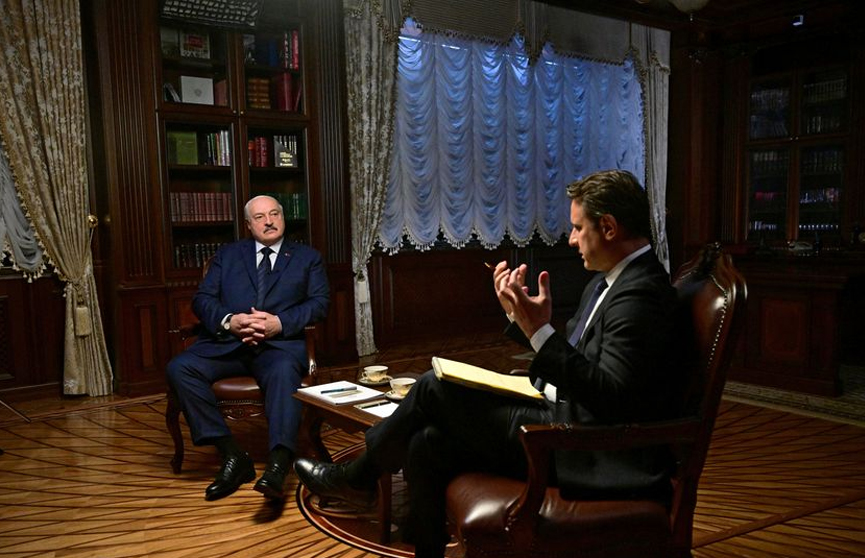
Alexander Lukashenko and Simon Shuster. Photo: ont.by
Evgenia Albats*: The American magazine “Time” published an article by its special correspondent Simon Shuster, based on his extensive interview with the Belarusian dictator Alexander Lukashenko. The essence: since January, Lukashenko has acted as a kind of postman between the Americans and Vladimir Putin. Lukashenko claims that Putin wants peace, he understands that he made a mistake by attacking Ukraine. It turned out that back in May, Simon Shuster was contacted by an aide to Alexander Lukashenko and asked how much his interview with Lukashenko would cost. This is actually how Shuster's article in “Time” begins. Simon, how much did they want to offer you?
Simon Shuster: I don't know. I immediately cut off this conversation and asked not to raise this topic again.
Evgenia Albats: You know what surprised me in the words of Lukashenko's aide? He said: “Well, I asked to avoid misunderstandings”. Have they already agreed with someone like that?
Simon Shuster: I don't know. I had the feeling that this person simply had little experience communicating with independent media and perhaps with Western media. A person who really communicates often and organizes interviews for the head of state knows that it is indecent to offer money to journalists. Apparently, this person was inexperienced.
A Balcony to Europe
Evgenia Albats: In the article, you write that contacts between representatives of the US State Department and the White House and Alexander Lukashenko began as early as January. And negotiations began at the initiative of the American side. Am I understanding correctly?
Simon Shuster: Yes, that's correct.
Evgenia Albats: Why did the American side decide to talk to Lukashenko, knowing that Belarus is a vassal state, completely dependent on Russia? Or, as you wonderfully write in your article, Belarus is a Russian balcony from which Russia observes Europe.
 Simon Shuster: The motivation for the Americans was related to the change in the White House. When President Biden was in power, US policy was very tough towards Belarus. Maximum pressure was often applied to it. With the help of sanctions, political and diplomatic isolation, they tried to pressure the Lukashenko regime to change its course and not support Russia in the war in Ukraine. This seems to have had the opposite effect. Lukashenko became only more dependent on Russia, the war brought these two regimes closer. In 2023, Russia even deployed nuclear missiles in Belarus.
In the State Department, there is an official, diplomat Christopher Smith, who saw that after Trump's victory, US policy towards Russia, Ukraine, the European region in general, and NATO would change. From Trump's statements, this was completely obvious. And Chris Smith, who is responsible in the State Department for American policy in Eastern Europe, including Belarus, Moldova, Ukraine, and so on, decided to check what role Belarus could play in Trump's new policy. It was clear that Trump would try to establish relations with Putin and quickly end the war in Ukraine.
Evgenia Albats: He speaks Russian, as I understand.
Simon Shuster: Yes, he speaks Russian well. A good specialist. And he contacted the Belarusian ambassador to the UN, Valentin Rybakov. A dialogue began, they started to look at each other and discuss how to resume this dialogue and what role Belarus and Lukashenko personally could play in normalizing relations or activating dialogue between Russia and the United States.
Evgenia Albats: Lukashenko tells you in the interview that “we are not conducting any negotiations behind Putin's back”. It's taboo to talk to the Americans behind Putin's back. So Smith contacts Lukashenko through the Belarusian representative to the UN, and Lukashenko immediately calls V.V. Putin and says: “Vova, the Americans want to talk”. Am I understanding correctly?
Simon Shuster: That's how I imagine it, yes.
Evgenia Albats: Then Lukashenko makes, so to speak, a gesture of goodwill and releases an American citizen from prison. Then he will release another American citizen who, apparently, is Belarusian by birth.
Simon Shuster: Yes, at the end of January. And this is before anyone from the Trump administration or from Washington meets with Lukashenko. Lukashenko, as a gesture of goodwill or as an invitation to dialogue, releases an American woman. Her name is Anastasia Newfer, she was released on January 26, and this greatly pleased the Trump administration. It should be noted that it was the first week after Trump's inauguration, his supporters were returning to the White House and looking for some victories, some obvious changes: Trump returned to the White House, and everything is getting better. And the release of Anastasia from Belarus was made into quite a big story. Secretary of State Marco Rubio himself wrote a post about how everything starts to change immediately after Trump's arrival, and this is the result of Trump's strong position. Honestly, I doubt Trump knew much about it. Nevertheless, the administration somehow visibly and brightly reacted to this gesture from Lukashenko. Because at that time, the Trump administration definitely wanted to show how great they are and how quickly everything in the world is getting better.
Evgenia Albats: Pretty soon, the Americans meet with Kirill Dmitriev and a couple of other Russian officials on the territory, I think, of Saudi Arabia. Meanwhile, contacts with Belarus, with Lukashenko, continue. Why?
Trump sees that Putin is deceiving him. That is, the direct channel through which he tries to achieve some understanding or peace agreement with Putin is not working. And this increases the cost and importance of the parallel channel with Lukashenko
Simon Shuster: To have a backup. It's always good to have a spare communication channel. That's how American diplomats explained it to me, who led this parallel channel. For several months at the beginning of this year, the direct dialogue channel between the White House and the Kremlin showed no results, and Trump gradually began to get angry, irritated. How come? I send Steve Witkoff to the Kremlin, Kirill Dmitriev came to the White House, the first high-ranking Russian official since the start of the full-scale war in Ukraine. Nevertheless, Russia continues to bomb, kill civilians, and only intensifies drone and missile attacks on all cities and the civilian population in Ukraine. Trump sees this and understands that Putin is deceiving him. That is, the direct channel through which Trump tries to achieve some understanding or peace agreement with Putin is not working. And this increases the cost and importance of the parallel channel with Lukashenko.
Evgenia Albats: You write that there were five meetings with Lukashenko.
Simon Shuster: Yes.
Evgenia Albats: Did Lukashenko tell you in the interview how one meeting differed from another? What were the Americans trying to convey to Putin through Lukashenko? What were they passing on? You write that Lukashenko is constantly whispering something to Putin. Probably, this feeling arose when there was a story with Prigozhin, supposedly it was Lukashenko who negotiated with Prigozhin to stop his march on Moscow. You had 15 sources you spoke with, what were they trying to convey through Lukashenko, what were they trying to convince Putin of?
Simon Shuster: Lukashenko told me one specific example. The Americans tried to understand through Lukashenko why Putin couldn't even stop bombing for two weeks, make a pause in these terrible strikes on civilians in Ukraine. This does not contribute to the peace process, does not allow the peace process to move from a dead point, and this irritates Trump. And the Americans ask through Lukashenko: what's going on? Why can't Putin at least make some pause, do something, some gesture that he is ready to move forward to peace? Lukashenko called Putin and returned to the Americans with certain signals and answers. In that case, the answer from Putin was: it's the Ukrainians who are bombing us, we are responding to them. In general, this could be expected. I don't think it was any surprise for the Americans, but there was such a dialogue. And through Lukashenko, such signals and messages were transmitted.
“Putin is good”
Evgenia Albats: Lukashenko tells you, and he conveyed this to the Americans, that in fact, Putin wants peace, that he is ready to make some concessions. I am completely convinced that Putin simply needs a break. You yourself write in your article that in July there was a drop in oil and gas revenues by 26 or 27 percent. The National Welfare Fund has been spent by 70 or even 80 percent. There is a problem with hiring contractors. Did Lukashenko somehow explain why, if Putin wants peace, he launched over 6500 missiles and drones at Ukraine in recent months?
Simon Shuster: Only in July.
Evgenia Albats: Just an incredible number.
Simon Shuster: It's a record. This was the main essence, the main topic of this long-running dialogue — how to arrange such a summit between Trump and Putin, which is supposed to take place this week in Alaska.
Evgenia Albats: Do you think it will take place?
Simon Shuster: I try not to predict the future. But according to the latest statements, it should take place. The main topic of discussion, if summarized — under what conditions and how to organize such a summit to end the war. When the direct channel stalled and Trump switched to a tougher policy towards Russia, and began to threaten Putin, and publicly scold him, and in recent days began to impose sanctions or tariffs, that is, noticeably toughened his policy, — then messages through parallel channels, through Lukashenko began to arrive even more actively: no-no-no, you are misunderstanding everything, Putin is kind, Putin is good, Putin wants peace, let's negotiate. These signals through Lukashenko clearly reached the White House. And what effect? They actually gave Putin more time to continue the summer offensive and seize more territories. That is, before the start of peace negotiations, he needed time to squeeze, steal, take more Ukrainian lands. And this was done, among other things, with the help of signals through Lukashenko and through other channels, that no-no-no, don't be angry with us, don't impose sanctions, no tariffs are needed, let's talk, Putin wants peace.
Evgenia Albats: So Putin used Lukashenko for the purpose of disinforming the Americans?
Simon Shuster: Yes. You could say that. I won't say that the Americans believed him at his word. They are not fools either. But they were looking for ways out of the situation. Trump set the task to end the war in Ukraine. He made this very clear. He promised this to his voters during the election campaign. Well, and his entire team is trying to somehow achieve this. But they don't understand how to do it when Putin continues to bomb the civilian population in Ukraine. Lukashenko was one of those who gave them hope that it would still be possible to agree with Putin. Despite all of Trump's grievances and attacks from Medvedev, and even nuclear threats from both sides, Lukashenko says that it is possible to talk with Putin. Lukashenko explained to his American interlocutors: guys, you just don't understand how to talk to Putin properly. I know him better than anyone, I'll tell you how to do it. And he told the Americans in personal meetings that you need to be careful with him, you need to treat him with respect, and the tone of communication is even more important than the content. Because Putin needs to save face, he can't look weak, Americans should take this into account when building their policy and plans for conflict resolution.
Lukashenko did not really want to go into details. It's not his role. He is a mediator. It's not for him to decide. The big guys, Trump and Putin, should get together and draw some line on the map
Evgenia Albats: But the same Lukashenko says that Ukraine will have to give up four occupied territories. At the same time, the Russians have not yet fully taken the Donetsk region. Kherson is in the hands of Ukraine. In Zaporizhzhia, Russian troops control the Zaporizhzhia NPP, but most of the Zaporizhzhia region is in the hands of the Armed Forces of Ukraine. Did you ask Lukashenko how Ukrainians can give up regions that are part of Ukraine and inscribed in its Constitution?
Simon Shuster: We discussed this in detail, I asked him about specifics. Which regions, what concessions is Putin ready to make. Lukashenko did not really want to go into details. It's not his role. He is a mediator. It's not for him to decide. The big guys, Trump and Putin, should get together and draw some line on the map. This is his view of things. He did not describe anything in detail, because this might have limited his patron, partner, big brother Putin in conversation with Trump.
But one moment I will emphasize, it was quite interesting and unexpected for me. Lukashenko said that Zaporizhzhia and Kherson have always been historically Ukrainian, originally Ukrainian. According to the rhetoric of Putin and Lukashenko, Donbass is originally Russian lands. He clearly emphasized in his rhetoric the difference that Zaporizhzhia and Kherson are not Russian lands. It doesn't have real historical significance, it's just rhetoric, labels they put on this or that territory depending on whether they want to steal it or not. But here he said that these two regions have always been historically Ukrainian. Perhaps hinting that Russia might withdraw its troops from these regions. And Trump said at the end of last week that there might be some territorial exchanges. He did not specify which, but perhaps in Alaska they will discuss this.
Evgenia Albats: Yes, but in the American and world media, it is discussed that when Witkoff spoke with Putin, there were no people who would record this conversation. Perhaps Witkoff misunderstood Putin and incorrectly conveyed to the White House that Putin is ready to give up the Kherson and Zaporizhzhia regions. Trump insists that there will be a territorial exchange. That is, Russia will request all four to the maximum, but may roll back and be satisfied with Donbass?
Simon Shuster: Yes, this is one of the possible outcomes. I think so. But it depends on Trump, how well and effectively he will conduct negotiations and pressure Russia. Not just accept Putin's terms. It's very sad that this is all being done without the direct participation of Zelensky. Rubio said that perhaps they will invite Zelensky there. But this format, where two superpowers gather and decide the fate of Ukraine, is simply terrible, it's humiliating, it contradicts the main principle of the West that there are no spheres of influence, and the basic principle of Ukraine that nothing about Ukraine should be decided without its participation. Nothing about Ukraine without Ukraine.
A New Deal
Evgenia Albats: Financial Times published a column by its international observer Rahman, in which he compares the meeting in Alaska with the Munich Agreement, when the fate of Czechoslovakia was decided without Czechoslovakia. This is the main thing that the meeting in Alaska resembles. Nevertheless, Trump is going for it. If Ukraine does not agree to give up four territories, can Trump say that Zelensky does not want peace, and since he does not want peace, we will not give him weapons? That is, simply force Zelensky to make some decisions.
One should not underestimate Zelensky. He is quite powerful, cunning, and smart player. He is already an experienced military leader and diplomat. He can also send everyone away if he is pressured
Simon Shuster: Perhaps there were such attempts in the spring. After the scandal in the Oval Office, the Americans stopped military aid and even stopped the supply of intelligence from the US to Ukraine, which hit the Ukrainians very hard. These levers of pressure have already been used, and this can be repeated. But Zelensky has quite a lot of subjectivity. He can also say no, guys, we do not accept these conditions, according to the constitution, it is impossible to give Ukrainian territories to anyone, he has no such right. Even if at this stage Putin and Trump are trying to push him aside, one should not underestimate Zelensky. He is quite a powerful, cunning, and smart player. He is already an experienced military leader and diplomat. I think he can also send everyone away if he is pressured in this way. A fundamentally important part of his character is stubbornness. He reacts very poorly to external pressure, it causes a backlash. If such ways of pressure on Zelensky are undertaken, it does not mean that he will raise his hands and say: “Okay, since you decided so, then so be it”.
Evgenia Albats: Putin is always bluffing. This is what he was taught in intelligence school and what he has been doing all his life. He is always bluffing, he is always lying. Do the Americans understand who they are dealing with? Or does the illusion that Vladimir is so wonderful, strong, and can be dealt with still prevail in Trump's White House?
Simon Shuster: There are different voices in Trump's entourage. For example, Chris Smith in the State Department has a very sober view. He is a staunch supporter of Ukraine, he has very close and good relations with Zelensky's team. So he, I think, knows who he is dealing with both in Minsk and in the Kremlin. There are others, I would say, less experienced people close to Trump who are involved in the diplomatic process, who have no experience in diplomacy, but they are trying to end the war and cling to any hopes or proposals from Putin or Russia. They have no idea what Kramatorsk or Slavyansk is and why they need to fight on the side of Ukraine for these two cities. There are representatives of the Trump administration who participate at a very high level in the negotiation process, who are more focused on a quick solution. They need to fulfill Trump's promise to quickly end the war.
Evgenia Albats: So they are ready to pressure Zelensky?
Simon Shuster: Yes.
Evgenia Albats: Does Smith have access to Trump?
Simon Shuster: No. Smith began to establish a channel through Lukashenko and led this dialogue, but he gradually involved higher-ranking diplomats and those close to Trump. One of them is John Cole, a former lawyer for Trump. He can call, go in, text the president. And he also came to Lukashenko at the request of Chris Smith. That is, diplomat Smith involved people in this process who have access to the Oval Office.
Evgenia Albats: In Russia, it has always been customary to think that if an official goes public, to the media, it means that this official has lost access to the ear of the first person. Does the fact that Lukashenko went to the media with a story about his participation in negotiations between two great powers not indicate that the White House has lost interest in this channel of contacts with Putin?
Simon Shuster: No, I don't think so. These contacts continue even now. Certainly, contacts between Lukashenko and Putin continue. We saw their meeting after my interview, a few days later, in a monastery on Valaam. I think Lukashenko decided to do this, as he explained to me himself, to “stir Trump up”. When he gave me the interview, Trump was very much changing his policy towards Russia and preparing sanctions. He was already beginning to apply sanctions against Russia and India, which buys Russian oil. And Lukashenko wanted to stop this in every possible way, that is, to pressure Trump through the American public or the media, so that Trump would calm down and return to dialogue, closed or open, so as not to start punishing Putin, but to continue communication. We all see and understand that in this way, Putin and Lukashenko were simply buying time for Russian troops to advance.
Without a Record
Evgenia Albats: You write that for his American guests, Lukashenko served lunch. There were potato pancakes, we call them latkes.
Simon Shuster: Draniki in Belarus.
Evgenia Albats: And what did Lukashenko treat you to?
Simon Shuster: We didn't have lunch together, after the interview we talked for quite a while in the same room, but we didn't have lunch afterward.
Evgenia Albats: So you had a conversation without a record? Didn't you ask why he doesn't release Maria Kolesnikova?
Simon Shuster: I asked on record about Kolesnikova and other political prisoners, and then I also asked about it, we discussed an extensive list of political prisoners. How did he respond? He said that “we have already made so many gestures of goodwill to you, released so many political prisoners, let's have you respond with something good”. That is, he continued to bargain. It seemed to me that he believes that it's time for the Americans to respond either by lifting sanctions or... well, he quite specifically described various options for what he wants from the Americans before releasing Kolesnikova.
Evgenia Albats: So is release possible soon?
Simon Shuster: To this question, he said: “anything is possible”.
Evgenia Albats: Lukashenko told you that his KGB guys collected a file on you. What was in this file?
Simon Shuster: I don't know. He didn't show me this file. This is apparently his usual greeting to foreigners. He said the same to Chris Smith when he first came in February. I don't think there are any top-secret information there. The only thing Lukashenko told me from this folder is that I was the editor of a student newspaper at the university. This is not true, but this mistake is on my Russian-language Wikipedia page. I was one of the editors, but not the main one, as it says in Russian Wikipedia. So I don't know what sources the KGB agents used, or who prepared this dossier for him.
Evgenia Albats: You write that getting to Belarus is very difficult because the sky is closed. You flew to Lithuania and from there traveled by car.
Simon Shuster: No, by bus. I wanted to see — what it's like for people crossing the border. What it looks like. How thoroughly they are checked — both the Lithuanian side and the Belarusian side. It was interesting to see what it looks like from the side of ordinary people who are forced to cross the new iron curtain that hangs between Belarus and Lithuania now.
Evgenia Albats: And how were you checked?
Simon Shuster: Thoroughly, but... There was a rather amusing conversation when I and other passengers of this bus had already crossed the Lithuanian side of the border. We came to the Belarusian side, there they were already checking my American passport. There are a lot of stamps, and there is Ukraine. I have been to Ukraine many times over the past few years during the war, especially in 2022. Well, and this woman who checked, saw this and said: please come with me. We went to the interview room. They also looked at my passport there. Well, they communicated politely, everything was fine. They asked the purpose of the visit. I said that I was going to interview your president. And I asked: should I say hello to him from you? They said: no-no-no, thank you, no need. And then one of these people went to another room. Apparently, he called someone, was absent for quite a while, then returned and gave me the passport, said that everything was fine, go ahead. Everything was polite, but I think they checked who this strange American was, who was supposedly going to interview the president. When they confirmed this information through their channels, they immediately let me in.
Evgenia Albats: You know that there is a hunt for American passports to replenish the exchange fund. Weren't you afraid that you would be detained for proximity to Zelensky on the territory of Belarus, they would come up with something there... Did you receive guarantees that you would not be arrested?
Simon Shuster: Of course, I was afraid of this, my wife and I were preparing for such a danger. In my article, it is described how Lukashenko uses his prisoners in prisons, including American citizens, as a bargaining chip. He gives them away to establish dialogue. That is, for him, these are very valuable coins. So, of course, I realized that this could happen. I communicated with American and European diplomats, including about the danger of my detention there. In general, they told me that if you are going at Lukashenko's invitation, for an interview, it is unlikely to be dangerous. One diplomat even told me that there is no risk at all. But I believe there was a risk, especially since I know how they treat me in Russia. My book is banned in Russia. I have a ban on entry. We don't know if there is a criminal case against me, and if there is such a case or an arrest warrant in Russia, then Belarus would be forced to and would want to arrest me and extradite me to Russia. That is, this should be taken seriously. As for security guarantees, this was also an interesting experience. Many diplomats and experts who go to Belarus participate in establishing dialogue, try to find out something through their channels. And many in recent months, when this dialogue intensified, also poured into Minsk. I communicated with them and asked the question: did you receive any security guarantees when you first started going there? One said yes, he did. I ask, what does it look like? He said it's just a phone call to a person from the KGB or the Ministry of Foreign Affairs. And they tell you that no, no, no, we are not going to arrest you. But this will not save you. I discussed this with representatives of the Lukashenko administration and mentioned the case of Evan Gershkovich. Of course, they said that no-no-no, don't worry, we invite you, and everything will be fine. But I had no experience communicating with these people, I had no trust in them. So yes, it was worrisome.
The Triumph of the Big Guys
Evgenia Albats: You write in the article that your condition was that there should be no questions that you cannot ask. But we are professional journalists and know that during an interview there are all sorts of situations. Were there situations where Lukashenko was irritated? Were there questions that he refused to discuss with you on record, but was ready to answer off record?
Simon Shuster: Yes, there were such questions. I can't disclose because overall I really appreciate his approach, that he was really ready to answer all questions. And he talked to me for a long time. And in advance, his team said that there are no problems, you can discuss any topics. This is quite rare now. Especially if you are talking to the head of state, no matter where. Most often, the press service tries to somehow limit you or understand what the journalist will ask about. Well, somehow control for self-preservation. But here there was none of that at all. They said — ask any questions. Yes, some of them caused a more emotional reaction from Lukashenko. For example, I asked about the possibility of a Nuremberg trial at the end of this war, where war criminals would be tried. When I said that Ukraine would never forgive him, including for this war.
Evgenia Albats: Not forgive Lukashenko?
Simon Shuster: Not only Lukashenko, I listed who Ukraine would not forgive. And he reacted normally, he is an experienced person, he gave an interview to my friend and colleague Steve Rosenberg from BBC, Steve also asks very tough questions, does not hesitate. Lukashenko is used to this, he felt quite confident in communicating with me.
It's sad to see how, with the help of Lukashenko, Putin managed to push aside or repel both Zelensky and the Europeans from the negotiation process. And that Trump went along with it
Evgenia Albats: Is there anything I didn't ask you that you would like to add?
Simon Shuster: We discussed everything in great detail. But I would like to emphasize once again how sad it is to see how, with the help of Lukashenko, Putin managed to push aside, repel both Zelensky and the Europeans from this negotiation process. And that Trump went along with it. If the summit in Alaska takes place on Friday and there is no one there except Putin and Trump, then this, unfortunately, will be a great success for Putin and Lukashenko, who persuaded the Americans that we don't need these Europeans, we don't need this Zelensky, let's, we big guys, get together and decide everything... It's sad that the world is arranged this way.
Reference
Simon Shuster was born in the Soviet Union, then his parents moved to the United States of America. He speaks Russian well. He worked in Russia for many years until he was expelled for publications that did not suit the Kremlin. In recent years, he has written a lot from Ukraine and about Ukraine. He wrote a book about the President of Ukraine Volodymyr Zelensky.
Video version
* Evgenia Albats is declared a “foreign agent” in the Russian Federation.