Eugenia Albats*: Why did the federal government attack Harvard University, the oldest and richest university in America, freezing $2.3 billion in funding for fundamental research and threatening obstacles with issuing visas to foreign students? Why? What is the goal?
What the Trump administration is trying to implement is a cultural revolution related to the fact that the majority of the United States population, its ideological composition, and worldview are very unsatisfactory to this administration and the forces it represents
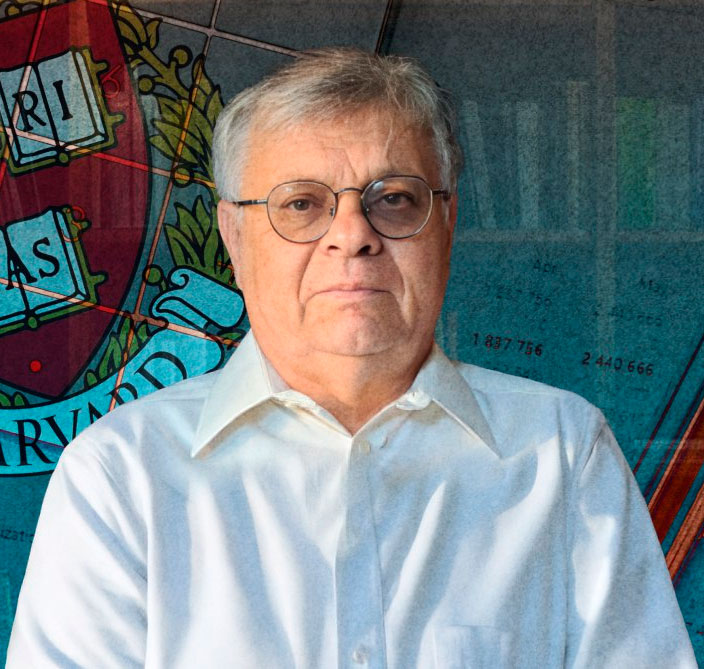 Eugene Shakhnovich: We can only speculate here, so what I will say are my assumptions, guesses, and, as they say here, speculations. Because the declared goal — the fight against anti-Semitism — does not hold up to any criticism. We can talk about this, and I will say why I think so. What the Trump administration is trying to do is globally change the higher education system in the United States so that it produces people who ideologically and worldview-wise are more suitable for this administration. And why Harvard? It is obvious because Harvard is the most famous, the richest university in the United States, known worldwide. Therefore, Harvard is not an easy prey, but an obvious target. From my point of view, the attempt to arrange a cultural revolution in the country is primarily aimed at the higher education system, at universities, at how young people are taught in the United States.
Biden invented all this...
Eugenia Albats: There were rumors in American blogs and even in some media that the reason Trump attacked Harvard University was that Harvard refused to admit Trump's youngest son to college. Can you confirm or deny this?
Eugene Shakhnovich: I cannot confirm or deny it. I talk a lot, communicate with my colleagues, and I think some information from the circles I communicate with would have leaked out. I haven't heard anything like that even remotely. There is another version, which is much more likely: it's his war with the Pritzker family. Penny Pritzker is the chairman of the Harvard Corporation, the main executive body that plays a significant role, particularly in appointing the president of Harvard. Trump has a long history with the Pritzker family; they had some business deal that fell through, he believes they deceived him, and so on. It's pure business; he hates them. He is a very vindictive person and, as is known, forgives no one. Unofficially, there are talks that the possibility, at least partially, to resolve the conflict between the administration and the university is to replace Pritzker with someone else as the head of the corporation.
Eugenia Albats: It can also be said that the governor of Illinois, billionaire Pritzker, is also from this family. And he also speaks sharply critically of the current president of the United States. But Trump is not a pioneer in trying to tell private universities what and how they should do. I would like to remind you that in 2021, President Democrat Joseph Biden, the previous president of the United States, stated that the issuance of federal grants, that is, federal government money, should be linked to compliance with the principle of DEI — Diversity, Equality, Inclusion — diversity, equality, and inclusion. This program provides some advantages, some help primarily to racial minorities. How is Trump's attack different from Biden's attack?
Eugene Shakhnovich: I am equally categorically against Biden's attack. That is, I don't care who does it — Biden, Trump, or someone else; I am fundamentally against such government interference in university affairs. From my point of view, these are equally unacceptable actions. The difference is that the Biden administration followed a certain protocol based on a law passed during President Lyndon Johnson's time, which formally prohibited discrimination in educational institutions — based on gender, racial, ethnic, religious grounds. The Biden administration felt that not enough attention was being paid to helping minorities, in response to which DEI offices appeared at the university, a bureaucratic structure that had to be formally acknowledged, but in general, it had no influence on university decisions. Although in my view, its presence was highly negative and pointless.
Eugenia Albats: Well, how could it be pointless if you, professor, along with a number of other Harvard University professors, created the Council for Academic Freedom, the Council for the Protection of Academic Freedom.
Eugene Shakhnovich: Precisely because it is pointless, precisely because another administrative unit was added, which brings no benefit, no use to the university. There were ridiculous requirements, for example, that a person applying for a professorial position had to write a DEI statement. That is, they had to pass a political litmus test. You apply for a position as a chemistry professor, but you have to write a special essay on how you will help minorities. That's the kind of thing our Council of Academic Freedom of Harvard arose to oppose. In the end, even before Trump came to the White House, the requirement to write these DEI statements when applying for a professorial position was canceled. So we managed to achieve something. We also participated in the story of the resignation of <Harvard president> Claudine Gay (due to her position on anti-Semitism on the Harvard campus. — NT).
I just want to say that such issues should be resolved internally, not through external influence.
How is Trump and his administration different? The pretext for their actions was real, or fictional, or a mixture of both, anti-Semitism at the university.
Eugenia Albats: That is, a violation of the law article prohibiting discrimination based on religion.
Eugene Shakhnovich: Yes, exactly. Discrimination based on religion is prohibited, and if the university violates the law, then claims can be made against it and this process can be conducted. The number one claim against the Trump administration is that there was no process. They did not make any specific claims, specific examples of anti-Semitism, etc. The process under the article against discrimination involves quite a few steps. It must necessarily include arbitration, there must be an independent arbitrator, a judge, who determines whether the law was violated or not. And much more.
Two weeks after the accusations were made, on April 11, a letter came from the administration, which in an ultimatum form said that the university must do this and that, otherwise all funding would be canceled. At the same time, the letter is notable for containing impossible and internally contradictory requirements. For example, that student admissions, professor appointments should be merit-based, that is, based on merit, in itself a wonderful requirement, but at the same time, some government commissions or overseers and auditors were proposed as arbitrators. I absolutely cannot imagine how this can work, and it smelled a bit like the CPSU.
On the other hand, while demanding a merit-based approach, they insist that conservatives and liberals be equally represented. That is, they establish ideological quotas. Therefore, the algorithm of the university's actions is not very clear: even with the utmost goodwill towards the administration, it is not very clear what steps need to be taken to meet these requirements. And this is the difference between Biden's and Trump's. Biden at least had some reasonable algorithm by which you fulfill the requirements, and after that, the funding continues. Here, it is not even clear how to respond to this letter, only yes, sir. Therefore, it feels like we are in some kind of wonderland, where the rules are constantly changing, and the game is played by rules known only to one side.
Group consciousness
Eugenia Albats: Not in the order of dispute, but just to note that there are other points of view. The current president of Harvard said that he personally experienced anti-Semitism from some representatives of Harvard University, and not only students. Second: recently there was a discussion between the past president of Harvard Larry Summers, who was "eaten", and Alan Dershowitz, a famous lawyer and professor of law school, a very conservative person, in which they both agreed that the level of anti-Semitism at Harvard has sharply increased. And considering Harvard's history, where until 1947 there were quotas for Jews, that is, the admission of Jews was limited, this is especially concerning. The third argument is that in December 2024, on Hanukkah, the rabbi was told that he should remove the menorah, which is always placed near the memorial church, a common church where people of different faiths can gather and conduct their service. Allegedly, the university cannot guarantee protection if something unpleasant happens. Finally, on the steps of Harvard's main library, there were constantly posters "Zionists out of Harvard!" And the last argument — in the same tent city, which was set up in the main garden of Harvard University, in front of the statue of the university's founder John Harvard, there were posters with the famous slogan From the river to the sea Palestine will be free, that is, "from the river to the sea Palestine will be free". From the river to the sea means throwing Jews into the sea, this is the destruction of the state of Israel. In this sense, the Trump administration's claims that the law on the inadmissibility of religious persecution was violated at Harvard University are generally justified.
Eugene Shakhnovich: I will not argue, all these facts with interpretation a little here, a little there took place. The problem is as follows: I do not know the answer to the question of how to fight this. The trouble is that the attitude towards Israel in American society, and not only at Harvard University, is alarming and saddening. What we see in universities is a reflection of public sentiment, which is now, unfortunately, anti-Israel in Western society.
Eugenia Albats: The Trump administration is fighting woke culture. What is it?
Eugene Shakhnovich: It is the same cultural revolution, but the opposite. It's better to show it with examples. Example number one — from Harvard. We had a biologist Carol Hoeven, very qualified, very strong. She taught a course in the biology department on yeast, and in particular, she had a lecture on yeast reproduction. Well, she said that they have two ways of reproduction, including sexual reproduction, where there are two types of yeast, like two sexes. And suddenly there was a strong opposition, a movement among students about how she offended some LGBTQ who are non-binary, that is, cannot identify themselves as either male or female, and by stating that yeast has two sexes, she offended these people.
Eugenia Albats: And they compared themselves to yeast?
The central thing in woke culture is that it is group-based. You fight not for yourself as an individual, but for some group of "humiliated and insulted"
Eugene Shakhnovich: Sort of. I don't know what was in their heads, but they were terribly offended. They started to protest, to picket the biology department, to walk around with some posters. It ended with the administration going along with these students, and the excellent lecturer Carol Hoeven was not renewed her contract, she had to leave the biology department. This is woke — some completely absurd hypersensitivity of some people arises. Example number two: students boycotted a course on modern methods of police work in fighting crime, to which the head of the Cambridge police was invited to teach. And all because the Cambridge police are considered "racist", allegedly punishing racial minorities more than whites. The course was canceled. These are examples of people experiencing some kind of hypersensitivity when completely normal manifestations of human activity are perceived through the prism of some deep grievances for one or another group of the population.
The central thing in woke culture is that it is group-based. You fight not for yourself as an individual, but for some group — non-binary people in sexual relations, a racial minority, etc. Groups gather in packs and defend their interests. This is a certain cultural environment in which we revolve among young people. I don't think it is imposed from above. All such manifestations usually come from below. The university's fault is that it indulges in this. There was no resistance to the woke culture, which is imposed in university dormitories, in the student environment, the university did not provide, at least in the past. And this, by the way, is another reason why we have the Council of Academic Freedom. Because there was a feeling that we should not go along with either the students or some bureaucrats from the administration, but we should show will and speak with our own voice. And this arose in response to woke manifestations when people are evaluated, sorted by group criteria. The individual is completely lost in this culture, and a person's identity is determined only by their relation to one or another group. This is a replacement of individuality with a group.
Eugenia Albats: Let's say that woke culture is translated as "awakened culture". The idea is that some groups of the population were oppressed, which was the case in the United States concerning racial minorities, concerning the black population, concerning Native Americans, with which serious struggle began with the decision of the US Supreme Court in 1948 and then continued with the laws of 1964. It is clear that queer culture, LGBTQ culture was also suppressed and oppressed for a long time, and therefore people feel that now they should take their own.
The state's refusal to fund science is a "bomb Voronezh" scenario because science funding is needed not by professors receiving a grant, not by departments and faculties — it is needed by society
At Columbia University, anti-Semitic sentiments and leftist protests with the transfer of the Israeli government's blame to all Jews were especially harsh. But Columbia University, which was also attacked by the Trump administration, made serious concessions. It can even be said that it knelt in exchange for the return of $1.3 billion in funding. This is state funding for research, not education (just as Harvard had $2.3 billion frozen specifically for research grants). So, in exchange for this, the university promised, first, to pay $200 million in fines to the federal government over three years. Another $21 million for closing the lawsuit against the university for religious-based harassment. As I understand it, the federal government got the opportunity to monitor university admissions and hiring procedures and intervene if it believes the university is again violating the principle of merit-based hiring, not based on ideology. For example, the appointment of the head of the Middle Eastern Studies department at Columbia University was approved by officials from Washington. Another famous Ivy League university, Brown University, which is located in Providence, also made serious concessions and agreed to return to admitting students and hiring staff based on knowledge and professional achievements. In turn, Harvard University fired the head of the Middle Eastern Studies department and closed several courses that were openly anti-Semitic and funded by grants from the Emir of Qatar. The White House proposed a $500 million fine, and Harvard President Allen Garber just announced that he would not agree to this. How do you assess the decision of your colleagues from Columbia and Brown universities?
Eugene Shakhnovich: I assess this negatively overall because it is the wrong approach. Today Trump is in the White House. Tomorrow, God forbid, there will be <leader of the "progressive democrats"> Alexandria Ocasio-Cortez... Or someone like that. So today they will fight anti-Semitism, and tomorrow, for example, President Sanders will say that non-union members are not entitled to any funding. Or the same Cortez will say that whites cannot be funded because they participated in slavery, and so on. I believe these are arbitrary actions. And there is another point, it may sound unpleasant, but it is my firm belief that a person in the United States has the right to shout any slogans.
Eugenia Albats: This is guaranteed by the First Amendment.
Eugene Shakhnovich: The alternative to this is an article for inciting hatred, like in Russia. The example of Russia shows that freedom can be either complete or none. You can't be half-pregnant in terms of freedom, you understand? Therefore, despite my disgust for these slogans, I believe that people, including on university campuses, have the right to shout them. But there must be certain rules where this is allowed, like Hyde Parks. The First Amendment allows speaking! As I said, our political pendulum will swing, and at some point, it will swing to the left, and then no one should complain that some Ocasio-Cortez will make us all march under red flags through Harvard Yard, or else we will be deprived of funding. Therefore, the decision of Columbia and the decision of Brown seems to me, in general, very tragic.
Eugenia Albats: What were they based on?
Eugene Shakhnovich: They need to get funding because their laboratories are falling apart. You see, the state's refusal to fund science is a "bomb Voronezh" scenario because science funding is needed not by me when I receive a grant, not by departments and faculties — it is needed by society. Society has decided that it needs science. And this is a process in which society participates, starting with Congress and ending with scientists who sit on these panels and decide who to give, who not to give a grant. When we engage in science with the help of state funding, we bring benefits to society. We make our American society richer in many ways. By stopping funding scientific research, the administration and society as a whole are shooting themselves in the foot. That's what Columbia was based on, they needed to ensure that laboratories did not fall apart, that people did not leave. And we are in a similar state, a little better, we have a little more money, but still. They did this to prevent American science from collapsing in one particular place, in this case at Columbia University. If this continues for a long time, it will collapse at Harvard University, it will collapse in any other, in the end, it will be bad for society. Biological research, research in the field of physics are under threat. And if we do not have these studies, we will turn, as they said about the Soviet Union, into Burkina Faso with missiles. Therefore, I understand what the Columbia University administration was based on, but I consider this decision tragic and having very long-term consequences as a precedent.
Harvard and foreigners
Eugenia Albats: A federal judge in Boston, Massachusetts, who was hearing Harvard University's lawsuit against the federal government over the freezing of billions for research, indicated that she is inclined to support Harvard. This was literally two weeks ago. In response, the administration threatened Harvard that it would not issue visas to foreign students and teachers. How much will the federal government further hinder Harvard's international office from sponsoring visas? I am a person with a foreign passport, so our Harvard International Office warns about problems that may arise. How serious is this restriction for Harvard? And what goals does the US State Department pursue?
Eugene Shakhnovich: If this is indeed implemented, it will be a severe blow, just a punch to the gut. Because the overwhelming majority of students and graduate students in all scientific faculties are foreigners. What is the government guided by? I think this is another way to prick, to hit. This is such a war, in which, as they say, all means are good. But this is another version of "bombing Voronezh", because these people make American science. American science, like European science, is done by the hands of graduate students. They sit and pour liquids into test tubes, they calculate on computers. If these people do not come (and they cannot be replaced by Americans because for a number of reasons there is very poor education in America now, there are not so many qualified people to be found) it will be a big blow to scientific research.
Eugenia Albats: 25% of Harvard students admitted each year are foreign students. Donald Trump stated that by admitting so many foreign students, Harvard University reduces the likelihood of American students getting into the best university in the world. How fair is this?
Eugene Shakhnovich: It is fair in the sense that it does indeed increase competition for American students. But because of this, those who come to Harvard to study both in college and even more so students are absolutely the cream of the crop. They are of the highest class, and the level does not deteriorate. I have been teaching at Harvard for 35 years, and during this time I do not see any trends towards deterioration, students and graduate students are of very high quality. Are they Americans or not Americans? In every way. There are many American citizens who are ethnically of Asian origin. We do not separate them, we absolutely do not care, even if they are from the moon. By creating some artificial obstacles, quality cannot be improved. We have already gone through this, we know this both from the Soviet Union and from North Korea. If someone is restricted access to competition for a place in the best university, it means that those remaining with less competition will be worse. The less competition, the worse the quality.
Eugenia Albats: What is your forecast, professor, how will this confrontation end? Will Trump break Harvard or will Harvard defeat the federal government?
Eugene Shakhnovich: I think it will end in a kind of draw. In the sense that there will be some kind of agreement, but maybe not like Columbia University, maybe a little differently: formally there will be some equivocations towards the administration, and maybe not very formally, they will conclude some kind of deal, as Trump says, and life will return more or less to normal. With changes — for example, there will be no DEI, which, in my opinion, is good.
Eugenia Albats: It's already gone.
Eugene Shakhnovich: But it won't arise.
Eugenia Albats: Will they allow a federal overseer?
Eugene Shakhnovich: No. As far as I understand Trump, the main thing for him is not substance, but image. And there may be some vague phrase about us giving something, some statistics, information about something. He will announce that this is his giant victory, and at the same time, little will change. But real overseers who will have the right of veto or even a serious right to voice, whom to appoint, whom not to appoint, whom to admit as students, whom not to admit as students, I think Harvard will not allow, and it will have the resources to resist. But I repeat, there will be some version of the deal, when both sides will declare that they have won, and then everything will go its own way.
Video version:
Reference:
Eugene Isaakovich Shakhnovich — a graduate of the Faculty of Physics of Moscow State University. After graduating from the Faculty of Physics at MSU, he worked at the Institute of Protein of the USSR Academy of Sciences. In 1990, he came to the USA for graduate studies at Harvard University, was a student of the 2013 Nobel laureate Martin Karplus. In 1997, Professor Shakhnovich became a full professor, that is, received a lifetime contract at Harvard University. He became a professor in the Department of Chemistry and Chemical Biology, and since 2019 — head of the department, also heads the Laboratory of Molecular and Evolutionary Biophysics. Author of about 500 articles and founder of a number of very successful biotech companies.
* Eugenia Albats is declared a "foreign agent" in the Russian Federation.
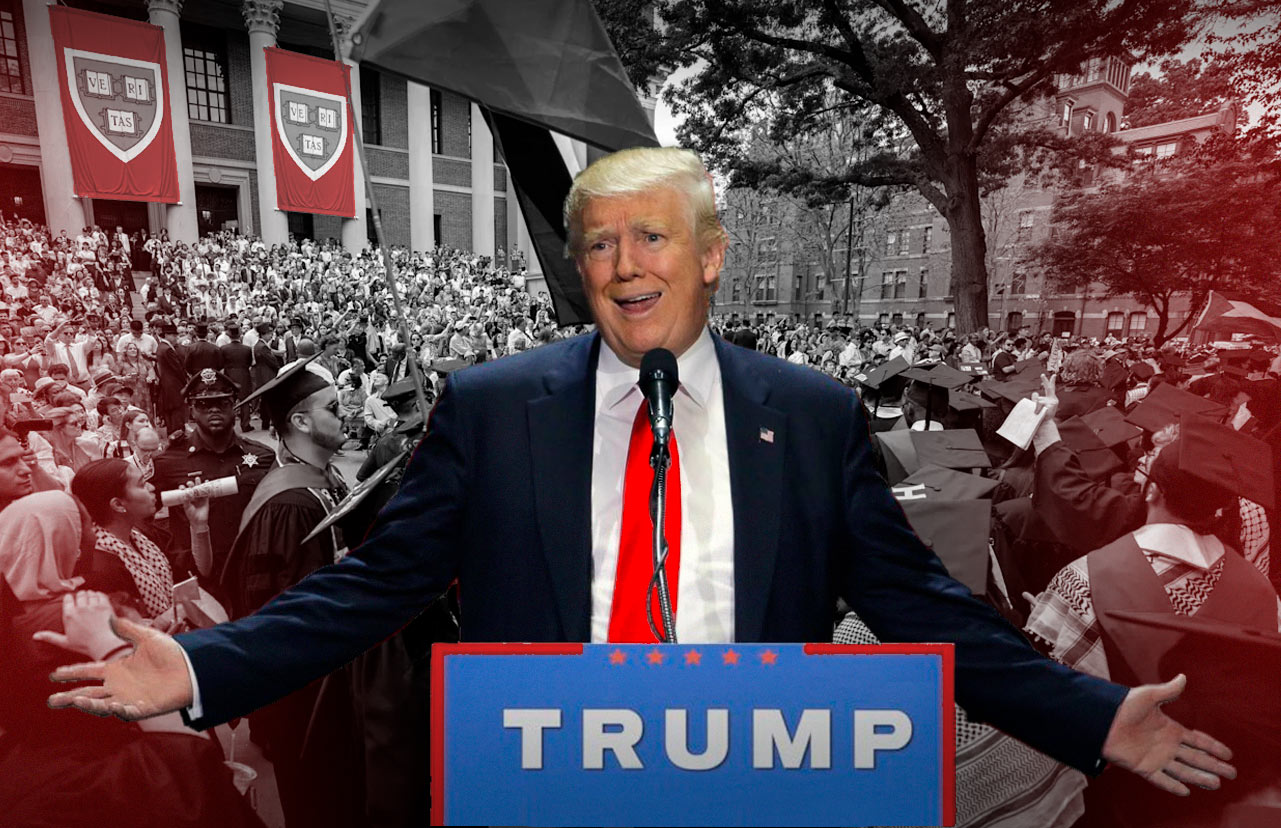
Photos used in the design: student demonstration at Harvard University, May 2024 (AP Photo / Ben Curtis); Donald Trump at a rally in the USA, Florida (AP Photo / Chris O’Meara).