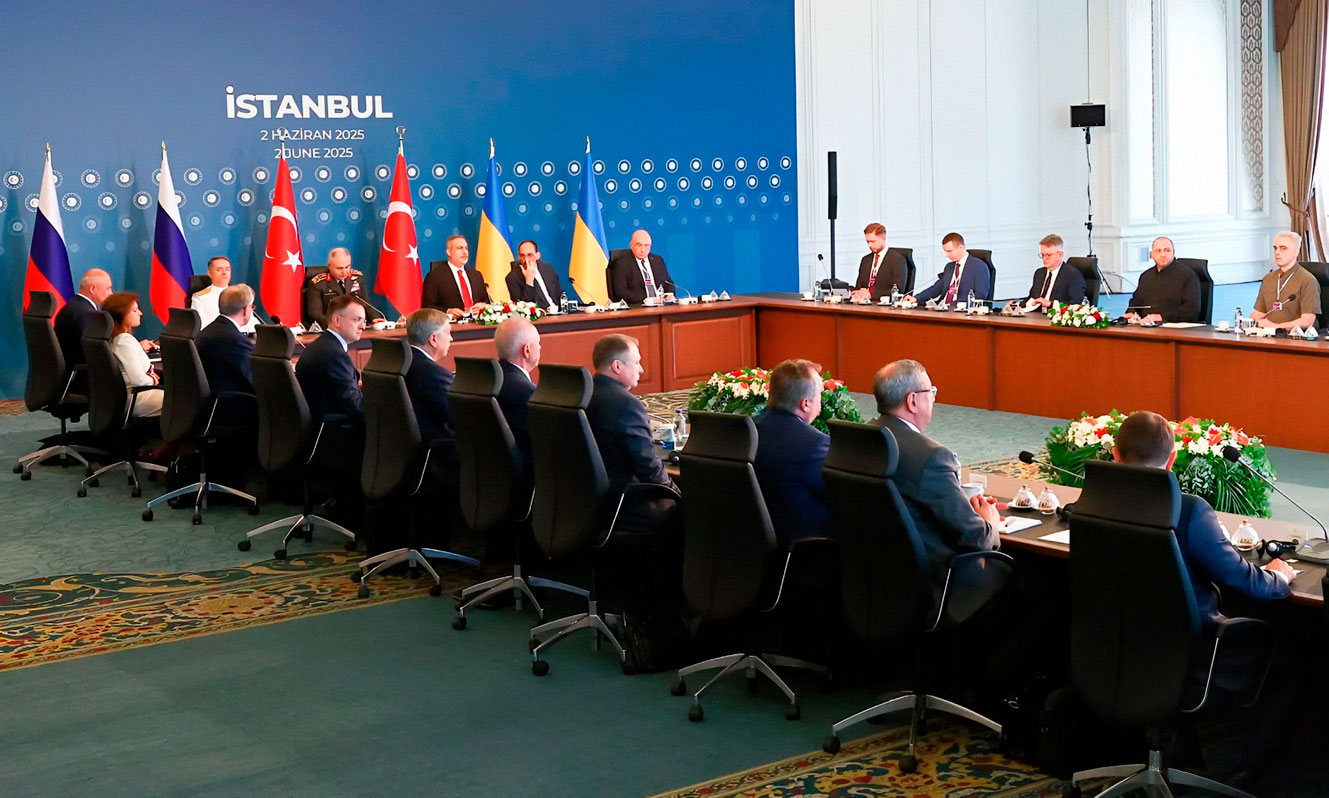
Russia and Ukraine hold the second round of direct negotiations in Istanbul, June 2, 2025. Photo: Alexander Ryumin / TASS / Profimedia
Yevgenia Albats*: Andrey Vladimirovich, you assessed the prospects of negotiations between the Russian and Ukrainian delegations quite harshly, saying that the result would be zero. What can be said now about the outcome of these negotiation exercises?
 Andrey Kozyrev: If we talk about the real return in terms of what the negotiations were conducted for (that is, to achieve a truce), the assessment has not changed — the result is zero. The exchange of prisoners is coordinated through completely different channels, intelligence agencies do it, and they would have agreed on it anyway if there was political will, and there was. These negotiations had a hidden goal. Poorly hidden, of course. We all know that President Trump is a hot-headed person, he really wants to receive the Nobel Prize, he wants quick successes, and he thinks that everyone before him was a fool (perhaps not without reason, but that doesn't mean it isn't repeated now). He thought everything could be settled in one fell swoop. And the negotiations were partly needed to distract attention from the fact that nothing is working out. They say it's better when diplomats speak than when guns speak. In this case, only guns speak to the point. And there are no diplomats there, it is unpleasant for me as a former diplomat to think of Medinsky as a diplomat. It's a distraction. And they achieved this goal. Well, Ukraine is the least interested in creating illusions because there are bombings, people are really dying, Ukraine is a victim of barbaric aggression. But it is forced to participate in this, just to do what Trump wants, because Trump leads America, and America is a serious source of military and other assistance for Ukraine.
Putin Plays Trump
Yevgenia Albats: Why did Putin propose the meeting? What is he playing at?
Putin achieved his goal, that is, mocked and effectively humiliated America. He likes it, it's generally one of the goals of his policy and even this war in Ukraine
Andrey Kozyrev: He is playing along with Trump, trying to deceive him. Honestly, I have the impression that he is doing it quite successfully — to laugh at him. And secondly, it's a distraction from his aggressive actions and plans, an opportunity to use so-called useful idiots, who are abundant in the West. That is, people who still haven't realized that Russia is an aggressive state, and Putin is a maniacally eager to perform military feats and ready to sacrifice as many Russians as needed for this. But Zelensky outplayed him. He plays, I believe, excellently, he once again confirmed that he is a great president, and will enter the textbooks of world diplomacy and politics as a great president.
Putin, of course, refused the meeting because he really has nothing to say there — everyone will understand that the emperor has no clothes. I have lived in the United States for a long time, always wishing success to American presidents, and it is a bit offensive to me that Trump fell for this bait: he said he would come to Turkey if necessary, even interrupt his pompous visit to the Persian Gulf countries. Well, it turned out that Putin achieved his goal, that is, mocked and effectively humiliated America. He likes it, it's generally one of the goals of his policy and even this war in Ukraine. Honestly, I don't even know what is more important to him — the capture of Ukraine or the discrediting, humiliation of the West. It is quite possible that the latter.
Yevgenia Albats: American media, whose authors analyzed the relations in the triangle USA–Ukraine–Russia, wrote that Putin plays Trump like a flute, using the American idiom. Let's say Trump is not obliged to understand what Putin is and what the regime existing in today's Russia is. But there are many experts around him. I can't comprehend how in a country with such wonderful universities, such excellent expertise, the president can lack information about who and what he is dealing with.
Andrey Kozyrev: Firstly, this president is special, but it must be said that the previous president also listened very selectively to the advice given to him, and most of all listened to advice that corresponded to his view that Russia is something like the Soviet Union in all respects, which, of course, is very pleasant for Putin: not only that it is a nuclear superpower (all that is left of the Soviet Union), but also that Putin is like a direct heir to the Soviet leaders. Moreover, the period that Biden caught, that is, the thaw, the so-called détente, etc. Biden proceeded from this picture, that they can be negotiated with, on the one hand, on the other hand, that nothing should be escalated, somehow it will pass by itself. It is necessary to help Ukraine, but within such limits as not to anger Putin, the Kremlin, and so on.
Many American experts live with old ideas. With Trump, this is exacerbated by his character traits, he believes he knows everything best, and never listens to anyone
Some of these experts are simply annoying. A murky mixture of gullibility and little awareness, living with old ideas. With Trump, this is exacerbated by his character traits, he believes he knows everything best, and never listened to or listens to anyone. He invited people who always say "yes." Whatever they think, they cannot stand their ground, they have hidden all their ambitions, all their knowledge, at best, in their pocket, if not thrown away completely, and now do what they are told.
Yevgenia Albats: As I understand it, you mean Mark Rubio, the current Secretary of State and simultaneously National Security Advisor, after Trump fired his first National Security Advisor Waltz. What does the combination of the positions of Secretary of State and National Security Advisor say? After all, it is believed that the Secretary of State is a person who flies around the world and talks to everyone. And the National Security Advisor provides the president with expertise. For this, various people from all departments are gathered there — CIA, FBI, and who is not there. What does this tell you?
Andrey Kozyrev: This suggests that Trump probably considers Rubio a hundred percent loyal person who will say "yes" to everything. Well, and a person who probably has a certain perseverance. He doesn't travel around the world like other Secretaries of State and Foreign Ministers. Trump's Secretary of State is of a different type, he has personal envoys traveling around the world, who have not been approved by anyone, who have no diplomatic experience at all. One is a businessman, that's Whitcoff, the second is Kellogg, who is just a retired general, probably a good general, but not a diplomat. That is, they apparently understand little about international politics, especially Russian politics, but they take on everything they are assigned. Whitcoff is now dealing not only with Russia but with everything in general: Iran, the Middle East. But he is a businessman. Diplomatic negotiations differ radically from business negotiations. In business, the parties want the same thing — money, this is the criterion of their success. In diplomacy, this is not the case, there can be a common interest only among allies. When it comes to diplomacy between opponents, there may not be a common table, and very often there isn't. A classic example is negotiations with Nazi Germany. Even when World War II had already begun, the British and Americans had illusions that they could negotiate with Hitler. Then everyone realized that it was useless to negotiate, it would only distract attention, reduce the intensity of mobilization for war. In this situation, diplomacy only hinders and has no chances. And fortunately, the leaders of the anti-Hitler coalition understood this in time and fought the war to defeat.
The same is true now in Ukraine. But the defeat of Russia is impossible, but the defeat of the Russian interventionist group in Ukraine is quite possible, and this needs to be done. Now, it seems, in Europe they have begun to understand that nothing can be achieved by negotiations, only by force.
Intimidate Europe
Yevgenia Albats: But you wrote in your book that the so-called détente under Brezhnev was an attempt to postpone World War III. There were fears in the West, and as Andrey Kolesnikov wrote in our New Times, the Brezhnev generation, which survived World War II, was also very afraid of war. They knew, they saw what Russia, Ukraine, Belarus, the Caucasus turned into after the invasion of the German army. It still worked. Reagan called the USSR an evil empire, yet he managed to negotiate with Gorbachev.
Andrey Kozyrev: I saw the evolution of the Soviet Union from the inside when I worked in the Soviet Foreign Ministry, at the end of the chapter, as they say, but for quite a long time. At that time, there was an awareness that there should be no nuclear war. The attitude towards the war in Afghanistan in the Foreign Ministry was absolutely skeptical. No one, of course, said this publicly, but I know, our old-timers, grandfathers, who were older than us, were simply horrified. There was not a single person in the Foreign Ministry who was sincerely a supporter of this Afghan adventure. Everyone understood that the country was drawn into it, but not diplomats. Not Andrey Andreyevich Gromyko. And not Leonid Ilyich Brezhnev himself. In the Foreign Ministry, absolutely everyone considered it some kind of wild mistake. Then, under Leonid Ilyich, despite all his peace-loving nature, some crazy forces within the military-industrial complex came up with the idea that we would place medium-range missiles, something like today's "Iskanders," with nuclear warheads. We will intimidate Europe in this way. Such missiles do not reach America, and therefore America will not respond with anything, but we will scare Western Europe to death and destroy NATO. And these crazy ideas, as I understand it, are now perfectly comfortable in the Kremlin and in other departments of today's Russia.
So, no negotiations yielded any results until President Reagan deployed Pershing missiles in Europe, the same medium-range missiles that would not reach from America, but from Europe, from West Germany, they would reach the Kremlin and almost the Urals perfectly. That's why awareness suddenly began. And the second thing he did, he proclaimed the concept of "Star Wars," that is, the creation of a shield against intercontinental ballistic nuclear missiles. And they believed in it, this is generally an idea that is in the air and is becoming more and more possible, especially now, thanks to artificial intelligence.
In the Soviet Union, they were then scared to death. In Europe too. In Germany and many other Western countries, in NATO countries, millions of so-called "peaceniks" took to the streets, that is, people who wanted peace at any cost.
Yevgenia Albats: These were active measures of the first directorate of the KGB of the USSR.
Andrey Kozyrev: I am sure that it is the same now, but now it is even more obvious, we see it on social networks. And therefore the so-called anti-war movement, "we want peace at any cost, 5,000 people die in Ukraine every day" and so on, — these are crocodile tears. Well, give Ukraine weapons, and this bloodshed will stop. What Reagan did in his time: he deployed missiles in Europe, he started a major military program that scared the Kremlin. And both of these circumstances played a role. This is what I learned back then. Even in the Cold War, but to prevent the Cold War from becoming hot, you need to use the threat of force. Weapons speak louder than diplomacy.
And when they felt strength from America, the Kremlin began to look for a way out of internal problems because the Soviet Union, like Russia now, was in an economic dead end. That's where Gorbachev came from. And Gorbachev turned out to be, by the way, an extremely decent person, truly a great person, this is indisputable. He was genuinely against violence. And he did not resort to open violence in the Soviet Union to retain power. This is a historical feat.
But if we return to where we started — I am sure that Reagan, with his words, but mainly with serious actions, fundamentally changed the situation. And even before him, Brzezinski and Carter, when they started giving weapons to the Afghan mujahideen. Why I keep saying that if now (or even better three years ago) the West gave Ukraine weapons equivalent to what Russia has, it would really change the military situation. There would be a very good chance to defeat, or start defeating, or show with real actions the possibility of defeating the group in Ukraine. And just like from Afghanistan, Putin's troops under flags, as then, would have returned in an organized manner. I am sure that no one from the Ukrainian side would have hindered them. And this would have been declared a victory, as in the Soviet Union, when General Gromov, who led the Soviet group, returned under the red flag on a tank. Therefore, nothing prevents Putin from ending the war, but the West must show iron will, just like Reagan.
People of Servile Rank
Yevgenia Albats: I once published a letter to the Politburo of the CPSU Central Committee from the penultimate chairman of the KGB of the USSR, Vladimir Kryuchkov, quite a Soviet hawk, regarding North Korea. When North Korea turned to the USSR for help in building a reactor, Kryuchkov wrote that the KGB does not recommend doing this. Because the situation there is very strange. Now Putin is not just dealing with North Korea. North Korea is a supplier of shells, guns, and soldiers. It receives colossal money from Russia. Moreover, obviously not only money but also technologies they need to finally make their ballistic missiles fly somewhere, not just take off straight and fall. How did this become possible? After all, the KGB always had excellent expertise. The best institutes of the Academy of Sciences worked as the expert department of the KGB. What happened?
Andrey Kozyrev: What happened is what we feared, and the West was very afraid of at one time, why it was against the collapse of the Soviet Union and even went to such disgraceful steps as attempts to interfere with the democrats in Russia. We, the first Yeltsin government, felt at least skepticism from the West, if not opposition, especially when the Soviet Union was already visibly falling apart. What were they afraid of? That instead of a generation seasoned with experience, where many went through the war, like Leonid Ilyich himself, and then studied for a long time both the negotiation process and world politics in general — others would come, already without any human traits. Instead of marshals and generals, colonels or even lieutenant colonels came. And they lost their brakes. At first, they seemed to be looking for their place, trying to mimic the elders. And Putin partially went through this in the early 2000s when he tried to engage in Brezhnev-Gromyko-type diplomacy. But then the bit got under the tail, there was not enough education, experience, and knowledge to behave normally, and there appeared a servile desire to command. Yuri Lotman explained where rudeness comes from: it comes from a servile self-perception. Here I was humiliated, I was nobody, and I will become everything. I will show you, and you will dance for me. Well, yes, now everyone is dancing, and the West cannot understand this.
Yevgenia Albats: Mikhail Sergeyevich Gorbachev, with whom we talked a lot about Putin, told me: you see, C-students came to power, C-students.
Andrey Kozyrev: Yes-yes, that's what I'm saying, C-students instead of marshals. When a C-student sees Lomonosov University in front of him and realizes that he will not be accepted there, it does not cause him a desire to sit down with books and try to enter next year. It causes him a desire to break the windows in the university. Here I am such a great hooligan, let them be afraid.
Yevgenia Albats: The Clinton Library declassified many documents, negotiations, correspondence between Clinton and Yeltsin. In particular, there are quite a few conversations about NATO expansion. It seems to me that history has proven how correct the idea of expanding NATO to the east was. Because this is what now protects the Baltic countries, which is why Sweden and Finland rushed to NATO as soon as Putin began aggression against Ukraine. It is clear that this is the only thing that protects the small countries of Europe from an aggressive militaristic state like Russia. But Yeltsin was very strongly against it. And he kept telling Clinton: you promised us, but didn't do it, why are you doing this, and so on. You were the foreign minister. Did you also believe that NATO expansion — it started later — caused any damage to the security of the Russian Federation?
Andrey Kozyrev: Absolutely not. And this was one of the reasons why I then went for the second time to the elections <to the Duma> and, in general, asked Yeltsin for resignation for a very long time. The Foreign Ministry, together with the military, submitted a memorandum, an official note to the president, stating that we do not oppose NATO, and it is useless to oppose NATO expansion. But I managed to include the wording that we are against hasty NATO expansion. This was a compromise with the so-called hawks. Because opposing NATO expansion is a Cold War, it's a return to the Soviet Union, and that's exactly what the top of the KGB and partly the armed forces wanted, who did not want to lose their power. For this, they needed an external enemy, they needed the image of an enemy in the face of NATO.
By the way, Pavel Grachev, who was the Minister of Defense, initially and for quite a long time listened to me, maybe even more than Primakov, my successor. His general staff in the army understood that military confrontation with NATO is generally unrealistic. They didn't even want to think about military actions like the Ukrainian one. Because as military people they understood the fatality, idiocy, and madness of such a war. And in the proposals that we submitted and orally reported together to Yeltsin about NATO, Grachev agreed that it should be said exactly like this: hasty expansion. And behind this was the idea that it would be good to first either accept Russia into NATO or at least regulate, make new alliance relations stable with it. And then NATO will not be perceived as an enemy. But the other side didn't want this. They didn't care about the program of cooperation for peace, and so on. They wanted to keep the image of the enemy. This is simply an irreplaceable thing, otherwise, democracy will really come, and then they will say, why the KGB, why such a large army, why this status of a nuclear superpower, it all costs a lot. Therefore, a real threat or an unrealistic one, but the image of the enemy must be real. And they achieved their goal, Yeltsin gave in to them for many reasons.
Ukraine Cannot Surrender
Yevgenia Albats: Returning to today. Ukrainian intelligence conducted a very successful operation "Web", strategic bombers were destroyed. Trump said that Putin would respond, and Putin responded. For several days now, there has been a brutal bombing of civilian targets, hitting homes in Kharkiv, Sumy, Kyiv, Rivne, the Russian Federation army began an offensive in the Dnipropetrovsk region. The "Web" operation, of course, showed that contrary to Trump's words, Zelensky has cards in his hands. But in reality, how risky is such an operation in terms of consequences? What do you say as a diplomat?
Andrey Kozyrev: I think the situation would be even more risky if Ukraine did not conduct such operations. Ukraine has no choice. It cannot surrender and be enslaved. The experience of history speaks very well of the deportations of millions of people, resettlement to Siberia. This is a Soviet practice that is already being applied in Ukraine and will be applied if, God forbid, Ukraine does not withstand military competition.
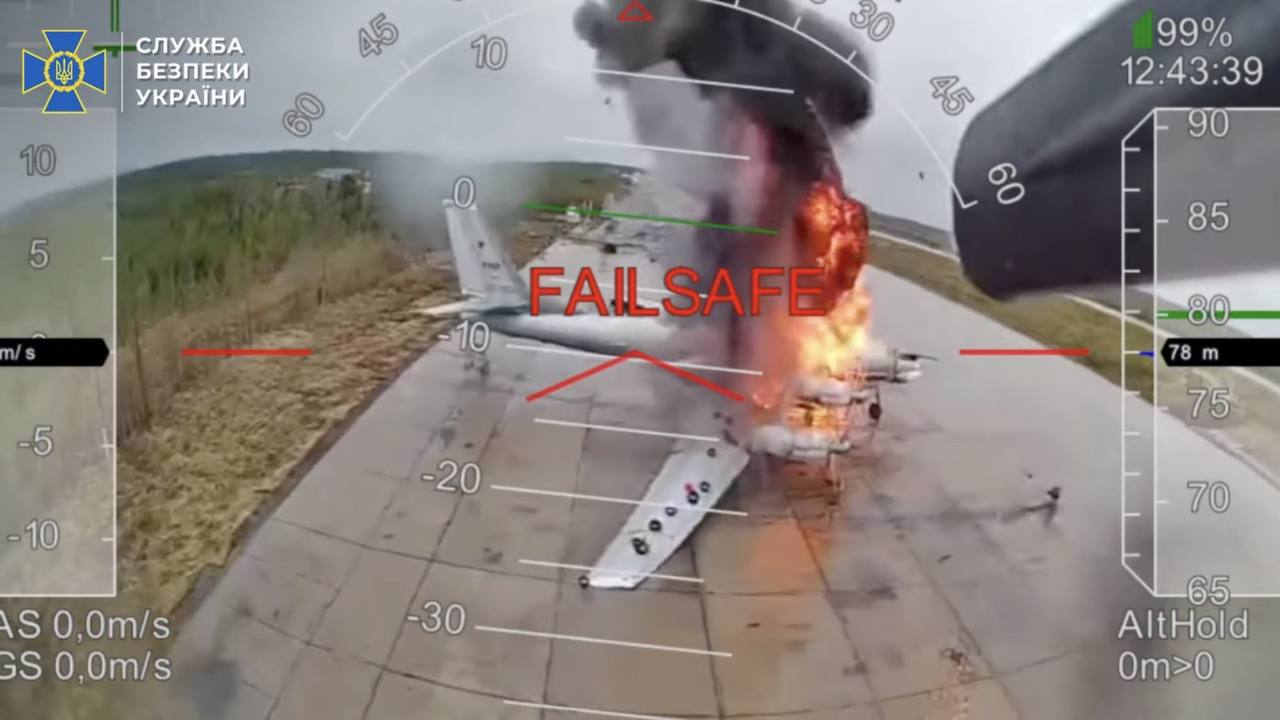
Operation "Web". Damaged Tu-95 aircraft at the "Olenya" airbase, June 1, 2025. Photo: ssu.gov.ua
Yevgenia Albats: Do you mean Stalin's deportations of Kabardians, Balkars, Crimean Tatars, Meskhetian Turks, Chechens, Ingush?
Andrey Kozyrev: An even closer example is the Baltics. There was a massive forced resettlement of people from the Baltics. Why is the Baltics closer to the topic we are discussing now? Because it was the result of the occupation of the Baltics, just as they now want to occupy Ukraine. They conducted, in essence, ethnic cleansing, and to this day the problem of the Russian population in the Baltics is a legacy of the fact that Balts were sent in trains deep into the Soviet Union, and people from Russian regions were brought to their place. The same story awaits Ukraine, there will be an attempt to destroy culture, language, Russification. We see children who were taken away and with great difficulty returned, while being re-educated in an anti-Ukrainian, some kind of hysterical military spirit. That is, Ukraine has no way out of this monstrous situation other than to defend itself and stand to the death. They will snap back, they will fight. And this war will take on increasingly severe forms.
If Putin does not stop (and he will not stop if the West does not provide weapons for defeat or the beginning of defeat, after which negotiations can acquire substantive character), there will be not the conquest of Ukraine, but the transformation of the war into an even more monstrous catastrophe. There is a nuclear response to nuclear weapons. Not necessarily with nuclear weapons. The entire Soviet Union was covered and is now covered with nuclear power plants. And we saw Chernobyl. If you sit in a glass house, don't throw stones. Until now, Ukrainians have tried to wage war, I would say, in chivalrous ways. But you can wage war in chivalrous ways until the other side limits itself to battles on the battlefield.
The war has taken on a terrorist character, primarily from the Russian side, which is destroying the civilian population because it cannot cope with Ukraine militarily. If it doesn't work on the battlefield, then we'll bomb the population. But if you bomb the population, what kind of response do you expect?
Nothing is Predetermined
Yevgenia Albats: Andrey Vladimirovich, now the new Chancellor of Germany, Merz, is becoming a serious leader of Europe. He came to the White House and tried to explain to Trump that Russia attacked Ukraine, not vice versa. He talks about how for all three years of the war, Ukraine fought the Russian army "with hands tied behind its back". When the Berlin Wall fell, Margaret Thatcher warned against the restoration of Greater Germany. And now we see how a qualitative transition has occurred. Germany, which was previously very cautious in producing weapons and creating an army, is now preparing to arm itself seriously. Does this not cause you concern?
Andrey Kozyrev: No, this is a different Germany. I do not feel, despite the crimes of Hitlerism, the Holocaust, and the horrific war, hatred for the German people or special suspicion towards them.
Yevgenia Albats: But we now see that AFD, the right-wing party of Germany, has become the second party in the country. They scored 20%, primarily in the eastern lands, where there was never any denazification. This is an understandable reason. Nevertheless, after all, sooner or later AFD can come to power.
Andrey Kozyrev: But that doesn't mean they are Nazis, I don't see that. There are plenty of such right-wing parties that are now concerned about immigration. In America itself, we see with you Trump's powerful war with illegal migrants. Now he sent troops to Los Angeles, but that doesn't mean America has turned into a fascist state, and even more so into a Nazi state. Therefore, I do not believe in the danger from a strengthening Germany. History is filled with situations where many nations behaved monstrously. But I am more concerned that in Russia they do not want to understand that wars for dominance in Europe, for possession of some territories are a thing of the past. That the national interest is to allow their peoples to live, develop, cooperate. This does not mean that they do not remember their history, it means that they have learned from it. And Russia still lives in the past centuries, still in the times of Catherine the Great. This is madness, it's time to wake up.
I do not believe that the German people are bad. Just as Russians are not beasts and the French are not conquerors. France has nuclear weapons, but that doesn't mean Napoleonic wars will repeat tomorrow.
Carpet Battles
Yevgenia Albats: A question I cannot help but ask you. In recent days, in the United States, and not only in the United States, everyone is watching the struggle that has unfolded between the president of the most powerful state in the world, Trump, and the richest man in the world, Elon Musk. What do you say about this from the point of view of a diplomat and a person who worked in the government? Why do they allow themselves to quarrel publicly? And how can this end?
Andrey Kozyrev: Churchill, I think, said that politics in Russia is done as a result of a bulldog fight under the carpet. It seems to me that the advantage of democratic systems, including the American one, is that the bulldog fight, apparently inevitable in some cases, takes place on the carpet. That is, people can see it, they can judge it. This seems to me a gigantic advantage of a democratic system. People may not participate in politics, but they see how it is done. And then in the elections, they will draw a conclusion about how Trump behaved, why he brought this guy, undoubtedly a technical genius — because of his money, or because of his irresponsible political statements, or because of something else. Then we will figure it out, but the main thing is that it is done openly. You can say — how can you display dirty laundry for all to see? But that's how it should be in politics, that is, the more publicity, the better Americans will see what is happening in the White House. The worst thing would be if everything were closed, and we would see some Kremlin box, from which something suddenly jumps out, and no one can judge it, prevent it, or make a conclusion from it in the next elections and choose someone else.
Yevgenia Albats: This is a very interesting conclusion, thank you for it. I would only add to this that it seemed important to me. Remember when Trump brought Musk, everyone said that the oligarchy took power in the United States of America. And now everyone has clearly shown that the richest oligarchs are nothing compared to the power of the state and CEO, Chief Executive, that the state can reject any, the richest person. The question is not about oligarchy, the question is always about the excessive power of the state. Andrey Vladimirovich, I am very grateful to you for this conversation.
Video version:
Reference:
Andrey Kozyrev — the first Minister of Foreign Affairs of independent Russia (1990–1996), a well-known diplomat. Deputy of the State Duma of the 1st and 2nd convocations. With his assistance, the START II treaty was signed. Under Kozyrev, the Partnership for Peace agreement with NATO was also signed. Author of the book Firebird ("Firebird"). Lives in the USA.
* Yevgenia Albats, Andrey Kozyrev have been declared "foreign agents" in the Russian Federation.