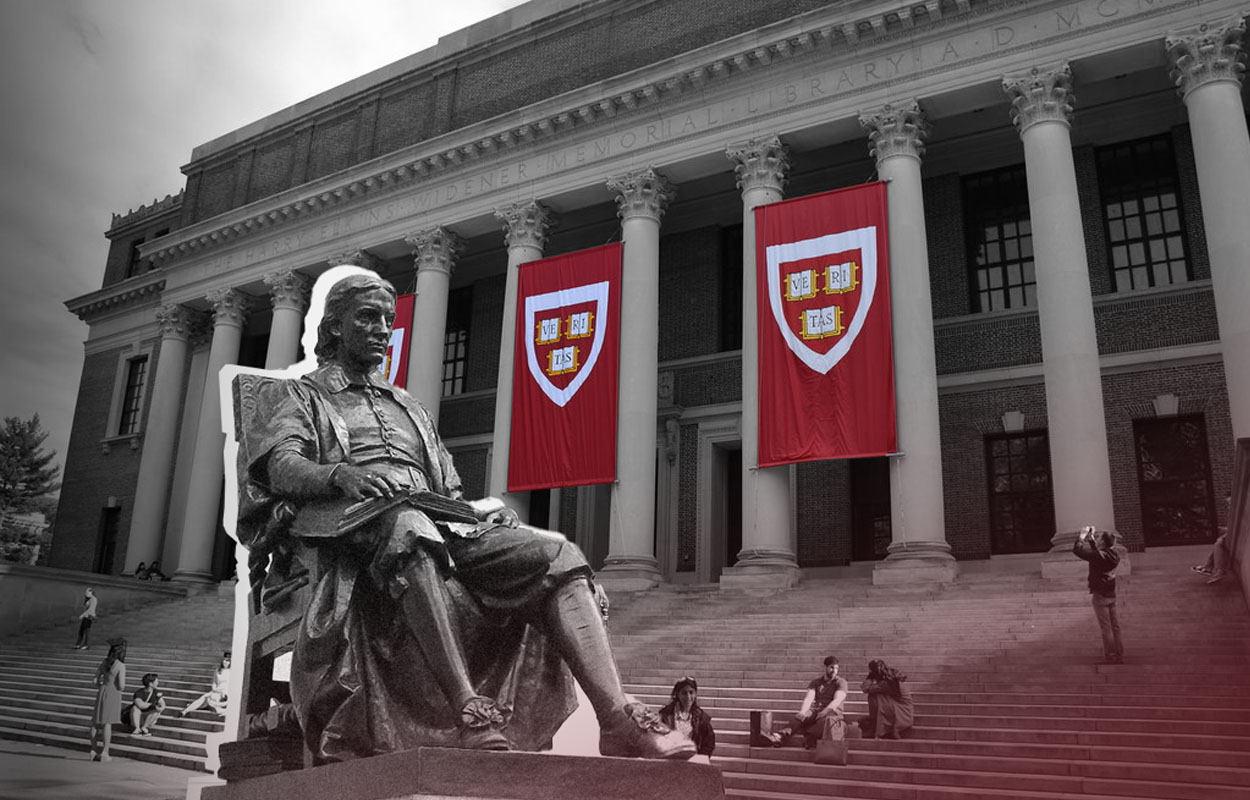
Harvard University. Photo: Tracy Lee Carroll
Evgenia Albats*: Oleg, the rating agency Moody suddenly unexpectedly downgraded the rating of the United States. Because of this, bond prices rose, and the stock prices of leading companies fell. What is happening?
One Step Down
 Oleg Itskhoki: Why are prices falling in the financial market? Because investors are getting rid of assets. This is not directly related to rating agencies changing something. Rating agencies can push investors to abandon, for example, American bonds treasuries, and then we will see an increase in yields on these bonds or a drop in their price, which is the same thing. Interestingly, we observed a major panic in the financial market after April 2, when a tariff war was announced at the White House. But the stock market has already recovered all the losses since then, and with bonds, it is still unclear. That is, their yield is slightly higher, but we do not fully understand whether investors have changed their portfolio decisions or still realized that there are no alternatives to these government bonds.
But what we are paying attention to is the currency market, where changes have occurred: the dollar has depreciated by about 10% relative to all currencies, relative to the euro, relative to the yen. And apparently, there are still no alternatives to American bonds. That is, if European, Asian investors sell these bonds, they do not understand what else to buy. But now they have started to hedge more, to buy more insurance on the currency market. And because of this, the dollar has depreciated. And this may be the first step in the financial market's loss of confidence in American assets. It happens not in securities first of all, but in the weakening of the dollar.
Evgenia Albats: Does this mean that the dollar may cease to be a reserve currency?
Oleg Itskhoki: In some perspective. It seems that today little threatens the dollar because there is no alternative. But if you think about it, it's not quite accurate to call it a dominant currency. Rather, it is a privilege that a country issuing the most reliable assets has. And this privilege has been with the USA for many decades. We are likely observing one of the potential steps in losing this privilege. More insurance — American bonds will be higher. It will be more expensive for the American government to borrow. It will be more expensive for American consumers to borrow. This is one of the steps down in the loss of financial dominance in the world. But it's a small step. It hardly changes the balance qualitatively.
The trade war is 10 or 100 times more important for Trump than everything that is happening in Ukraine. As for the sanctions that Trump threatens, he is unlikely to have something in reserve that has not yet been used
Evgenia Albats: Today I looked at the price of a barrel of Urals oil, which the Russian Federation sells. They give $53 per barrel, and the average price from January to March was $60. Do you think Trump agreed with the Saudis not to cut oil production to lower the price of Russian oil? And what will this mean for Russia's military spending?
Oleg Itskhoki: Due to the global recession, maybe oil prices will be lower. But data has come out that there will still be no global recession, the world will continue to grow, the USA will most likely continue to grow, just at a slower pace. That is, the trade war reduces the growth rate in the world by about 1%. This reduces the expected demand for oil. This is superimposed on something happening in OPEC, but for me, these are difficult things to observe. How much it influences what Trump agreed on in Saudi Arabia — I'm not sure. It should be emphasized that there are American producers who really do not want to see the oil price below 60. If the price falls significantly below 60, it will hit American shale oil producers hard. Therefore, I do not think that Trump has the goal of lowering the world price below 60, but what he would like to do — so that Saudi Arabia could replace the amount of oil that Russia supplies to this market at current prices of 60 dollars. If he could do that, it would indeed be a great success in foreign policy.
But it is important to understand that Russia sells very little oil at Urals prices. Most of the oil goes to Asia, to India and China, and Urals does not reflect this price. Therefore, I focus on the world price, that is, on Brent. This is the European price, it is about 65 dollars. I think that most of its oil Russia sells closer to Brent, contracts with China are tied to Brent.
Evgenia Albats: Even despite the discount at which it sells oil to India and China?
Oleg Itskhoki: There is a price cap. It does not work on pipeline oil, which mainly goes to China. This is now about half of Russia's oil exports. And it is actually sold at world prices. What India bargains for itself as a discount, we do not fully know. Given the current situation, it seems that lowering the price cap becomes a more reasonable tool. We hear little about this in the news, which is a big mystery to me. It would seem that this is the moment when this tool would work. But you are right, the strong action that Trump could take against Russia economically is to lower the price of oil. And he did it.
Evgenia Albats: On the very first day in the White House, more than a hundred days ago, he said that if Russia does not go to end the war, then we can impose secondary sanctions, etc. Could this be a hidden form of sanctions against Russian oil?
Oleg Itskhoki: I would not think about some big strategy here. There is a trade war, which is 10 or 100 times more important for Trump than everything that is happening in Ukraine. And about the sanctions that Trump threatens, I think that he is unlikely to have something in reserve that has not yet been used.
The Trade War Continues
Evgenia Albats: You mentioned the trade war. But, as I understand it, the United States has agreed with China. Does this mean that the trade war is over?
Oleg Itskhoki: It means nothing. With small countries, a trade war, when it is against Vietnam or South Korea, can yield results, it really puts these countries in a dead end. But big countries, like China, Europe, have nowhere to hurry, for them it is not so critical, they can wait out these tariffs. And it turns out that if these countries wait, then Trump has an incentive to just backtrack. We are observing this. Even with Canada, against which, it would seem, the USA had a big leverage, it did not work out, Canada made a very qualitative response back in January to the trade war, and in fact, the USA withdrew all the tariffs they threatened Canada with. Whether the same will happen with China, we do not know.
Perhaps part of this administration's strategy is indeed a real trade war with China, despite the costs to America itself. At the end of the 90-day embargo, we will find out how much Trump 2.0 differs from Trump 1.0, how much he fears a negative reaction in the financial markets, or whether he really believes that his task as president is to start a full-fledged trade war with China.
Evgenia Albats: So the likelihood that in 90 days tough relations with China will resume is quite high?
Oleg Itskhoki: Well, by the way, a 30% tariff is close to record highs. And in this sense, the trade war continues. American consumers will first experience what a 30% tariff on goods from China is. Therefore, in America, they fear the reaction of consumers when they come to Walmart and see how much everything they are used to buying has become more expensive. By the way, this is a very wrong policy — to impose tariffs on intermediate goods used for production. The correct economic policy is to exclude from tariffs what is needed for production so as not to let domestic production stall, but to impose a duty on consumer goods, such as electronics, in particular. Now we see the opposite, steel, aluminum fall under tariffs — what is needed for production in America, but electronics do not. But on the other hand, if you think about the trade war not as a way to win, but as a way to make China lose more than America loses, then this is quite possible. There is such an idea that China is now at a low point compared to the last 30 years of growth. And if you can hit China, now is the right time.
I want to add that the USA has lost interest in maintaining the established system of international institutions. You can think of this as a trend and fundamental changes. The USA has lost interest in being the world's policeman. The USA is not so interested in what is happening in Europe, they are more interested in what is happening in the Pacific Ocean. They want to withdraw from the internal affairs of Europe. The Trump administration seems to find it more profitable to have such a trade policy that looks inward rather than outward. We can discuss for a long time whether this is a good idea or not. I think it's a bad idea. But anyway, the USA has ceased to be that key institution, the country that maintained balance. China has not taken on an equal role as a big country, the largest trading partner in the world for all countries. The political system in China does not promote international cooperation. And we are now observing all these changes. The world is indeed being significantly restructured.
Putin Does Not Need Peace
Evgenia Albats: How do you explain what happened in Istanbul? Why was there all this fuss with the negotiations?
Oleg Itskhoki: This is far from my expertise. But it seems to me that Putin is not interested in these peace negotiations.
Evgenia Albats: Why did he propose them? Direct negotiations?
Oleg Itskhoki: Trump has expectations that he can get something from Putin. These expectations were obviously inadequate from the very beginning. And now there is a gradual reassessment of these expectations. Trump with J.D. Vance is strongly recalibrating what they can expect, and the non-meeting in Istanbul is an important stage of this recalibration. Why were they so short-sighted? Did they deceive themselves or really not understand something — that's another question. And Putin never had an interest in peace negotiations.
Evgenia Albats: But he outplayed both Trump and Whitcoff, and everyone else.
Oleg Itskhoki: I don't think it's a matter of winning or losing. There is an understanding that Putin is not interested in these peace negotiations because he thinks he is winning the war or he has the opportunity to win it. And Trump has no leverage over Putin. This can be stated. The only thing Putin understands is strength. Now neither the USA nor Europe is using force against him. And he feels he is winning, and he doesn't need negotiations.
Politicians, when it suits them, can present themselves as short-sighted. This is not Trump's belief in Putin's words, it's rather his illusion
Evgenia Albats: I remember my conversation in 2013, literally on the eve of Crimea, with a person from Putin's close circle, who told me: the most unpleasant thing happening now is that Putin has started openly lying to his colleagues in the G8, the leaders of other countries. This was not accepted. There was an unspoken agreement: you can not say, but not lie. And Putin started lying. And it seems to me that this is so obvious that I can't understand how people in Trump's entourage and in the State Department do not understand who they are dealing with.
Oleg Itskhoki: Yes, but Putin hasn't been lying since the 23rd year, it seems to me, the moment that should have opened everyone's eyes is, of course, the Malaysian "Boeing." But politicians, when it suits them, can present themselves as short-sighted. Therefore, I don't think it's a belief in Putin's words, it's some kind of illusion of Trump's.
Science is Expensive
Evgenia Albats: The Trump administration demanded that Harvard University take a number of steps that Harvard considered interference in the sovereign policy of the university. Some of these steps Harvard took, just didn't make it public, but some it sharply refused. In particular, from overseers who would monitor what courses, teachers, etc., are at the university. In response, the Trump administration ordered to deprive Harvard of contracts, federal research grants worth 2.5 billion dollars. Harvard filed a lawsuit, to which the Trump administration responded by taking away another 400 million dollars in grants. And now there is talk that Harvard as an educational institution will be deprived of the opportunity not to pay taxes, and a tax will be introduced on the endowment, which at Harvard is more than 56 billion dollars. This will be a very serious blow to the financial survival of the university. Why is the Trump administration doing this, considering that in Washington, Harvard University graduates, as well as in corporations, in law firms — they are just every other one?
Oleg Itskhoki: Why is the administration doing this? Universities are identified as the main enemies of the current administration. Along with USAID, along with Biden. For the current coalition that came to power in America, universities are enemies, they are in the opposing coalition, they need to be fought. This is not only Trump, this is also J.D. Vance, this is also part of Silicon Valley that thinks so.
One of the biggest divides in society is by education level. The current coalition, MAGA, is a coalition of uneducated people. This is a revolution of Sharikovs
If you look at how they voted for Trump, one of the biggest divides is by education level. The current coalition, the Republican Party, or MAGA, as it can be called, is a coalition of uneducated people first and foremost. A stronger word is a revolution of Sharikovs. This is not the only thing happening, but it is something that cannot be ignored. Moreover, universities do not look like an important institution in the eyes of the median voter. You will not lose much popularity if you take money from Harvard with a 50 billion dollar endowment. By the way, 50 billion is not that much when annual expenses are about 4 billion. It is not possible to cover all annual expenses from this endowment, in any case, current money needs to be attracted.
It is important to tell how this money is attracted. Part of it is from what university students pay. But this is a small part. The larger part is grants, applications for which are submitted by professors. Grants are absolutely competitive. That is, a grant is not assigned to a university or a laboratory. The selection of applications is conducted by the scientists themselves. That is, it is not a bureaucrat who solely decides whether a state organization should finance an application, he relies on the opinion of scientists. And this is how most of the funding is built.
I am an economist, and economics is different in that we do not need grants so much, we practically do not receive them because we do not have laboratories. My laboratory is my computer, and in it, programs that help me model the world. Biologists, physicists, chemists, doctors have it differently. A quality university is primarily a laboratory. A laboratory is multimillion-dollar costs. It's like a startup, it's like a company. Each professor has about 30 employees whom he pays a salary, and from the university, he receives a laboratory. A laboratory is some space that competes with the most advanced companies in chemistry, biochemistry, medicine. Hiring a scientist is relatively inexpensive, but creating a laboratory is insanely expensive. Especially maintaining a hospital. All university hospitals are companies that conduct fundamental research, they are companies that are not focused on profit. They have laboratories that are often not in regular hospitals that work for profit because they do not pay off.
Of course, destroying the institution is quite simple — if the state does not give these two billion dollars to Harvard. But it must be said that the first restrictions did not come from these two billion, which are specific to Harvard, but from the decision to roughly halve the expenses of the National Institute of Health and the National Science Foundation. This is what all scientific institutions, practically every researcher in America, receive funding from. This hits every university. Universities do not plan any hiring for the next year. Graduate students who enter the market will have to look for work in Europe and elsewhere.
The executive branch acts selectively, applies restrictions to those it dislikes. This is illegal because many of these funds are allocated by Congress. It is not the prerogative of the executive branch to make such decisions. None of the senators wants to vote for this so as not to spoil their reputation.
Another unconstitutional thing that will be applied to institutions is the order not to give visas to foreign students and foreign professors. I am an American, but once I was a foreigner working in an American institution. People do not understand what an American university is. On the same floor with me sat a Japanese economist, an English economist, a German economist, one American, one Italian, one French. That was our floor. Why is it so? Because hiring is competitive. They hire the best in a specific field and usually do not look at nationality. In this sense, without visas, an American university cannot work.
I had some communication with people from the Trump administration to understand what they are doing, and there are two theories. One theory is that they just want to subjugate universities to themselves so that they do what they want from them. And the second — they just decided that this institution cannot be fixed, it needs to be destroyed, like USAID. The same with universities. One can imagine what consequences this will have for American science, for American leadership. By the way, one of the goods that America exports is education. This is a colossal export category. Without visas, naturally, nothing like this will happen.
An American university can reform itself. It is important that the state in the person of the executive branch did not interfere in this, universities began to make reforms of their own free will
The question is, what does the administration want? You remember well and were also in opposition to what was happening at Harvard last year when student anti-Israel protests began.
Evgenia Albats: More than 30 student groups...
Oleg Itskhoki: Yes. It must be said that this is an absolute minority among students, probably a few percent of students who are in some unions. But it was a difficult situation, universities had to decide what methods, what measures they could apply to protesting students. After all, these are members of the community, the university community, regardless of what opinion they have, the university is responsible for them as students. And this put universities in a very difficult situation. I was then a professor at UCLA, and at UCLA there was an equally difficult situation as at Harvard. By the way, at UCLA protesting students were beaten on campus by people who came from outside the university. And the university could not prevent this, it was also a huge news event.
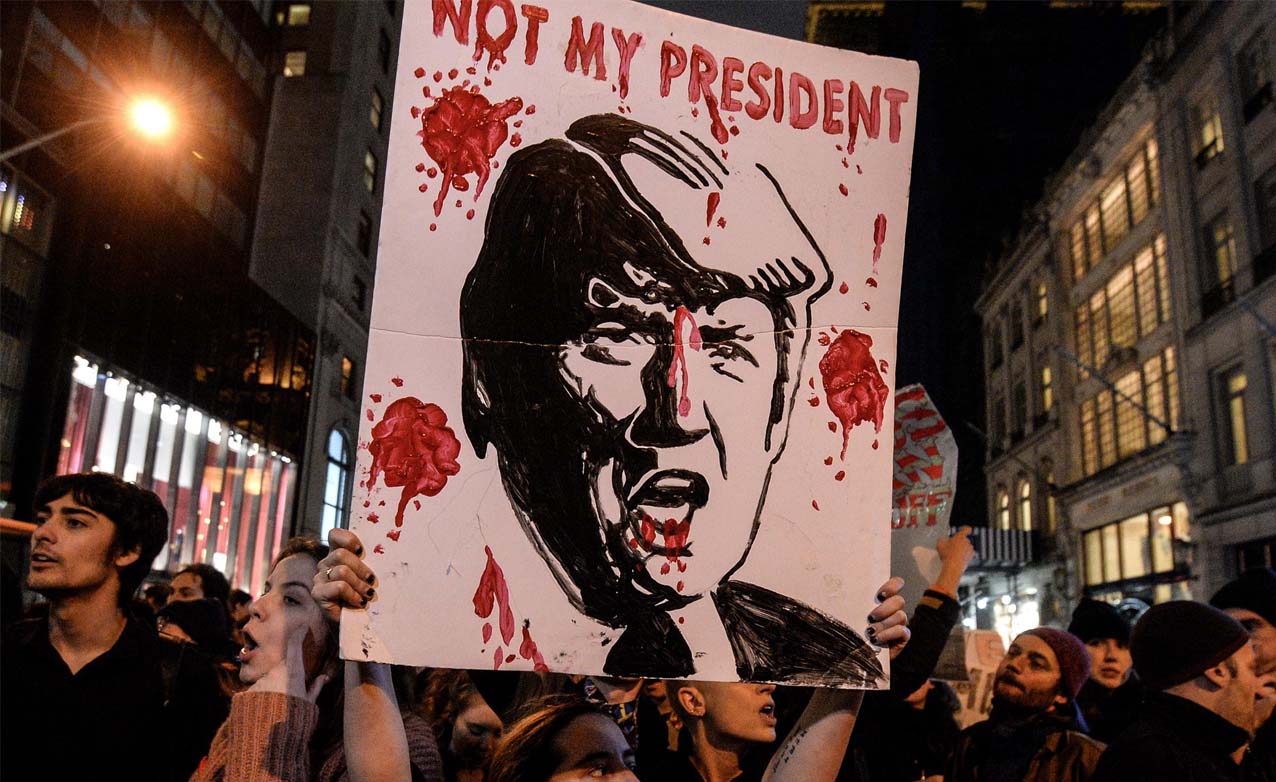
Archive photo. Protest in New York. Photo: Sputnik / Alexey Filippov
Evgenia Albats: After they refused to let Jewish students into the libraries.
Oleg Itskhoki: Yes. There was such a situation when students occupied the campus, and they did not dare to disperse them by force because these small groups of students were looking for a direct confrontation with the university. They wanted to get into the news, obviously. And universities had to make difficult decisions. But what did this lead to? To the fact that university presidents, in particular Harvard, MIT, and Pennsylvania, were summoned to Congress. They had to answer unpleasant questions, as a result, major reforms began in universities. Inside, there was a very healthy discussion. This push — partly from outside, but also from within, when it became clear that there is a problem with freedom of speech, with its unequal application on campus — led to the fact that internal reforms began in universities. I was very pleased to observe that such a complex organism as an American university can reform itself. Here it was very important that the state in the person of the executive branch did not interfere in this, universities began to make reforms of their own free will.
Now, when the Trump administration and J.D. Vance, MAGA, came to power, I see that this is not only Trump, this is a big movement. From the point of view of their party, universities are evil. They want to use the levers of pressure on universities that they have as the executive branch to change something in universities. They emphasize that there is no representation of people with conservative views in many faculties. But I have never encountered hiring a person for their political views, rather than for scientific results. They oppose the policy of DEI (Diversity, Equality, and Inclusion), because it was used by their political opponents, the Democrats, but now they themselves demand DEI-hiring for their supporters. That is, they want universities to hire a certain number of people for political reasons, whose views are similar to Trump's. In the letter sent to Harvard, this was a direct demand. Such interference in university autonomy has never happened in American history. It is important that they use it through funding.
Evgenia Albats: And how can this be done? I can't imagine hiring people in a laboratory because they are Republicans.
Oleg Itskhoki: It is impossible to imagine such a thing, but they think to scare, and in some cases, they succeed.
Evgenia Albats: Yes, like with law firms, with Columbia University, which knelt down...
Oleg Itskhoki: We saw how the biggest billionaires in America, who are hundreds of times more successful as financiers than Trump, came to kiss his hand at his inauguration. He sees that it works. And he thinks it will work with universities.
Freedom and Security
Evgenia Albats: Here we have an example of Columbia University, which agreed to literally everything that the authorities demanded from it, there was a question of 400 million dollars, which Columbia University was deprived of. Even though Columbia University is one of the largest landowners in New York. It owns a colossal amount of land, buildings, etc. They made all the concessions, after which they were presented with new claims. That is, it turns out that even if you agree and kneel, it gives nothing. On the other hand, when I was last at Columbia University, I was giving a lecture about Alexei Navalny**, to enter the building, I was sent a special pin code. And there was security. Why? Because literally a week before that, some people in Palestinian scarves came and sprayed pepper gas, and then poured cement into the toilet. Honestly, some absolute idiocy. If you were the president of Columbia University, what would you do when you can't, you don't have the strength to stop the vandals, and on the other hand, the administration is pressing on you?
Oleg Itskhoki: The university is a very complex organism with a huge number of people with very different points of view. Science and teaching allow you to gather the most talented people regardless of their views. And this is what the university president should support first and foremost. Freedom of speech is the key thing the university president should be responsible for.
Evgenia Albats: But the university president is also responsible for the safety of students. And for students in kippahs to be able to sit in a lecture, and at the same time, not to be interrupted by someone bursting into the auditorium, as it was at the same Harvard University, and not to interrupt the lecture until "all these Zionists" leave the auditorium.
Oleg Itskhoki: Yes, and look at what is happening at Harvard. Here you could always pass everywhere without a pass. On campus, in any building, at any lecture. Anyone can come and listen to any lectures they want. But now, for the first time in many years, passes are being checked at the entrance to Harvard Yard, at the entrance to individual buildings. This is some refusal of the liberal idea that this is an open space. But this is the lesser evil of those that the university administration must choose. The university will now not allow unauthorized gatherings that contradict university rules. There is freedom of expression, but you cannot, according to university principles, occupy university space. Tent cities contradict the university charter. Now all universities have realized that this needs to be fought with the appearance of the first tent on campus. Because if you allow 10 tents, it will be very difficult to dismantle them. Libraries are protected in the same way.
I want to emphasize that this is part of freedom of speech — not only to let anyone speak out but also to protect other people from what contradicts university rules. For example, if someone bursts into a lecture and does not allow it to be conducted, this is against freedom of speech. And universities are fighting this. It is very important to emphasize that this understanding came without a stick from the president's administration. Universities are a complex living organism that has existed for many hundreds of years, it regulates itself and maintains a balance of ideas and rights of very different members of this society.
Evgenia Albats: We didn't talk about affirmative action, about the program adopted under President Clinton, which gave great opportunities for the black minority to enter good universities. Everyone understood that people from the black minority inherit problems that were created by whites who brought them here as slaves. Segregation, which continued in America in the southern states until 1964, really limited the opportunities for children from the black minority. They studied in bad schools, lived in bad areas, and, of course, could not enter good universities. I believed that so-called positive discrimination, giving them additional opportunities, was the right measure, but, for example, there are some of our mutual acquaintances, very liberal, who believed that this was complete disgrace, and now this measure has been canceled because it is admission to the university not based on abilities, but because of belonging to a certain race or a certain ethnic, religious, or racial minority. What do you think?
Oleg Itskhoki: I believe that it is often impossible to correct the imbalances that were created in society by previous hundreds of years of discrimination without affirmative action. Simply removing discrimination is not enough. Correcting imbalances without targeted policy is very difficult. This is my personal opinion, I do not impose it on anyone. It is very important to emphasize that there are a huge number of libertarians who are against affirmative action. In many questions, there is no right point of view. The truth is born as a result of debates that take place inside the university, outside the university, under the pressure of some political groups, but it should be legal pressure within the framework of the Constitution, and not such adventurism of taking away money that actually does not belong to the Trump administration but was allocated by Congress. I am for healthy competition of opinions. And for the Constitutional Court to make a decision that it considers correct, and we submit to this point of view as a university. And illegal, unconstitutional use of leverage that the executive branch seized as a result of this, I will repeat once again, revolution of the lumpen — should not work.
Ignorance is Darkness
Evgenia Albats: Oleg, but still the university is about education. And probably you observed last year at UCLA, and I observed it here at Harvard, that one of the reasons for the protests was the colossal ignorance of the participants. When the protesters occupied the square of Harvard University near the monument to John Harvard, I went there to talk to them. I was absolutely amazed at how uneducated they were. One of the slogans of this protest camp was that "fighting Zionism does not mean anti-Semitism." Meanwhile, this is exactly what it means because Zionism is the movement of Jews to return to where, at least, they are not killed as much as they were all over Europe, all over the world, except for two countries in the world — China and India. When I talked to them, I suddenly realized that no one, even the same Middle Eastern center that I took myself when I studied, did not eliminate their illiteracy, and this is at Harvard University!
Oleg Itskhoki: Both you and I know professors from different faculties who went to these tent camps to communicate with students and educate them. If you complain that a bad young generation is coming to us...
Evgenia Albats: No, the claims are not against the young generation, but against the professorship, which often fears to say some things because for a long time it was considered that there are questions that are better not raised. You know that Harvard was at the bottom of the freedom rating among other American universities. Harvard was accused of violating the principle of freedom of speech due to a distorted understanding of political correctness.
There is a point of view that the Trump administration is fighting Harvard precisely as a flagship university, as the richest, most famous, possibly the best university in the world because the new administration is fighting the American elite. That in fact, the whole idea is to replace the modern American elite with Sharikovs, as you said.
Oleg Itskhoki: In America, there are two political elites. The elite associated with the Democratic Party and the elite associated with the Republican Party. Now the Republican Party is the MAGA movement. This is not one Trump. This is indeed a powerful movement. And they want to replace the elites that exist with their own.
Evgenia Albats: Like Putin.
Oleg Itskhoki: Yes. This is not a fight against elites in general, this is a fight for the change of elites. But if your elites are uneducated, then you need to put uneducated people in universities. I simplify, but you can think about it so primitively. What seems really important here. We are witnessing a political revolution. At the same time, it must be said that the victory in the elections was 49 to 48, and with a high probability, the administration will change in three years. And what is really scary is that we are moving not to the fact that both administrations will agree: we do not touch our universities, we do not touch the principles of our foreign policy, which includes trade policy, we do not touch other institutions that work well. And we compete politically for a vision of the future. What will the taxes be, high or low, what redistribution, and we compete at the level of these ideas, and not try to crush existing institutions, otherwise every four or eight years there will be a tug-of-war from one administration to another. And this is happening now. Republicans, the MAGA movement, understand that they do not have much support in universities. And they want to either destroy this institution or try to introduce their elite into it. The second is unlikely to succeed, but destroying universities — maybe.
And the last thing I want to say — I have come to greatly respect people with conservative views who continue to express these views. Such people include Elizabeth Cheney, Mitt Romney. Such people include part of the Republican businessmen and donors who are not afraid to express their opinion. One of these people is the famous financier Cliff Asness, he is one of the real conservatives. He says, quite rightly, that now in America we have actually got two communist parties. To some extent, this is true. Two populist parties, despite the fact that they want to be called differently. This is the worst situation we can get into when every four years everyone will rewrite grants to the tune and the words that are now in political fashion. And it is quite possible that this will happen.
This is very bad. I hope that American voters will see how disgusting this is and will decisively show what they, those who are in the center, really want to see from this system.
Video version:
* Evgenia Albats is declared a "foreign agent" in Russia.
** Alexei Navalny is included in the list of "terrorists and extremists."