Evgenia Albats*: The President of the United States of America, Donald Trump, imposed import tariffs against all countries of the world. He called it «Liberation Day». The result of Monday, April 7, was a stock market crash in Asia, Paris, and London. The index of the 500 largest American companies fell by 20%. In short, a full-blown panic began in the markets. Is this an expected reaction?
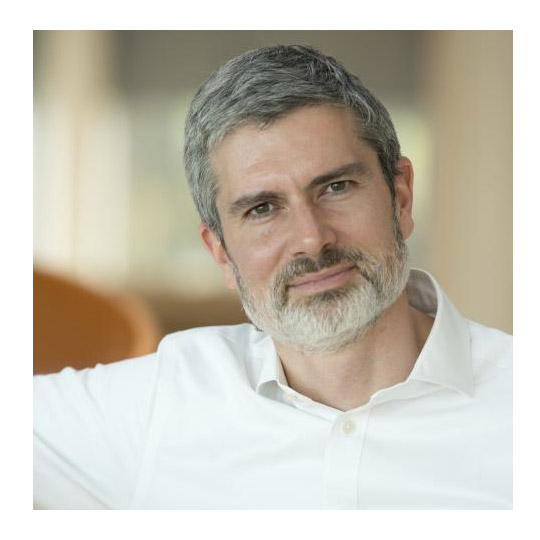 Rory MacFarquhar: It depends on what one expects. After the announcement of the tariffs, it became obvious to all financial market participants that there would be a significant downturn. What Donald Trump expected, no one knows. Around him are strong, serious economists who understand perfectly how markets work, how the world works, but we do not know what they reported to him in advance, how honestly they explained the situation. Because this is his policy, he has been advocating tariffs for 40 years, and members of his administration, to get their positions, had to recognize the correctness of this policy, the policy of tariffs. Donald Trump obviously believes that everything is for the better. We do not know how much he expected such a 15% drop in American markets, but for market participants, everything is absolutely logical.
Evgenia Albats: Kirill, how is Europe reacting to the introduction of tariffs? How serious is it for Europe?
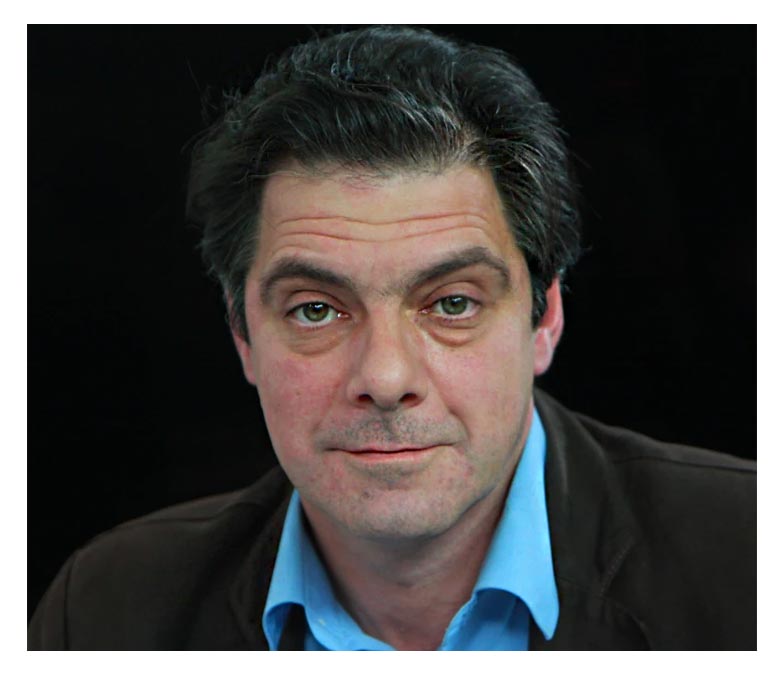 Kirill Rogov: In everyday life in Europe, at least in Vienna, nothing special is happening yet. I think that in what is happening in the markets, we will have to distinguish two sides. The first is the short-term effect, the immediate response of the markets, and we see how negatively the American market is reacting. It would seem that if tariffs are supposed to protect the American economy, then the American market should have been pleased, unlike the markets of other countries against which the tariffs are directed. But we see that this is not the case at all. Secondly, as I understood from the comments, the strength of the market reaction is not only related to Trump trying to implement his tariff policy, but also to the markets suspecting that there will be a strong response from his Chinese and other counterparts. And this could lead to an escalation of the tariff war, which will have a destabilizing effect on everyone. This moment is important from the point of view of political analysis.
We have been observing how Trump acts for two and a half months, and in principle, an important statement is that Trump's political and economic partners in negotiations consider him less strong than he considers himself. This is manifested in his negotiation strategies with Ukraine, in his negotiation strategies with Russia, and will manifest in his negotiations with others. Trump's general negotiation model is to start with an ultimatum. So, all the counterparts assess him in this attempt at an ultimatum as weaker than he assesses himself. And this is the problem of all the communications he is now building in the international sphere. The option of escalating a trade war, a tariff war, looks very likely for the markets, which determines their painful reaction.
Tariffs are a consumption tax, and a consumption tax mainly hits the poorer part of the population
Rory MacFarquhar: I believe that the market reaction reflects an increase in the expectation of a downturn in the American economy, that is, a recession. If, say, a week ago Goldman Sachs or JP Morgan thought that the probability of a recession this year was somewhere around 30 percent, now JP Morgan has raised the probability to 60. And I don't think this is exclusively about the possible reaction of other countries.
This is the direct effect of the introduction of tariffs because tariffs are a consumption tax, and a consumption tax mainly hits the poorer part of the population. The wealthy spend a relatively smaller part of their money on consumption, they save their money, while the relatively poor consume all their income. And for them, this means a huge tax increase of a size we haven't seen in fifty-sixty years. The last time this happened was in 1968 during the Vietnam War. That's why the markets are reacting this way.
An Unusual President
Evgenia Albats: Larry Summers, a very famous economist, a former high-ranking economic official in various US administrations, and president of Harvard University, said the following in an interview on Sunday to the CBS channel. The losses for the economy are like if all oil prices doubled, if gasoline prices rose to six or even seven dollars per gallon or something like that. Now they are 3–4 dollars per gallon (a gallon of gasoline in the US is 3.8 liters. — NT). And he says — we've never seen anything like it. Rory, you worked in the National Security Council of the United States in the Obama administration, you know how such decisions are made. Did the economists around Trump calculate the consequences?
Rory MacFarquhar: Every president, every administration works in its own way. Trump is a very peculiar president, atypical. So I would say that my experience does not work in this case. A week ago, Kevin Hassett, the head of the National Economic Council under Trump, said that very detailed analytical materials are laid out before the president, and he will make the decision himself. So in theory, they did all the calculations, they reported to him what would happen with this approach or another, they should have given him several options. The president chose this one. The thing is, it's his deep belief that tariffs will help the economy in the long term, that the current downturn is a temporary phenomenon, and that if he stays the course, a better, brighter future will come.
Evgenia Albats: So this is practically a unilateral decision by President Donald Trump?
Rory MacFarquhar: Absolutely.
Evgenia Albats: Kirill, throughout the 90s, and then especially in the early 2000s, when oil prices rose and everyone suddenly realized that the Russian economy was reviving after the 98 crisis, there were debates about various regulations. And it was endlessly said that tariffs should be maximally removed. We got used to reading and listening that we live in a global economy. The famous Thomas Friedman, a columnist for the «New York Times», wrote a book about the «flat earth», about how the globalization of the economy allows living as if one family. And now Donald Trump is building trade barriers around the United States. Is this the end of the global world?
The previous mainstream and previous political forces that opposed Trump and played a key role in American political life for the last 15–17 years are in crisis. But this does not mean that what Trump declares opposes this crisis
Kirill Rogov: I think not. Trump is an eccentric person with exotic views on reality. And here, in my opinion, there are two sides. On the one hand, there is some regularity and logic in why a person with such exotic views came to the White House again, won the elections again. This is an important question. But unlike many, including intellectuals, whom I call Trump-fershteyers, «understanding» Trump, it does not seem to me that Trump represents some new mainstream that will replace the previous mainstream, liberal. Certainly, the previous mainstream and previous political forces that opposed Trump and played a key role in American political life for the last 15–17 years are themselves in crisis. But this does not mean that what Trump declares opposes this crisis. This is still exotic, and to some extent, Trump makes an impression on me as an eccentric Brezhnev. He is a very old man, he is 78 years old. We see that he is not very good at formulating his thoughts, so he speaks in stereotypical phrases that he repeats many times during his speech.
Evgenia Albats: Soundbites.
Kirill Rogov: Yes, yes, he finds it difficult to construct a new long sentence, he does not have enough speed of neuron movement for this. On the one hand, he is fanatically convinced of some outdated truths, and at the same time, he is in a state of some paranoid solipsism because he believes very much in himself and his chosenness. This is a rather exotic story and some, I would say, outburst of democracy. At the same time, we must understand that this is a reflection of a significant crisis in the relations of the world that existed after the end of the Cold War. The crisis of this world order began, probably, back in the mid-2010s, and it is developing. It has many aspects, and in particular, there is a problem, the reaction to which is Donald Trump's policy — this is the problem of the US trade deficit and American debt.
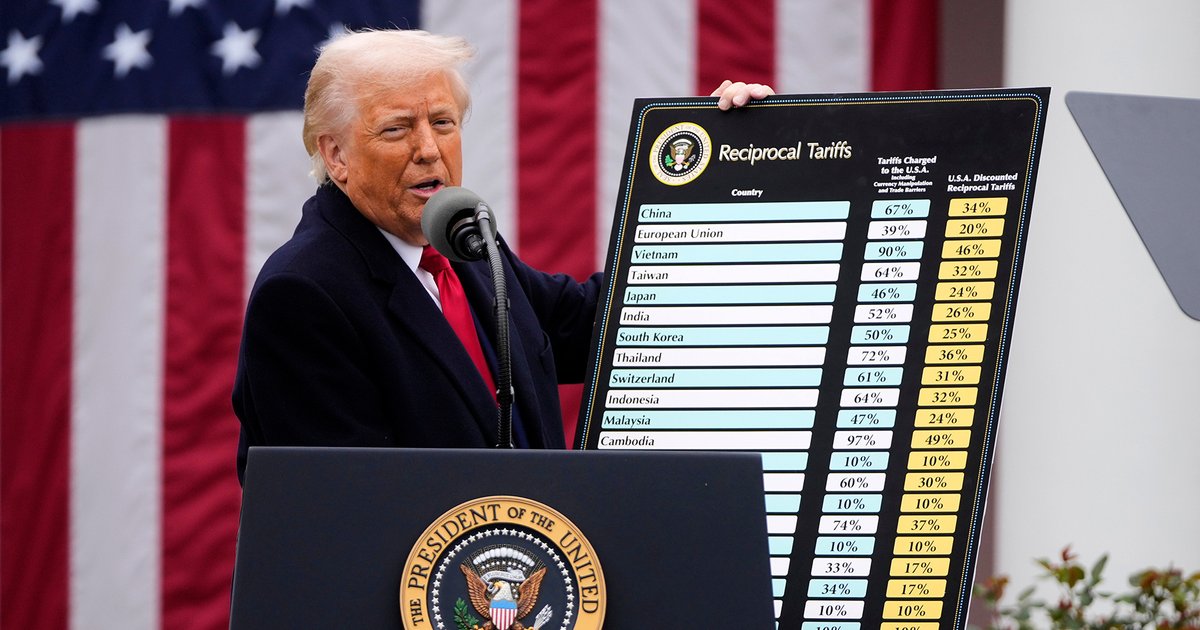
Donald Trump speaks at an event announcing new tariffs, April 3, 2025. Photo: AP/Mark Schiefelbein
This problem hangs over the American political system, and some solutions will have to be sought. It does not resolve itself. There is a problem of the changed global context in which the United States and its allies, not only Europe, have a completely different weight in the world economy. Their share has become much smaller than it was 20–25 years ago. This is also a change to which political and economic adaptation is needed, and the United States and its allies have not been engaged in this for the previous 20 years. It was believed that the balance of power that was established in the 90s after the defeat of the communist bloc and the end of the Cold War was institutionally maintained. But during this time, the share of the so-called global South economies, outside the organization of economically developed countries, has grown from 20 to 45 percent. It has doubled, their weight has doubled, and political institutions must respond to this. The system must change, the balance and all the institutional foundation of this balance must change.
And the reaction to this crisis was the appearance of such an exotic figure as Trump. The world is looking for answers to questions that the liberal-democratic mainstream could not answer. But so far, these answers look very strange.
The Benefits of Tariffs
Evgenia Albats: Trump's economic advisors, the Secretary of Commerce, the Secretary of the Treasury, and others who are part of the Economic Council under the President of the United States, say that the introduction of tariffs against everyone is a matter of national security. That there has been a catastrophic deindustrialization in the United States, the United States does not even produce its antibiotics, and that the main task is for factories to return to America from Asia, where they are located, or from Mexico, and so on. And for this, tariffs are being introduced. To this, the famous historian, including economic historian Niall Ferguson said the following: the president, meaning Donald Trump, «has as much chance of reindustrializing the US as you have of getting your frozen laptop to work by smashing the motherboard with a hammer in Minecraft». But tell me, please: is this a real problem? I was in the United States during COVID. And I remember how during those months it was impossible to buy masks, gloves, or other things for protection against the virus because they were not produced in the United States, but were produced in China. Is there any positive side to tariffs?
Rory MacFarquhar: Trump and his advisors name three different goals for these tariffs. First, as you rightly say, they believe that the decline of industry in the US threatens national security, but in addition, they believe that there are few well-paid jobs for the less educated part of the population. And the first goal is to return industry to the US. The second goal is not entirely compatible with the first. They believe that tariffs in other countries are on average higher than in the US. And to make them lower tariffs on American exports, they need to threaten with their tariffs. That is, the second goal is the development of American exports. The third goal is to reduce income tax and other taxes. And other sources of revenue for the budget need to be found so that the deficit does not grow even higher than it already is.
In my understanding, very high levels of tariffs have been named now, but most likely this is not the final position. They are ready to trade partially with Europe, Japan, and other trading partners, but ultimately they intend to leave tariffs at the 10% level, these are the base tariffs worldwide. Between today and, say, in the next 3–6 months, they will be trading the delta between the current levels and 10 percent. How realistic is all this? I read classical economics textbooks, often written by famous economists, Nobel laureates, and from them, it follows that all these ideas are crazy. Trump thinks differently.
Most likely, Niall Ferguson is right when he says that the return of industry, especially with a very high level of uncertainty, is unrealistic, no one will make large investments in the US economy when it is unknown what will happen tomorrow. So most likely this is a major mistake. Maybe Trump is smarter than all of us, but I don't think so.
Evgenia Albats: American media reported that there is already a queue of prime ministers, presidents, and monarchs who would like to negotiate with Trump and bargain for a lower tariff. Is there an option that Trump will eventually lower tariffs on American goods and cancel these tariffs against everyone?
Rory MacFarquhar: He will negotiate, he really wants other countries, presidents, monarchs, and so on to ask him to negotiate. This is very acceptable to him. But the question is to what level he will lower it. It seems to me that not to zero.
They talk about a recession because of uncertainty, because those corporations that partially work abroad, partially in the American market, are paralyzed, they will not invest funds, because they do not know what will happen tomorrow
Evgenia Albats: And is 10 percent a lot? How much does it raise prices in the country?
Rory MacFarquhar: This is four times more than they were. But it should be noted that imports to the US account for 14 percent of GDP, which is about 20 percent of consumption, so yes, prices are rising, but somewhere at the level of one and a half to two percent across the country.
Evgenia Albats: So it's not very much.
Rory MacFarquhar: But not little either.
Evgenia Albats: Yes, but compared to 20 percent inflation, especially food inflation, it doesn't look so scary. Why then is everyone talking about a recession?
Rory MacFarquhar: That's a good question. Mechanically, the current effect is not enough for us to fall into a recession. They talk about a recession because of uncertainty, because those corporations that partially work abroad, partially in the American market, are paralyzed, they will not invest funds, they may even start laying off workers, because they do not know what will happen tomorrow.
The Trouble with Non-Professionals
Evgenia Albats: Kirill, what will be the consequences for our part of the world — for Russia, which is waging an aggressive war against Ukraine, and for Ukraine, which is resisting with its last strength. Trump says: this is an economic revolution. What is happening — does it help dictators like Putin survive? People from Trump's entourage said that his idea is to separate China from Russia, so that there is no «axis of evil», as was said under Biden: Russia, China, North Korea, and Iran. That this alliance needs to be broken, and the main thing is for China to stop being an ally of Russia.
To this, China responded by Xi Jinping coming to Russia. China also responded very sharply to the introduction of tariffs. From this point of view, does the economic war with everyone change anything?
Kirill Rogov: It seems to me that several questions need to be separated here, although they are interconnected. Firstly, what is happening now on the Russian-Ukrainian front, namely missile attacks on cities with a large number of civilian casualties, including, most terribly, children, — this is a continuation and consequence of very unsuccessful attempts to negotiate a partial ceasefire. Before the negotiations on a partial ceasefire began, Russian air attacks on Ukraine were not so strong. There was some lull, right up to the moment these negotiations began. The fact is that strikes on the Ukrainian energy infrastructure no longer matter, it is very diversified, on the one hand, on the other hand, the cold season is over. At the same time, Ukrainian strikes on the Russian energy infrastructure, primarily on the oil refining structure, were gaining strength and had an economic effect. And in some sense, the Russian shelling of the last two weeks is an attempt by Putin to show that his air strikes cause great harm to Ukraine. And he inflicts them on civilians. This draws our attention to the fact that there is a very large lack of professionalism in the tactics of negotiations that the Americans are conducting with Putin. On the American side, they are conducted by people who are not immersed in the issue. They do not really understand what the consequences of certain decisions will be. Putin's strikes on the civilian population of Ukraine are not included in the pool of ceasefire obligations, this is a direct consequence of the illiteracy of Trump's negotiators.
Evgenia Albats: Putin directly said: we will finish off Ukraine. It is clear that he will continue to destroy it.
Kirill Rogov: Yes, this is a more general question, but I would like to draw attention to the aspect that the lack of professionalism in the formulations from the Trump team leads to such excesses when they are deceived: well, we did not strike at the infrastructure, the playground is not part of the energy infrastructure.
It is very important to understand what is happening around the Ukrainian issue. The Trump team cannot conduct professional negotiations on the settlement in Ukraine. But they are not conducting them. They are conducting them about some larger deal that Trump has conceived and in which Ukraine is either a part or a bargaining chip of a big deal. These are completely different negotiations about a different issue. And this is what you asked about: to what extent is the idea of this deal to separate Russia from China. The field on which this is supposed to be done is mainly quite mythical global projects. This is a project of some global agreement where the United States and Russia divide the Arctic. And the meaning of this project is quite pragmatic, the United States is afraid that otherwise, the Arctic will be divided by China with Russia. Russia is not scary as a player in the Arctic. But if it is there together with China, this is already much more dangerous.
The second idea is related to Trump's concept, part of his big doctrine America First, in which the United States is the dominant player in the energy market. And here the logic is about the same. Several global alliances can be created in the energy market. The alliance that scares the United States is the alliance between Russia, China, and Iran. Russia and Iran have 40% of the proven gas reserves. And with Chinese investments, this can be a powerful energy union, mainly concentrated on gas, because it is believed that the share of oil in the fuel balance will decrease, and the share of gas will still grow for quite a long time. And Trump's fantasy is that an alternative alliance of the United States and Russia will become a global player.
And indeed, if we look at the current gas export of the United States, it is somewhere around 20% of all gas exports. And Russia before the sanctions is more than 20% of gas exports in the world. If you add this up, we get about 45% of gas exports. Why do I say that these are quite mythical things? Because this is a beautiful conspiratorial layout. We understand that such global deep alliances require a long period of forming trust and interconnections, which must have a stable foundation. The formation of such an alliance is beyond the constitutional presidential term of Trump and is unlikely to be considered by Vladimir Putin as a serious proposal. What will happen after Trump finishes his term? And in the short term, Russia has redistributed about 30% of its imports and exports from the European direction to the Asian one over the past three years. And today, breaking the connection between Russia and China means first of all making a reverse maneuver, transferring these 30% of exports and imports from China to Europe. But what does Trump have to do with it, and how can Trump accomplish this? This logic has some rational basis, but it does not have a reasonable implementation plan.
Evgenia Albats: But if Trump wants to negotiate with China, why is he imposing such prohibitive tariffs against China?
Kirill Rogov: As Rory correctly said, these are claims put forward, after which negotiations should follow. And indeed, Trump's idea is that, of course, they will decrease, these very barriers, and then reach 10%. Then an alternative arises. Either investors will decide that it is better to transfer production inside America, or American consumers will simply pay these 10% out of their pocket. Or most likely it will somehow be distributed. But how will it be distributed? Let's say 7% will be paid by American consumers, and 3% will go to investments. The American economy will then lose because more went to price growth than to real investment inflow. If more than 5% goes, then it can be said that somehow nothing yet. But I completely agree that the chances of this being in favor of the United States are very low because there are specific limitations.
And the problem is also that today import substitution is not that you produce a car entirely, you have international chains for different components, and you take components where they are cheaper, from different places, and then you assemble it into a car. Therefore, everything is much more complicated. You can end up with a situation, as in the Russian experience of Putin's import substitution, that you seem to have assembled a computer here, and then we see that 90% of its components are not from here. You just wrote that it is from here, and for this, you sawed off the import substitution program for 10 billion rubles. You need to approach it somehow completely differently. And the way Trump's team approaches it looks like a 50-year-old jackhammer, with which they are trying to adjust something that already has a completely different form and structure.
Evgenia Albats: Why are there no sanctions against Russia and Belarus, but there are against the McDonald Islands, where people do not live, but penguins do? This question was asked by the host of a very popular Sunday program in America Face the Nation to the Secretary of Commerce. He answered that in this way the United States avoids arbitration courts: if you impose against some countries and not against others, then those against whom these sanctions are imposed will go to arbitrations and challenge them. Explain, what is the logic here?
Rory MacFarquhar: It seems to me that the logic is a little different. They say: well, Russia and Belarus are a separate issue. There are already sanctions on them. Not tariffs, but sanctions. And since negotiations are actively underway, supposedly if you also impose tariffs, it will interfere with the course of negotiations. The explanation is quite simple. I don't think this reflects Trump's special love for Putin, although this is also not very clear.
The Specter of the Great Depression
Evgenia Albats: The last question, of course, is about the near future. The most frightening now are the forecasts of famous investors who say that literally tomorrow a collapse may occur, that not only big companies but also small businesses will collapse. Again, they started talking about it leading to what happened during the Great Depression. Konstantin Sonin, a professor at the University of Chicago, wrote that if Trump's task is to bring down the dollar, and we see that the dollar is falling, then he is acting absolutely correctly, and thus the dollar will cease to be the world's currency, and so on. In short, there are a lot of fears.
Kirill Rogov: In general, a crisis is normal. Economists and businessmen have such a motto: Don’t waste the crisis. Do not miss the crisis, because a crisis is change, it is development. But every crisis has the potential to turn into a catastrophe, this must also be remembered. And if we look at history, there are many periods when a Great Empire, experiencing some, seemingly not so terrible internal problems, suddenly begins to act in such a way that these problems turn into a catastrophe, there are many such examples in history. But what looks very dangerous is that chaotic economic policy in Trump's execution is adjacent to the undermining of America's geopolitical power. The undermining of America's geopolitical power is the destruction of its traditional alliances, which existed for many decades, regardless of which president comes to power. In an amazing way, American politics was arranged with high turnover of domestic political agendas, economic decisions, and at the same time extraordinary stability of the contour. This was the incredible strength of American democracy, as it was perceived in the world. And it is this amazing property of American politics that Trump undermines. He undermines the geopolitical power of the United States by destroying traditional alliances and presenting the United States as an unreliable partner. It seems to me that in the long run, this creates real threats from the American debt, which is largely based on the perception of the geopolitical power of the United States and its invincibility. And here, indeed, very unpleasant prospects arise. But maybe the world and the United States will manage to get out of it, and it will just be a crisis that will renew everything, and not turn onto the trajectory of catastrophe.
Evgenia Albats: Can the dollar cease to be a reserve currency?
Rory MacFarquhar: I think this is possible only in a very long-term perspective, because today there is no other currency ready to replace the dollar in international transactions. So in the short term, I'm not very worried about this. We must also remember that what we are observing in recent days is not a natural disaster. This is not a market crash like in 1998 in Russia or 2008 worldwide. This is a completely different phenomenon. What we are observing is the result of specific political decisions by the American administration. This means that they can retreat. And if they retreat, they can stabilize the markets at any moment.
Video version:
Reference:
Kirill Rogov graduated from the Faculty of Philology of Moscow State University and began his career as a historian of Russian culture of the 18th–19th centuries. He was a columnist for «Kommersant», «Vedomosti», edited the projects «Polit.ru» and «In Liberty», worked as a research fellow at the Institute of Economic Transition named after Yegor Gaidar. In exile, he founded the analytical project Re: Russia and became a weekly author of the Sakharov Center project* «Country and World».
Rory MacFarquhar — chief economist of an investment company, former special assistant to President Obama and senior director for international economics and finance at the National Security Council in the Obama administration. After leaving the government, he worked as a senior vice president at «Mastercard». He worked for many years in Russia as an analyst for Goldman Sachs, speaks Russian well.
* Evgenia Albats, Kirill Rogov, the Sakharov Center in Russia are declared «foreign agents».