In a ceremonial setting in the White House Rose Garden, Trump declared April 2 as 'Liberation Day' for America and announced unprecedented tariffs on imports to the U.S. not seen since the beginning of the last century.
'Today is Liberation Day. This is one of the most important days in American history, it is a declaration of American economic independence,' Trump stated, adding that he would make America 'great and wealthy' again. 'Our country has been ripped off for over 50 years. This will no longer happen,' assured the U.S. president.
Trump's three main targets are the European Union (the world's second-largest economy), China (third), and neighbors and partners in the customs union, Canada and Mexico. They account for the lion's share of the U.S. trade deficit.
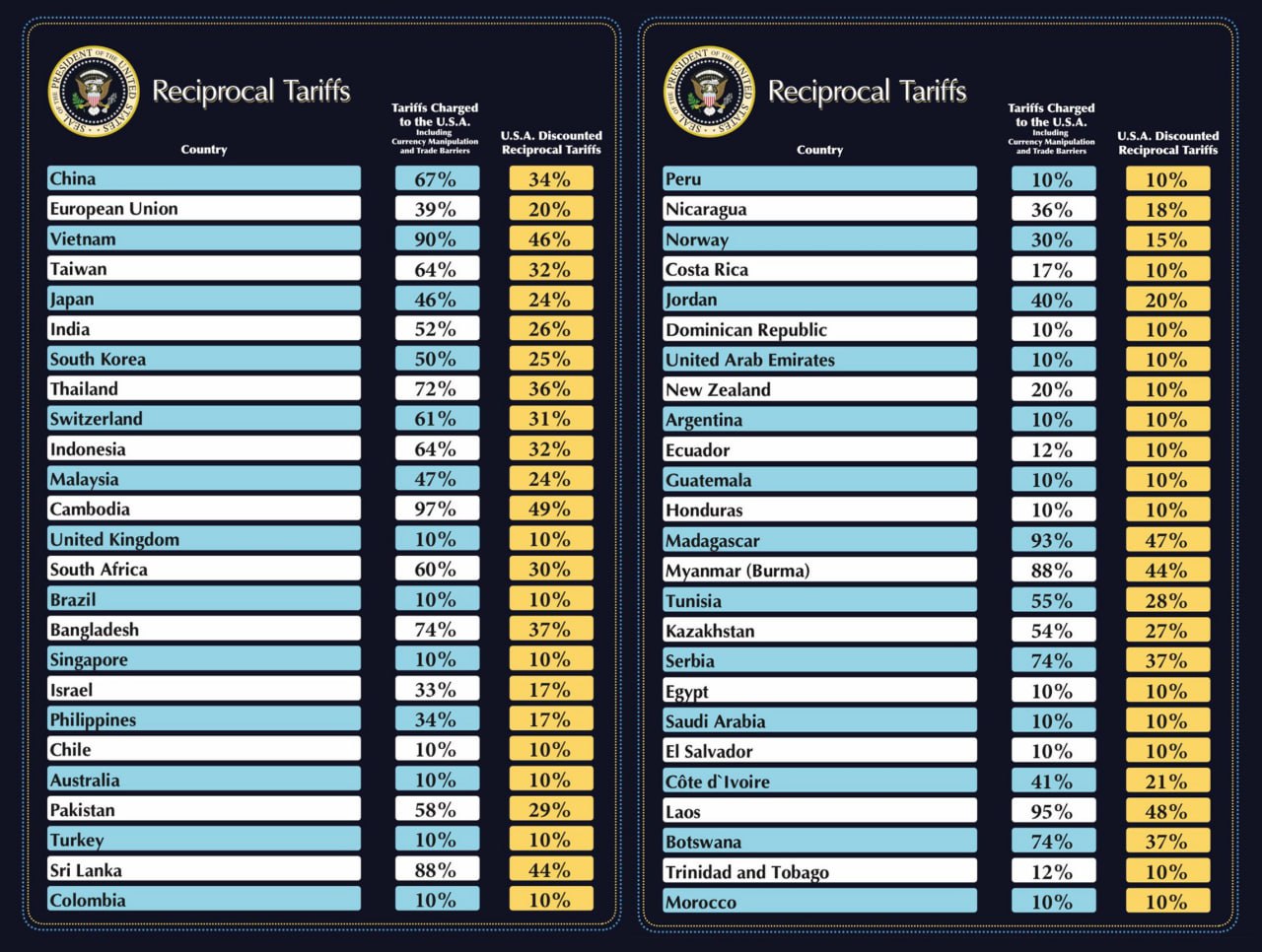
Trump believes that trade partners are profiting off America because they sell more goods to it than they buy from it, and their tariffs are higher than American ones. Today's 'retaliatory' tariffs are intended to level the playing field.
Trump imposed a 'retaliatory' tariff of 34% against China, 20% against the European Union, 24% against Japan, and 26% against India.
The highest tariff rates were imposed against Cambodia (49%), Vietnam (46%), and Sri Lanka (44%). The lowest — against Brazil, Singapore, Australia, the United Kingdom, and several South American countries (all at 10%). According to Trump, when calculating their tariffs, U.S. authorities took half of each country's tariff rate on American goods
According to the U.S. president, Washington will direct 'trillions of dollars' in revenue from mirror tariffs to tax reductions and debt repayment, all happening 'very quickly.' However, economists warn that this will complicate life for everyone, including Americans, who will pay for the import tax introduced by Trump.
Donald Trump also offered countries a way to reduce the tariff to zero: 'If they complain, if you want your tariffs to be zero, then build your product right here in America, because there are no tariffs if you build your plant, your product in America. And we see companies coming here like never before.'
'This is an economic deadlock, at the end of which lies a loss of prosperity on both sides of the Atlantic,' Reuters quotes Wolfgang Grosse Entrup, head of the German Chemical Industry Association.
The European rating agency Scope stated that 'President Trump's escalation of the trade war will lead to rising inflation, slowing economic growth, and adjustments in global supply chains.' In this regard, the agency lowered growth expectations for 2025 to about 1% (compared to 2.7% in the December forecast) and to 1.5-2% in 2026 (compared to 2.2%).
Russia is not on Trump's list. According to The Bell*, Russia occupies such an insignificant share in U.S. foreign trade that it did not even make it into the top 50 trading partners. In 2024, trade turnover between Russia and the U.S. amounted to $3.5 billion — the lowest level since 1992.
Later, a source in the White House told The New York Times that mutual tariffs do not apply to Belarus, Cuba, Russia, and North Korea because they already 'face extremely high tariffs, and our previously imposed sanctions prevent any significant trade with these countries.'
* Recognized in Russia as a 'foreign agent'.
Photo: The New York Times