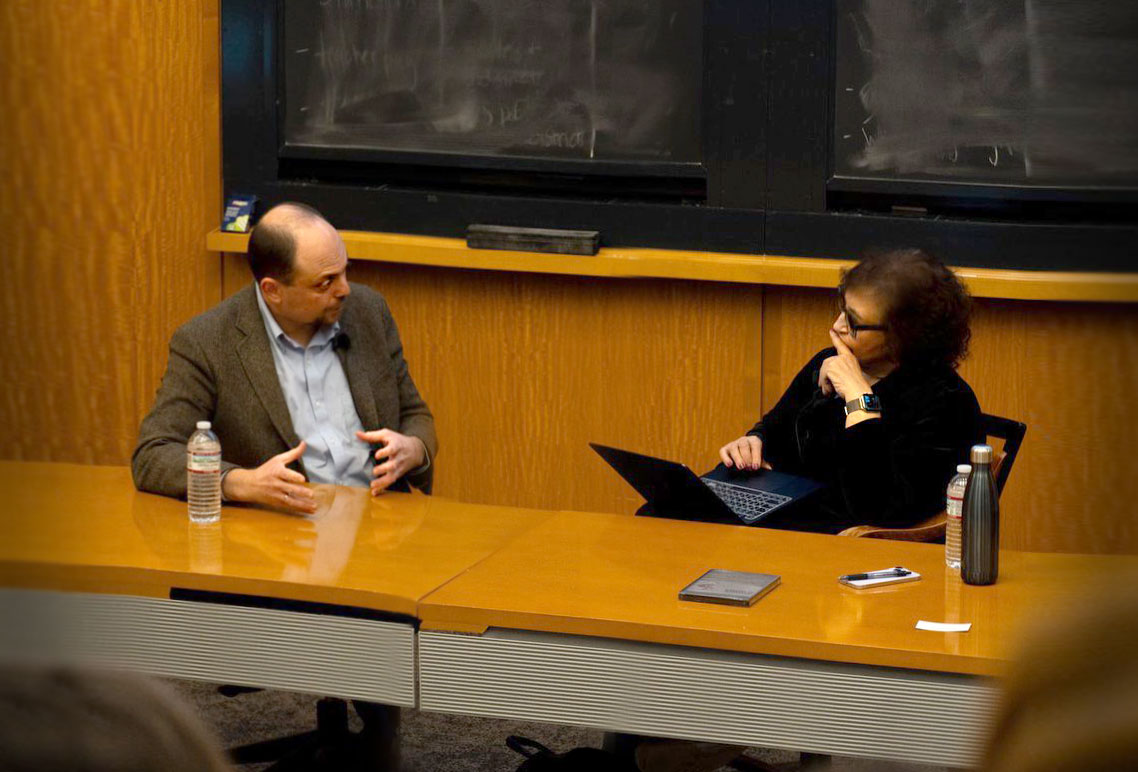
Evgenia Albats*: Many are interested in your surname. Kara-Murza — does it mean black prince?
Vladimir Kara-Murza: It originates from ancient Turkic languages. I often say that my family's history very well illustrates that Russia, at least in the 20th century, was as much a melting pot as America was and remains.
Four of my great-grandfathers were born in the late Russian Empire, all of different nationalities, different religions, and completely different life callings. One great-grandfather was Jewish. He was an engineer. Another great-grandfather was Latvian, Lutheran by faith. And he was a revolutionary, a social democrat, and also a political prisoner. Another great-grandfather was Russian, Orthodox, and served in the Russian Imperial Army. He was a Knight of the Order of St. George during World War I, the highest military award in the Russian Empire.
And finally, the great-grandfather whose name I bear, Sergey Kara-Murza, was, as my wife would say, a Renaissance man. He was simultaneously a lawyer, a writer, and a theater critic. Every Tuesday he hosted perhaps the most famous literary salon in Moscow in the early 20th century. It was attended by people like Alexei Tolstoy, Maximilian Voloshin, Ilya Ehrenburg, and many, many others. And he was Armenian, belonging to the Armenian Apostolic Church by faith. But he was from the Crimean Armenians. Until the times of Catherine the Great, Crimea was a vassal state of the Ottoman Empire. And many Armenian surnames of people living under the Ottoman Empire, such as Shakhnazarov or Babayan, have Turkic roots in the name.
The surnames underwent Turkification, but not the people themselves. They continued to remain Christians but Turkified the surname. This was also the case with my great-grandfather. Kara-Murza indeed means "black prince" or "black prince" in the Turkic language. But he was a hundred percent Armenian. There is a mountain in Crimea named Kara-Murza. So the name really comes from there.
The Story of the Arrest
Evgenia Albats: In April 2022, while in Moscow, you were detained in the courtyard of your residential building. Initially, the investigation accused you, I quote, of "changing the trajectory of movement." Did you do something wrong?
Vladimir Kara-Murza: It was April 11, 2022, about six weeks after the start of the full-scale war in Ukraine. I was returning home, driving home after a meeting with
I was returning from him by car, driving along the Boulevard Ring to my home, which is located in Zamoskvorechye. And when I approached my house, I saw that some silver van was parked at the entrance. I didn't pay attention to it because it's the center of Moscow, there are always lots of cars. And on the bridge, as I was approaching the house, I noticed a surveillance car following a black "Volkswagen." But this also did not attract much attention because if you are an opposition politician in Moscow, it is part of your daily life, just like traffic jams or bad weather. So it's not something to pay attention to.
But when I stopped in front of my house to click the remote, open the gates, drive into the yard and park, I saw in the rearview mirror of my car that the doors of the silver van were opening, and five or six policemen in black uniforms with black masks covering their faces were coming out. It turned out to be the second special regiment of the Moscow police.
We are used to the fact that the Russian authorities constantly lie. But still, when you see an official document stating that 2 plus 2 equals 5, you are still shocked
They started running out of the van and chasing my car. Of course, I understood everything at that moment. I managed to park the car and write to Vadim Prokhorov*, my longtime lawyer, that I was arrested. And at that moment, the commander opened the door and said: "Vladimir Vladimirovich, please come with us". I asked: "What's the problem? What rules did I break?" He said: "Everything will be explained to you".
They put me in this minibus, drove for an hour and a half through Moscow traffic to Komorniki. And there they charged me with an administrative offense, which you referred to. I don't remember the name of the article or its number, but it was indeed "changing the trajectory of movement." And when they showed me the indictment... We are all used to the fact that the Russian authorities constantly lie, there should be nothing surprising in this. But still, when you see an official document stating that 2 plus 2 equals 5, you are still surprised and shocked. In this official police indictment, they wrote that a police patrol happened to be on that street. And I was walking down the street. Walking... Of course, it was prepared in advance. They didn't know if I would drive or walk. And they wrote that when I saw the police, I changed the trajectory of my movement, hence the phrase, and actively resisted the police. We all know what Orwellian reality we live in, but still, when you see this... I, of course, wrote that this is complete nonsense and has nothing to do with reality.
As we know, in Russia, it doesn't matter what the truth is. But this was the first charge that resulted in 15 days in an administrative prison. And then, while I was there, criminal charges began to accumulate. First, it was Article 207.3 — spreading knowingly false information about the Russian armed forces, translated from Kremlin Orwellian to plain human language — speaking out against the war in Ukraine.
Then there was Article 284 slash 1. It seems it was cooperation with an undesirable organization. I must mention that the first charge was related to my speech in the Arizona State House of Representatives in March 2022.
Evgenia Albats: Via Skype?
Vladimir Kara-Murza: No. I was there in person, speaking at a plenary session. It was about two weeks before my arrest. It was a speech. The main topic was the war in Ukraine. It was the second or third week of the full-scale invasion. And I spoke about the war crimes committed by Russian troops, about the bombing of hospitals, schools, and residential areas. And this was "spreading knowingly false information," of course. The second charge was cooperation with an undesirable organization.
Evgenia Albats: Was it the "Free Russia Foundation"**?
Vladimir Kara-Murza: Presumably, although it has nothing to do with the case. In fact, it was a seminar, or conference, I would say, that we held at the Sakharov Center* in Moscow, now non-existent, in 2021 at the end of October. It's a tradition. We held this conference every year together with the Sakharov Center and "Memorial"* on the Day of the Political Prisoner, which is celebrated on October 30, to draw public attention, journalists, diplomats, and generally all interested parties to the worsening situation with politically motivated imprisonments in Russia. So this was the second criminal offense.
And finally, the charge of treason, Article 275. This was for my three speeches. One of them was my testimony to the Helsinki Commission of the US Congress, also about the war in Ukraine. There was also a speech I gave in Oslo about political repression and political killings in Russia. And the third was my speech before the NATO Parliamentary Assembly about the illegality and illegitimacy of the so-called President Putin remaining in power beyond constitutional terms.
And these were the five criminal charges. For this, I received a 25-year sentence. And on the day of sentencing, which was in April 2023, when the police convoy was leading me down the stairs of the Moscow City Court — there is a basement with cells for prisoners, and they were leading me down, I was walking in handcuffs behind my back, surrounded by policemen — the commander turned to me and asked: "Did you really just get 25 years in prison for five speeches?" I replied that yes, probably. He looked at me again, and I said: "I hope they were good ones".
But yes, it all started with the trajectory of movement. And what is very important, I must say, is that two weeks ago the European Court of Human Rights issued a decision on a major landmark case in which they combined several dozen applications from Russian citizens arrested for speaking out against the war in Ukraine. My case was included in this number. And I won it on two different articles — Article 10 of the European Convention on Human Rights, which concerns freedom of expression, and Article V, which concerns the right to liberty and personal security, i.e., unlawful arrest. So I am pleased to report that the charge of "changing the trajectory of movement" in the yard of my house was officially refuted by the highest judicial authority in Europe.
Evgenia Albats: But how do you understand this? Why did they start with this? Perhaps they wanted to imprison you for two weeks to then come up with something more serious. "Disinformation" about the activities of the Russian army is of the same order.
Vladimir Kara-Murza: It's important to say that none of the charges involved actual criminal activity.
Evgenia Albats: No, of course not. But how did they proceed to the charge of treason, why?
Vladimir Kara-Murza: They arrest you on a ridiculous administrative case. And while you're sitting, they prepare a criminal charge. I was the first this happened to. Then there was Dmitry Ivanov* from Moscow State University, then Ilya Yashin* in June, who was first arrested allegedly for swearing at the police or something like that. We both understand how plausible that is. And then, while everyone was sitting in administrative prisons, criminal charges came. So they just tested this model on me.
I don't know why they couldn't just arrest on a criminal charge right away. Maybe they don't immediately figure out what to do next. We've seen that our mutual acquaintance Leonid Gozman* was also arrested on an administrative charge. And everyone thought the same thing would happen to him. But then he was released, and he was able to leave the country.
So maybe they need time to make a decision. I don't know. Maybe someday we'll find out. Like you, I went to the old KGB archives as an expert for the parliamentary commission in the early 90s. Someday, I'm sure, the current archives will also be opened, and researchers will come there. Maybe there we'll find the answer.
As for "treason," essentially, it's an old Soviet tradition where opposing the government was equated with betraying the Motherland. This hasn't happened for half a century.
Evgenia Albats: Not many dissidents were charged with treason.
Vladimir Kara-Murza: But back then, even in the case of Sharansky, they at least tried to justify it. If you remember, they accused him of providing information about "refuseniks" to a correspondent, I think, of the "Los Angeles Times." And the correspondent, not Sharansky, but the correspondent wrote an article based on this information, which essentially revealed which of the Soviet "mailboxes," the so-called closed scientific institutions, had top-secret clearance because people from there were denied exit visas to Israel. And they concocted a case that he allegedly passed on secret military information. This became the formal "basis" for charging him with treason.
The last case we researched with my lawyer Vadim Prokhorov, who, like me, is a historian. We researched this with him during my trial. The last time someone in our country was charged with "treason" just for speaking out, not even pretending it allegedly had anything to do with military secrets, was Alexander Solzhenitsyn in February 1974. He was charged with treason because of the book "The Gulag Archipelago" and nothing else. Since then, until my case, this hasn't happened. But, of course, if you go back to Stalin's times, it happened all the time. And so I would say that this is a revival of the old tradition where speaking out against the government is equated with betraying the Motherland. I literally had nothing but five speeches. No one pretended that I had given away any secret information because I never had access to it. They just said: yes, he spoke out. And by speaking out against the war in Ukraine, speaking out against the illegitimacy of Putin staying in power beyond his term, speaking out against political repression in Russia, he damaged the reputation and discredited the Russian Federation on the international stage, blah-blah-blah. This was their logic. So this is a common cause that fits into the ideology, if it can be called that, or the behavior model of the current regime.
Judge under Sanctions
Evgenia Albats: But judging by the degree of severity, there must be another reason.
Vladimir Kara-Murza: There was also a personal reason, I think, too. As you know, they tried to poison me twice for my work on the "Magnitsky Act." Thanks to the brilliant investigations conducted by Alexei Navalny's*** team, Bellingcat*, Insider*, and Der Spiegel, we now know not only the units but also the specific names of the FSB officers who poisoned Alexei Navalny, poisoned Dmitry Bykov*, poisoned me, and followed Boris Nemtsov in the weeks leading up to his murder.
This death squad, this death squad in Putin's special services, was exposed by investigators in 2021. So the same FSB officers who poisoned Navalny poisoned me. Obviously, things didn't go as they wanted because I survived. And I think these 25 years in the sentence were a way to kill me more slowly and more sadistically. Because I couldn't get out of there alive. I was sure I would die in a Siberian prison. It still feels like I'm watching a movie, even though it's been seven months since that miracle of release on August 1 last year. Sometimes I have to pinch myself to realize that this is actually real because... well, because I wasn't supposed to get out of there.
And I mentioned that they did it intentionally because the reason for my poisonings was, of course, the work on the "Magnitsky Act." The judge who sentenced me to 25 years was the same judge Sergey Podoprigorov who imprisoned Sergey Magnitsky in 2008, the same judge Sergey Podoprigorov who was sanctioned under the "Magnitsky Act" among the first thirteen names in 2013, the same judge Sergey Podoprigorov who wrote a letter with the help of a very expensive British-Australian law firm, appealing to the US Treasury to be removed from the sanctions list. As we know, very often representatives of the Putin regime try to say: "Oh, it's so cool to be under sanctions!.." He didn't do that, he wrote that it's really a big problem for him. And he was the one assigned to judge me. It was very deliberate.
Evgenia Albats: But that's a clear conflict of interest, isn't it?
Vladimir Kara-Murza: Absolutely. This will be one of the grounds on which we are going to appeal to the UN Human Rights Committee. We can no longer use the European Court of Human Rights because Russia was expelled from the Council of Europe when Putin invaded Ukraine. But we can still use the UN Human Rights Committee. It's a much weaker instrument, but it's the best there is now in terms of international law.
So in addition to the five official charges, five speeches, there was also an undeclared charge — the "Magnitsky Act." They very clearly explained why I was actually put behind bars.
For my judge, the process was deeply personal. And although the outcome was predetermined, he did everything to make every minute of this process a personal hell for me, and he enjoyed every minute
We know that these sentences, including the specific terms to which they are sentenced in prison, are decided elsewhere. They are not decided by the judges. But how the process will go depends on the judge. For example, in August 2023, I was a defense witness at Alexei Navalny's trial. I was on video link from my prison, he was on video link in his prison because his trial was held in prison, as you know, in the Vladimir region. The judge in Alexei's case had nothing personal. Of course, all the time he was conducting the process, he already had the verdict and the term in front of his eyes, but he had no personal hatred because there was no reason for it. So he just let us talk for 10–15 minutes. That is, I was giving official testimony, but we were just chatting with Alexei. And that was the last time I talked to him.
For Podoprigorov, my judge, the process was deeply personal. And although the outcome was predetermined, he did everything to make every minute of this process a personal hell for me, and he enjoyed every minute. He interrupted me at every phrase. He interrupted my lawyers. He was rude to the defense witnesses, including Nobel Peace Prize laureate Dmitry Muratov*.
Can you imagine, he didn't let us attach a single document from the defense side during the entire process. Zero. I had to ask my lawyers: does this even happen? Again, everyone knows the outcome. What harm is there in just adding a few documents to show that there are two sides to the process? No, zero. All the documents that were submitted, he threw out. And he really enjoyed every moment. It was visible in his eyes.
These are all the reasons. Essentially, it was a death sentence. And when I was being transferred from Moscow to Siberia, to Omsk, and this was in September 2023, the chief doctor of the Moscow prison called me, asked the guards to escort me to him. And he said very honestly — he's a good guy on a human level. He looked at me and said: Vladimir Vladimirovich, once you get there, you'll have a year and a half. Because after the poisonings I had, it's not the best place for the healthiest person, since it's a Russian prison, but after two poisonings with nerve agents, it's definitely not the place to be. And he said I have a year and a half. And I lasted a year, the exchange happened in August. So, again, it's a miracle. And I still sometimes have to pinch myself to feel that it's real.
Enemy of the People
Evgenia Albats: In your final statement before sentencing, this was April 10, 2023, you said: "In terms of secrecy and discrimination against the defense, my trial in 2023 left behind the trials of Soviet dissidents of the 60s and 70s, not to mention the requested term — 25 years — and the rhetoric about the enemy". The rhetoric was that prosecutor Boris Loktionov stated: "Kara-Murza is an enemy, and he must be punished". This is not even the 70s. This is the 30s. Could you elaborate on this? Why such secrecy? Did you have a closed trial?
Vladimir Kara-Murza: Completely closed.
Evgenia Albats: There was no public, as there was with Alexei Navalny. But at the same time, your interrogations were not led by the FSB, not the KGB, although perhaps they were behind it. As far as I remember, your case consisted of nine volumes. Out of nine books, there were exactly 37 pages written by FSB officers, their conclusion. What was on these 37 pages? What did the FSB accuse you of and why did they decide not to conduct the investigation themselves but to entrust it to the Investigative Committee?
Vladimir Kara-Murza: I must say that I did not read these 37 pages on purpose, and when I was offered to read them, I asked for paper and a pen. And I made a written statement to the investigator that I consider the Cheka and the KGB-FSB a criminal organization responsible for the deaths of millions of our people, and I am not interested in their opinion about me. I signed it and handed it to them. I hope this is in the case file, at least it should be. But as far as I understood from what was voiced during the trial by the prosecutor you referred to, it was essentially the opinion of several FSB officers. They wrote a legal opinion, about which my lawyer said: what is this? There are no grounds for this in the law. We can have either evidence or witness testimony or an official examination, say, linguistic, if it's about words. But they called it a legal opinion. In fact, it is the court that should issue the only legal opinion — whether someone is guilty or not. But even formally, before the court issued its opinion, there was a legal opinion from the FSB, which stated that by speaking out against Putin, against the war in Ukraine, against political repression, I damaged the international reputation of the Russian Federation in the eyes of the world community. And therefore I committed treason.
Evgenia Albats: Wait, you are a British citizen...
Vladimir Kara-Murza: I am, of course, a Russian citizen. But also British.
Evgenia Albats: You have British citizenship. How can they accuse you of treason? I just don't understand the logic.
Vladimir Kara-Murza: I don't think logic is what we should be looking for there. If they just need to send someone away so that he or she doesn't come back, they do it. And the court was completely closed, held behind closed doors...
Evgenia Albats: And it wasn't a military tribunal, was it?
Vladimir Kara-Murza: It was the Moscow City Court.
Evgenia Albats: How did they explain why they closed it?
My trial was the first closed trial of well-known political prisoners, but not the last, because now they do this with everyone. They no longer need to explain anything
Vladimir Kara-Murza: Because there were "state secrets," which, of course, there weren't. But they say so. That's the point. My trial was the first closed trial of well-known political prisoners, but not the last, because now they do this with everyone. The trial of Evgenia Berkovich*** and Svetlana Petrychuk*** was also held behind closed doors because they said: "Oh, there's a security threat". They no longer need to explain anything. To whom? We have no parliament, we have no free press. We have no functioning civil society because it's a totalitarian dictatorship. They don't care. They can say whatever they want.
Evgenia Albats: During the trials of dissidents in the 60s and 70s, despite the KGB doing everything to prevent people from attending the trials, they were still not closed.
Vladimir Kara-Murza: When I was first arrested, I expected my experience to be similar to what dissidents went through in the 60s, 70s, and 80s. This was one of the main areas of my study when I read history at university, and then I made a documentary about dissidents, and I had the honor of knowing many of these people personally, such as Vladimir Bukovsky, Yuri Orlov, and Natan Sharansky. During the dissident times, de facto trials were closed because the seats in the courtroom were filled with KGB people, Komsomol activists, informers. And when relatives and friends of the defendants came, they were told: "Sorry, the hall is full. We can't let you in". But close relatives could still come. At Sharansky's trial, his brother Leonid Sharansky was sitting and taking notes. At Bukovsky's trial, his mother and sister were in the hall, taking notes. Or, if they weren't allowed to take notes, they memorized what they could and then passed it on to others.
My trial was completely closed. It was an empty hall, three judges, which is also very symbolic, a "troika," three judges. The wonderful prosecutor you referred to, Boris Loktionov. He could have played in a theatrical performance or a film about the Stalinist trials, the Moscow trials of the 1930s. He didn't need makeup. You could just put him there and start filming, that's how he looked. And in his final statement before the court, in the indictment, again returning to the 1930s, he ended his final statement with these words. He looked at the trio of judges, pointed at me sitting in the cage, and then said: "Here you see an enemy who must be punished". He sat down, and my lawyer Maria Eismont and I, we just looked at each other. Because words like "enemy" you wouldn't even hear in the 70s. This goes back to Stalin's times, not Brezhnev or Khrushchev.
This is how they do it now. And now most trials of political prisoners are closed to the public. So, again, this was a test they were trying to conduct. And all this will be the basis on which one fine day, I have no doubt, this sentence will be overturned.
In the indictment, there was a phrase that in my speech before the Arizona legislature, I used expressions and words hostile to the leadership of the Russian Federation, including the President of the Russian Federation Vladimir Vladimirovich Putin. And literally two or three months before my arrest, I went to the reading room of the Russian State Archive to familiarize myself with the NKVD case against my grandfather Alexei Kara-Murza, who was also a journalist and historian. He was arrested in 1937 and convicted under the infamous Article 58/10, "anti-Soviet agitation and propaganda." He served time in the Gulag in the Far East, in the Khabarovsk Territory.
And in his indictment in 1937, it was said that he expressed hostile attitudes towards the leadership of the party and government. So these are literally the same expressions they use today in indictments, identical to those used by the NKVD in the 1930s. It's impossible to make this up. I wouldn't have believed it myself if someone had told me this before my arrest.
How to Survive Prison
Evgenia Albats: Kira Yarmysh***, who was Alexei Navalny's press secretary, wrote a book after she was imprisoned for a year. She wrote that for a person who is used to taking a shower daily and taking care of themselves, it's a real ordeal. How did you cope with all this?
Vladimir Kara-Murza: I don't want to say that I was prepared because it's impossible to prepare for this. But I studied the history of the Soviet dissident movement in detail, knew many of these people, I read all their memoirs. And, by the way, I reread many of them in prison. And I read them completely differently when you are essentially living inside such a book. So I was ready, at least on an intellectual level, because I was surprised at how everything remained exactly the same.
Evgenia Albats: What was the most difficult for you?
What was really hard was solitary confinement. All day you just walk around a tiny circle in your cell — four walls, a small window with bars under the ceiling. About 2 by 3 meters. Nothing to do. No one to talk to. Nowhere to go
Vladimir Kara-Murza: The ban on phone calls with family. Again, this is an old Soviet tradition. They seek to punish not only the opponent but also his family. They torture families. In the two years and three months I spent in prison, I was able to talk on the phone with my wife only once and twice with our children. The last time was in December 2023, shortly before the New Year, it was a 15-minute call, and that's all you get. And we have three children. So my wife literally had to keep track of time with a stopwatch to make sure everyone could talk.
This is torture for families. They've been doing this since communist times. I didn't care, to be honest, about the shower or the food, it doesn't matter on the scale of life values. But when you are not allowed to hear your child's voice for months and years, it's torture. And they do it intentionally.
And what was really hard was solitary confinement. I never understood... Of course, I knew about this rule in international law. It's contained in the so-called Nelson Mandela Rules, the United Nations Standard Minimum Rules for the Treatment of Prisoners. This document states that solitary confinement for more than 15 days is officially considered a form of torture.
Before my imprisonment, I spoke a lot in defense of political prisoners, so I knew about this rule. I often quoted this rule, but I never understood it. Because, being a layman, before going through it myself, I thought: well, what's so torturous about it? Of course, it's better than sitting in a room full of criminals, you're sitting alone, reading, writing, doing whatever you want, I thought.
But, first of all, they don't let you write. They give you a pen and paper for only 1.5 hours a day. Then they take them away. And all day you just walk around this tiny circle in your cell — four walls, a small window with bars under the ceiling. About 2 by 3 meters. Nothing to do. No one to talk to. Nowhere to go.
About two weeks later, so that this figure in the UN rules doesn't seem random, your mind starts playing tricks on you. You start forgetting even the simplest words. You start forgetting names. This is still with me, I'm very bad at remembering names, and it wasn't like this before. You start yelling at the walls, arguing with the walls. You stop understanding the difference between what is real and what is imagined.
It seems that even Aristotle said that we, humans, are social creatures, social animals. We need interaction with each other just as we need water to drink or oxygen to breathe. And when a person is in complete isolation and is prohibited from any human interaction, even having no one to say hello to, it hits the head very hard, and it's very easy to go insane. This is not a metaphor. It takes special efforts to keep your sanity. And that's what books and communication with people like Bukovsky, Sharansky, Orlov helped me with. All these political prisoners, whom the Soviet regime considered particularly dangerous, were always kept in isolation, always in solitary cells. The same is true now. Alexei Navalny was always in a solitary cell. I was always in a solitary cell. They don't allow us to communicate with people. And so, to not lose your mind, you need to fill your head with something practical, something constructive, so that there aren't constant crazy thoughts in your head.
And another of the most terrible things in prison is watching the time of your life pass by meaninglessly. You sit in this small cell day after day, week after week, month after month, and do nothing. It's a terrible feeling. So the advice given to many Soviet dissidents was to learn a new language. That's what Bukovsky did. He learned English when he was in Vladimir Central. That was his English school. Sharansky worked on his Hebrew. Soviet political prisoners who were Catholics studied Latin.
I made the prison administration order me a Spanish textbook from a local bookstore in Omsk. There was a point I found in the prison rules book. They tried to make me follow all the rules. For example, I unbuttoned a button — that's a violation for which I was taken to solitary confinement. I take off my hat in the yard when walking — that's a violation: disciplinary commission, punishment, and so on.
And I thought: okay, guys, if you can do this to me, then I will do this to you. And I found in the rulebook a point that any prisoner has the right to buy books from a local bookstore with the money in their account. Omsk is a city of a million people, there are many bookstores. I made them order me a Spanish textbook. And I sat with it from morning till evening. Again, it's difficult because I remember when I write by hand or type, but I couldn't write, so I had to literally repeat to myself 100 times to remember. And then every evening, going to bed, I could say to myself: "Today I really did something useful". I didn't waste this day. I learned a new verb. I learned a new tense. Or I learned the Spanish subjunctive mood, or something else.
I never thought I would ever be able to use it. At best, I thought, if I go insane, I could yell at the walls in perfect Castilian dialect. But a month ago, I was in Madrid at a meeting with the Spanish parliament and was surprised at how few Spanish politicians speak English. So I had to use my Spanish. And you know what? It worked. I was able to communicate with them.
Reality and Dreams
Evgenia Albats: Did you have dreams when you were in solitary confinement in Omsk?
Vladimir Kara-Murza: Alexander Podrabinek* has a special chapter in his memoirs called "Dissidents on Prison Dreams." And he uses a phrase that is amazing and completely true: a prisoner's dream is sacred because when a prisoner sleeps, he is free. Because in a dream, you return to the real world. And I can confidently say that I remember how for the first few months I constantly dreamed of Paris.
The reason is that it was the last place abroad where I was before the arrest. In early April 2022, I was testifying at hearings at the Parliamentary Assembly of the Council of Europe in Paris. Among other things, these were hearings on Russian political prisoners, believe it or not. And I was giving testimony there. My wife Evgenia was with me at this time and spent that day at work, but then we had the weekend. And we spent that weekend just walking around the city together, talking, talking, talking. Later in one of the interviews, she said she had a feeling that after this we wouldn't be able to talk for a long time. We just kept talking to each other, walking around Montmartre, taking a boat ride, and all that. And then I returned home. It was early April. And about a week after returning, I was arrested.
And for the first few months, every night in my dreams, I saw Paris. It was very painful, I must say, because then you wake up and see what's around you...
The eight-hour sleep you get is the only time when a prisoner is free. But I must say that after about two years of imprisonment, the prison entered my dreams as well. In my dreams, I was already imprisoned too, so the distinction ceased to manifest.
Returning to the question of how the details don't change, I remember interviewing Natan Sharansky for a film about Soviet dissidents who chose freedom. It was a four-part television documentary about the Soviet dissident movement, filmed 20 years ago, in 2005. Sharansky recalled how he had to wake up every morning to the sounds of the Soviet anthem because that's what they played, and it just tore you out of sleep.
Evgenia Albats: Stalin's anthem.
Vladimir Kara-Murza: Of course. And, as we know, in the first year of his rule, Putin brought it back. So I woke up at 5 a.m. to the sounds of the same Alexandrov anthem. And when I saw Sharansky in Canada a couple of months ago, I shared this experience with him. Even the anthem is the same again.
Evgenia Albats: Didn't the KGB guys try to recruit you? I can imagine all sorts of conversations they could have had with you.
Vladimir Kara-Murza: No, never, not once. And I take it as a compliment because there was no point in it.
Release
Evgenia Albats: When did you find out that you were on the list of those to be exchanged?
Vladimir Kara-Murza: On the way to the airport.
Evgenia Albats: You didn't know anything?!
Vladimir Kara-Murza: I knew absolutely nothing.
Evgenia Albats: Did you have to sign any paper?
Vladimir Kara-Murza: Let's start from the very beginning. For me, everything started on July 24. It was a Tuesday. The exchange took place on August 1. I was sitting in my cell in Omsk, as always, alone, when suddenly a security officer entered with prison guards and took me to some prison room. It was a small room. There was a table, a chair, a large portrait of Vladimir Putin on the wall. And on the table lay a blank sheet of paper with a pen and something like a pre-printed template.
I was told to write a pardon petition in which I had to admit my guilt, express remorse for all my crimes, and ask Mr. Putin to pardon me. I just started laughing when I saw the sheet
And the security officer says: "Please sit down and write by hand what is printed here". I sat down and looked at the template. And it was a pardon petition addressed to Vladimir Putin, in which I had to admit my guilt, express remorse for all my crimes, and ask Mr. Putin to pardon me. At first, I thought it was a joke. I just started laughing when I saw the sheet. I looked at the guy, but from the expression on his face, it was clear that he wasn't joking. And I asked: "What is this? Is this a prank?" He said: "No, please write and sign this". I said I would never write this. He said: "Why?" I said: "Well, first of all, because I don't consider Putin a legitimate president. He's a usurper. I'm not going to ask for anything. And secondly, because I'm not guilty of anything. The criminals are those guys in the Kremlin who started the war, not those of us who oppose it. I'm not going to write this".
He was clearly unhappy with what I told him. And he said: "Okay, please write what you just said on the sheet of paper". I replied that I was very glad. And I wrote this, and then added a phrase that I very much hope to live to see the day when Vladimir Putin stands trial for all the crimes he committed. I signed it, put the date, and handed it to the security officer. I was taken back to the cell.
This happened completely unexpectedly. I had no idea why, what it was, and where it came from. Then we move to Sunday, July 28 — I remember these dates because it was like in slow motion. On Sunday, July 28, I was sleeping. It was the middle of the night. It was dark. That is, it was the night from Saturday to Sunday. And suddenly the light came on in the door... Two metal doors creaked loudly open. The same security officer entered with guards and told me: "Convict Kara-Murza, you have 10 minutes to get up and get ready".
I asked, what time is it? Prisoners are not allowed to have watches. You have no idea what time it is. But I saw it was dark outside. He said it was three in the morning. And he repeated: you have 10 minutes to get up and get ready. And at that moment I was sure they would take me to the nearest forest and shoot me.
And I thought it was probably because of what I wrote. I thought they didn't like it very much in Moscow. And in such moments, you don't think, you're just on adrenaline. So I took all my things. I was taken to the storage room because you can't go to solitary with all your things. All you're allowed is slippers, soap, two towels, and a plastic cup for water. And two books. You're allowed two books.
Evgenia Albats: For a week or four?
Vladimir Kara-Murza: In a regular solitary cell, you're allowed two books. When you're in a punishment cell, you're allowed one book. I was constantly between solitary and punishment. So I had two books, I could swap them. I had a Spanish textbook. I had a Bible, especially when it was fasting time. I had literature I was reading. I could swap them, but no more than one or two at a time.
Anyway, they took me to the storage room. I took all my things in bags. But then instead of the nearby forest, they took me to the airport. Omsk airport, a normal, regular passenger airport. And I must say, after spending a year in solitary, I suddenly found myself in the middle of a busy, noisy airport with people, families, and children walking around, shops and cafes. I almost went crazy there.
Evgenia Albats: Were you handcuffed?
Vladimir Kara-Murza: Of course, and a police escort. But Omsk is a city of prisons, so no one cared. No one even noticed me there. Because Omsk has many prisons. And it always has, as you know.
Evgenia Albats: Everyday life.
Vladimir Kara-Murza: It's everyday life, exactly. And then they escorted me with this police escort onto a passenger plane, again, a regular commercial flight. I tried to ask what was happening. No one said anything. The road from Moscow to Omsk in 2023 took me two weeks. The return journey last year was much faster. Just a three-hour flight.
And then in Moscow, they took me to Lefortovo, only they didn't say it was Lefortovo. I know what Lefortovo looks like. Those yellow walls are unmistakable. When they brought me into some strange room, an FSB captain entered.
And he started looking through the contents of my bags. I asked him: "Where am I? Although I knew where I was". But I just wanted them to confirm it. He said: "You don't need to know this". I asked if they had an electronic correspondence system through which you can write to political prisoners. And he said no. Lefortovo is the only prison in Moscow where it doesn't exist. All others have it. So he essentially confirmed my guess.
And then I said: okay, how do I then inform my wife and lawyers that I was transferred to Moscow. I know the law. I have the right to inform my family and my lawyers that I was transferred to another region, to another prison. They have the right to know. How can I do this?
He looked at me and said... very carefully looked, and said: "You won't inform anyone about anything". I said: okay, interesting turn of conversation. Sorry, I know the law. I don't remember now, but I even quoted the article that when a prisoner is transferred to another region, he has the right, blah-blah-blah. I said I'm in Moscow. I need to notify the family. He again very carefully looked at me and said: "But, Vladimir Vladimirovich, you're not in Moscow. You're still in Omsk".
Evgenia Albats: Oh, horror!
Vladimir Kara-Murza: That was not the turn of conversation I expected. And so they brought me into a cell, again solitary. And at that moment, since I know it's Lefortovo, I think it's going to be a new criminal case because that's the only reason they return prisoners who already have a sentence to Lefortovo — to give them another criminal sentence, as happened with Alexei. So it was with many others.
It was hard for me to understand the logic of this. If I already have 25 years, what's the point of adding a couple more. But, as we know very well, the system doesn't always work logically. It has its internal dynamics, how it functions. But to be honest, and I don't know how this will sound, but I enjoyed my stay in Lefortovo because... I think it was Descartes who said that everything is known in comparison. So, compared to Omsk, it was a five-star resort.
First of all, I had a bed. In Omsk, there was a bunk that had to be attached to the wall at five in the morning. And I could only return it at 9:00 p.m., before the lights went out. All day I could just walk or try to sit on a small uncomfortable stool sticking out of the wall, but you can't sit on it for long. Here I had a real bed.
No one limited the books I had. I could take all the books I wanted. No one limited me in writing. I could write all day. I had Spanish. I had all my history books. I had everything I needed. And the food was immeasurably better. Everyone writes about this, by the way, that the food in Lefortovo is good, well, again compared to other prisons. I always have to add that. But I just really liked it, except, of course... Admittedly, the uncertainty was nerve-wracking because I had no idea what I was doing there.
And finally, on August 1, that morning, an FSB lieutenant colonel, the deputy head of the Lefortovo prison, entered my cell, surrounded by guards who brought my bags from storage. He ordered me to take off my prison uniform and put on civilian clothes that were in my bags.
To show how surreal the whole day was, that evening I was meeting with German Chancellor Olaf Scholz — in a T-shirt, long sleeves, and rubber slippers. I had no other clothes
And the only civilian clothes I had in my bags were a black T-shirt I slept in and long pants because in winter in Omsk it's minus 40. When you go outside, you need something to wear under your clothes. And I had rubber slippers I wore to the prison shower. That's all I had. I put them on. The guy looked at me and said: "Is that all you have? Do you have normal civilian clothes?"
I replied: "Lieutenant Colonel, I'm serving a 25-year sentence in a solitary cell in a special regime prison in Siberia. Why do I need civilian clothes?" He had nothing to say to that. He said I could go. And so they took me out. To show how surreal the whole day was, that evening I was meeting with German Chancellor Olaf Scholz in a T-shirt, long sleeves, and rubber slippers.
That's how it was. They escorted me down. And another detail we know from memoirs: in Lefortovo, when the prison guards escort you, they snap their fingers. Because prisoners shouldn't meet face to face. So if he hears another guard snapping fingers, he puts the prisoner facing the wall while the other passes by. So they escorted me down, snapping fingers. Whether it's fingers snapping or keys clacking. For me, it was fingers.
I think it was three or four flights of stairs down. There stood a row of men in civilian clothes, but their faces were completely covered with black balaclavas. I've seen a lot in prison, but this sight was still quite frightening. It was the "Alpha" group, the elite FSB special group, in Soviet times — the KGB special forces, the same group that took Bukovsky for exchange for Corvalan in December 1976.
And then they told me to go out into the yard. This is the inner yard of Lefortovo. There was a large bus, like a tourist one, but with tinted windows, a regular civilian bus, not a prison one. They told me to get on it. I get on the bus, and it's dark, and in each row, there are more men in black balaclavas. But next to each of them, I see friendly, familiar faces. I see Oleg Orlov* from "Memorial"*. He's the first one I saw. Then I saw Ilya Yashin. Then I saw Andrey Pivovarov*. And then I realized what was happening here because there was only one reason why we were all sitting on this bus together.
We quickly reached Vnukovo, to the government terminal. I've never been there, of course. I recognized it because I saw it on TV. And it was a government plane they took us to. Each of us was accompanied by a personal officer from "Alpha." On the plane, everything was the same as on the bus. One prisoner, one KGB officer, one prisoner, one KGB officer, and so on.
And so we took off. They didn't tell us where we were flying. At first, many of us thought they would fly to Kaliningrad and take us through the Polish border. But then an electronic map appeared, we saw the southeast and said: okay, the Middle East or Turkey. It turned out to be Ankara.
And when our plane landed in Ankara, the FSB officer sitting next to Yashin turned to both of us and said: guys, you don't think you can be safe there, do you? Krasikov can come for you (Krasikov — an FSB killer who was sitting in Germany for murder, one of those exchanged for political prisoners. — NT).
And when we landed in Ankara, we taxied to some military wing of the airport, my FSB escort, again, taking me by the shoulder, before leading me down the steps, looked at me and said: be careful with the food, Vladimir Vladimirovich, you know how it is. And led me down the steps.
The exchange itself went quite quickly, maybe in 40 minutes, less than an hour. We were taken to a bus. Three American citizens were put on another bus. And the Russians and Germans were put on one. And then we saw how the bus with the people Putin was returning approached our plane. We saw them start to climb the ladder. And I recognized one because I knew him personally, many of us did — the so-called Spanish journalist Pablo Gonzalez, who turned out to be a GRU officer.
And then, as soon as they entered, the door closed, our bus drove to some closed building inside the government zone of the Ankara terminal, something like a large reception room. And we were let in there. I can't even describe how surreal it was. It all happened in one day. It was the longest day of my life.
We entered, there was a large table set with sandwiches, coffee, and tea. We stood and didn't know what to do... And then a woman approached me. She was dressed in a business suit, holding a mobile phone. She approached me and asked: "Are you Mr. Kara-Murza?" I replied: yes, that's me, ma'am. She handed me the phone and said: "The President of the United States is on the line and waiting to talk to you". And she handed me the receiver.
At that moment, I thought I would just completely give up trying to understand what was happening. And I took the receiver. I heard President Biden's voice. And of course, I hadn't used any conversational English words for two and a half years. I hadn't even really spoken Russian because I was in solitary confinement, except for talking to the walls. I had to sweat to put together at least something to say to him.
I remember thanking him for what he did because without the US this would never have happened. And since then I've learned that it was mainly Biden and Scholz. Two people who made this happen. And by the way, neither of them is in power anymore. I talked to him, and then, which I naturally didn't expect, he said that my wife and children were with him in the Oval Office, and he handed over the phone.
And then I heard their voices on the phone. As I mentioned, I wasn't allowed to talk to them from prison. And here are their voices on the phone. It was on speakerphone, so they could all talk to me at once. I don't think I can find words in any language I know to express what I felt.
What is Worse than Prison
Evgenia Albats: In early April 2022, we had a phone conversation. Our mutual acquaintance, with whom we had lunch together and who has a good source in the FSB, said: Volodya, they're going to arrest you. And I remember he was trying to tell you it was time to leave. In early April, you were in Paris, and then you returned to Moscow...
Vladimir Kara-Murza: Actually, I made a whole tour. On the day of the invasion, February 24, I woke up in my apartment in Moscow, turned on my phone, and saw the news we all knew would happen, but hoped wouldn't. Because it seemed like we understood it would happen, but until the last moment, we didn't want to believe it. I saw the news and sent Evgenia, my wife, a message: "It started".
And then there was crazy surveillance in the first days of the war. In February, the anniversary of Boris Nemtsov's murder, we always hold a memorial event on the bridge, which we did, it was the last time we could do it, and Ilya and I. We were there. In early March, I went to my eldest daughter's 16th birthday. My family is in the US, for reasons I probably don't need to explain. I couldn't miss her 16th birthday, so I went to the States. Then I went to Arizona to give that speech. And then I made what later looked like a farewell tour. Of course, it wasn't. But I went to Germany, to Israel, to England, to France. France is the Council of Europe, where I was giving testimony. And then I returned...
Evgenia Albats: So you were warned about the arrest. And you returned to Moscow. Why did you do that? Didn't you believe it?
Vladimir Kara-Murza: Listen, first of all, I was already poisoned twice, and that's worse than arrest, as wild as it sounds. But to compare it to being in a coma with a 5% chance of survival, as the doctors told my wife, and then learning to hold a spoon, walk, stand for a year or two — that's worse than prison.
I didn't leave for the same reason I didn't leave after two poisonings. I am a Russian politician. A politician must be in his country. It can't be otherwise. I always believed in this, as did Alexei Navalny, as did Boris Nemtsov, as did Ilya Yashin. What moral right would I have to call on my fellow citizens to oppose this dictatorship if I had fled and, sitting in some distant safe place, said that people should take to the streets.
No, for me, this is unacceptable. I believe that we, opposition politicians, have a special responsibility to our fellow citizens, which, frankly, surpasses any considerations of personal comfort and personal safety.
* Recognized in the Russian Federation as "foreign agents".
** Recognized in the Russian Federation as an "undesirable" organization.
*** Included in the Russian Federation in the register of "terrorists and extremists".