Yevgenia Albats*: I was brought a book from Moscow about the internationally recognized director Pier Paolo Pasolini. Published in Moscow in 2024 by one of Moscow's largest and wealthiest publishers, AST. The book was translated from Italian into Russian at the expense of the Minister of Foreign Affairs of the Italian Republic. Many have probably seen it: entire chunks of text are blacked out, smeared with black paint. Even in Soviet times, I don't remember anything like this. Everything related to sex, gays, anything indecent, in the understanding of censorship, is blacked out. Why did they do it in such a stupid way?
 Nina Khrushcheva: It's not a stupid way. It was done on purpose. You are not allowed to publish something. You want to mock those who ordered you not to publish. So you publish it like this, with a message: look at what we have to do to survive here. So this book is actually a very important testimony to what is happening in Russia. They had a choice. Instead of refusing to publish, they say: «We will mock this system. We will publish it like this to show you how stupid it looks». This is a new form of protest. So it's not capitulation, it's not idiocy.
No rules
Yevgenia Albats: How is this different from the Soviet Union?
Nina Khrushcheva: In the Soviet Union, you knew what you could do, what you couldn't. And now everything happens on the principle of «hit or miss». Sometimes you can, sometimes you can't. Someone goes to jail, someone doesn't. Someone can stage something, and someone can't. I just saw, speaking of theater, Dmitry Krymov's play «Seryozha». It's not new. It used to have a director. Now, if you go to the Moscow Art Theater website, there's no director's name. Everything else is there: the lighting designer, the costume designer, the actors, but no director. That's how they do it. Another example, at the Vakhtangov Theater, the famous director Tuminas staged Tolstoy's «War and Peace» right before the war. There was a huge poster, and when I got to Moscow in 2022, when the war started, I thought: okay, five more minutes, and they'll take down this poster. But it's still there. Why did they allow «War and Peace» to hang? Maybe someone didn't notice, or someone said: «You know, we're watching...» In the places I visited, in all the cities—I realized that everything depends on the leader, the governor, or the mayor, because if the governor and the mayor say: we will pay tribute to what we are told, but we will not go further than necessary—that's one thing. In Kazan, I saw on the main square an accordion «Tatarstan at War», and there are some heroes. And in the local theater, the director said: «We are very focused on the special military operation. So we will have this Z sign on the theater». But in December, when I was there, the Z sign was gone. It was supposed to be lit in electric light. I asked: «What happened to the Z?» «Oh, you know, the light bulbs just burned out».
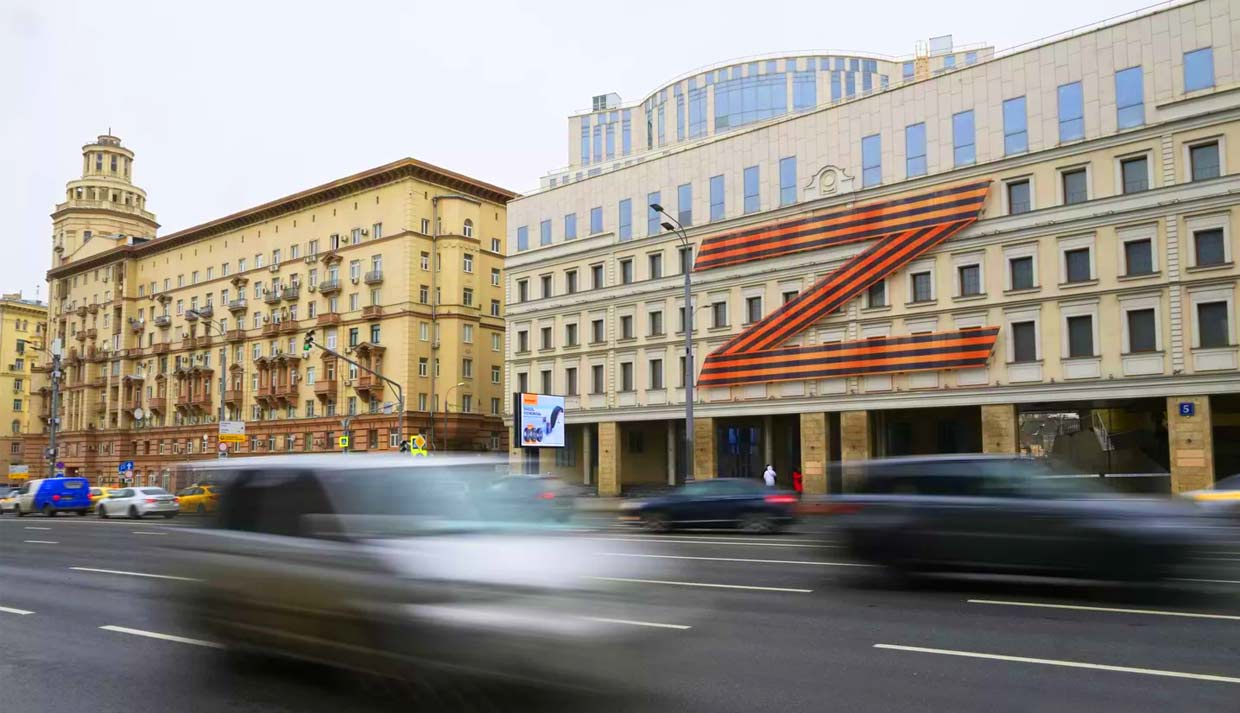
The facade of the Oleg Tabakov Moscow Theater (March 2022). Photo: RIA Novosti / Grigory Sysoev
In fact, this Pasolini will become a very important artifact, a very important testimony of how people can act in conditions when they cannot say «no». In fact, they had to surrender, otherwise the risk is too great. We can mock as much as we want, but we must understand that this is actually a public statement. They could have pretended that the order not to publish anything about LGBT and everything else does not exist, and yet they show that it does.
When a magnet with Stalin is sold in the Hermitage... Until 2023, you couldn't even imagine that this would happen
Yevgenia Albats: Tell me, how comfortable did you feel in Moscow? Did you feel surveillance? What were your impressions of the surroundings?
Nina Khrushcheva: I first went there in 2022 and was confused—what am I doing here? This was because the war had started. And I was planning to go there even before the war started. I saw many artifacts for sale there: chocolates, soap with portraits of world leaders, there were also Johnny Depp, Elizabeth Taylor—in 2022, people still didn't understand what had happened to them. They were still in a global environment. But then everything changed. By 2024, you wouldn't see any of this. You would see Tolstoy, Peter the Great, Gagarin...
Yevgenia Albats: Stalin...
Nina Khrushcheva: And Stalin, but then Stalin was just appearing. So essentially you live in Orwell. No one has ever lived in George Orwell, it's a dystopia, it was written about some other country, and here you walk around thinking: «Did this really happen to me?» Stalin is still kind of diluted with others, but since 2022, 2023, he is practically everywhere. And a lot of Putin. It was a shocking sight. When a magnet with Stalin is sold in the Hermitage... Until 2023, you couldn't even imagine that this would happen.
So no, I wasn't afraid, but it was a kind of social experiment. I wanted to see how long I could last, how long I could pretend to be like everyone else, and slip through like raindrops. This lasted until November, and then I made a mistake by agreeing to go to a presentation of my book at the «Yeltsin Center» in Yekaterinburg: the combination of Yeltsin and Khrushchev just became an explosive problem.
As for Orwell, «1984» could then be seen in all bookstores. In one bookstore in St. Petersburg, it was displayed right next to the checkout, right in your face. I talked to a woman and said: «You have an interesting greeting», — and she replied: «We must remember what world we live in». So people understand very well what's going on. And in some places, more intellectual ones, there's also Huxley. The combination of Zamyatin, Huxley, and Orwell in many, many places. So there is propaganda, but there is also insidious anti-propaganda. There is always a reminder that something else is happening that we need to pay attention to.
Khrushchev in color
Yevgenia Albats: Why was the event with your participation at the «Yeltsin Center» canceled in November 20024? What happened?
Nina Khrushcheva: Actually, everything was interesting, I was very proud that for two years I managed to break through with this book about Khrushchev. And then the publisher, who ordered this book in 2020, suddenly said: «Oh, we now have censorship, and we can't publish it». And one of the problems was related, by the way, to the cover.
Yevgenia Albats: Why?
Nina Khrushcheva: Because on it he looks too good. He shouldn't look like that. Seriously, Putin doesn't like him. They needed a gray, black-and-white photograph. And they found a photograph, and then said: «Well, you know, actually we have censorship now, so the book won't be published». And then Vitaly Dymarsky*, editor of «Diletant», said: «We have our own publishing house, we'll publish it». And they published it.
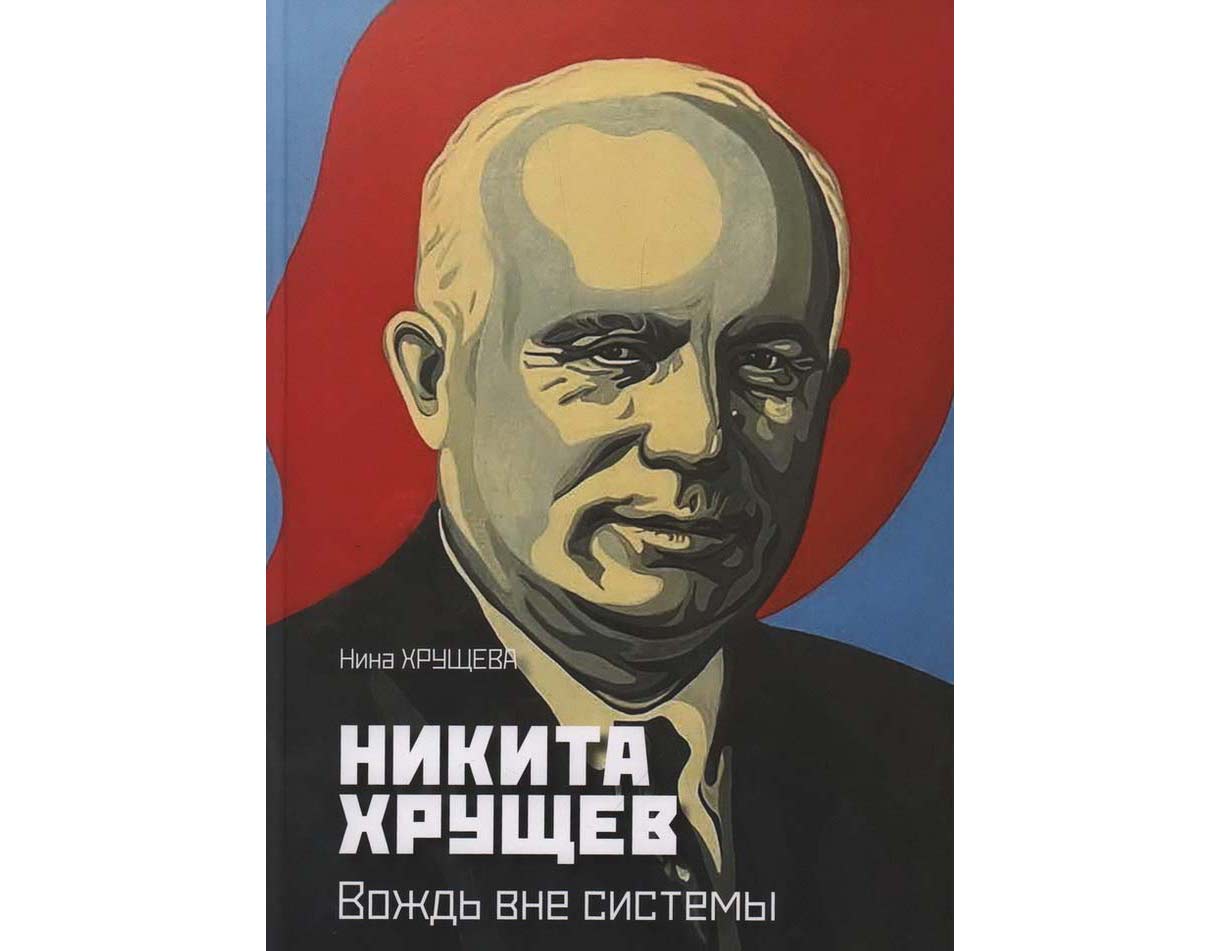
Cover of the book published by «Diletant»
I am actually amazed because I have never been a bestselling author. And suddenly everyone wanted to buy this book. And it is very heavy and very expensive by Russian standards. And I started asking—why? «Well, firstly, because we want to know what made people serve Stalin». Because Khrushchev talked about learning from him. He was one of the most loyal. And what had to happen for him to turn away and say: «My hands are elbow-deep in blood. We need to repent». That's interesting. After all, I wrote about society, about how people succumb to fear, but also about what's happening today with Vaino, Kiriyenko, Naryshkin, and Lavrov—all these Russians who were initially perhaps a little more educated than they present themselves now because they have to be tough and patriotic. People started reading my book for this. It was amazing.
In general, the book came out, was sold out, and suddenly the original publisher called me and said: «We want to publish it». Excuse me, what? They had to buy the rights from «Diletant» to publish the book they originally ordered, edited, and designed, but were scared of this photograph and placed it inside the book. And it's not even a photograph, it's a portrait made by Nadia Léger. Nadia Léger was an artist of Belarusian origin, the wife of Fernand Léger, who, like her, was a cubist. You might have seen her works. She painted Gagarin, Minister of Culture Ekaterina Furtseva, Tsiolkovsky, and others. But this was the first portrait, and it was a small bribe for Khrushchev because, you know, his views on art were, to put it mildly, not avant-garde. To put it mildly. And so she thought she would paint Khrushchev, and he wouldn't cancel the cubists' exhibition in Moscow. She made the portrait and handed it over. My mother told a wonderful story. She brought the portrait and said: Nikita Sergeyevich, here's the portrait. It's such a wonderful portrait! And my grandmother turned to him and said: «Why don't you take it? You like such things». This portrait hung in our apartment, and no one saw it for 70 years. And suddenly it ends up in the book, and they are afraid to publish it because Khrushchev looks too good.
The «Yeltsin Center» was not the first
Python's embrace
Yevgenia Albats: The people you talked to, do they watch TV? Do they talk about the war? Are they afraid?
Nina Khrushcheva: This, I repeat, is not the Soviet Union. There is no monolith here, everything is very fragmented. People don't watch TV the way we used to, it's no longer a linear way. Many watch on their computers, many have Google TV. You can choose channels, and very few people actually watch them as before.
Yevgenia Albats: But now YouTube is banned.
Nina Khrushcheva: YouTube is banned, but there's still VPN. Yes, it's hard and it's getting harder. And of course, they lie when they say it «slowed down». Nothing slowed down, you just can't log in. But people go to the site. People still watch, they still write on Facebook**. It's very much like the KGB. Something like a python that slowly strangles you. It won't kill or poison you right away, it will slowly strangle you. But the country is not completely disconnected yet, something can still be done.
In 2022, the only thing people talked about was the war. In fact, openly in a cafe, they said: «Bastards, what are we doing? My God!» And someone said: «How do I find a job? How can I leave the country? Oh, my friend left the country. Can I leave if I help Ukrainians, I have family in Ukraine, no matter what happens to me» — and so on. This has become much less. In Yekaterinburg, interestingly, they are less cautious in this regard. When I was canceled, I went to the museum because I needed to do something two days before leaving. And people approached me and said: «What bastards, this is ridiculous. We wrote a petition». In Yekaterinburg, there is a museum of artistic metal casting, since tsarist times, they even were at the Paris exhibition with their metal gazebo. And there is a section of the 1930s, but Stalin is not there. There are all these others—Kirov, Voroshilov, Budyonny. I ask: «Where is Stalin? Where did Stalin go?» And, apparently, they had a vote, the head of that section wanted to place Stalin, saying, this is history, we must remember. And the museum director said: «No, we don't place murderers in our exhibitions». So the debates are still going on. They are becoming less and less, eventually, the python will squeeze out all the life. But they are still there.
Yevgenia Albats: Are people afraid? We both lived in Soviet times, we had to put a pillow on the phone because we assumed the phone was tapped by the KGB. Now people are imprisoned for a post on social media.
Nina Khrushcheva: Yes, people are afraid, but many are not afraid because everything depends on chance. Everyone knows the story of the pediatrician Buyanova. It was an example for everyone that you need to be afraid. But this is not a Soviet monolith. Therefore, the publisher first says they can't publish the book, and then they publish it. In the Soviet Union, this couldn't happen. What is happening now is almost impossible to rationalize.
They mixed the war with stories about the most ordinary things. You bought a new car, or here's a new musical. Then about hairstyles. And then about the special military operation
In April last year, I was driving around Moscow. Propaganda is always in front of your eyes. But the problem with such propaganda is that eventually, you just stop noticing it. But they are not fools, so on TV, they mixed the war with stories about the most ordinary things. You bought a new car, or here's a new musical—it's great and wonderful. Then about hairstyles, that you can dye your hair in different colors. And then about the special military operation. It's like the war in Afghanistan, it's far away. So let's talk about the great musical, and then so many people were killed today. This way they reduce the impression.
«Barbie» hits the screens, but very quickly gets banned. Because it contradicts some values. This was in 2023, and it seems like it was thoroughly banned. But then you walk down Nevsky, and there they are—«Barbie» and «Oppenheimer», also banned. I talked to people coming out of the cinema, a young couple watched «Oppenheimer». «You know, we just went because we wanted to see why it was banned». Banning something is a good way to make people want to see it. And they said: «Well, the cinema will probably be closed, but it's very brave of them to show it». So not everyone, but people are aware. And actually, by the way, the cinema is not closed. They continue to show movies.
Propaganda turns everything into a presentation. Part of the propaganda is that almost every Soviet and imperial exhibit comes to you from everywhere. You go to the Russian Museum, and there's an exhibition «Pictures of Military Life». You imagine that scenes of life at war are kind of a tribute to the special military operation. And then you go inside—and there's destruction after destruction. But officials, apparatchiks won't go to see the exhibits. They just see the title, and that's it. But in fact, people go there because they want to see the destruction of war. And this is another cunning way to get around what is imposed on you. But at the same time, almost every exhibit is dedicated to something Soviet. In the museum of decorative arts, for example, it's a satellite from the Vologda factory «Snowflake» in 1960. The Soviet surrounds you everywhere because museums are pressured to have references to Soviet life.

Exhibition in the Benois building, Russian Museum, St. Petersburg, 2022. Photo: «Map I. in St. Petersburg»
Yevgenia Albats: Soviet empire or Russian empire?
Nina Khrushcheva: This is another interesting point. It seems that in 23, Putin suddenly started talking about the cultural code: the cultural code of Russia, the unity of the people, nations, and all that, quite creatively. So, in the Hermitage, there were figurines, porcelain dolls made under Nicholas II for the anniversary of the Romanov house. They started making them but didn't finish because the revolution happened. And now they were taken out of the basement and completed: there are 400 nationalities, 400 statues. The exhibition is sent for three months to each region, it travels around Russia. And everyone sees what a wonderful multinational country it is. There are Georgians, Armenians, Little Russians, Ukrainians. And someone comes and says: «Oh, what beautiful dolls, my God, all these other peoples—they are all ours». They become ours, even if they are not ours. Moldovans, Latvians, Lithuanians, all parts of the Russian empire—400 dolls. And this is another part of the propaganda that hits you. And of course, the war. You have this
There is a wonderful place near Tver, a very tiny town, where they make gold embroidery. It's a very small town, and until 2022, the gold embroidery museum was in great decline. In 2022, they suddenly decided it would serve their propaganda. And they exhibited Stalin, exhibited religious things. I love when religion, Stalin, and Lenin are together, but here you can see portraits of Stalin, Voroshilov, Medvedev, and Putin.
I want to say that it comes to you from different sides, and it's very hard to escape from it. In some sense, it's very total propaganda. But it's also porous, unlike the Soviet one, because you can still break it or get out through different holes. This porous way of existing today somehow helps Russia. It doesn't save it, but it helps to some extent.
A small life for a big project
Yevgenia Albats: What do you feel being at the scene? Do people support the war? Do people in the provinces feel different than in Moscow? Now we know the numbers—about 700,000 dead and wounded. Has the attitude towards the war changed?
Expanding the possibilities of a small life through the great idea of the state is a very powerful way of propaganda
Nina Khrushcheva: I think that initially, it was very negative, and now it is perceived less and less negatively, and it also depends on the place. Last year I was in Omsk, in the villages around, and I was amazed because suddenly beauty salons appeared in all the villages. Suddenly, in a tiny village where 70 people live, there are three. Some hut, half-ruined, and it says «Beauty Salon» in English, which is crazy in itself. I went in, and there were women, one of them turned out to be a widow. And she said: «Well, I'm a widow now, and thanks to Putin, I live well now. And you know, I have to be beautiful because I'm going to get married again». Or something like this: my husband serves, fights, and thanks to Putin, because now our economic conditions have become better—because in these places, especially where weapons are produced, they really live better. Such an expansion of the possibilities of a small life through the great idea of the state is a very powerful way. Suddenly, a small life becomes necessary for the big project of a unique civilization or what Putin is doing with the war. But it also depends on the city. In Yekaterinburg, there is the most
I was in Kostroma, a wonderful city, and there a woman was selling Stalins, just Stalin, Stalin, Stalin, Stalin. I said: «You are selling a mass murderer». And she replied: «Well, my grandfather gave his life... for state security». And I, like, a proud descendant. I said: «Then we disagree». And she replied: «Well... but it's great if everyone will be healthy». And asked if I wanted to buy Stalin. I said: no, thank you, I don't want to, but again—this is not a Soviet monolith. There is no monolith. It is very porous and very different.
In every city, there is something about Harry Potter. When I tell them it's banned, they are surprised: «Really?» No one knows about it and no one is going to cancel it
The most militant city I visited was Tula, where they make guns. It was incredible: everyone for peace, for Russia, for the president, for the army, for courage, for truth. Very Orwellian. By the way, Harry Potter is our everything. He is banned because J.K. Rowling is banned. And yet, wherever you go, in every city, there is something about Harry Potter. When I tell them it's banned, they are surprised: «Really?» No one knows about it and no one is going to cancel it.
As for those returning from the war. I photographed a soldier. He has no left arm. There will be more and more of them. But Putin does not want to repeat the Afghan mistake when people came back from the war and were left unwanted. Many then ended up in gangs. Now they are becoming governors, mayors, studying. And he said that this will be «our elite».
New propaganda
Yevgenia Albats: Peter, to what extent is this propaganda different—in technique, language, tools—from what was in Soviet times? And to what extent is it effective?
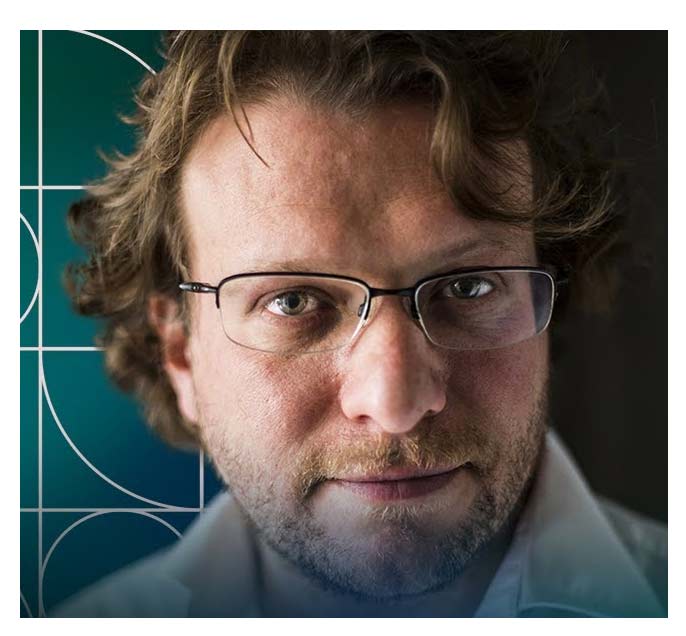 Peter Pomerantsev: I was born in the Soviet Union, but then my parents left, I was nine months old then. So it's very difficult for me to judge the Soviet, although I have read something. But I haven't specifically studied it. When I lived in Moscow—2001, 2010—it was a completely different propaganda system based on manipulating a kind of pseudo-democracy. What you're talking about today seems like a kind of pastiche on dictatorship, a parody, an imitation of capitalism.
I haven't been to Russia since 2014, and I had to turn to completely alternative ways of understanding what's happening there. But some conclusions resonate with Nina's conclusions. Sociology is difficult now, although there are things that can be done in sociology. I turned to a team of people working at Harvard and kind of came up with an idea. And here's what they did—they combined data using all available sources on social media. All state media, all economic data, all behavioral data that can be obtained from Russia, were put into a kind of data processing machine to try to understand what's happening there or give some perspective. As a result, a three-dimensional picture of how propaganda works emerged.
One example is the mood around NATO in Russia. There is often a discrepancy between what is said in state media and on social media. Looking at this discrepancy, we can see where propaganda is having difficulties. In August 2024, Russian state media wrote a lot that «NATO is evil», and on social media, people also said that «NATO is evil», which means either the work of troll farms or that people agree with it or don't dare to disagree. But then you move on to the issue of wage increases—a lot is written that there is a huge economic boom in Russia, but it's fake because wages are not keeping up with the level of inflation, and people, despite high employment, do not always feel economic benefits. Take the Moscow region. In the news, you see that the mood about wage increases is growing, growing, and growing. If you delve into the chart, you will find many articles and news notes in a slightly Soviet style, saying that your salary is better than it was before, it is growing. Farmers and bakers in the Moscow region are very happy with their salaries, and so on. And some of this is indeed so. But on the Internet, you can see that everything is completely different. People complain.
Experts work on forums of all types of social networks. They collect conversations that people have in VK, Telegram. City forums are very interesting. In Russia, there are professional forums, veteran forums, sports forums. There is less censorship on them. People talk more there. These are approximate data, but you immediately see that there are things people can complain about, and they complain quite angrily.
Another big topic that seems to really annoy people on the Internet is the topic of payday loans. Russians take them like crazy. These crazy jumps can be seen on social media. The troll farm says: don't take payday loans. The ruble is strong. And people say: «No, we don't believe in the ruble. We don't have enough money to live». On social media, there is a struggle between state propaganda, the troll farms they use, and what people say.
All behavioral data suggest that a kind of golden age has arrived. And on the Internet, they complain about rising prices, people feel poor
We looked at the Samara region. In Samara, everything is very good economically, on paper, it's a place of rapid growth. Like in all regions of the Volga region, everywhere around. A huge boom in industrial production. Enterprises are opening, salaries are rising, unemployment is falling. People spend crazy money on restaurants. All behavioral data suggest that a kind of golden age has arrived. Then you turn to what is written on the Internet. They complain about rising prices, that despite such high economic activity, they feel poor, they have to take payday loans. So even in Samara, there is tension.
There have always been different types of polarization in Russia. The new type of polarization we are observing is between the economic winners and the economically losers in the war. The economic winners are obviously the regions of the military-industrial complex around the Volga, and then in the Far East, on the border with China, where things are going incredibly well due to new trade with China. The places that have lost and are very angry are the regions along the western border, Pskov and similar places that have really suffered from the lack of trade, they are kind of economic losers. Thus, a new polarization is happening in the country, related to the war.
The next question is the quality of medical care. People are upset that bad drugs are sold on the market. The big problem is everything related to healthcare, medical services. The state is constantly conducting campaigns, stating that we have opened a new hospital or a new pharmaceutical factory in the Moscow region that will produce drugs better than anywhere in the West. The government is trying to promote this propaganda, and people disagree with it and say: «No, this is nonsense. We need other medicine».
Through the ears
Yevgenia Albats: Propaganda, like in the Soviet Union, is ineffective, people listen to all this nonsense that pours from the TV, but they don't trust it, just as we didn't trust Soviet propaganda.
Peter Pomerantsev: In economic matters, there is a small opportunity for criticism, particularly about relations with China. If you look at business newspapers, at forums for elite economic discussion, you will hear how academics, business experts say, contrary to Putin's claims: «All this is complete nonsense», — business with China is very weak, we are in a very bad position in relation to China. And in state media, of course, this cannot be talked about. So the picture is much more complex. Of course, when it comes to economic issues, it seems that there are many opportunities to express criticism. But maybe that's how people sublimate their attitude towards politics.
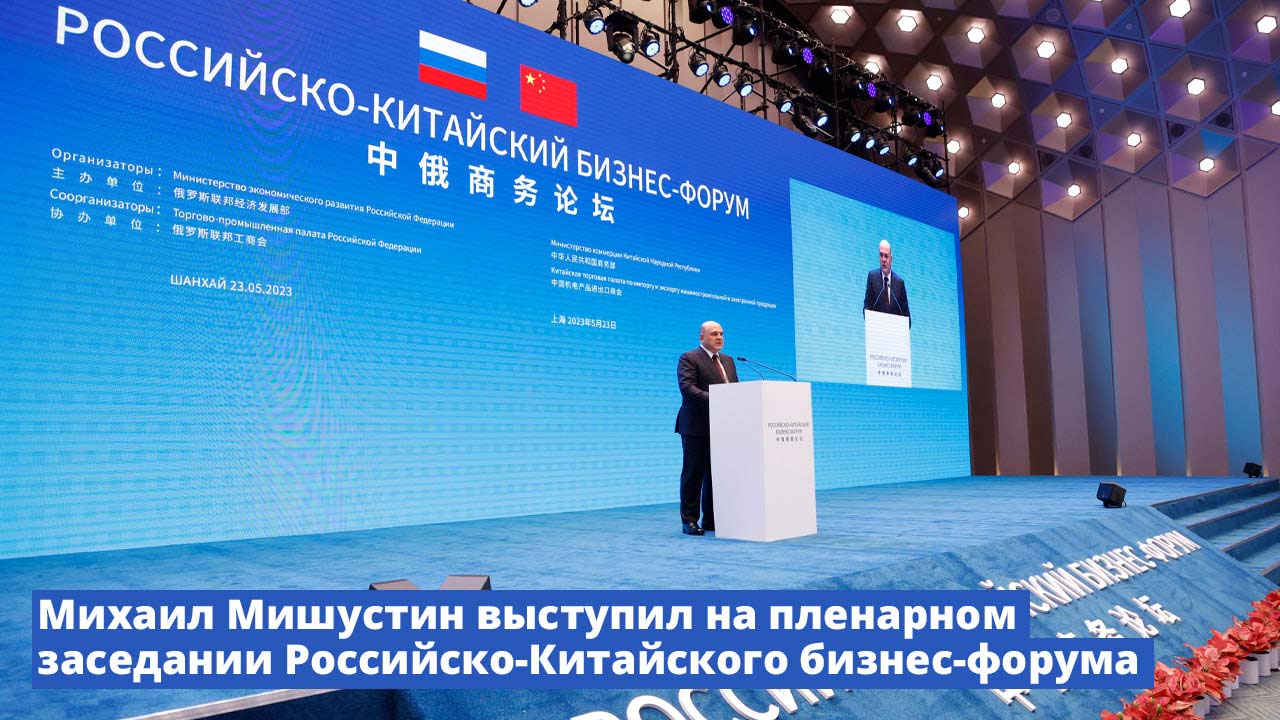
Photo: Government of Russia, 2022
As for whether propaganda works or not. We looked more at what is said on state television about identity issues, about the idea of a popular sense of greatness among people—that we are part of something big. The survey was conducted online, by phone, it was checked in small groups to make it as accurate as possible. We used an approach that looked at the connection between support for the war and other positions and its connection with various identity models, and considered identity as something quite aggressive when you believe that your country is not just good, but that it is better than others.
We found that there is a type of people who support the war more. Moreover, the more you watch TV, the more you support the war, the more likely you are to adhere to a chauvinistic identity model. So something here really works. According to our survey, chauvinists make up 55%, that is, more than half of the population.
Yevgenia Albats: Russian or imperial chauvinism?
Peter Pomerantsev: I don't know if we delved into ethnicity. But it was about Russia being superior to other countries. «We are better than other nations».
In the survey, we asked different groups questions about their attitude to the war, trying to do it as carefully as possible because people are very suspicious. To put it briefly, when people were asked questions about identity, they were much more likely to say they wanted Putin to continue the war. If they didn't get a bunch of identity questions beforehand, they were much more likely to say they wanted peace. When you just discuss, say, inflation, they are more likely to say they want peace.
No queues yet
Yevgenia Albats: In Soviet times, propaganda and all the Soviet pathos were ignored. Brezhnev was laughed at. Why are people now much more inclined to believe what they are told?
Nina Khrushcheva: We laughed at Brezhnev, but by that time, 70 years had passed since the revolution. And initially, Bolshevik propaganda was quite successful because it really provided the working class with better conditions, at least better than they were initially. But all these hopes did not come true. I think you're talking about a fake version of democracy in the Soviet Union. What is happening now is somewhat similar to the Brezhnev period. But at the same time, show me a country that wants to be defeated. Hostility from outside, which is constantly talked about on TV, actually helps Putin a lot.
Moreover, although the economy has declined, there are still no queues. You can still press a button, and food will be delivered to you, services are still available. I think when the economy collapses and people stand in line, then real hell will begin. But for now, they are staying afloat.
And also, it seems to me, it's because Putin is clearly a descendant of Stalin now. As a descendant of Stalin, he doesn't think he will die. Stalin really thought he would exist forever. It's paranoia. He told his students: «Oh, you are like blind kittens, the world, the West will eat you». But in fact, he didn't think he would die. For Putin, it's like this: I will go down in history like him, and what happens next doesn't concern me.
Peter Pomerantsev: They learned the lessons of mobilization when a million people left the country, and they didn't do it again. They distribute money across the country and create all these economic advantages. If you talk to journalists and human rights activists, the main complaints are not about the death of people, but about not being paid the money promised. The most alarming story is about the rise in crime as a consequence of the war. Sending convicts to the army and their return to society is a huge problem. Journalists say this is the only topic that will upset the most patriotic and chauvinistic segments of society. And I think it's because people are willing to sacrifice a big idea, but the undermining of order—because they are obsessed with order, security, and a strong hand—worries them.
Nina Khrushcheva: That's why the authorities are concerned that there is no Afghanistan or Chechnya. Now there are many billboards about sanatoriums, places for recovery. Those who returned from Ukraine are treated as if they are heroes who defended the Motherland from the onslaught of Western hatred. It's very similar to how the KGB figures out how to influence your consciousness. But everything is still ahead. So far, I have only seen one person without an arm. But there will be many more because now they are hidden in these sanatoriums, where they stay for six months, a year. They have been paid off, at least many of them. But when they start coming out and walking the streets, they will be visible. We just don't know how long they will be hidden.
Peter Pomerantsev: We often think of propaganda as brainwashing, as a spell cast on people, and sometimes it works that way. We have a lot of research that shows that propaganda can somehow persuade people. But sometimes it's only needed to do really terrible things that you always wanted to do. One of the best films about the war is a documentary about intercepted conversations between Russian soldiers. And some of them are so honest that they admit: finally, I can do what I always wanted. Some are horrified. Some say: «I can't believe what we just did». But many others say: finally, finally, I can do what I did. I'm talking about rape, torture, and mutilation. And the conversation I will never forget and which I think will stay with me is a conversation between a soldier and his mother. And the mother tells him: «Oh, I always wanted to do this too. We are so alike. I'm so glad you're there raping, killing, robbing, maiming». So maybe propaganda just released what was waiting for its time.
Peter Pomerantsev — senior fellow at the SNF Agora Institute at Johns Hopkins University, where he is one of the leaders of the Arena initiative—a research project dedicated to overcoming the problems of disinformation and polarization in the digital age. Previously led the same project at the London School of Economics. Author of several books, including «Nothing is True and Everything is Possible» (2014) and «This is Not Propaganda» (2019). The latest book of 2024 is «How to Win an Information War». Writes a column for The American Interest, writes for The New York Times, Granta, and The Atlantic.
Nina Khrushcheva — professor of the Julien J. Studley Graduate Programs of International Affairs at the New School in New York. Editor and contributor to Project Syndicate, an association of newspapers worldwide. Winner of the «Great Immigrants: Pride of America» award from the Carnegie Corporation and the Gold Medal of Honorary Patronage of Trinity College in Dublin. Published in Foreign Policy, The New York Times, The Wall Street Journal, and others. Author of books «Imagining Nabokov: Russia Between Art and Politics», «The Lost Khrushchev: A Journey into the Gulag of the Russian Mind», «Nikita Khrushchev: Leader Outside the System». Great-granddaughter of Nikita Khrushchev, First Secretary of the CPSU Central Committee (1953–1964).
* Yevgenia Albats, Vitaly Dymarsky in the Russian Federation are declared «foreign agents».
** Owned by Meta, recognized as an «extremist organization» and banned in Russia.